

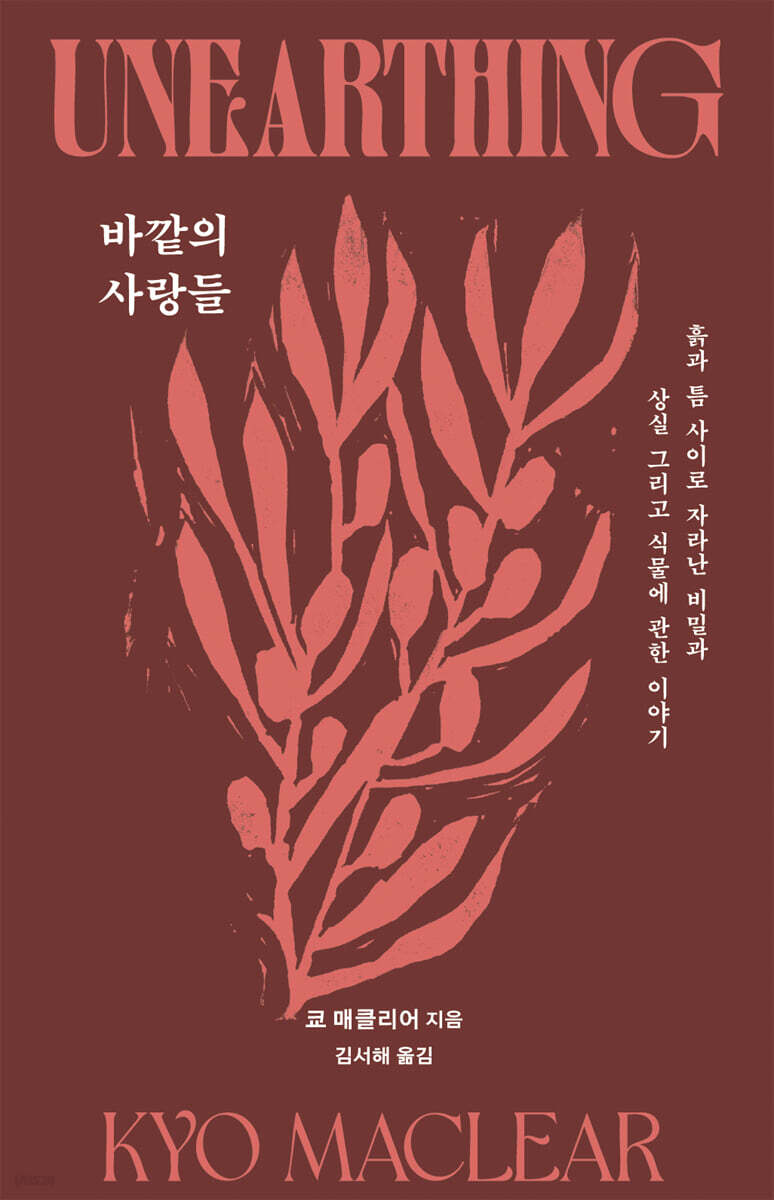
Loves Outside
 |
Description
Book Introduction
★Canadian National Bestseller
★2023 Governor General's Nonfiction Literary Award
“MacLean speaks to the fragile nature of kinship and memory through recursive and often allusive prose.
The elaborately constructed narrative and garden metaphors reveal how permeable self, culture, and belonging are.
“A fascinating book that fluidly straddles the line between memoir and philosophy.” - 2023 Governor General’s Literary Award Peer Review Committee
“It is an amazing discovery.
Building on the shocking revelations of DNA testing, Maclear shifts our perception of kinship, self, memory, and roots across time, space, and species, shifting our understanding and exploring them on a broader scale.
“A groundbreaking memoir of root-finding, finding roots everywhere, including in plants.” - Naomi Klein (author of How Capitalism Feeds on Disaster and Becomes a Monster, Doppelganger)
Family secrets and tangled love revealed through DNA testing
How does life across the boundaries of a multiracial family become a story?
Genetic genealogy is the study of tracing ancestral lineage through DNA-based genetic testing. Recently, direct-to-consumer (DTC) genetic testing, which does not go through a medical professional, has emerged as a new industry.
Companies like 23andMe and Ancestry.com in the US offer direct-to-consumer genetic ancestry analysis to consumers who purchase test kits online or at pharmacies. DTC genetic testing allows for the simple act of tracing one's ancestry and discovering one's roots, simply by scraping one's mouth with a cotton swab or spitting.
But easy genetic testing can also cause unexpected confusion.
The appearance of biological parents or half-siblings whose existence was unknown can cause irreversible problems for an individual or an entire family.
What starts out of simple curiosity or fun can shake up your very identity, and sometimes what starts out of utmost love and grief can unearth long-buried family secrets.
"Outside Loves" is a non-fiction work that begins by confronting this very issue head-on.
Kyo Maclear, a novelist and children's book author, was born to a British father and a Japanese mother and grew up amid frequent moves, parental discord, and racial turmoil.
Now in her middle age, having achieved social success as a writer and living peacefully with her Jewish husband and two sons, she is confronted with an unexpected truth.
Finding out that the father with whom I had maintained a close relationship my entire life was not my biological father.
The author used DTC genetic testing services because it was an easy way to explore her father's maternal lineage while mourning his father's passing after a battle with cancer.
However, the fact that he was of Jewish paternal descent from the Balkan Peninsula was completely different from the genetic history of his father that the author knew.
After learning that he was born through sperm donation, the author begins to trace his genetic lineage, searching for traces of his biological father and contacting half-siblings he never knew existed.
Can we feel special affection for strangers simply because of blood ties? How is that even possible?
Tracing one's lineage leads the writer into a sensitive and complex reflection, as he considers his own connections to biological ancestors in distant times and places.
If it had been just a matter of exploring my genealogy and ancestors that I had never known about, it would have been simpler.
But one day, the story begins to take a different turn when the mother suddenly reveals a secret.
The biological father the author discovered was actually his mother's affair partner.
The problem is that my mother is having problems with her memory and cognitive abilities due to illness and aging.
The mother appears to be telling the truth, but then quickly denies it, repeating lies and evasions.
Moreover, unlike her Japanese mother, who thinks and writes in English, English is not her native language.
As a married immigrant woman, my daughter, who grew up dealing with government offices, insurance companies, and hospitals on behalf of her mother, who was not fluent in English and was often ignored, is once again experiencing the inability to communicate, even though she has done so her entire life.
In that case, I have no choice but to approach my mother's story slowly and arduously through gardening, another language of my mother.
The daughter, who has found meaning in reading and writing all her life and creating stories, begins to plant a garden by putting her hand in the round earth to communicate with her mother who does not believe in the power of stories.
★2023 Governor General's Nonfiction Literary Award
“MacLean speaks to the fragile nature of kinship and memory through recursive and often allusive prose.
The elaborately constructed narrative and garden metaphors reveal how permeable self, culture, and belonging are.
“A fascinating book that fluidly straddles the line between memoir and philosophy.” - 2023 Governor General’s Literary Award Peer Review Committee
“It is an amazing discovery.
Building on the shocking revelations of DNA testing, Maclear shifts our perception of kinship, self, memory, and roots across time, space, and species, shifting our understanding and exploring them on a broader scale.
“A groundbreaking memoir of root-finding, finding roots everywhere, including in plants.” - Naomi Klein (author of How Capitalism Feeds on Disaster and Becomes a Monster, Doppelganger)
Family secrets and tangled love revealed through DNA testing
How does life across the boundaries of a multiracial family become a story?
Genetic genealogy is the study of tracing ancestral lineage through DNA-based genetic testing. Recently, direct-to-consumer (DTC) genetic testing, which does not go through a medical professional, has emerged as a new industry.
Companies like 23andMe and Ancestry.com in the US offer direct-to-consumer genetic ancestry analysis to consumers who purchase test kits online or at pharmacies. DTC genetic testing allows for the simple act of tracing one's ancestry and discovering one's roots, simply by scraping one's mouth with a cotton swab or spitting.
But easy genetic testing can also cause unexpected confusion.
The appearance of biological parents or half-siblings whose existence was unknown can cause irreversible problems for an individual or an entire family.
What starts out of simple curiosity or fun can shake up your very identity, and sometimes what starts out of utmost love and grief can unearth long-buried family secrets.
"Outside Loves" is a non-fiction work that begins by confronting this very issue head-on.
Kyo Maclear, a novelist and children's book author, was born to a British father and a Japanese mother and grew up amid frequent moves, parental discord, and racial turmoil.
Now in her middle age, having achieved social success as a writer and living peacefully with her Jewish husband and two sons, she is confronted with an unexpected truth.
Finding out that the father with whom I had maintained a close relationship my entire life was not my biological father.
The author used DTC genetic testing services because it was an easy way to explore her father's maternal lineage while mourning his father's passing after a battle with cancer.
However, the fact that he was of Jewish paternal descent from the Balkan Peninsula was completely different from the genetic history of his father that the author knew.
After learning that he was born through sperm donation, the author begins to trace his genetic lineage, searching for traces of his biological father and contacting half-siblings he never knew existed.
Can we feel special affection for strangers simply because of blood ties? How is that even possible?
Tracing one's lineage leads the writer into a sensitive and complex reflection, as he considers his own connections to biological ancestors in distant times and places.
If it had been just a matter of exploring my genealogy and ancestors that I had never known about, it would have been simpler.
But one day, the story begins to take a different turn when the mother suddenly reveals a secret.
The biological father the author discovered was actually his mother's affair partner.
The problem is that my mother is having problems with her memory and cognitive abilities due to illness and aging.
The mother appears to be telling the truth, but then quickly denies it, repeating lies and evasions.
Moreover, unlike her Japanese mother, who thinks and writes in English, English is not her native language.
As a married immigrant woman, my daughter, who grew up dealing with government offices, insurance companies, and hospitals on behalf of her mother, who was not fluent in English and was often ignored, is once again experiencing the inability to communicate, even though she has done so her entire life.
In that case, I have no choice but to approach my mother's story slowly and arduously through gardening, another language of my mother.
The daughter, who has found meaning in reading and writing all her life and creating stories, begins to plant a garden by putting her hand in the round earth to communicate with her mother who does not believe in the power of stories.
- You can preview some of the book's contents.
Preview
index
To our Korean readers 13
Prologue 19
January - March 2019
1.
Daikan (Korea) Starting Point 25
March - May 2019
2.
Shunbun (Vernal Equinox) Small Peach 55
April 2019
3.
Seme (Qingming) Deleted Scenes 79
May - June 2019
4.
Kokuu (Gokwoo) Two Hands 99
July - August 2019
5.
Taisho (Great Western) collapsed 139
August - September 2019
6.
Shosho (Soso) August 25, 189
September 2019
7.
Hakuro (White Heron) Plant Witness 231
October 2019
8.
Kanro (Hanro) Night Garden 255
October 2019
9.
Soko (ascending) corrosion 293
November 2019
10.
317 caught in Ritto (entrance)
December 2019 - August 2020
11.
Winter Solstice (Toji) 337
September 2020 - September 2021
11.
Setki (seasonal) food 405
Fall 2021
Review: I Remember 423
Herbarium 451
Prologue 19
January - March 2019
1.
Daikan (Korea) Starting Point 25
March - May 2019
2.
Shunbun (Vernal Equinox) Small Peach 55
April 2019
3.
Seme (Qingming) Deleted Scenes 79
May - June 2019
4.
Kokuu (Gokwoo) Two Hands 99
July - August 2019
5.
Taisho (Great Western) collapsed 139
August - September 2019
6.
Shosho (Soso) August 25, 189
September 2019
7.
Hakuro (White Heron) Plant Witness 231
October 2019
8.
Kanro (Hanro) Night Garden 255
October 2019
9.
Soko (ascending) corrosion 293
November 2019
10.
317 caught in Ritto (entrance)
December 2019 - August 2020
11.
Winter Solstice (Toji) 337
September 2020 - September 2021
11.
Setki (seasonal) food 405
Fall 2021
Review: I Remember 423
Herbarium 451
Detailed image

Into the book
Ultimately, this book is about what we inherit and what we can lead forward.
As a scholar and a person of mixed race, I have never trusted the way genealogy is imagined and the narrow-mindedness inherent in it.
We didn't even agree on the boundaries of where we consider ourselves and where we begin to classify ourselves as 'others.'
In North America, DNA is used to find links to the past, biological origins, and roots.
I understand that desire too.
In fact, one of the forces that moves this book is that desire.
But at the same time, I believe our imagination needs to grow.
Faced with the currents of nepotistic xenophobia, colonialism, and fascism happening around the world today, I believe the world demands greater imagination from us.
--- pp.14-15
When my father passed away and I was undoubtedly his daughter, I looked at a small white cardboard box.
It was a DNA kit with terms and conditions attached.
There was a sentence written there along with an explanation about privacy.
“As you use our services, you may learn unexpected facts about yourself or your family, which may be beyond your control.” At the end of January 2019, I spit into the plastic tube and put it back in the box.
--- p.46
The original mystery implied by the question, "Who is my father?" remained unsolved even after I learned his name.
Rather, the mystery spread wider and became more heated.
His name threw me into one huge, broken, beautiful family, filled with more confusion, more disconnection, more secrets, more shame.
Anyone who has ever delved into family secrets might not be at all surprised.
Just as a spider lays hundreds of eggs, one secret gives birth to other secrets, and one name multiplies into countless names.
--- p.133
Stories that deal with a mother's secrets are rare.
I wanted to strip away the pesky moralism that accompanies women's promiscuity and think about what it means to be a mother.
I wanted to know more about this heart.
I wanted to understand the heart of someone who has found a lover, not the suffocating heart I had seen growing up.
--- p.150
My mother was an imperfect and brave person.
He knew how to let out the wild heat that was emanating from his temperament without suppressing it.
Even if blocked from the outside or held back from the inside, I was able to express my painful emotions without suppressing them.
My mother had a very distinct inner world.
But white people, at least those with more power than my mother, didn't see that world, and so they ignored it.
To them, mother was simply a “weird person” who refused to fulfill the role she was supposed to play.
--- pp.177-178
For some people, the right question never existed in the first place.
Sometimes the act of asking questions itself was the problem.
I was increasingly realizing that this was the case with my mother.
No matter how many questions I asked, I could only find out a few facts, but it was not enough to get to the heart of the story.
In fact, my questions pushed me further away.
We ended up having to talk in an uncomfortable role of calculating profit and loss.
--- p.220
If you plant a plant in the wrong spot, your garden will be merciless in telling you that it is wrong.
The garden mocks the compulsion to impose order and control on everything, turning any naive utopian impulse on its head.
But this was a detour from my narrow path of paper and ink.
When the danger of being blown away looms, hands dipped in black soil can serve as anchors.
Even though I've never been this clumsy in my life, this is the work of putting down roots in the earth.
If you pour water into a hole for a long time, the narrative will subside.
--- p.228
To imagine our parents' stories as a plant's time is to think about what happens when we are no longer in this world.
How fleeting and ambiguous we are, how insignificant the actions of individual human beings are to our fate, how quickly we fade into the shadows of trees and disappear into the whispering grass, and how faint a trace our stories leave in the vast narrative of this world.
--- p.236
Assimilation is tricky.
You need to be different enough to be likable and interesting, but not so different that you become threatening or “inviting” bullying.
Even if they live as anti-assimilationists and traditionalists at home, in public they are forced to become politically and socially integrated in order to “reduce” social friction.
--- p.267
We are all full of epigenetic puzzles.
To borrow my friend M's expression, we are a “living collage” of our ancestors.
We inherit phantom habits, gestures, phobias, flaws, and talents that are difficult to detect.
But heredity is not simply about leading the next generation to an unhappy ending or freeing them from that framework.
The past remains and endures within us, but we are also each unique being, a precise and special part of the present world.
--- p.279
The kinship of influence is with me every day.
So, writing about heritage is impossible and absurd without speaking of writing itself as heritage.
Writing is a burden to me as a child.
It must be lifted with the weight of a huge bouquet of gratitude.
--- p.391
One night, while resting in bed, Mom suddenly says:
I wish I could just die.
That statement and its suddenness made me freeze.
No, Mom.
I say.
I love my mom.
He keeps telling his mother that he loves her as she waves her arms and punches the air.
Mom, punching the air like a drunken signalman.
I stop talking.
I wish my mother's arm would stop, but instead she suddenly swings her fist at me.
Hard.
With clenched hands.
Now Mom is a boxer.
The spark of tenderness, beating out one's own shadow.
--- pp.406-407
Dear daughter, let me tell you a story.
Before our planet was even born, the particles that make up the soil were waiting in the inky darkness of space.
Dear daughter, I'll tell you another story.
We are made of the things we remember, but we are also made of the things we forget.
As a scholar and a person of mixed race, I have never trusted the way genealogy is imagined and the narrow-mindedness inherent in it.
We didn't even agree on the boundaries of where we consider ourselves and where we begin to classify ourselves as 'others.'
In North America, DNA is used to find links to the past, biological origins, and roots.
I understand that desire too.
In fact, one of the forces that moves this book is that desire.
But at the same time, I believe our imagination needs to grow.
Faced with the currents of nepotistic xenophobia, colonialism, and fascism happening around the world today, I believe the world demands greater imagination from us.
--- pp.14-15
When my father passed away and I was undoubtedly his daughter, I looked at a small white cardboard box.
It was a DNA kit with terms and conditions attached.
There was a sentence written there along with an explanation about privacy.
“As you use our services, you may learn unexpected facts about yourself or your family, which may be beyond your control.” At the end of January 2019, I spit into the plastic tube and put it back in the box.
--- p.46
The original mystery implied by the question, "Who is my father?" remained unsolved even after I learned his name.
Rather, the mystery spread wider and became more heated.
His name threw me into one huge, broken, beautiful family, filled with more confusion, more disconnection, more secrets, more shame.
Anyone who has ever delved into family secrets might not be at all surprised.
Just as a spider lays hundreds of eggs, one secret gives birth to other secrets, and one name multiplies into countless names.
--- p.133
Stories that deal with a mother's secrets are rare.
I wanted to strip away the pesky moralism that accompanies women's promiscuity and think about what it means to be a mother.
I wanted to know more about this heart.
I wanted to understand the heart of someone who has found a lover, not the suffocating heart I had seen growing up.
--- p.150
My mother was an imperfect and brave person.
He knew how to let out the wild heat that was emanating from his temperament without suppressing it.
Even if blocked from the outside or held back from the inside, I was able to express my painful emotions without suppressing them.
My mother had a very distinct inner world.
But white people, at least those with more power than my mother, didn't see that world, and so they ignored it.
To them, mother was simply a “weird person” who refused to fulfill the role she was supposed to play.
--- pp.177-178
For some people, the right question never existed in the first place.
Sometimes the act of asking questions itself was the problem.
I was increasingly realizing that this was the case with my mother.
No matter how many questions I asked, I could only find out a few facts, but it was not enough to get to the heart of the story.
In fact, my questions pushed me further away.
We ended up having to talk in an uncomfortable role of calculating profit and loss.
--- p.220
If you plant a plant in the wrong spot, your garden will be merciless in telling you that it is wrong.
The garden mocks the compulsion to impose order and control on everything, turning any naive utopian impulse on its head.
But this was a detour from my narrow path of paper and ink.
When the danger of being blown away looms, hands dipped in black soil can serve as anchors.
Even though I've never been this clumsy in my life, this is the work of putting down roots in the earth.
If you pour water into a hole for a long time, the narrative will subside.
--- p.228
To imagine our parents' stories as a plant's time is to think about what happens when we are no longer in this world.
How fleeting and ambiguous we are, how insignificant the actions of individual human beings are to our fate, how quickly we fade into the shadows of trees and disappear into the whispering grass, and how faint a trace our stories leave in the vast narrative of this world.
--- p.236
Assimilation is tricky.
You need to be different enough to be likable and interesting, but not so different that you become threatening or “inviting” bullying.
Even if they live as anti-assimilationists and traditionalists at home, in public they are forced to become politically and socially integrated in order to “reduce” social friction.
--- p.267
We are all full of epigenetic puzzles.
To borrow my friend M's expression, we are a “living collage” of our ancestors.
We inherit phantom habits, gestures, phobias, flaws, and talents that are difficult to detect.
But heredity is not simply about leading the next generation to an unhappy ending or freeing them from that framework.
The past remains and endures within us, but we are also each unique being, a precise and special part of the present world.
--- p.279
The kinship of influence is with me every day.
So, writing about heritage is impossible and absurd without speaking of writing itself as heritage.
Writing is a burden to me as a child.
It must be lifted with the weight of a huge bouquet of gratitude.
--- p.391
One night, while resting in bed, Mom suddenly says:
I wish I could just die.
That statement and its suddenness made me freeze.
No, Mom.
I say.
I love my mom.
He keeps telling his mother that he loves her as she waves her arms and punches the air.
Mom, punching the air like a drunken signalman.
I stop talking.
I wish my mother's arm would stop, but instead she suddenly swings her fist at me.
Hard.
With clenched hands.
Now Mom is a boxer.
The spark of tenderness, beating out one's own shadow.
--- pp.406-407
Dear daughter, let me tell you a story.
Before our planet was even born, the particles that make up the soil were waiting in the inky darkness of space.
Dear daughter, I'll tell you another story.
We are made of the things we remember, but we are also made of the things we forget.
--- p.418
Publisher's Review
Kinship beyond blood, inheritance beyond heredity
A story about race and immigration, war and assimilation, and the unruly flow of love.
"Outside Loves" traces the author's own biological lineage and tells the story of meeting a new family, while also reflecting on the complex and strange married life of her mother and father and situating the diverse experiences of a mixed-race female writer in middle age within a confusing cultural context.
Her father, Michael, was an international journalist who experienced war and had an unfortunate childhood; her mother, Mariko, who married a white European man but refused to play the role of a docile Japanese woman; and her biological father, A, who was a symbol of her Jewish identity and had to constantly move from place to place to hide his identity.
They are not only the parents who gave birth to and raised the writer, but also dramatic figures who reveal war, migration, assimilation, and racial discrimination in the midst of 20th-century history.
The lives of our parents' generation, as Kyo Maclear explores them, resemble the lives of plants that migrate, transplant, and propagate across the sea from their original place of birth.
Plants stretch, bend, lean, tangle, get injured, and form knots, and yet they keep going, blooming and bearing fruit.
The author uses plants or gardening as a crucial link that runs through the heart of all these stories.
Gardening and storytelling naturally intertwine through the metaphor of finding one's roots.
The original title, 'Unearthing', clearly shows that the act of digging up the ground, planting and caring for plants, confirming the author's own genetic position, and constructing a new family chronicle are not different.
"Outside Loves" recounts the author's childhood and family history, while also exploring the adventurous side of Japanese women living in a predominantly white society (featuring Yoko Ono, the world's most famous Japanese woman), and focuses on the author's present-day confusion as she learns the secret of her birth.
In this process, we can reconstruct a person's life and the joys and sorrows, hopes and despair contained within each chapter, and reflect on the process in which feminism, ecology, colonialism, and racism intersect and overlap.
As this book was written during the COVID-19 pandemic, it is also touching how it broadens the narrative's perspective by intertwining social distancing and caregiving.
Not only is it full of rich metaphors and narratives, quotations and information from various fields of literature and art, but you will also enjoy literary enjoyment through the connection and repetition of short passages.
This book has also been a hot topic, winning the Governor General's Award for Nonfiction in Canada in 2023 and being selected as a Canadian National Bestseller.
Kim Seo-hae, a young novelist who has recently been gaining attention, has taken on the role of translator and has fully conveyed Kyo Maclear's beautiful and thoughtful sentences.
A story about race and immigration, war and assimilation, and the unruly flow of love.
"Outside Loves" traces the author's own biological lineage and tells the story of meeting a new family, while also reflecting on the complex and strange married life of her mother and father and situating the diverse experiences of a mixed-race female writer in middle age within a confusing cultural context.
Her father, Michael, was an international journalist who experienced war and had an unfortunate childhood; her mother, Mariko, who married a white European man but refused to play the role of a docile Japanese woman; and her biological father, A, who was a symbol of her Jewish identity and had to constantly move from place to place to hide his identity.
They are not only the parents who gave birth to and raised the writer, but also dramatic figures who reveal war, migration, assimilation, and racial discrimination in the midst of 20th-century history.
The lives of our parents' generation, as Kyo Maclear explores them, resemble the lives of plants that migrate, transplant, and propagate across the sea from their original place of birth.
Plants stretch, bend, lean, tangle, get injured, and form knots, and yet they keep going, blooming and bearing fruit.
The author uses plants or gardening as a crucial link that runs through the heart of all these stories.
Gardening and storytelling naturally intertwine through the metaphor of finding one's roots.
The original title, 'Unearthing', clearly shows that the act of digging up the ground, planting and caring for plants, confirming the author's own genetic position, and constructing a new family chronicle are not different.
"Outside Loves" recounts the author's childhood and family history, while also exploring the adventurous side of Japanese women living in a predominantly white society (featuring Yoko Ono, the world's most famous Japanese woman), and focuses on the author's present-day confusion as she learns the secret of her birth.
In this process, we can reconstruct a person's life and the joys and sorrows, hopes and despair contained within each chapter, and reflect on the process in which feminism, ecology, colonialism, and racism intersect and overlap.
As this book was written during the COVID-19 pandemic, it is also touching how it broadens the narrative's perspective by intertwining social distancing and caregiving.
Not only is it full of rich metaphors and narratives, quotations and information from various fields of literature and art, but you will also enjoy literary enjoyment through the connection and repetition of short passages.
This book has also been a hot topic, winning the Governor General's Award for Nonfiction in Canada in 2023 and being selected as a Canadian National Bestseller.
Kim Seo-hae, a young novelist who has recently been gaining attention, has taken on the role of translator and has fully conveyed Kyo Maclear's beautiful and thoughtful sentences.
GOODS SPECIFICS
- Date of issue: October 25, 2025
- Page count, weight, size: 464 pages | 135*210*20mm
- ISBN13: 9791193801208
You may also like
카테고리
korean


korean

![GQ KOREA Mark (Monthly): December [2025]](http://librairie.coreenne.fr/cdn/shop/files/8ef265dbbfbf186523ed75ba7319009d.jpg?v=1765340328&width=3840)


