

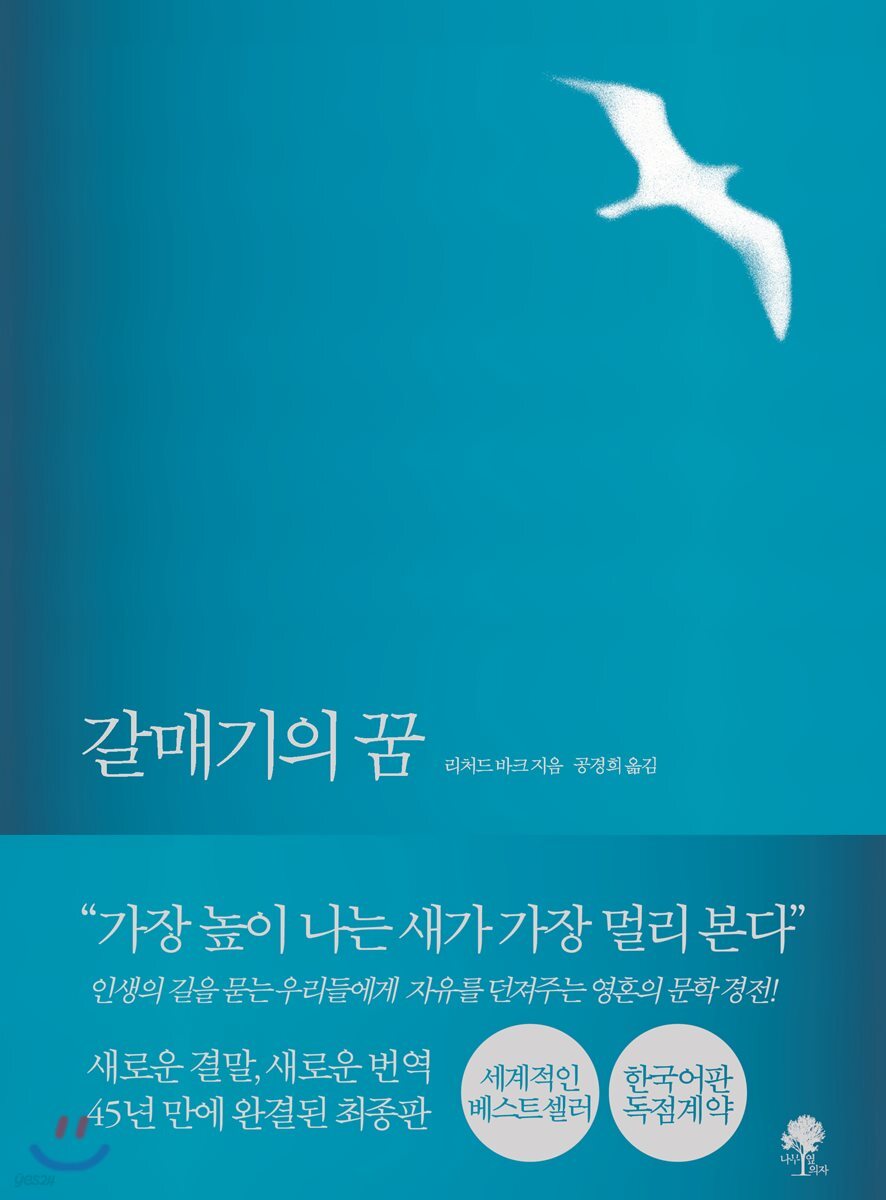
Seagull's Dream
 |
Description
Book Introduction
“The bird that flies highest sees farthest.”
New ending, new translation!
The final edition, completed after 45 years!
Since its publication in 1970, Richard Bach's fable novel, Jonathan Livingston Seagull, has been translated into over 40 languages and sold over 40 million copies worldwide. It is a bestseller that has touched the hearts of countless readers across generations. It has been newly translated and published in a revised and expanded edition.
This classic fable novel, which was first officially published in Korea in 2003 through the translation of poet Ryu Si-hwa and has been much loved, has been completely reborn after 45 years, with the addition of the author's previously unpublished manuscript and the language of veteran professional translator Gong Gyeong-hee.
New ending, new translation!
The final edition, completed after 45 years!
Since its publication in 1970, Richard Bach's fable novel, Jonathan Livingston Seagull, has been translated into over 40 languages and sold over 40 million copies worldwide. It is a bestseller that has touched the hearts of countless readers across generations. It has been newly translated and published in a revised and expanded edition.
This classic fable novel, which was first officially published in Korea in 2003 through the translation of poet Ryu Si-hwa and has been much loved, has been completely reborn after 45 years, with the addition of the author's previously unpublished manuscript and the language of veteran professional translator Gong Gyeong-hee.
- You can preview some of the book's contents.
Preview
index
Chapter 1 | 11
Chapter 2 | 51
Chapter 3 | 87
Chapter 4 | 115
Last Words | 143
Translator's Note | 155
Chapter 2 | 51
Chapter 3 | 87
Chapter 4 | 115
Last Words | 143
Translator's Note | 155
Into the book
"Why, John? Why? Why is it so hard for you to live like other birds, John? Why can't you leave the low-altitude flying to the pelicans or albatrosses? Why don't you eat? Look at how skinny you are, boy!"
“It doesn’t matter if you’re skinny, Mom.
I just want to know what I can and can't do in the air, that's all.
“I just want to know.” --- p.15
He was full of life, trembling with joy, and proud of his fears under control.
Then, without making a fuss, it folded its forewings, extended its short, angular wingtips, and flew straight down toward the sea.
By the time he passed 1,200 meters, Jonathan had reached his limit, and the wind was like a wall of screaming iron, preventing him from going any faster.
Now he was descending straight ahead at 344 kilometers per hour.
Jonathan swallowed, knowing that if he unfurled his wings at that speed, his body would be torn apart.
But speed was power, speed was joy, speed was pure beauty.
--- p.26~27
As each day passed, Jonathan realized that he had as much to learn about flying here as he had in his previous life.
But there was a difference.
The seagulls here thought like Jonathan.
For each of us, the most important thing in life was to strive for perfection in what we most wanted to do.
And the thing I wanted to do most was fly.
They were all majestic birds, spending hours each day flying and testing difficult skills.
--- p.55
Is there a seagull who sees the meaning of flight as more than just a means to get food or scraps from a ship, who strives to break free from its limitations? Perhaps there is a seagull who was exiled for telling the truth to its tribe.
The more Jonathan practiced what he had learned about kindness and tried to understand the nature of love, the more he wanted to return to Earth.
Despite his lonely past, Jonathan Seagull was a natural teacher, and his way of showing love was to teach the truth he knew to the seagull who was seeking a chance to learn the truth on his own.
--- p.74
So that morning, eight gulls flew from the west in a double diamond formation, wingtips almost overlapping.
They flew towards the shore, the meeting place of the tribe, at a speed of 217 kilometers per hour.
Jonathan stood in front, Fletcher on the right, and Henry Calvin, with fighting spirit, on the left.
The entire formation rolled to the right as one… … horizontally… … there… … back… … there… … horizontally… … The wind blew fiercely against everyone.
The formation was silent, as if it had become a giant sword, cutting through the squawking, cawing noise of the seagull tribe, and eight thousand eyes watched without blinking.
Eight seagulls took off one after another, made a sharp turn in the air, flew straight ahead, and landed slowly in a standing position on the sand.
--- p.92~93
"Why is it the most difficult thing in the world to convince a bird that he is free, that with a little practice he can prove it himself? Why is it so arduous?" --- p.105
Less than two hundred years later, Jonathan's teachings had largely disappeared from everyday practice, with the simple words "holy" and the aspirations of ordinary seagulls, even more humble than sand fleas, falling short.
Over time, the rituals and ceremonies in Jonathan's name became more extreme.
A thinking seagull would change course in the sky to avoid seeing the stone tomb.
It was a stone tomb built on empty words and superstition by those who would rather make excuses for their failures than try and become great.
The thinking seagulls paradoxically closed their hearts to words like 'flight', 'stone tomb', 'Great Gull', and 'Jonathan'.
They were the most lucid and honest birds since Jonathan on other matters.
But when Jonathan's name or any other term coined by the 'high-ranking local disciples' was mentioned, their hearts slammed shut like a trapdoor.
--- p.127
There was a key, and Anthony the Seagull knew he had said those words at that moment.
He didn't have the answers, but he knew he would be grateful and willing to give his life if he could just follow the bird that could show him what he was talking about.
If only there were a bird that could offer some answers that would influence and bring joy and wonder to life! Until I found that bird, life was aimless, dull, desolate, and absurd.
All seagulls would remain as mere corpses of blood and feathers, bound for oblivion.
“It doesn’t matter if you’re skinny, Mom.
I just want to know what I can and can't do in the air, that's all.
“I just want to know.” --- p.15
He was full of life, trembling with joy, and proud of his fears under control.
Then, without making a fuss, it folded its forewings, extended its short, angular wingtips, and flew straight down toward the sea.
By the time he passed 1,200 meters, Jonathan had reached his limit, and the wind was like a wall of screaming iron, preventing him from going any faster.
Now he was descending straight ahead at 344 kilometers per hour.
Jonathan swallowed, knowing that if he unfurled his wings at that speed, his body would be torn apart.
But speed was power, speed was joy, speed was pure beauty.
--- p.26~27
As each day passed, Jonathan realized that he had as much to learn about flying here as he had in his previous life.
But there was a difference.
The seagulls here thought like Jonathan.
For each of us, the most important thing in life was to strive for perfection in what we most wanted to do.
And the thing I wanted to do most was fly.
They were all majestic birds, spending hours each day flying and testing difficult skills.
--- p.55
Is there a seagull who sees the meaning of flight as more than just a means to get food or scraps from a ship, who strives to break free from its limitations? Perhaps there is a seagull who was exiled for telling the truth to its tribe.
The more Jonathan practiced what he had learned about kindness and tried to understand the nature of love, the more he wanted to return to Earth.
Despite his lonely past, Jonathan Seagull was a natural teacher, and his way of showing love was to teach the truth he knew to the seagull who was seeking a chance to learn the truth on his own.
--- p.74
So that morning, eight gulls flew from the west in a double diamond formation, wingtips almost overlapping.
They flew towards the shore, the meeting place of the tribe, at a speed of 217 kilometers per hour.
Jonathan stood in front, Fletcher on the right, and Henry Calvin, with fighting spirit, on the left.
The entire formation rolled to the right as one… … horizontally… … there… … back… … there… … horizontally… … The wind blew fiercely against everyone.
The formation was silent, as if it had become a giant sword, cutting through the squawking, cawing noise of the seagull tribe, and eight thousand eyes watched without blinking.
Eight seagulls took off one after another, made a sharp turn in the air, flew straight ahead, and landed slowly in a standing position on the sand.
--- p.92~93
"Why is it the most difficult thing in the world to convince a bird that he is free, that with a little practice he can prove it himself? Why is it so arduous?" --- p.105
Less than two hundred years later, Jonathan's teachings had largely disappeared from everyday practice, with the simple words "holy" and the aspirations of ordinary seagulls, even more humble than sand fleas, falling short.
Over time, the rituals and ceremonies in Jonathan's name became more extreme.
A thinking seagull would change course in the sky to avoid seeing the stone tomb.
It was a stone tomb built on empty words and superstition by those who would rather make excuses for their failures than try and become great.
The thinking seagulls paradoxically closed their hearts to words like 'flight', 'stone tomb', 'Great Gull', and 'Jonathan'.
They were the most lucid and honest birds since Jonathan on other matters.
But when Jonathan's name or any other term coined by the 'high-ranking local disciples' was mentioned, their hearts slammed shut like a trapdoor.
--- p.127
There was a key, and Anthony the Seagull knew he had said those words at that moment.
He didn't have the answers, but he knew he would be grateful and willing to give his life if he could just follow the bird that could show him what he was talking about.
If only there were a bird that could offer some answers that would influence and bring joy and wonder to life! Until I found that bird, life was aimless, dull, desolate, and absurd.
All seagulls would remain as mere corpses of blood and feathers, bound for oblivion.
--- p.131~136
Publisher's Review
The international bestseller, a life guidebook, now has a revised and expanded edition with a new translation.
Jonathan Livingston Seagull is a mystical novel in the form of a fable that awakens the transcendental powers of all beings through the life of Jonathan Livingston Seagull, a former pilot who constantly strives to realize his dream and belief in flight. As soon as it was published, it surpassed the sales record of Gone with the Wind and became an international bestseller.
This work symbolically depicts the essence of human life through a seagull dreaming of flight to realize the true meaning of freedom.
In particular, we come to realize the importance of self-fulfillment through the impressive figure of Jonathan the Seagull, who stubbornly challenges his dream without wavering even when bullied by the seagulls.
The author reminds us of the truth of life that “the bird that flies highest sees farthest,” and tells us that we humans should not be fixated on what is right in front of us, but should look far ahead and live with our own dreams and ideals in our hearts.
Moreover, this revised and expanded edition was translated with great care by professional translator Gong Gyeong-hee, who preserved the original text's solemn style, and translated the thrilling and realistic flight scenes that Richard Bach, a former pilot, described in his novel based on his own experiences, into Korean more closely to the author's intentions.
The final chapter, added after 45 years, reveals its shocking conclusion.
The new ending to this legendary work is shocking enough to send shivers down the spine of even established readers, and groundbreaking enough to spark controversy.
Through its new ending, the novel demonstrates and declares the complete resurrection of the essence that has become conscious, corrupted, and corrupted.
The final chapter, which contains this shocking conclusion, was unfinished when Journey Living Seagull was first published, and Richard Bach recalls that he ultimately left it out because he felt it was unnecessary for the work.
However, the author says that after half a century, he discovered the manuscript by chance and decided that the 21st century, a suffocating century overflowing with authority and consciousness, was the time to revive it.
“This was written when no one knew the future.
Now we know the future.”
The story of Jonathan Seagull ended when I stopped writing Chapter 4.
Half a century passed and the manuscript was forgotten.
Sabrina found the manuscript a while ago.
The faded and tattered manuscript lay buried beneath a pile of useless papers.
That wasn't what I wrote.
It was something he, a young man at that time, had written.
_From "The Last Words"
Translator Gong Gyeong-hee said of the newly added Chapter 4 in the revised and expanded edition, “This passage, which reminds us of the world after Jesus’ death, shows the reality of the human world that is fundamentally difficult to change even after receiving great teachings.” She added, “It seems to send a small hope through Anthony the Seagull, who dreams of a new flight while suffering from an unchanging world.”
“It is not the story of Livingstone the Seagull that became a legend.
“This is the story of all our seagulls.”
_From the translator's note
Translator Gong Kyung-hee has grasped the author's intention to revive the true value of this work, which has now become a legend, losing its original meaning and becoming nothing more than a famous novel, through his second coming, and to extend its meaning to today's reality, which seems to have lost its way, by sending it off with hope on Anthony's wings that will spread wide in the future.
He didn't have the answer, but
If only I could follow the bird that can show me what I'm talking about now
I knew that he was grateful and willing to give his life.
Influential, bringing excellence and joy to life
If only there were a bird that could give some answers!
Jonathan Livingston Seagull is a mystical novel in the form of a fable that awakens the transcendental powers of all beings through the life of Jonathan Livingston Seagull, a former pilot who constantly strives to realize his dream and belief in flight. As soon as it was published, it surpassed the sales record of Gone with the Wind and became an international bestseller.
This work symbolically depicts the essence of human life through a seagull dreaming of flight to realize the true meaning of freedom.
In particular, we come to realize the importance of self-fulfillment through the impressive figure of Jonathan the Seagull, who stubbornly challenges his dream without wavering even when bullied by the seagulls.
The author reminds us of the truth of life that “the bird that flies highest sees farthest,” and tells us that we humans should not be fixated on what is right in front of us, but should look far ahead and live with our own dreams and ideals in our hearts.
Moreover, this revised and expanded edition was translated with great care by professional translator Gong Gyeong-hee, who preserved the original text's solemn style, and translated the thrilling and realistic flight scenes that Richard Bach, a former pilot, described in his novel based on his own experiences, into Korean more closely to the author's intentions.
The final chapter, added after 45 years, reveals its shocking conclusion.
The new ending to this legendary work is shocking enough to send shivers down the spine of even established readers, and groundbreaking enough to spark controversy.
Through its new ending, the novel demonstrates and declares the complete resurrection of the essence that has become conscious, corrupted, and corrupted.
The final chapter, which contains this shocking conclusion, was unfinished when Journey Living Seagull was first published, and Richard Bach recalls that he ultimately left it out because he felt it was unnecessary for the work.
However, the author says that after half a century, he discovered the manuscript by chance and decided that the 21st century, a suffocating century overflowing with authority and consciousness, was the time to revive it.
“This was written when no one knew the future.
Now we know the future.”
The story of Jonathan Seagull ended when I stopped writing Chapter 4.
Half a century passed and the manuscript was forgotten.
Sabrina found the manuscript a while ago.
The faded and tattered manuscript lay buried beneath a pile of useless papers.
That wasn't what I wrote.
It was something he, a young man at that time, had written.
_From "The Last Words"
Translator Gong Gyeong-hee said of the newly added Chapter 4 in the revised and expanded edition, “This passage, which reminds us of the world after Jesus’ death, shows the reality of the human world that is fundamentally difficult to change even after receiving great teachings.” She added, “It seems to send a small hope through Anthony the Seagull, who dreams of a new flight while suffering from an unchanging world.”
“It is not the story of Livingstone the Seagull that became a legend.
“This is the story of all our seagulls.”
_From the translator's note
Translator Gong Kyung-hee has grasped the author's intention to revive the true value of this work, which has now become a legend, losing its original meaning and becoming nothing more than a famous novel, through his second coming, and to extend its meaning to today's reality, which seems to have lost its way, by sending it off with hope on Anthony's wings that will spread wide in the future.
He didn't have the answer, but
If only I could follow the bird that can show me what I'm talking about now
I knew that he was grateful and willing to give his life.
Influential, bringing excellence and joy to life
If only there were a bird that could give some answers!
GOODS SPECIFICS
- Date of issue: June 1, 2018
- Page count, weight, size: 160 pages | 358g | 152*206*20mm
- ISBN13: 9791161570341
- ISBN10: 1161570349
You may also like
카테고리
korean


korean

![ELLE 엘르 스페셜 에디션 A형 : 12월 [2025]](http://librairie.coreenne.fr/cdn/shop/files/b8e27a3de6c9538896439686c6b0e8fb.jpg?v=1766436872&width=3840)


