

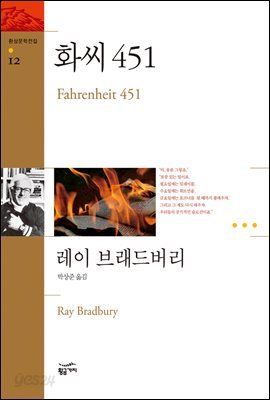
Fahrenheit 451
 |
Description
Book Introduction
A future where books are banned,
A stark warning to a society where human thought is controlled!
This dystopian future novel tells the story of people trying to revive the fading spiritual culture behind the advancement of science and technology. Set in a near future where books are banned, it contains a strong warning message about a society where human thoughts are controlled.
Guy Montag, a pyromaniac whose job is to burn books.
He had never felt any doubts about his daily life, but one day, his life began to change when he met Clarisse, the girl next door.
Through Clarisse, a vibrant girl who wants to see and feel everything in the world around her, Montag realizes that his life is empty.
Then one day, Clarisse suddenly goes missing, and Montag decides to take the first step toward change...
Also, the unique surrounding characters such as Mildred, his wife who sits in front of the wall-mounted televisions that fill three walls all day and feels that the people on the TVs are her family and only hopes that the remaining wall will be replaced with a wall-mounted television, Beatty, the chief of the fire department who has read many books himself but is a skeptic who believes that books can't change anything, and Faber, who was once a professor but now hides and watches the world, make the story richer.
A stark warning to a society where human thought is controlled!
This dystopian future novel tells the story of people trying to revive the fading spiritual culture behind the advancement of science and technology. Set in a near future where books are banned, it contains a strong warning message about a society where human thoughts are controlled.
Guy Montag, a pyromaniac whose job is to burn books.
He had never felt any doubts about his daily life, but one day, his life began to change when he met Clarisse, the girl next door.
Through Clarisse, a vibrant girl who wants to see and feel everything in the world around her, Montag realizes that his life is empty.
Then one day, Clarisse suddenly goes missing, and Montag decides to take the first step toward change...
Also, the unique surrounding characters such as Mildred, his wife who sits in front of the wall-mounted televisions that fill three walls all day and feels that the people on the TVs are her family and only hopes that the remaining wall will be replaced with a wall-mounted television, Beatty, the chief of the fire department who has read many books himself but is a skeptic who believes that books can't change anything, and Faber, who was once a professor but now hides and watches the world, make the story richer.
- You can preview some of the book's contents.
Preview
index
Translator's Note
Chapter 1: The Fireside and the Salamander
Chapter 2: The Body and the Day After Tomorrow
Chapter 3: The Burning Flame
Reviews
Concluding remarks
A Conversation with Ray Bradbury
Chapter 1: The Fireside and the Salamander
Chapter 2: The Body and the Day After Tomorrow
Chapter 3: The Burning Flame
Reviews
Concluding remarks
A Conversation with Ray Bradbury
Publisher's Review
Author: Ray Bradbury
Arthur C.
Ray Bradbury, a unique writer who is revered as a master of science fiction literature along with Clarke and Isaac Asimov, is called an all-round writer who raised the status of science fiction literature by adding lyricism and literary quality to it.
Born in Waukegan, Illinois, on August 22, 1920, he graduated from Los Angeles High School and gave up on college, but he amassed a vast knowledge through extensive reading, to the point where he said, "The library raised me."
Beginning with his first short story, "Hollerbochen's Dilemma," published at the age of twenty, he contributed his work to various magazines and published over 500 works across genres, including short stories, novels, plays, and poetry.
Based on a lyrical and refined writing style and delicate poetic sensibility, he has published many works that have been recognized not only in science fiction literature but also in the existing literary world.
In particular, 『Fahrenheit 451』 and 『The Martian Chronicles』, which have become classics in the criticism of civilization, contain efforts to explore and regenerate the spiritual culture and human existence that science, technology, and civilization are destroying.
He also wrote the screenplay for the 1956 John Huston film Moby Dick, and 65 of his works were broadcast on television under the name "Ray Bradbury Theatre," winning seven Emmy Awards and other media awards.
Translator: Park Sang-jun
Science fiction writer and translator, columnist.
He graduated from Hanyang University's Department of Earth and Marine Sciences and completed his graduate studies in Comparative Literature at Seoul National University.
He served as the first editor-in-chief of the monthly magazine 『Fantastic』 and is the representative of Seoul's 'SF Archive'.
Arthur C.
Ray Bradbury, a unique writer who is revered as a master of science fiction literature along with Clarke and Isaac Asimov, is called an all-round writer who raised the status of science fiction literature by adding lyricism and literary quality to it.
Born in Waukegan, Illinois, on August 22, 1920, he graduated from Los Angeles High School and gave up on college, but he amassed a vast knowledge through extensive reading, to the point where he said, "The library raised me."
Beginning with his first short story, "Hollerbochen's Dilemma," published at the age of twenty, he contributed his work to various magazines and published over 500 works across genres, including short stories, novels, plays, and poetry.
Based on a lyrical and refined writing style and delicate poetic sensibility, he has published many works that have been recognized not only in science fiction literature but also in the existing literary world.
In particular, 『Fahrenheit 451』 and 『The Martian Chronicles』, which have become classics in the criticism of civilization, contain efforts to explore and regenerate the spiritual culture and human existence that science, technology, and civilization are destroying.
He also wrote the screenplay for the 1956 John Huston film Moby Dick, and 65 of his works were broadcast on television under the name "Ray Bradbury Theatre," winning seven Emmy Awards and other media awards.
Translator: Park Sang-jun
Science fiction writer and translator, columnist.
He graduated from Hanyang University's Department of Earth and Marine Sciences and completed his graduate studies in Comparative Literature at Seoul National University.
He served as the first editor-in-chief of the monthly magazine 『Fantastic』 and is the representative of Seoul's 'SF Archive'.
GOODS SPECIFICS
- Date of issue: March 4, 2009
- Page count, weight, size: 279 pages | 428g | 148*210*20mm
- ISBN13: 9788982739088
- ISBN10: 8982739084
You may also like
카테고리
korean


korean

![GQ KOREA Mark (Monthly): December [2025]](http://librairie.coreenne.fr/cdn/shop/files/8ef265dbbfbf186523ed75ba7319009d.jpg?v=1765340328&width=3840)


