

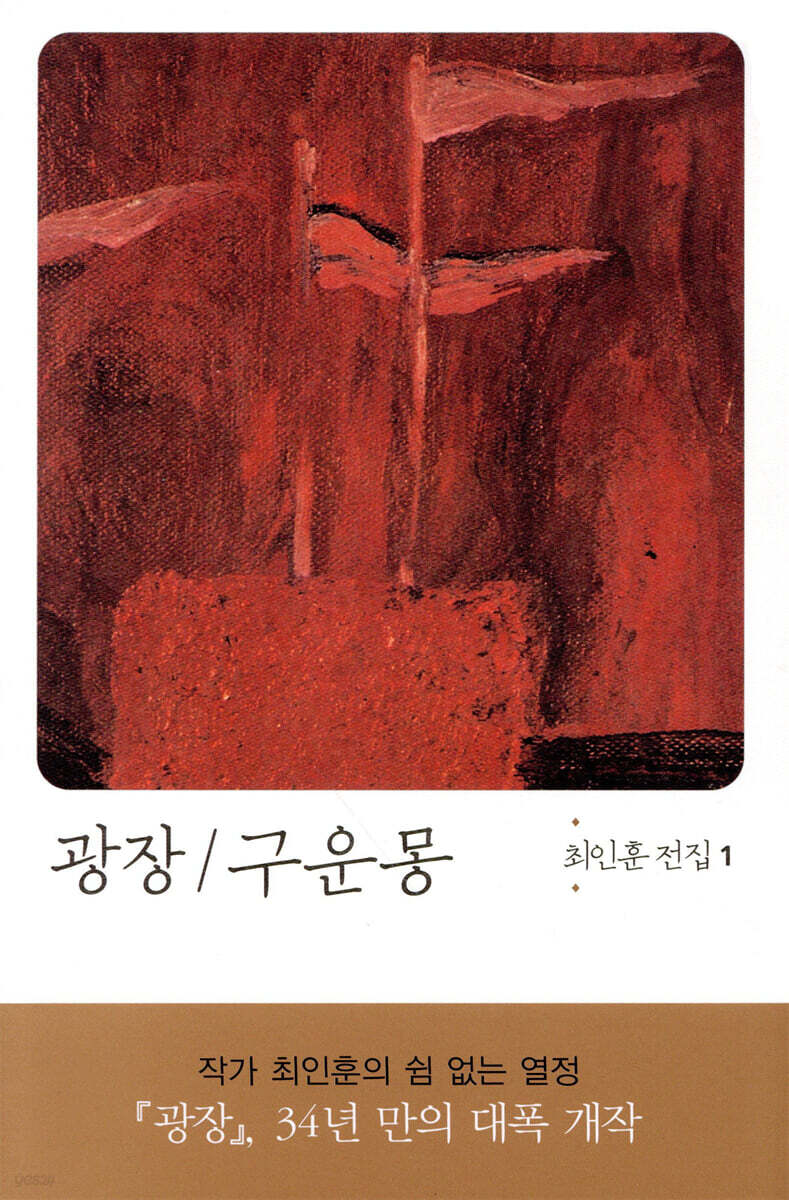
Square / Guunmong
 |
Description
Book Introduction
A giant of Korean literature, Choi In-hun, reads 50 years of his literary career.
A new edition of the complete works of Choi In-hun, a writer who opened new horizons for post-war Korean literature based on his interest in modernity, resistance to ideology, and exploration of new forms.
In addition to his existing works, including 『Square』, this collection includes 『Hwadu』 from 1994, encompassing his world of works that have been infused with his meticulous writing style for over 50 years.
Among them, 『The Square』, published in November 1960, immediately after the April 19 Revolution, is a work that shows a detailed reflection on ideology and love against the backdrop of post-war Korean society, and is considered one of his representative works, and is considered to be the 'peak of exploration of human interiority.'
"The Square" has been loved and respected by both critics and the public, to the point that it was the most frequently included work in high school literature textbooks, was selected as "Korea's Best Novel" by Korean writers in 2004, and was one of the most translated and introduced Korean novels abroad. Even after half a century, it continues to convey to readers a critical awareness that has not faded.
A new edition of the complete works of Choi In-hun, a writer who opened new horizons for post-war Korean literature based on his interest in modernity, resistance to ideology, and exploration of new forms.
In addition to his existing works, including 『Square』, this collection includes 『Hwadu』 from 1994, encompassing his world of works that have been infused with his meticulous writing style for over 50 years.
Among them, 『The Square』, published in November 1960, immediately after the April 19 Revolution, is a work that shows a detailed reflection on ideology and love against the backdrop of post-war Korean society, and is considered one of his representative works, and is considered to be the 'peak of exploration of human interiority.'
"The Square" has been loved and respected by both critics and the public, to the point that it was the most frequently included work in high school literature textbooks, was selected as "Korea's Best Novel" by Korean writers in 2004, and was one of the most translated and introduced Korean novels abroad. Even after half a century, it continues to convey to readers a critical awareness that has not faded.
- You can preview some of the book's contents.
Preview
index
Preface to the 1989 edition
Preface to the Complete Edition
Preface to the Japanese translation
Preface to the 1973 edition--For the repose of the soul of Lee Myeong-jun
Preface to the 1961 edition
introduction
square
Guunmong
Commentary: Reaffirmation of Love/Kim Hyeon
Rereading the Commentary on "The Square" / Kim Byeong-ik
Commentary: The Labyrinth of Love and Revolution/Kim In-ho
Commentary on "The Square," the Politics of Escape/Lee Gwang-ho
Preface to the Complete Edition
Preface to the Japanese translation
Preface to the 1973 edition--For the repose of the soul of Lee Myeong-jun
Preface to the 1961 edition
introduction
square
Guunmong
Commentary: Reaffirmation of Love/Kim Hyeon
Rereading the Commentary on "The Square" / Kim Byeong-ik
Commentary: The Labyrinth of Love and Revolution/Kim In-ho
Commentary on "The Square," the Politics of Escape/Lee Gwang-ho
Publisher's Review
Choi In-hun, a giant of Korean literature
Reading 50 Years of His Literature
―In commemoration of the publication of the new edition of “Choi In-hun’s Complete Works” in 2008
Choi In-hun, the author of “The Square,” a legend of half a century of Korean literature, will celebrate his 50th anniversary as a writer next year (he debuted in 1959 with “Freedom Literature”).
Who is Choi In-hoon?
Choi In-hun is the 'hot history' of modern Korean literature, having struggled to properly understand the world colliding between pre-modern circumstances and the two major ideologies, and as a result, he has repeatedly published novels, plays, critiques, and essays in a variety of formats, which cannot be described as anything other than "opening a new chapter in the history of Korean literature."
Even today, in 2008, his literary world is still evaluated as an example of a sophisticated style and a sense of critical awareness that is not outdated.
Choi In-hun, an artist who, based on his interest in modernity, resistance to ideology, and exploration of new forms, has reached the pinnacle of exploring the inner self through his own methodology, without falling into mysticism or materialism in an age when God is dead and mythology has disappeared.
Perhaps he is a writer who is more apt to be described as having “lived literature” rather than as having “written literary works.”
Critic Kim Hyun once praised him as “the greatest post-war writer who expanded the theme of uprooted humanity into a universal human condition.”
Choi In-hun, who opened a new horizon for post-war Korean literature with his work “The Square” published at the beginning of the 1960s and allowed the young people of this land to experience a new baptism of intellectual and literary freedom, went on to symbolize the spatiotemporal situations and contexts of each time through none other than “language”: “Gray Man” (1963), which depicted the existential agony of an era with closed prospects; “Journey to the West” (1966), which showed an unconventional narrative experiment while crossing between reality and fantasy; “The Voice of the Governor-General” (1967-1968), which expressed the sense of crisis of neocolonial reality using the technique of satirical novels; and finally, “Hwadu” (1994), a masterpiece that comprehensively questioned the 20th century itself and looked at the fate of 20th-century people from a broad perspective.
The journey of Choi In-hun's novels from "The Square" to "The Topic" is truly recorded as a literary journey of reflection from the division of Korea to the 20th-century world system theory.
It would be fair to say that the past 50 years have been a time when many writers in the history of Korean literature were able to emerge as writers after reading the Complete Works of Choi In-hun, and many literary researchers were able to open up a heated world of intellectual research and literary criticism based on Choi In-hun's literature.
Since its founding in 1975, Munhak-kwa-Jiseongsa has strived to publish books that spark deep reflection on Korean society and literary works that portray the true shape of life. The publication of the "Complete Works of Choi In-hun" in 1976 was in itself a significant event.
This was because the late 1970s was a time when the foundation of our publishing literature market had not yet been fully established, and this publication was launched solely out of a sense of mission to pay tribute to the true novel craftsmen of our time and, at the same time, to organize the history of Korean novels.
Author Choi In-hun's sincerity and integrity toward literature have long been loved by many readers.
Above all, the fact that the “Complete Works of Choi In-hun,” which began in 1976 with “Gwangjang” as its starting point and was compiled into a 12-volume series in 1980, has secured a wide readership that transcends eras and generations through continuous reprinting [May 1996, a seminar commemorating the 100th printing of “Gwangjang” (Press Center); April 2001, a symposium commemorating the 40th anniversary of “Gwangjang” (Sejong Center for the Performing Arts); 159th printing of “Gwangjang” (approximately 550,000 copies as of November 13, 2008); and a symposium commemorating the publication of a new edition on November 21, 2008 (Friday) (Munji Cultural Center “Sai”)], is another monumental achievement in the history of Korean literature.
This is because the case of a surviving author's complete works going through so many editions and printings over such a long period of time, meeting readers in new formats without ignoring the changing times, is an unprecedented event that no other author has ever experienced.
Choi In-hun, the epitome of a living intellectual and a writer whose life and novels are inseparable, is the most fitting image. This is why we want to reread his literature, now presented in a new vessel, with 21st-century readers.
Beginning in 1976, the Complete Works of Choi In-hun (12 volumes; first edition completed in 1980) was finally published in a new format in November 2008, after five years of work, including revisions by the author and reprints by the publisher. This new edition is a response to the readers' continued interest and encouragement.
This collection includes the novel “Hwadu” (Minumsa, 1994; Munjae, 2002; Munhak-kwa-Jiseongsa, 2008) and the prose collection “Meditation on the Road” (Cheongha, 1989; Solgwahak, 2005; Munhak-kwa-Jiseongsa, 2009), which were published after the first collection.
A total of 15 volumes are planned for publication in the first half of 2009, and as of November 13, 2008, the first batch of 4 volumes in 5 volumes (〈Hwadu 1·2〉, 〈Gwangjang/Guunmong〉, 〈Gray Man〉, 〈Journey to the West〉) has been published first.
The most notable aspect of this new edition of the complete works, as mentioned earlier, is the inclusion of "Hwadu," which comprehensively summarizes his entire literature both in content and form, thus establishing the complete works of Choi In-hun in name and reality.
In particular, his masterpiece, “Hwadu” (1994, winner of the 6th Yisan Literary Award), which broke his 20-year silence since “Typhoon” (1973) and was published, is a “summary of Choi In-hoon’s literature” that deserves to be highly evaluated in that it is a sincere record of the author who has persistently and earnestly reflected on the problematic situation of the present “here and now” while living through the painful modern history since liberation.
Through "Hwadu," author Choi In-hun honestly accepts our ideological and realistic concerns, presents a method of observation and thought as an intellectual who must live in this era and this land, and achieves outstanding literary significance by revealing the source of the writer's artistic imagination and writing attitude, while creating a masterpiece that makes the most of the functions of the novel, an extremely open genre.
Thus, as the author himself stated in the preface of this book, through “the story of a scale attached to the dinosaur’s body,” he is exploring the author’s own life, the ideologies that influenced him, and his own memories. The greatest literary significance of “Hwadu” lies in the fact that the story of an individual who lived through the turbulent 20th century can encapsulate the concerns and lives of universal 20th-century people.
This is in line with the original purpose and significance of publishing the “Complete Works of Choi In-hun.”
Furthermore, by publishing new commentaries by Korean literature majors who have deeply explored Choi In-hun's literature and published papers and reviews alongside existing commentaries on his works, we sought to draw attention to the current nature of Choi In-hun's literature, which raises questions that transcend the barriers of time and remain relevant even in the 21st century.
In detail, each volume was individually checked by the author, and great care was taken to correct editing errors and typos found in existing collections.
Above all, in order to make the anthology as accessible as possible to current readers, we chose a refreshing format closer to a paperback, breaking away from the limitations of the existing new national edition's external heaviness.
Here, we have not neglected to include the outstanding works of representative artists of the Korean modern art world, Yoo Young-kuk, Yoo Geun-taek, and Seo Yong-seon, on the covers of each volume, thereby enhancing the weight of the works and their aesthetic value as a collection.
The newly refurbished “Choi In-hun Complete Works” will provide a unique opportunity to examine how Choi In-hun’s works continue to make meaningful historical and social statements beyond the era in which they were written.
Furthermore, in recording the universal wounds and memories of humanity, the author's remarkable literary imagination moves beyond the conventional novel grammar of simply reproducing and listing events, employing a variety of narrative devices and experimental methods of modernism that were ahead of their time. This will be a good opportunity to confirm the author's world of amazing literary imagination through actual texts, not fossilized textbooks or empty rumors.
Reading 50 Years of His Literature
―In commemoration of the publication of the new edition of “Choi In-hun’s Complete Works” in 2008
Choi In-hun, the author of “The Square,” a legend of half a century of Korean literature, will celebrate his 50th anniversary as a writer next year (he debuted in 1959 with “Freedom Literature”).
Who is Choi In-hoon?
Choi In-hun is the 'hot history' of modern Korean literature, having struggled to properly understand the world colliding between pre-modern circumstances and the two major ideologies, and as a result, he has repeatedly published novels, plays, critiques, and essays in a variety of formats, which cannot be described as anything other than "opening a new chapter in the history of Korean literature."
Even today, in 2008, his literary world is still evaluated as an example of a sophisticated style and a sense of critical awareness that is not outdated.
Choi In-hun, an artist who, based on his interest in modernity, resistance to ideology, and exploration of new forms, has reached the pinnacle of exploring the inner self through his own methodology, without falling into mysticism or materialism in an age when God is dead and mythology has disappeared.
Perhaps he is a writer who is more apt to be described as having “lived literature” rather than as having “written literary works.”
Critic Kim Hyun once praised him as “the greatest post-war writer who expanded the theme of uprooted humanity into a universal human condition.”
Choi In-hun, who opened a new horizon for post-war Korean literature with his work “The Square” published at the beginning of the 1960s and allowed the young people of this land to experience a new baptism of intellectual and literary freedom, went on to symbolize the spatiotemporal situations and contexts of each time through none other than “language”: “Gray Man” (1963), which depicted the existential agony of an era with closed prospects; “Journey to the West” (1966), which showed an unconventional narrative experiment while crossing between reality and fantasy; “The Voice of the Governor-General” (1967-1968), which expressed the sense of crisis of neocolonial reality using the technique of satirical novels; and finally, “Hwadu” (1994), a masterpiece that comprehensively questioned the 20th century itself and looked at the fate of 20th-century people from a broad perspective.
The journey of Choi In-hun's novels from "The Square" to "The Topic" is truly recorded as a literary journey of reflection from the division of Korea to the 20th-century world system theory.
It would be fair to say that the past 50 years have been a time when many writers in the history of Korean literature were able to emerge as writers after reading the Complete Works of Choi In-hun, and many literary researchers were able to open up a heated world of intellectual research and literary criticism based on Choi In-hun's literature.
Since its founding in 1975, Munhak-kwa-Jiseongsa has strived to publish books that spark deep reflection on Korean society and literary works that portray the true shape of life. The publication of the "Complete Works of Choi In-hun" in 1976 was in itself a significant event.
This was because the late 1970s was a time when the foundation of our publishing literature market had not yet been fully established, and this publication was launched solely out of a sense of mission to pay tribute to the true novel craftsmen of our time and, at the same time, to organize the history of Korean novels.
Author Choi In-hun's sincerity and integrity toward literature have long been loved by many readers.
Above all, the fact that the “Complete Works of Choi In-hun,” which began in 1976 with “Gwangjang” as its starting point and was compiled into a 12-volume series in 1980, has secured a wide readership that transcends eras and generations through continuous reprinting [May 1996, a seminar commemorating the 100th printing of “Gwangjang” (Press Center); April 2001, a symposium commemorating the 40th anniversary of “Gwangjang” (Sejong Center for the Performing Arts); 159th printing of “Gwangjang” (approximately 550,000 copies as of November 13, 2008); and a symposium commemorating the publication of a new edition on November 21, 2008 (Friday) (Munji Cultural Center “Sai”)], is another monumental achievement in the history of Korean literature.
This is because the case of a surviving author's complete works going through so many editions and printings over such a long period of time, meeting readers in new formats without ignoring the changing times, is an unprecedented event that no other author has ever experienced.
Choi In-hun, the epitome of a living intellectual and a writer whose life and novels are inseparable, is the most fitting image. This is why we want to reread his literature, now presented in a new vessel, with 21st-century readers.
Beginning in 1976, the Complete Works of Choi In-hun (12 volumes; first edition completed in 1980) was finally published in a new format in November 2008, after five years of work, including revisions by the author and reprints by the publisher. This new edition is a response to the readers' continued interest and encouragement.
This collection includes the novel “Hwadu” (Minumsa, 1994; Munjae, 2002; Munhak-kwa-Jiseongsa, 2008) and the prose collection “Meditation on the Road” (Cheongha, 1989; Solgwahak, 2005; Munhak-kwa-Jiseongsa, 2009), which were published after the first collection.
A total of 15 volumes are planned for publication in the first half of 2009, and as of November 13, 2008, the first batch of 4 volumes in 5 volumes (〈Hwadu 1·2〉, 〈Gwangjang/Guunmong〉, 〈Gray Man〉, 〈Journey to the West〉) has been published first.
The most notable aspect of this new edition of the complete works, as mentioned earlier, is the inclusion of "Hwadu," which comprehensively summarizes his entire literature both in content and form, thus establishing the complete works of Choi In-hun in name and reality.
In particular, his masterpiece, “Hwadu” (1994, winner of the 6th Yisan Literary Award), which broke his 20-year silence since “Typhoon” (1973) and was published, is a “summary of Choi In-hoon’s literature” that deserves to be highly evaluated in that it is a sincere record of the author who has persistently and earnestly reflected on the problematic situation of the present “here and now” while living through the painful modern history since liberation.
Through "Hwadu," author Choi In-hun honestly accepts our ideological and realistic concerns, presents a method of observation and thought as an intellectual who must live in this era and this land, and achieves outstanding literary significance by revealing the source of the writer's artistic imagination and writing attitude, while creating a masterpiece that makes the most of the functions of the novel, an extremely open genre.
Thus, as the author himself stated in the preface of this book, through “the story of a scale attached to the dinosaur’s body,” he is exploring the author’s own life, the ideologies that influenced him, and his own memories. The greatest literary significance of “Hwadu” lies in the fact that the story of an individual who lived through the turbulent 20th century can encapsulate the concerns and lives of universal 20th-century people.
This is in line with the original purpose and significance of publishing the “Complete Works of Choi In-hun.”
Furthermore, by publishing new commentaries by Korean literature majors who have deeply explored Choi In-hun's literature and published papers and reviews alongside existing commentaries on his works, we sought to draw attention to the current nature of Choi In-hun's literature, which raises questions that transcend the barriers of time and remain relevant even in the 21st century.
In detail, each volume was individually checked by the author, and great care was taken to correct editing errors and typos found in existing collections.
Above all, in order to make the anthology as accessible as possible to current readers, we chose a refreshing format closer to a paperback, breaking away from the limitations of the existing new national edition's external heaviness.
Here, we have not neglected to include the outstanding works of representative artists of the Korean modern art world, Yoo Young-kuk, Yoo Geun-taek, and Seo Yong-seon, on the covers of each volume, thereby enhancing the weight of the works and their aesthetic value as a collection.
The newly refurbished “Choi In-hun Complete Works” will provide a unique opportunity to examine how Choi In-hun’s works continue to make meaningful historical and social statements beyond the era in which they were written.
Furthermore, in recording the universal wounds and memories of humanity, the author's remarkable literary imagination moves beyond the conventional novel grammar of simply reproducing and listing events, employing a variety of narrative devices and experimental methods of modernism that were ahead of their time. This will be a good opportunity to confirm the author's world of amazing literary imagination through actual texts, not fossilized textbooks or empty rumors.
GOODS SPECIFICS
- Publication date: November 13, 2008
- Page count, weight, size: 426 pages | 512g | 148*210*30mm
- ISBN13: 9788932019154
- ISBN10: 8932019150
You may also like
카테고리
korean


korean

![ELLE 엘르 스페셜 에디션 A형 : 12월 [2025]](http://librairie.coreenne.fr/cdn/shop/files/b8e27a3de6c9538896439686c6b0e8fb.jpg?v=1766436872&width=3840)


