

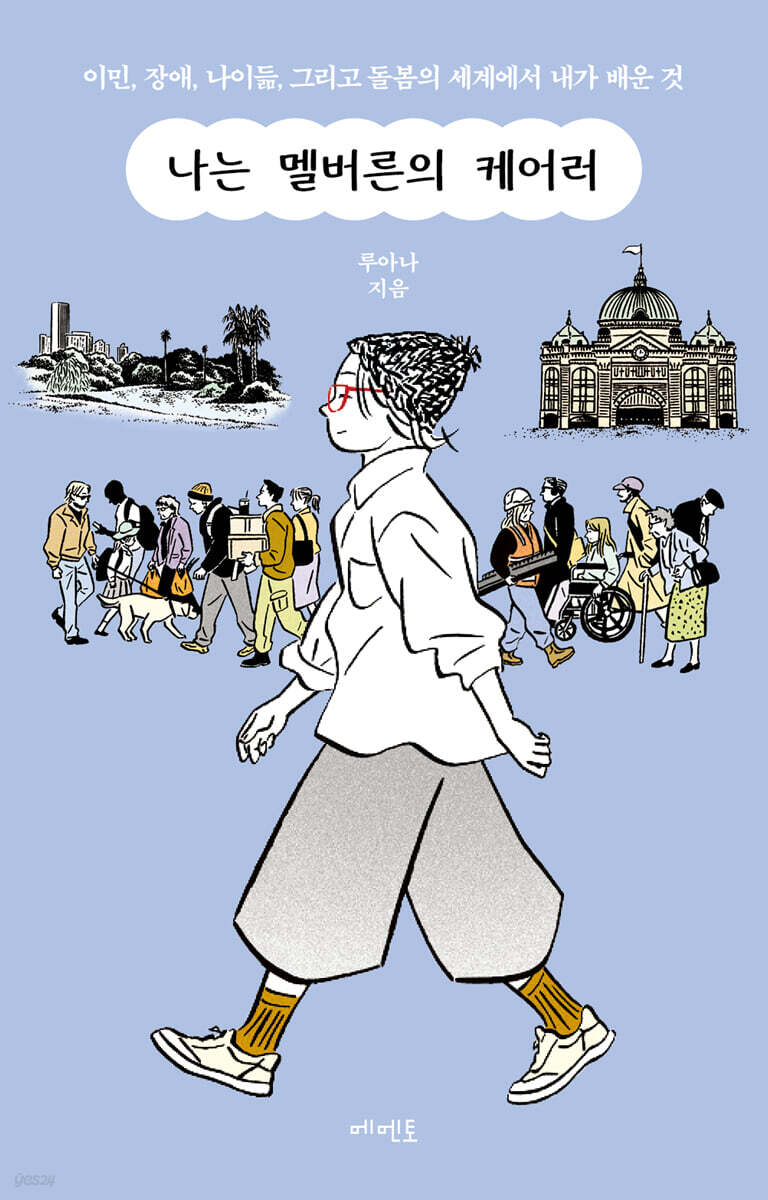
I am a carer in Melbourne
 |
Description
Book Introduction
Disabled and elderly people receive aquatic rehabilitation and physical therapy, people with severe and complex disabilities participate in camping to stay physically active, and elderly people receiving palliative care pass away peacefully at home with the help of nurses.
In a landscape where all bodies exist as "their own bodies," including young bodies, old bodies, bodies that struggle to control themselves, and even twisted bodies, the boundaries between disability and non-disability are broken down, and various patterns of life dance.
A colorful and beautiful story of care created by a Melbourne carer with these bodies.
The author, a Korean-Australian immigrant who worked as an English teacher for about ten years before taking a break from her career due to pregnancy, childbirth, and childcare, began working as a care worker in 2022.
Melbourne's care scene is a microcosm of multiculturalism.
Australia's welfare system would not function without the labour of migrants from India, Nepal, Kenya, the Philippines, China, Sri Lanka, Indonesia, Uzbekistan and Myanmar, aged from their 20s to their 60s.
The author is also a part of that multicultural scene, and an immigrant who endures under the name of a caregiver.
The burden of care was heavy.
But within it, a new meaning blossomed.
Caring for the lives of others becomes a process of rewriting one's own life and a journey of growth.
This book is a record of his growth as a disability support worker and caregiver, developing his professional skills and expertise, and is an essay that delicately captures the weight of different lives carried out in the name of welfare as he moves between the care landscapes of Korea and Australia.
In a landscape where all bodies exist as "their own bodies," including young bodies, old bodies, bodies that struggle to control themselves, and even twisted bodies, the boundaries between disability and non-disability are broken down, and various patterns of life dance.
A colorful and beautiful story of care created by a Melbourne carer with these bodies.
The author, a Korean-Australian immigrant who worked as an English teacher for about ten years before taking a break from her career due to pregnancy, childbirth, and childcare, began working as a care worker in 2022.
Melbourne's care scene is a microcosm of multiculturalism.
Australia's welfare system would not function without the labour of migrants from India, Nepal, Kenya, the Philippines, China, Sri Lanka, Indonesia, Uzbekistan and Myanmar, aged from their 20s to their 60s.
The author is also a part of that multicultural scene, and an immigrant who endures under the name of a caregiver.
The burden of care was heavy.
But within it, a new meaning blossomed.
Caring for the lives of others becomes a process of rewriting one's own life and a journey of growth.
This book is a record of his growth as a disability support worker and caregiver, developing his professional skills and expertise, and is an essay that delicately captures the weight of different lives carried out in the name of welfare as he moves between the care landscapes of Korea and Australia.
- You can preview some of the book's contents.
Preview
index
Opening Remarks - Disability as a Teaching Tool for Life
Part 1 I am a carer in Melbourne
I am a carer in Melbourne
Voluntarily chosen non-regular hourly wage system
Still, there is room
It requires ability and sincerity
Money earned through physical labor
I live on rice
Interview 01 Not 'This' but 'This' Meaningful
- Senior C, retired as a nursing assistant
Interview 02 “Practical experience is more important here.”
- K, a care work advocate
Part 2 With a heart to care for my mother
Safety, safety, safety again
With a heart that cares for my mother
Don't hate even if you don't feel affection
I met my mom after 5 years
End-of-life experiences of home caregivers
Last care, last goodbye
Interview 03 “This should be my job.”
- J, who has been working as a nurse for 20 years
Part 3: Two Races, Two Cultures
Another world called autism
Two races, two cultures
Time to change modes
The decision to take off the mask
Show as much as you know, and act as much as you know.
“Try saying the Z again.”
Interview 04 I Never Imagined My Child Would Have Autism
- L, a single mom and disability support worker
Part 4 NDIS, Please Help Me with Disability
NDIS, please help me with my disability
It's okay even if it's reckless
My first disability camp
Disability support workers are all-rounders
Three disabled women live there.
Welcome to Melbourne's public swimming pools
Interview 05: Living Witness to Disability Welfare in Australia
- NDIS Support Coordinator A
Interview 06: Immigrant Families Receiving Disability Welfare Benefits
- Parent M of a child with disability receiving NDIS services
Closing Remarks - Elder Care: Teaching About Death
References
Release - Rethinking Labor and Welfare, Disability and Care (Hong Na-ri)
Part 1 I am a carer in Melbourne
I am a carer in Melbourne
Voluntarily chosen non-regular hourly wage system
Still, there is room
It requires ability and sincerity
Money earned through physical labor
I live on rice
Interview 01 Not 'This' but 'This' Meaningful
- Senior C, retired as a nursing assistant
Interview 02 “Practical experience is more important here.”
- K, a care work advocate
Part 2 With a heart to care for my mother
Safety, safety, safety again
With a heart that cares for my mother
Don't hate even if you don't feel affection
I met my mom after 5 years
End-of-life experiences of home caregivers
Last care, last goodbye
Interview 03 “This should be my job.”
- J, who has been working as a nurse for 20 years
Part 3: Two Races, Two Cultures
Another world called autism
Two races, two cultures
Time to change modes
The decision to take off the mask
Show as much as you know, and act as much as you know.
“Try saying the Z again.”
Interview 04 I Never Imagined My Child Would Have Autism
- L, a single mom and disability support worker
Part 4 NDIS, Please Help Me with Disability
NDIS, please help me with my disability
It's okay even if it's reckless
My first disability camp
Disability support workers are all-rounders
Three disabled women live there.
Welcome to Melbourne's public swimming pools
Interview 05: Living Witness to Disability Welfare in Australia
- NDIS Support Coordinator A
Interview 06: Immigrant Families Receiving Disability Welfare Benefits
- Parent M of a child with disability receiving NDIS services
Closing Remarks - Elder Care: Teaching About Death
References
Release - Rethinking Labor and Welfare, Disability and Care (Hong Na-ri)
Detailed image
Into the book
“Disability teaches you how to live.
My son's disability diagnosis and my job as a disability support worker have layered a colorful and dense world into my life.
Perhaps, until I died, I was arrogant and proud, thinking that I knew the world well only from half the life of a non-disabled person.
“My disability has made me a person who is completely humble, who can understand the feelings of others that cannot be expressed in words.”
--- p.13
“After living close to them for half my life, I have become someone who loves physical laborers.
Unlike my parents, I studied hard to become a teacher to earn money without using my body, but then I ended up in Australia as a physical laborer who uses his body to make a living just like my parents.
Nowadays, it is rare to see people wearing suits or skirts with high heels on the street.
“The people who work hard every moment to earn a living are the ones I care about, and the workers who earn money through their labor and buy rice are now my colleagues.”
--- p.66~67
"How wonderful it would have been if, like my patient, doctors had connected mothers with therapists, if doctors, nurses, and therapists had visited patients with limited mobility in their homes to provide diagnosis and treatment, if home health care providers had been dispatched to ease the burden of care on families. It's all so futile and pointless.
“The trip to Korea, filled with family, passed by quickly, just like the speed of Korea.”
--- p.120
“At the nursing home where I work, butterfly stickers are placed on the visits of patients entering palliative care.
When a sticker is attached, it means that the patient is nearing death and that care will be taken to make the patient as comfortable and painless as possible until the last moment of breathing.
If the patient or family does not object, morphine is usually administered, the patient is weaned, and time is set aside to say goodbye to the family.”
--- p.133
“When I started to see autistic people as a distinct race from non-autistic people, a group with their own culture, I felt like a magical door had opened to connect with this race.
And because a significant number of autistic people also have ADHD traits, the process of deeply understanding autism soon led to an understanding of ADHD.
As a result, the unique characteristics of autistic and ADHD individuals, even among neurodiverse people, began to become more clearly evident one by one.”
--- p.161~162
“There is also an active social movement for people with autism who have been excluded from support and services for a long time because their condition is not apparent.
In Australia, a person wearing a necklace of yellow sunflowers on a green background is considered to be a person with an invisible disability.
Most of them are developmentally disabled, and contrary to their appearance, they actually have special needs like most disabled people.
“The growing number of sunflower stickers in Melbourne, across hospitals, swimming pools, shopping centers, performance venues, and airports, is a sign that we recognize their presence and are ready to support them to meet their needs.”
--- p.165~166
“In Korea, the discussion on deinstitutionalization is ongoing, but in Australia, it is in the past tense.
In Korea, parents of children with developmental disabilities shave their heads and prostrate themselves on the streets, demanding a national system for people with developmental disabilities, something Australia has already implemented.
And at the heart of Australian society with people with disabilities is the NDIS.”
--- p.230
“I’ve seen wheelchair-friendly swings at a few playgrounds in Melbourne, but I never imagined that a giant flying swing could be accessible to wheelchair users.
I am once again reminded of how difficult it is for an individual's imagination to transcend the borders of their home country.
After about 30 minutes of safety gear being put on and checked, the V hanging from the rope slowly rises into the sky.
Higher, higher, as high as the rope can reach, the V cuts through the sky and sways back and forth violently.
In the air, V shouts “Ah ...
“Everyone standing on the ground looks up at the V and applauds.”
--- p.247
“The support group home where three disabled women live together is also a ‘prefabricated family.’
A new family of three women with similar disabilities and similar personalities, who share space and functions and coordinate their daily rhythms.
“The world calls it a ‘support group home,’ but to me, it’s like a new family.”
--- p.261
“At around 10 a.m. on a winter weekday morning, severely disabled people in electric wheelchairs enter the spa one by one with a disability support worker.
In the middle of the spa pool, a person with brain damage who appears to be in his 30s is floating in the water, leaning on the gentle hands of a young disabled support worker.
A satisfied smile spreads across his face.
“You can also see people with disabilities receiving aquatic rehabilitation therapy from a physical therapist alongside people with disabilities and support workers who talk to them like old friends.”
--- p.269
“Elderly care teaches death.
We come to the realization that death comes in many different forms and at different speeds, and that the length of time lived is not proportional to the quality of life.
So, ultimately, it leads me to a life where I am in charge of myself without comparing myself to others, a life where I prioritize what is most important, and a life where I cherish the moments of my daily life.”
My son's disability diagnosis and my job as a disability support worker have layered a colorful and dense world into my life.
Perhaps, until I died, I was arrogant and proud, thinking that I knew the world well only from half the life of a non-disabled person.
“My disability has made me a person who is completely humble, who can understand the feelings of others that cannot be expressed in words.”
--- p.13
“After living close to them for half my life, I have become someone who loves physical laborers.
Unlike my parents, I studied hard to become a teacher to earn money without using my body, but then I ended up in Australia as a physical laborer who uses his body to make a living just like my parents.
Nowadays, it is rare to see people wearing suits or skirts with high heels on the street.
“The people who work hard every moment to earn a living are the ones I care about, and the workers who earn money through their labor and buy rice are now my colleagues.”
--- p.66~67
"How wonderful it would have been if, like my patient, doctors had connected mothers with therapists, if doctors, nurses, and therapists had visited patients with limited mobility in their homes to provide diagnosis and treatment, if home health care providers had been dispatched to ease the burden of care on families. It's all so futile and pointless.
“The trip to Korea, filled with family, passed by quickly, just like the speed of Korea.”
--- p.120
“At the nursing home where I work, butterfly stickers are placed on the visits of patients entering palliative care.
When a sticker is attached, it means that the patient is nearing death and that care will be taken to make the patient as comfortable and painless as possible until the last moment of breathing.
If the patient or family does not object, morphine is usually administered, the patient is weaned, and time is set aside to say goodbye to the family.”
--- p.133
“When I started to see autistic people as a distinct race from non-autistic people, a group with their own culture, I felt like a magical door had opened to connect with this race.
And because a significant number of autistic people also have ADHD traits, the process of deeply understanding autism soon led to an understanding of ADHD.
As a result, the unique characteristics of autistic and ADHD individuals, even among neurodiverse people, began to become more clearly evident one by one.”
--- p.161~162
“There is also an active social movement for people with autism who have been excluded from support and services for a long time because their condition is not apparent.
In Australia, a person wearing a necklace of yellow sunflowers on a green background is considered to be a person with an invisible disability.
Most of them are developmentally disabled, and contrary to their appearance, they actually have special needs like most disabled people.
“The growing number of sunflower stickers in Melbourne, across hospitals, swimming pools, shopping centers, performance venues, and airports, is a sign that we recognize their presence and are ready to support them to meet their needs.”
--- p.165~166
“In Korea, the discussion on deinstitutionalization is ongoing, but in Australia, it is in the past tense.
In Korea, parents of children with developmental disabilities shave their heads and prostrate themselves on the streets, demanding a national system for people with developmental disabilities, something Australia has already implemented.
And at the heart of Australian society with people with disabilities is the NDIS.”
--- p.230
“I’ve seen wheelchair-friendly swings at a few playgrounds in Melbourne, but I never imagined that a giant flying swing could be accessible to wheelchair users.
I am once again reminded of how difficult it is for an individual's imagination to transcend the borders of their home country.
After about 30 minutes of safety gear being put on and checked, the V hanging from the rope slowly rises into the sky.
Higher, higher, as high as the rope can reach, the V cuts through the sky and sways back and forth violently.
In the air, V shouts “Ah ...
“Everyone standing on the ground looks up at the V and applauds.”
--- p.247
“The support group home where three disabled women live together is also a ‘prefabricated family.’
A new family of three women with similar disabilities and similar personalities, who share space and functions and coordinate their daily rhythms.
“The world calls it a ‘support group home,’ but to me, it’s like a new family.”
--- p.261
“At around 10 a.m. on a winter weekday morning, severely disabled people in electric wheelchairs enter the spa one by one with a disability support worker.
In the middle of the spa pool, a person with brain damage who appears to be in his 30s is floating in the water, leaning on the gentle hands of a young disabled support worker.
A satisfied smile spreads across his face.
“You can also see people with disabilities receiving aquatic rehabilitation therapy from a physical therapist alongside people with disabilities and support workers who talk to them like old friends.”
--- p.269
“Elderly care teaches death.
We come to the realization that death comes in many different forms and at different speeds, and that the length of time lived is not proportional to the quality of life.
So, ultimately, it leads me to a life where I am in charge of myself without comparing myself to others, a life where I prioritize what is most important, and a life where I cherish the moments of my daily life.”
--- p.309
Publisher's Review
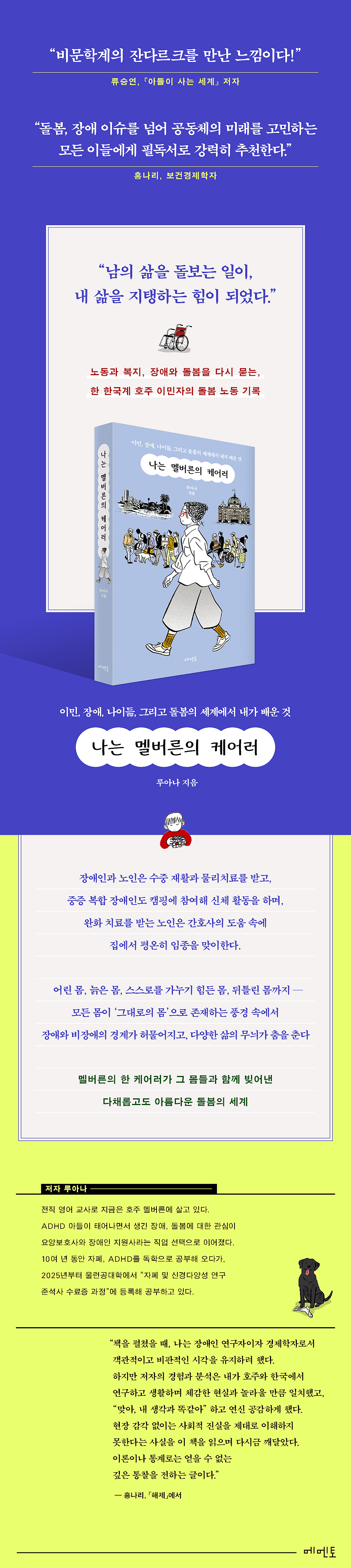
“Above all, it’s fun.
“It feels like I’ve met the Joan of Arc of the non-literary world.”
-Ryu Seung-yeon, author of "The World My Son Lives In"
“We think about the future of the community beyond issues of care and disability.
“I highly recommend this book as a must-read for everyone.”
Hong Na-ri, health economist
"Caring for other people's lives has become the strength that sustains my own."
Re-examining labor and welfare, disability and care,
Care work records of a Korean-Australian immigrant
Young bodies, old bodies, bodies that struggle to control themselves, even twisted bodies,
In a landscape where all bodies exist as ‘their own bodies’
The boundaries between disability and non-disability are collapsing, and diverse patterns of life are dancing.
A colorful and beautiful world of care created with those bodies
Ordinary citizens enjoy swimming freely while people with disabilities and the elderly receive aquatic rehabilitation and physical therapy.
People with severe and complex disabilities can also participate in camping and physical activity, with a 65-page support guide.
Elderly people receiving palliative care pass away peacefully at home with the help of nurses.
The sight of all bodies existing as 'their own bodies' - young bodies, old bodies, bodies that cannot support themselves, bodies with twisted limbs - was an unfamiliar and surprising sight even to an Australian immigrant of 10 years.
The author, who worked as an English teacher for over ten years before taking a break from her career due to pregnancy, childbirth, and childcare, found that the field that was easiest for an immigrant to enter was care work.
He studied hard to become a teacher, saying he wanted to live differently from his parents, but in the end, he became a manual laborer again like his parents.
It started out as a way to supplement my husband's income, but from the moment I decided to become a single mother, care work became a desperate livelihood.
Becoming a competent caregiver was not an option, it was a necessity.
The burden of care was heavy.
But within it, a new meaning blossomed.
Australia's culture of valuing and rewarding hard work financially and psychologically also had a major influence.
Helping a person with dementia bathe, caring for an elderly person who cannot control their body, and watching over their last breath were physically demanding, but each moment brought deep reflection and comfort.
Caring for the lives of others becomes a process of rewriting one's own life and a journey of growth.
So I'm happy to praise the work of a caregiver.
Melbourne's care scene is a microcosm of multiculturalism.
Australia's welfare system would not function without the labour of migrants from India, Nepal, Kenya, the Philippines, China, Sri Lanka, Indonesia, Uzbekistan and Myanmar, aged from their 20s to their 60s.
The author is also a part of that multicultural scene, and an immigrant who endures under the name of a caregiver.
This book is a record of his growth as he has developed his professional skills and expertise while working as a disability support worker and caregiver since 2022.
Moving between the care landscapes of Korea and Australia,
Continued in the name of welfare
Delicately capturing the weight of different lives
This book delicately captures the weight of different lives carried out in the name of welfare, moving between the care landscapes of Korea and Australia.
In the author's childhood memories, care was always the family's responsibility.
My mother, who had been taking care of my grandmother for three years and my father for two years on the floor of a room without a bed, eventually collapsed from a cerebral infarction.
In a time when the word "rehabilitation" was unfamiliar, there was neither the time nor the means to take the patient to the hospital several times a week.
My mother, who had lost the ability to speak and had difficulty moving, passed away in a nursing home.
When I think of a stroke patient who is working hard to rehabilitate at home, receiving physical therapy, speech therapy, and psychological treatment, I feel even more heartbroken for my mother, who once received no help.
I also have experience raising children.
When I complained about the difficulties of raising a child in Korea, I was met with responses like, “I’m a mother who is desperate to brand a perfectly healthy child with a disability.”
After immigrating, my son was diagnosed with ADHD, and when a developmental specialist told me to raise him “with the help of professionals instead of struggling alone,” I finally felt empathy and burst into tears.
In Korea, the burden of care that would be borne by the family is distributed across the state and institutions in Australia.
For the elderly, there is 'My Aged Care', and for the disabled, there is 'National Disability Insurance Scheme (NDIS)'.
These institutions, whose names are unfamiliar, have effectively shifted care from an individual responsibility to a social right.
In a structure where support funds are directly allocated and the necessary services are selected, the subject of care is no longer the family or guardian, but the person concerned.
Of course, inequality still remains in Australian society, and there are those who cannot overcome the system's limitations.
But at least someone's illness or disability doesn't immediately lead to the downfall of the entire family.
The fact that the burden of care is not borne alone makes Australia a different landscape from Korea.
From care for elderly people with dementia and palliative care patients
Covering disability camps, group homes, and daily support for autistic people
Contains a wide range of caregiving experiences
In Australia, the qualifications for both nursing assistant and disability support worker are interchangeable.
The author works in a variety of roles, including as a disability support worker at an agency, a freelance disability support worker, a home visiting caregiver, and a caregiver at a nursing home.
The customer base is diverse, ranging from elementary school students to those in their 60s, and the types of disabilities are also wide, including physical disabilities, developmental disabilities, dementia, eating disorders, Down syndrome, and severe multiple disabilities.
So, I am accumulating experience in a wide range of care, from caring for elderly people with dementia and palliative care patients to disability camps, group homes, and daily support for people with autism.
What is particularly noteworthy is the experience of supporting neurodiverse people, including those with autism and ADHD.
The author views neurodevelopmental conditions such as autism, ADHD, Tourette syndrome, and dyslexia as individual differences rather than pathological symptoms or defects, and calls these people neurodiverse.
He has been self-educating himself about autism and ADHD for over 10 years while raising his ADHD son.
Going through the arduous process of trying to understand my son gave me a new perspective on the world of neurodivergent people.
Now, we are expanding our activities to help children who were excluded from care and services because they were 'unseen' to be diagnosed and further to advocate for their right to education.
Care for the elderly and severely disabled has long been recognized as a 'necessary task'.
However, care for neurodiverse people is still shrouded in prejudice and stigma.
Although they are labeled as 'strange', 'sensitive', 'eccentric', 'insensitive', and 'unsocial', they too need care and support to survive in their daily lives.
The author argues that only when social understanding and culture of disability and diversity are widespread can these children be identified earlier and offered timely assistance.
Includes six interviews that capture the multifaceted voices of caregivers.
This book contains the voices of six people who live through care work and the welfare system: a retired caregiver, a new support worker just entering the field, a nurse with decades of experience, a practitioner in the field of disability welfare, and a parent raising a child with disabilities.
Their testimonies are not mere appendices; they complement the author's experiences and illuminate the field of care in a more three-dimensional way.
Retired caregiver C was humble and reserved, saying, “Why are you interviewing for something like this?” but the meaning of the labor he has accumulated throughout his life is fully reflected in his narrative.
J, a Korean immigrant who has worked as a nurse for over 20 years, provides an in-depth explanation of Australia's care system, from caregiving culture and the National Disability Insurance Scheme (NDIS) to voluntary assisted dying. A, an NDIS support coordinator, and M, an immigrant who raises a child with a disability and receives welfare benefits, reveal the specifics of daily life within the disability welfare system.
As their experiences are added, the book's narrative expands beyond individual experience to become a testimony of a community.
This leads care work to become a subject of social reflection rather than a matter of personal dedication, and clearly shows that the author's experience is not simply a personal record but rather intersects with issues of institutions and social structure.
“It feels like I’ve met the Joan of Arc of the non-literary world.”
-Ryu Seung-yeon, author of "The World My Son Lives In"
“We think about the future of the community beyond issues of care and disability.
“I highly recommend this book as a must-read for everyone.”
Hong Na-ri, health economist
"Caring for other people's lives has become the strength that sustains my own."
Re-examining labor and welfare, disability and care,
Care work records of a Korean-Australian immigrant
Young bodies, old bodies, bodies that struggle to control themselves, even twisted bodies,
In a landscape where all bodies exist as ‘their own bodies’
The boundaries between disability and non-disability are collapsing, and diverse patterns of life are dancing.
A colorful and beautiful world of care created with those bodies
Ordinary citizens enjoy swimming freely while people with disabilities and the elderly receive aquatic rehabilitation and physical therapy.
People with severe and complex disabilities can also participate in camping and physical activity, with a 65-page support guide.
Elderly people receiving palliative care pass away peacefully at home with the help of nurses.
The sight of all bodies existing as 'their own bodies' - young bodies, old bodies, bodies that cannot support themselves, bodies with twisted limbs - was an unfamiliar and surprising sight even to an Australian immigrant of 10 years.
The author, who worked as an English teacher for over ten years before taking a break from her career due to pregnancy, childbirth, and childcare, found that the field that was easiest for an immigrant to enter was care work.
He studied hard to become a teacher, saying he wanted to live differently from his parents, but in the end, he became a manual laborer again like his parents.
It started out as a way to supplement my husband's income, but from the moment I decided to become a single mother, care work became a desperate livelihood.
Becoming a competent caregiver was not an option, it was a necessity.
The burden of care was heavy.
But within it, a new meaning blossomed.
Australia's culture of valuing and rewarding hard work financially and psychologically also had a major influence.
Helping a person with dementia bathe, caring for an elderly person who cannot control their body, and watching over their last breath were physically demanding, but each moment brought deep reflection and comfort.
Caring for the lives of others becomes a process of rewriting one's own life and a journey of growth.
So I'm happy to praise the work of a caregiver.
Melbourne's care scene is a microcosm of multiculturalism.
Australia's welfare system would not function without the labour of migrants from India, Nepal, Kenya, the Philippines, China, Sri Lanka, Indonesia, Uzbekistan and Myanmar, aged from their 20s to their 60s.
The author is also a part of that multicultural scene, and an immigrant who endures under the name of a caregiver.
This book is a record of his growth as he has developed his professional skills and expertise while working as a disability support worker and caregiver since 2022.
Moving between the care landscapes of Korea and Australia,
Continued in the name of welfare
Delicately capturing the weight of different lives
This book delicately captures the weight of different lives carried out in the name of welfare, moving between the care landscapes of Korea and Australia.
In the author's childhood memories, care was always the family's responsibility.
My mother, who had been taking care of my grandmother for three years and my father for two years on the floor of a room without a bed, eventually collapsed from a cerebral infarction.
In a time when the word "rehabilitation" was unfamiliar, there was neither the time nor the means to take the patient to the hospital several times a week.
My mother, who had lost the ability to speak and had difficulty moving, passed away in a nursing home.
When I think of a stroke patient who is working hard to rehabilitate at home, receiving physical therapy, speech therapy, and psychological treatment, I feel even more heartbroken for my mother, who once received no help.
I also have experience raising children.
When I complained about the difficulties of raising a child in Korea, I was met with responses like, “I’m a mother who is desperate to brand a perfectly healthy child with a disability.”
After immigrating, my son was diagnosed with ADHD, and when a developmental specialist told me to raise him “with the help of professionals instead of struggling alone,” I finally felt empathy and burst into tears.
In Korea, the burden of care that would be borne by the family is distributed across the state and institutions in Australia.
For the elderly, there is 'My Aged Care', and for the disabled, there is 'National Disability Insurance Scheme (NDIS)'.
These institutions, whose names are unfamiliar, have effectively shifted care from an individual responsibility to a social right.
In a structure where support funds are directly allocated and the necessary services are selected, the subject of care is no longer the family or guardian, but the person concerned.
Of course, inequality still remains in Australian society, and there are those who cannot overcome the system's limitations.
But at least someone's illness or disability doesn't immediately lead to the downfall of the entire family.
The fact that the burden of care is not borne alone makes Australia a different landscape from Korea.
From care for elderly people with dementia and palliative care patients
Covering disability camps, group homes, and daily support for autistic people
Contains a wide range of caregiving experiences
In Australia, the qualifications for both nursing assistant and disability support worker are interchangeable.
The author works in a variety of roles, including as a disability support worker at an agency, a freelance disability support worker, a home visiting caregiver, and a caregiver at a nursing home.
The customer base is diverse, ranging from elementary school students to those in their 60s, and the types of disabilities are also wide, including physical disabilities, developmental disabilities, dementia, eating disorders, Down syndrome, and severe multiple disabilities.
So, I am accumulating experience in a wide range of care, from caring for elderly people with dementia and palliative care patients to disability camps, group homes, and daily support for people with autism.
What is particularly noteworthy is the experience of supporting neurodiverse people, including those with autism and ADHD.
The author views neurodevelopmental conditions such as autism, ADHD, Tourette syndrome, and dyslexia as individual differences rather than pathological symptoms or defects, and calls these people neurodiverse.
He has been self-educating himself about autism and ADHD for over 10 years while raising his ADHD son.
Going through the arduous process of trying to understand my son gave me a new perspective on the world of neurodivergent people.
Now, we are expanding our activities to help children who were excluded from care and services because they were 'unseen' to be diagnosed and further to advocate for their right to education.
Care for the elderly and severely disabled has long been recognized as a 'necessary task'.
However, care for neurodiverse people is still shrouded in prejudice and stigma.
Although they are labeled as 'strange', 'sensitive', 'eccentric', 'insensitive', and 'unsocial', they too need care and support to survive in their daily lives.
The author argues that only when social understanding and culture of disability and diversity are widespread can these children be identified earlier and offered timely assistance.
Includes six interviews that capture the multifaceted voices of caregivers.
This book contains the voices of six people who live through care work and the welfare system: a retired caregiver, a new support worker just entering the field, a nurse with decades of experience, a practitioner in the field of disability welfare, and a parent raising a child with disabilities.
Their testimonies are not mere appendices; they complement the author's experiences and illuminate the field of care in a more three-dimensional way.
Retired caregiver C was humble and reserved, saying, “Why are you interviewing for something like this?” but the meaning of the labor he has accumulated throughout his life is fully reflected in his narrative.
J, a Korean immigrant who has worked as a nurse for over 20 years, provides an in-depth explanation of Australia's care system, from caregiving culture and the National Disability Insurance Scheme (NDIS) to voluntary assisted dying. A, an NDIS support coordinator, and M, an immigrant who raises a child with a disability and receives welfare benefits, reveal the specifics of daily life within the disability welfare system.
As their experiences are added, the book's narrative expands beyond individual experience to become a testimony of a community.
This leads care work to become a subject of social reflection rather than a matter of personal dedication, and clearly shows that the author's experience is not simply a personal record but rather intersects with issues of institutions and social structure.
GOODS SPECIFICS
- Date of issue: September 15, 2025
- Page count, weight, size: 320 pages | 382g | 128*200*20mm
- ISBN13: 9791192099514
- ISBN10: 1192099516
You may also like
카테고리
korean


korean

![GQ KOREA Mark (Monthly): December [2025]](http://librairie.coreenne.fr/cdn/shop/files/8ef265dbbfbf186523ed75ba7319009d.jpg?v=1765340328&width=3840)


