

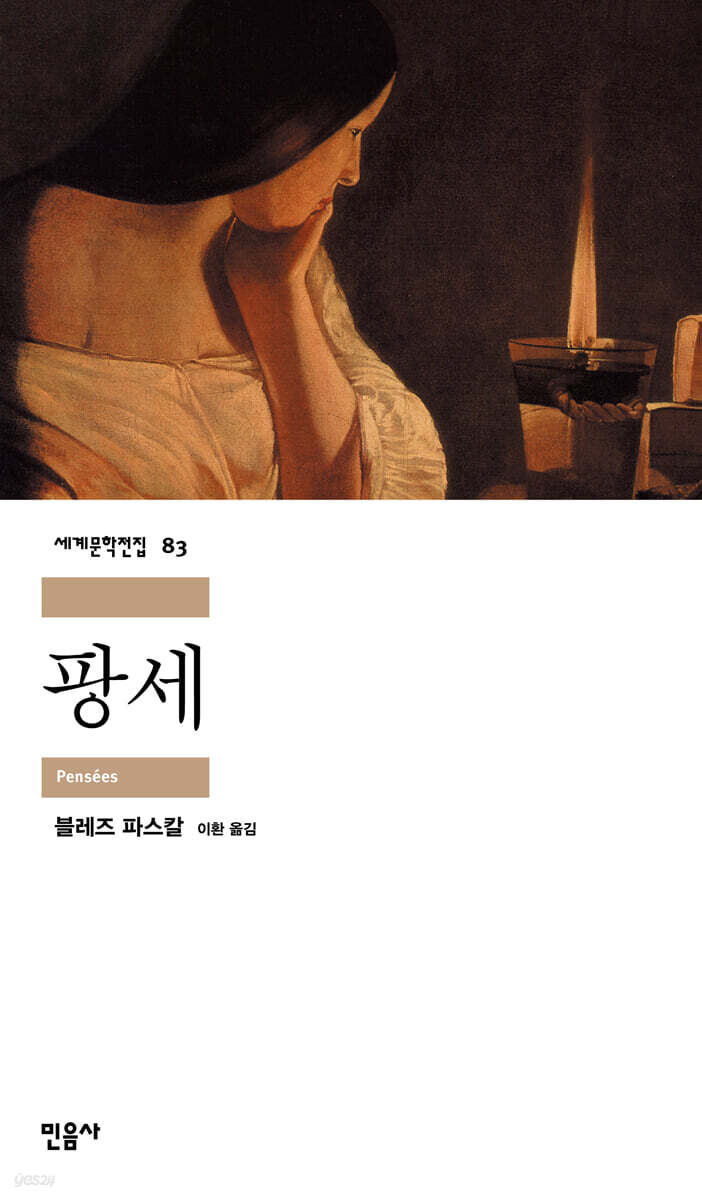
Pensees
 |
Description
Book Introduction
Pascal, the philosopher who recognized the lonely existence of human beings
A pioneering work of existentialism that inspired Baudelaire, Nietzsche, and Zola
“Man is but a reed, the most fragile thing in nature.
But he is a thinking reed.”
Pascal's Pensees was published in a translation by Lee Hwan (Professor Emeritus of French Literature, Seoul National University), a senior French literature scholar.
Lee Hwan is the first generation of Korean French literature researchers after liberation and an authority on Pascal studies.
Lee Hwan had already translated Pensees (Jeilmunhwasa) in 1964 and published several books and translations on Pascal's thought and Pensees.
『Pensees』, published in this collection of world literature, is the completion of a lifetime's work and will be a valuable work in the history of Korean French literature studies.
A pioneering work of existentialism that inspired Baudelaire, Nietzsche, and Zola
“Man is but a reed, the most fragile thing in nature.
But he is a thinking reed.”
Pascal's Pensees was published in a translation by Lee Hwan (Professor Emeritus of French Literature, Seoul National University), a senior French literature scholar.
Lee Hwan is the first generation of Korean French literature researchers after liberation and an authority on Pascal studies.
Lee Hwan had already translated Pensees (Jeilmunhwasa) in 1964 and published several books and translations on Pascal's thought and Pensees.
『Pensees』, published in this collection of world literature, is the completion of a lifetime's work and will be a valuable work in the history of Korean French literature studies.
- You can preview some of the book's contents.
Preview
Publisher's Review
A great testimony to human existence
Three and a half centuries have passed since Pascal's death.
During this time, few classics were as widely read as his Pensees.
However, there are few thinkers who have been as misunderstood and misinterpreted as Pascal.
One of the main reasons for this lies in the inevitable incompleteness of the text.
This is because he was unable to complete the "Christian Apology" he had conceived long ago, leaving behind only about 900 fragments.
Thus, from the time when the Pensées were first published after Pascal's death (1670), it was bound to be extremely incomplete and distorted, far removed from the original text due to various factors, and this form has been maintained without significant changes for nearly two centuries.
Moreover, amidst the persecution of the Jansenist movement to which he belonged and the subsequent cold reception of the 18th-century Enlightenment, Pascal was often only recalled as an object of criticism and ridicule.
However, by the mid-19th century, interest in him had begun to grow, and this interest led to a systematic study of the text of Pensees.
In the 20th century, several remarkable studies led to a complete renewal of our understanding of Pascal's texts and thought.
Today, we can at least say that we have access to Pascal's text in the state it was left behind when he died, and that we have the possibility of discovering his true self within it.
The original version of 『Pensees』 translated this time is L.
As a new edition of Lafuma, it is based on the results of recent philological research, so we can get one step closer to Pascal's true intention.
What is the human form described by Pascal?
It is summarized as 'the misery of man without God'.
This misery appears to him in a very original and clear form.
That is, human powerlessness, or rather, the powerlessness that arises from the contradiction between desire and reality.
Man, who encounters error in the truth he seeks, misery in the happiness he seeks, caprice in the justice he seeks, and the finite in the infinite, is a being of eternal dramatic division.
However, this depiction of tragedy is not an end in itself, but rather is intended to arouse the will to overcome this tragedy.
―From the translator’s note
Pascal's life
He was born on June 19, 1623, in Clermont-Ferrand, Auvergne, France, to his father, Étienne Pascal, a high commissioner of taxes, and his mother, Antoinette Begon.
He lost his mother when he was 3, and his family moved to Paris when he was 8.
When his father witnessed his 12-year-old son Pascal solve Euclid's 32 propositions, he was greatly surprised and began teaching him mathematics and geometry.
From the age of 14, he attended the Mersenne Academy, a gathering of scientists of the time.
In 1940, at the age of 17, he published “Conic Sections” and spent two years creating a calculator.
At the age of 24, he conducted an experiment on 'vacuum' and published the results in 'New Experiments on Vacuum'.
This led to a series of debates with Descartes and Father Noel.
He achieved outstanding research results in natural science, mathematics, and geometry until 1654.
Pascal went through a series of experiences, including his first conversion (1646), the death of his father Etienne (1651), his social life (1651–1654), and his second conversion (1654), and thereafter devoted himself to exploring the principles of Christianity and contemplating humanity and God.
In 1655, while staying at Port-Royal-des-Champs, he engaged in conversations on philosophy and religion with de Sacy.
It is believed that he wrote 『A Brief Life of Christ』 and 『The Geometrical Mind』 at this time.
From 1656, as the Jesuits' criticism of the Jansenists intensified, he took the lead in defending the Jansenists through his work, "Letter to a Provincial" (also known as "Provincial").
From 1658 onwards, he began to plan to write a 'Christian Apology' to counter those who opposed Christianity.
His health deteriorated significantly from 1659, and he died on August 19, 1662, at the age of 39, from a chronic illness.
In 1670, Pascal's posthumous publication was successful, and Pascal's Thoughts on Religion and Other Subjects (the first edition of Pensées) was published, with a preface by his nephew, Étienne Ferrier.
Three and a half centuries have passed since Pascal's death.
During this time, few classics were as widely read as his Pensees.
However, there are few thinkers who have been as misunderstood and misinterpreted as Pascal.
One of the main reasons for this lies in the inevitable incompleteness of the text.
This is because he was unable to complete the "Christian Apology" he had conceived long ago, leaving behind only about 900 fragments.
Thus, from the time when the Pensées were first published after Pascal's death (1670), it was bound to be extremely incomplete and distorted, far removed from the original text due to various factors, and this form has been maintained without significant changes for nearly two centuries.
Moreover, amidst the persecution of the Jansenist movement to which he belonged and the subsequent cold reception of the 18th-century Enlightenment, Pascal was often only recalled as an object of criticism and ridicule.
However, by the mid-19th century, interest in him had begun to grow, and this interest led to a systematic study of the text of Pensees.
In the 20th century, several remarkable studies led to a complete renewal of our understanding of Pascal's texts and thought.
Today, we can at least say that we have access to Pascal's text in the state it was left behind when he died, and that we have the possibility of discovering his true self within it.
The original version of 『Pensees』 translated this time is L.
As a new edition of Lafuma, it is based on the results of recent philological research, so we can get one step closer to Pascal's true intention.
What is the human form described by Pascal?
It is summarized as 'the misery of man without God'.
This misery appears to him in a very original and clear form.
That is, human powerlessness, or rather, the powerlessness that arises from the contradiction between desire and reality.
Man, who encounters error in the truth he seeks, misery in the happiness he seeks, caprice in the justice he seeks, and the finite in the infinite, is a being of eternal dramatic division.
However, this depiction of tragedy is not an end in itself, but rather is intended to arouse the will to overcome this tragedy.
―From the translator’s note
Pascal's life
He was born on June 19, 1623, in Clermont-Ferrand, Auvergne, France, to his father, Étienne Pascal, a high commissioner of taxes, and his mother, Antoinette Begon.
He lost his mother when he was 3, and his family moved to Paris when he was 8.
When his father witnessed his 12-year-old son Pascal solve Euclid's 32 propositions, he was greatly surprised and began teaching him mathematics and geometry.
From the age of 14, he attended the Mersenne Academy, a gathering of scientists of the time.
In 1940, at the age of 17, he published “Conic Sections” and spent two years creating a calculator.
At the age of 24, he conducted an experiment on 'vacuum' and published the results in 'New Experiments on Vacuum'.
This led to a series of debates with Descartes and Father Noel.
He achieved outstanding research results in natural science, mathematics, and geometry until 1654.
Pascal went through a series of experiences, including his first conversion (1646), the death of his father Etienne (1651), his social life (1651–1654), and his second conversion (1654), and thereafter devoted himself to exploring the principles of Christianity and contemplating humanity and God.
In 1655, while staying at Port-Royal-des-Champs, he engaged in conversations on philosophy and religion with de Sacy.
It is believed that he wrote 『A Brief Life of Christ』 and 『The Geometrical Mind』 at this time.
From 1656, as the Jesuits' criticism of the Jansenists intensified, he took the lead in defending the Jansenists through his work, "Letter to a Provincial" (also known as "Provincial").
From 1658 onwards, he began to plan to write a 'Christian Apology' to counter those who opposed Christianity.
His health deteriorated significantly from 1659, and he died on August 19, 1662, at the age of 39, from a chronic illness.
In 1670, Pascal's posthumous publication was successful, and Pascal's Thoughts on Religion and Other Subjects (the first edition of Pensées) was published, with a preface by his nephew, Étienne Ferrier.
GOODS SPECIFICS
- Date of issue: August 25, 2003
- Page count, weight, size: 572 pages | 746g | 132*224*35mm
- ISBN13: 9788937460838
- ISBN10: 8937460831
You may also like
카테고리
korean


korean

![GQ KOREA Mark (Monthly): December [2025]](http://librairie.coreenne.fr/cdn/shop/files/8ef265dbbfbf186523ed75ba7319009d.jpg?v=1765340328&width=3840)


