

Faust
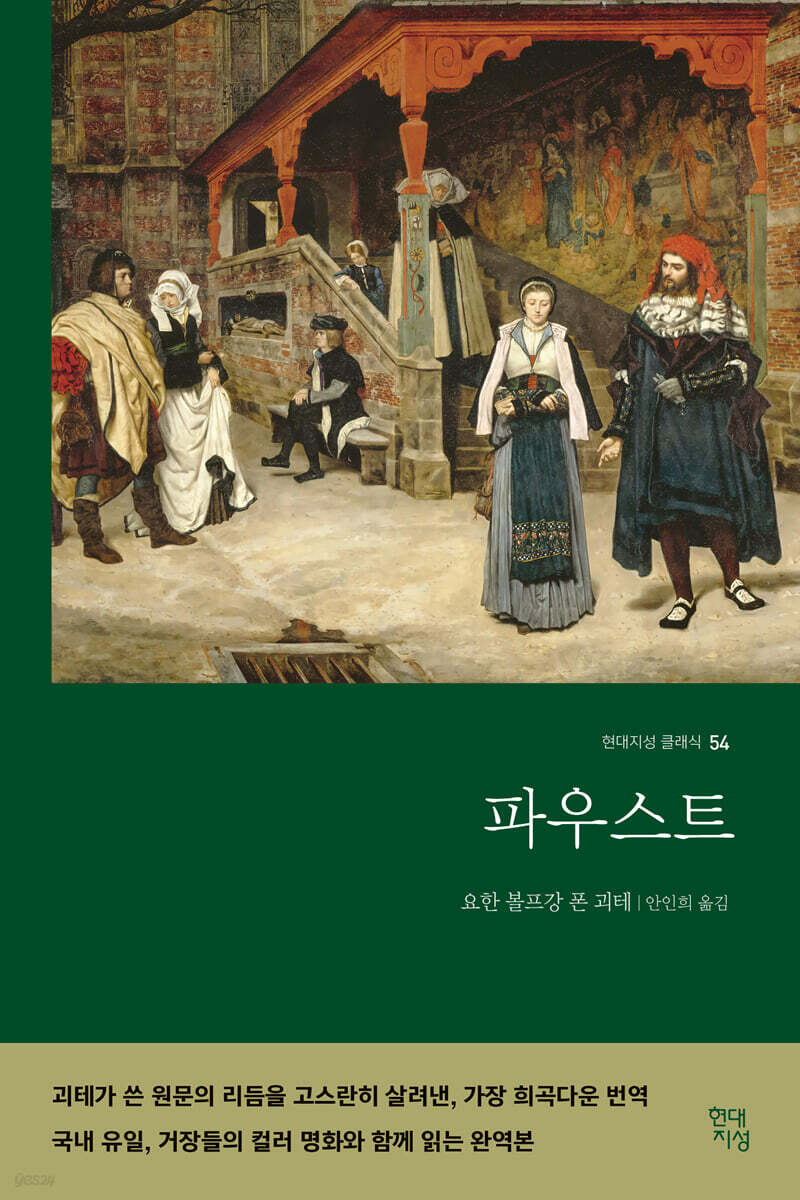 |
Description
Book Introduction
The most dramatic translation that preserves the rhythm of Goethe's original text.
The only complete translation in Korea, read with color masterpieces by masters.
*Nietzsche, Einstein, Jung, Emerson, Kafka… An immortal work praised by the masters of world history.
*Recommended books by Harvard and Seoul National University, one of the 100 best books selected by the Nobel Institute, and one of the SAT recommended books by the College Board of America
“Faust, an old scholar who was well-versed in all fields of knowledge and even learned magic, but felt the limits of his abilities and fell into despair.
In front of him, a demon named Mephistopheles appears and makes a tempting offer.
Faust, who fell for temptation, bets his soul with the devil and then indulges his desires to his heart's content… .”
"Faust" is a masterpiece that Goethe began writing in his early twenties, added to, and revised for over 60 years, and completed just before his death at the age of 83.
He weaved together stories inspired by legends, the Bible, Greek and Roman mythology, folk tales, and philosophical thought, and, using a vibrant vocabulary and diverse literary forms from all walks of life, created a magnificent drama of human history spanning 12,111 lines.
The character Faust does not simply pursue his desires, but struggles to overcome his limitations and fully realize his potential.
On the other hand, Mephistopheles constantly denies morality, ideals, and the value of life.
It is like two voices whispering in the human mind.
In this way, the protagonists of medieval Europe vividly expose human nature and the archetype of life, and pose unfamiliar and uncomfortable questions to us living today about the meaning of existence, the limits of humanity, and the concepts of good and evil.
On the one hand, it encourages us to not lose hope and to move forward toward our goals even in a life full of contradictions.
"Faust" is a play written in verse.
This work, which requires careful consideration of rhythm and rhythm to be fully immersed, is presented in the "most play-like translation" by Ahn In-hee, a leading German-speaking translator and humanist.
Readers will find themselves drawn to the rhythm of the sentences, and the dialogue will resonate with their ears and excite their hearts.
We've added helpful footnotes to every important word and phrase, and added a synopsis at the end of the introduction to help you grasp the vast content at a glance.
The masters' color masterpieces, each a work of art, stimulate the senses and imagination, allowing us to understand the work in three dimensions, as if watching a play.
The only complete translation in Korea, read with color masterpieces by masters.
*Nietzsche, Einstein, Jung, Emerson, Kafka… An immortal work praised by the masters of world history.
*Recommended books by Harvard and Seoul National University, one of the 100 best books selected by the Nobel Institute, and one of the SAT recommended books by the College Board of America
“Faust, an old scholar who was well-versed in all fields of knowledge and even learned magic, but felt the limits of his abilities and fell into despair.
In front of him, a demon named Mephistopheles appears and makes a tempting offer.
Faust, who fell for temptation, bets his soul with the devil and then indulges his desires to his heart's content… .”
"Faust" is a masterpiece that Goethe began writing in his early twenties, added to, and revised for over 60 years, and completed just before his death at the age of 83.
He weaved together stories inspired by legends, the Bible, Greek and Roman mythology, folk tales, and philosophical thought, and, using a vibrant vocabulary and diverse literary forms from all walks of life, created a magnificent drama of human history spanning 12,111 lines.
The character Faust does not simply pursue his desires, but struggles to overcome his limitations and fully realize his potential.
On the other hand, Mephistopheles constantly denies morality, ideals, and the value of life.
It is like two voices whispering in the human mind.
In this way, the protagonists of medieval Europe vividly expose human nature and the archetype of life, and pose unfamiliar and uncomfortable questions to us living today about the meaning of existence, the limits of humanity, and the concepts of good and evil.
On the one hand, it encourages us to not lose hope and to move forward toward our goals even in a life full of contradictions.
"Faust" is a play written in verse.
This work, which requires careful consideration of rhythm and rhythm to be fully immersed, is presented in the "most play-like translation" by Ahn In-hee, a leading German-speaking translator and humanist.
Readers will find themselves drawn to the rhythm of the sentences, and the dialogue will resonate with their ears and excite their hearts.
We've added helpful footnotes to every important word and phrase, and added a synopsis at the end of the introduction to help you grasp the vast content at a glance.
The masters' color masterpieces, each a work of art, stimulate the senses and imagination, allowing us to understand the work in three dimensions, as if watching a play.
- You can preview some of the book's contents.
Preview
index
tribute
Overture to the Stage
Heavenly Prelude
Tragedy, Part 1
night
In front of the city gate
Study (1)
Study (2)
Auerbach Bar in Leipzig
Witch's Kitchen
Street (1)
dinner
walk
The neighbor's house
Street (2)
garden
pavilion in the garden
Forests and caves
Gretchen's Room 195
Marthe's Garden 199
At the Well 206
Passage between the walls 210
Night 213
Cathedral 221
Walpurgis Night 225
Walpurgis Night Dream 246
Cloudy Day 255
Night, wide open field 258
Prison 259
Tragedy, Part 2 (5 Acts)
Act 1
pleasant area
Emperor's Palace
-Hall with throne
- A spacious hall with side rooms
-amusement park
-Dark corridor
-Brightly lit halls
-Hall of Knights
Act 2
A cramped Gothic room with high arches
laboratory
Classic Walpurgis Night
-Plains of Pharsalus
-Peneus
-Upper reaches of the Peneus River
-In the rocky bends of the Aegean Sea
-Telkines primitive race of Rhodes
Act 3
In front of the palace of Menelaus in Sparta
Castle courtyard
A small, shaded forest [Arcadia]
Act 4
mountaintop [alpine region]
In the hilly area
The tent of the opposing emperor
Act 5
Twin area
palace
- Wide ornamental gardens, straight Grand Canal
-Deep night
-Midnight
-The palace's spacious front yard
-burial
In the valley of the mountain
Release | Ahn In-hee
Goethe's chronology
Overture to the Stage
Heavenly Prelude
Tragedy, Part 1
night
In front of the city gate
Study (1)
Study (2)
Auerbach Bar in Leipzig
Witch's Kitchen
Street (1)
dinner
walk
The neighbor's house
Street (2)
garden
pavilion in the garden
Forests and caves
Gretchen's Room 195
Marthe's Garden 199
At the Well 206
Passage between the walls 210
Night 213
Cathedral 221
Walpurgis Night 225
Walpurgis Night Dream 246
Cloudy Day 255
Night, wide open field 258
Prison 259
Tragedy, Part 2 (5 Acts)
Act 1
pleasant area
Emperor's Palace
-Hall with throne
- A spacious hall with side rooms
-amusement park
-Dark corridor
-Brightly lit halls
-Hall of Knights
Act 2
A cramped Gothic room with high arches
laboratory
Classic Walpurgis Night
-Plains of Pharsalus
-Peneus
-Upper reaches of the Peneus River
-In the rocky bends of the Aegean Sea
-Telkines primitive race of Rhodes
Act 3
In front of the palace of Menelaus in Sparta
Castle courtyard
A small, shaded forest [Arcadia]
Act 4
mountaintop [alpine region]
In the hilly area
The tent of the opposing emperor
Act 5
Twin area
palace
- Wide ornamental gardens, straight Grand Canal
-Deep night
-Midnight
-The palace's spacious front yard
-burial
In the valley of the mountain
Release | Ahn In-hee
Goethe's chronology
Detailed image
.jpg)
Into the book
* In the excerpt below, characters and lines are separated by colons (:), and the line numbers have also been removed.
Please check the actual appearance of the text in “Preview”.
Mephistopheles:
What can you do? The Lord will lose him.
I gently lure him and guide him on my path.
If you allow me!
Lord:
As long as he stays on earth
Nothing is forbidden to you.
As long as humans try, they are bound to wander.
Mephistopheles:
If so, thank you.
I am with the dead
Because I don't really enjoy interacting with others.
--- p.29, from "Heavenly Prelude"
Faust:
Ah! I also study philosophy,
Law and medical students,
And unfortunately, even theology
I studied everything with all my might.
But still, poor fool!
He's really smart, then and now.
They are called masters, even doctors.
It's already been 10 years
Up and down, horizontally or in a curved path
Are you pulling my students' noses?
Even so, we see that we can't know anything!
--- p.34, from “Part 1 | Night”
Faust:
I said to the moment, “Stop!
If you say, “You are so beautiful!”
You can chain me up.
I will gladly fall!
Then the death bell rings
You are freed from slavery.
The clock stops and the hands fall.
My time has passed!
Mephistopheles:
Think about it carefully.
We don't forget those words.
--- p.100, from “Part 1 | Study (2)”
Faust:
If your heart is full of it, if it is so great,
And if you are happy in that feeling,
Call me whatever you want.
Happiness! Heart! Love! God!
I call it that
I don't have it! It's all about the feeling.
A name is a sound and a smoke,
The brilliance of the sky shrouded in fog.
--- p.201, from “Part 1 | Marthe’s Garden”
Faust:
I don't seek my healing in hardening.
Thrills are the best part of being human.
No matter how much the world ennobles human emotions,
Because humans only feel the horror after being shocked.
--- p.352, from “Part 2 | Act 1, The Emperor’s Palace”
Faust:
I want to see a bustling scene like this,
I want to stand with free people in a free land!
I think I can say this to the moment.
“Stop, you are so beautiful!
Traces of my time on earth
“You can’t fall in eternity.”?
In this high anticipation of happiness
I am enjoying the best moment right now.
(He falls backwards and the Lemures catch him and throw him to the ground.)
Mephistopheles:
No pleasure was satisfying him, and no fortune was enough for him.
So, I kept wanting to get a different look,
The last moments, painful and empty,
That poor thing wants to hold onto it.
--- p.620~621, from 「Part 2 | Act 5, The Palace」
According to Aristotle, every organism seeks to fully unfold its inner purpose, its entelecheia.
(…) He [Faust] is a man with ‘two souls’ inside him.
The impulse to pursue high and noble realms and intellect, and the impulse to turn towards the world and life.
(…) So what does Faust pursue? What does he desire, even after making a pact with the devil? Is it the ordinary desires of life, which the devil both stimulates and easily fulfills: lust, gold, power, and fame? Of course not.
Faust wants to fully unfold all his possibilities according to entelecheia.
That is, he is trying to unfold both of his 'two souls'.
The knowledge and scholarship that can be acquired through books and experiments has already been achieved to a considerable extent through lifelong effort.
But I want to use that knowledge to explore all aspects of life, from the deepest pain to the highest fulfillment, in both the small and the large worlds, and I haven't even begun to do that.
The path he is taking is not to enjoy all the pleasures life has to offer.
So his voluntary terms of contract appear.
No matter how enjoyable and beautiful it may be, if you feel like settling for that moment, that's the end of it.
Honestly, “Moment, stop.
If you ever feel like saying, “You are so beautiful!” then your path ends there.
Please check the actual appearance of the text in “Preview”.
Mephistopheles:
What can you do? The Lord will lose him.
I gently lure him and guide him on my path.
If you allow me!
Lord:
As long as he stays on earth
Nothing is forbidden to you.
As long as humans try, they are bound to wander.
Mephistopheles:
If so, thank you.
I am with the dead
Because I don't really enjoy interacting with others.
--- p.29, from "Heavenly Prelude"
Faust:
Ah! I also study philosophy,
Law and medical students,
And unfortunately, even theology
I studied everything with all my might.
But still, poor fool!
He's really smart, then and now.
They are called masters, even doctors.
It's already been 10 years
Up and down, horizontally or in a curved path
Are you pulling my students' noses?
Even so, we see that we can't know anything!
--- p.34, from “Part 1 | Night”
Faust:
I said to the moment, “Stop!
If you say, “You are so beautiful!”
You can chain me up.
I will gladly fall!
Then the death bell rings
You are freed from slavery.
The clock stops and the hands fall.
My time has passed!
Mephistopheles:
Think about it carefully.
We don't forget those words.
--- p.100, from “Part 1 | Study (2)”
Faust:
If your heart is full of it, if it is so great,
And if you are happy in that feeling,
Call me whatever you want.
Happiness! Heart! Love! God!
I call it that
I don't have it! It's all about the feeling.
A name is a sound and a smoke,
The brilliance of the sky shrouded in fog.
--- p.201, from “Part 1 | Marthe’s Garden”
Faust:
I don't seek my healing in hardening.
Thrills are the best part of being human.
No matter how much the world ennobles human emotions,
Because humans only feel the horror after being shocked.
--- p.352, from “Part 2 | Act 1, The Emperor’s Palace”
Faust:
I want to see a bustling scene like this,
I want to stand with free people in a free land!
I think I can say this to the moment.
“Stop, you are so beautiful!
Traces of my time on earth
“You can’t fall in eternity.”?
In this high anticipation of happiness
I am enjoying the best moment right now.
(He falls backwards and the Lemures catch him and throw him to the ground.)
Mephistopheles:
No pleasure was satisfying him, and no fortune was enough for him.
So, I kept wanting to get a different look,
The last moments, painful and empty,
That poor thing wants to hold onto it.
--- p.620~621, from 「Part 2 | Act 5, The Palace」
According to Aristotle, every organism seeks to fully unfold its inner purpose, its entelecheia.
(…) He [Faust] is a man with ‘two souls’ inside him.
The impulse to pursue high and noble realms and intellect, and the impulse to turn towards the world and life.
(…) So what does Faust pursue? What does he desire, even after making a pact with the devil? Is it the ordinary desires of life, which the devil both stimulates and easily fulfills: lust, gold, power, and fame? Of course not.
Faust wants to fully unfold all his possibilities according to entelecheia.
That is, he is trying to unfold both of his 'two souls'.
The knowledge and scholarship that can be acquired through books and experiments has already been achieved to a considerable extent through lifelong effort.
But I want to use that knowledge to explore all aspects of life, from the deepest pain to the highest fulfillment, in both the small and the large worlds, and I haven't even begun to do that.
The path he is taking is not to enjoy all the pleasures life has to offer.
So his voluntary terms of contract appear.
No matter how enjoyable and beautiful it may be, if you feel like settling for that moment, that's the end of it.
Honestly, “Moment, stop.
If you ever feel like saying, “You are so beautiful!” then your path ends there.
--- p.654~656, from 「Announcement」
Publisher's Review
"Faust" is not a novel, it's a play!
A complete translation that preserves the original's identity and rhythm.
Faust, the book that Germans hold second only to the Bible in importance and pride, the essence of German classical literature and a representative book of Western modern literature, is a cultural heritage considered one of the greatest works in the history of world literature.
Goethe began writing this masterpiece, which consists of 12,111 lines, in his early twenties, and continued adding and revising it for over 60 years before completing it just before he passed away at the age of 83.
He created a drama that will remain in human history by incorporating a vivid vocabulary used by people from all walks of life into a literary style that transcends ancient and modern times, and by incorporating Greek and Roman mythology, folk tales, and philosophical ideas.
This work contains fundamental reflections on the ideological background of the period of transition from medieval feudal society to modern civil society, namely, human-centrism and blind developmentalism.
In Korea, during the Japanese colonial period, numerous translated versions were published after Choi Seung-man (pen name Geuk-woong), a Japanese student studying abroad, first translated a passage and introduced it in the magazine 『Hyundae』 in 1920.
Each translation has its own direction, and this diversity has enriched our literary world.
So, what are the characteristics of the newly translated modern intellectual classic, Faust?
Inhee Ahn, a humanist and leading translator in the German-speaking world, focused on the identity and rhythm of the original work.
The genre of ‘Faust’ is verse drama.
That is, it is poetry, not prose, and a play, not a novel.
Accordingly, rather than simply translating poetic expressions into plain prose for easy understanding, the most appropriate Korean words were arranged rhythmically to convey the meaning implied in the original text and to ensure that the rhythm and lingering feeling were felt intact.
In particular, the characters' personalities, psychology, and relationships with each other were realistically depicted by utilizing everyday language, formal language, pretentious academic expressions, and even vulgar language.
For example, when they first meet, Mephistopheles seems to treat Faust as his master by calling him “my lord,” but at some point he subtly switches to using the word “du” (translated as “you”), a word used between friends.
Even after that, he uses a mixture of formal and informal speech, and sometimes even sarcastically, showing that the two are close friends.
Readers who have been accustomed to texts that have set the relationship between the two as superior and inferior and have unified titles will be able to break free from stereotypes and look at the work from various angles.
“As long as humans try, they are bound to wander!”
Even in a life full of contradictions, do not be frustrated
A classic that empowers you to move forward on the path to true self-realization.
If a devil approached you with the promise of granting you whatever you wanted, how many people would immediately reject his offer? But, as the translator notes, such luck(?) doesn't come to everyone.
Only when a soul lives fiercely to realize its full potential will the devil begin to pay attention.
The protagonist Faust was exactly that kind of person.
He was a great scholar who was well-versed in all the learning of his time and even mastered magic, but he became frustrated when he realized that human abilities were limited.
Mephistopheles appears to him and makes him a tempting offer.
Instead of helping you fulfill your desires on this earth, I will take your soul the moment you feel satisfied.
Faust immediately signs the contract and leaves the study, which he had considered a prison, and goes out into the world.
He, who has become younger through magical powers, begins to experience all kinds of pleasures, starting with falling in love with the beautiful girl Margarete.
He travels the world of myth, marries Helen, the most beautiful woman of ancient times, becomes a war hero, and later becomes a lord who rules over a region.
But he is not satisfied with that and strives to acquire more.
In this way, Goethe's insight and critical awareness of human nature, which rushes toward desire, are clearly revealed.
This is also a self-portrait of modern people.
So, did Faust simply pursue lust, gold, power, and fame? Of course not.
He sought to fully unfold the purpose and potential within himself, what Aristotle called 'entelecheia'.
Sometimes, they commit evil deeds, make wrong decisions, and mess things up because of a momentary emotion, but they never give up and run tirelessly towards 'self-realization'.
Faust's desire, which had never been satisfied even after experiencing both the fulfillment of the high and noble realms and the pain of the lowest places, finally ceased the moment he pursued the public good.
According to the contract he made with the devil, all that remains for him is destruction.
But here's where the twist comes in.
Faust is saved by the transcendent power of love.
His devotion and affection for others led him to transcend the limitations of his contract with the devil and reach the higher realms he sought.
Faust's example of striving toward a good goal despite error and wandering encourages us that even ordinary people who repeatedly struggle and fail in a reality full of contradictions can move forward on the path to true self-realization without becoming discouraged.
Masterpieces of the masters, each and every piece a work of art.
Rare illustrations drawn by Goethe himself,
Includes footnotes and annotations showing the trees and the forest together.
“Humans have a desire to express in words what they see with their eyes.
But the desire to see with one's own eyes what others have said is even stronger.
“We welcome the painter who brings to life before our eyes the characters from novels and poems.” _Goethe
When Part 1 of Faust was published, it was thought impossible to express its contents in pictures.
However, this book ignited the creative desire of countless artists, and paintings that went beyond mere decorative illustrations and became works of art in their own right began to appear.
In particular, the lithographs by Eugène Delacroix received rave reviews from Goethe, who said, “They made me discover things I didn’t even know about.”
The first part of 『Faust』, a modern intellectual classic, includes color masterpieces reinterpreted with unique painting techniques by masters who have left their mark on art history, including Delacroix, James Tissot, Arie Schaeffer, Eugène Siebert, and Adam Vogler.
Part 2 includes works by Franz Xaver Sim, which realistically depict difficult subjects.
Masterpieces by great artists stimulate our emotions and imagination, allowing us to appreciate the works in three dimensions, as if watching a play.
In addition, the scenes and stage scenes drawn by Goethe himself show the author's creative intentions and allow for a deeper understanding of the work.
The chronology includes visual materials that allow one to trace Goethe's footsteps.
Because "Faust" is a play and is so long, it is difficult to grasp the plot at a glance.
It's difficult to read it all in one sitting, and if you put it down for a while and then pick it up again, your memories will be hazy, so you'll often have to go back to the beginning.
Part 2, in particular, is less widely known than Part 1, and is unfamiliar even to those who have studied literature professionally.
So, to make it easier for readers to read and appreciate the story, I added a detailed synopsis after the introduction.
Additionally, 537 helpful footnotes were added to avoid distorting the original meaning or overlooking important content.
Through this, readers will be able to easily enjoy the pleasure of reading Faust, which they have been putting off for a long time but have hesitated to pick up.
A complete translation that preserves the original's identity and rhythm.
Faust, the book that Germans hold second only to the Bible in importance and pride, the essence of German classical literature and a representative book of Western modern literature, is a cultural heritage considered one of the greatest works in the history of world literature.
Goethe began writing this masterpiece, which consists of 12,111 lines, in his early twenties, and continued adding and revising it for over 60 years before completing it just before he passed away at the age of 83.
He created a drama that will remain in human history by incorporating a vivid vocabulary used by people from all walks of life into a literary style that transcends ancient and modern times, and by incorporating Greek and Roman mythology, folk tales, and philosophical ideas.
This work contains fundamental reflections on the ideological background of the period of transition from medieval feudal society to modern civil society, namely, human-centrism and blind developmentalism.
In Korea, during the Japanese colonial period, numerous translated versions were published after Choi Seung-man (pen name Geuk-woong), a Japanese student studying abroad, first translated a passage and introduced it in the magazine 『Hyundae』 in 1920.
Each translation has its own direction, and this diversity has enriched our literary world.
So, what are the characteristics of the newly translated modern intellectual classic, Faust?
Inhee Ahn, a humanist and leading translator in the German-speaking world, focused on the identity and rhythm of the original work.
The genre of ‘Faust’ is verse drama.
That is, it is poetry, not prose, and a play, not a novel.
Accordingly, rather than simply translating poetic expressions into plain prose for easy understanding, the most appropriate Korean words were arranged rhythmically to convey the meaning implied in the original text and to ensure that the rhythm and lingering feeling were felt intact.
In particular, the characters' personalities, psychology, and relationships with each other were realistically depicted by utilizing everyday language, formal language, pretentious academic expressions, and even vulgar language.
For example, when they first meet, Mephistopheles seems to treat Faust as his master by calling him “my lord,” but at some point he subtly switches to using the word “du” (translated as “you”), a word used between friends.
Even after that, he uses a mixture of formal and informal speech, and sometimes even sarcastically, showing that the two are close friends.
Readers who have been accustomed to texts that have set the relationship between the two as superior and inferior and have unified titles will be able to break free from stereotypes and look at the work from various angles.
“As long as humans try, they are bound to wander!”
Even in a life full of contradictions, do not be frustrated
A classic that empowers you to move forward on the path to true self-realization.
If a devil approached you with the promise of granting you whatever you wanted, how many people would immediately reject his offer? But, as the translator notes, such luck(?) doesn't come to everyone.
Only when a soul lives fiercely to realize its full potential will the devil begin to pay attention.
The protagonist Faust was exactly that kind of person.
He was a great scholar who was well-versed in all the learning of his time and even mastered magic, but he became frustrated when he realized that human abilities were limited.
Mephistopheles appears to him and makes him a tempting offer.
Instead of helping you fulfill your desires on this earth, I will take your soul the moment you feel satisfied.
Faust immediately signs the contract and leaves the study, which he had considered a prison, and goes out into the world.
He, who has become younger through magical powers, begins to experience all kinds of pleasures, starting with falling in love with the beautiful girl Margarete.
He travels the world of myth, marries Helen, the most beautiful woman of ancient times, becomes a war hero, and later becomes a lord who rules over a region.
But he is not satisfied with that and strives to acquire more.
In this way, Goethe's insight and critical awareness of human nature, which rushes toward desire, are clearly revealed.
This is also a self-portrait of modern people.
So, did Faust simply pursue lust, gold, power, and fame? Of course not.
He sought to fully unfold the purpose and potential within himself, what Aristotle called 'entelecheia'.
Sometimes, they commit evil deeds, make wrong decisions, and mess things up because of a momentary emotion, but they never give up and run tirelessly towards 'self-realization'.
Faust's desire, which had never been satisfied even after experiencing both the fulfillment of the high and noble realms and the pain of the lowest places, finally ceased the moment he pursued the public good.
According to the contract he made with the devil, all that remains for him is destruction.
But here's where the twist comes in.
Faust is saved by the transcendent power of love.
His devotion and affection for others led him to transcend the limitations of his contract with the devil and reach the higher realms he sought.
Faust's example of striving toward a good goal despite error and wandering encourages us that even ordinary people who repeatedly struggle and fail in a reality full of contradictions can move forward on the path to true self-realization without becoming discouraged.
Masterpieces of the masters, each and every piece a work of art.
Rare illustrations drawn by Goethe himself,
Includes footnotes and annotations showing the trees and the forest together.
“Humans have a desire to express in words what they see with their eyes.
But the desire to see with one's own eyes what others have said is even stronger.
“We welcome the painter who brings to life before our eyes the characters from novels and poems.” _Goethe
When Part 1 of Faust was published, it was thought impossible to express its contents in pictures.
However, this book ignited the creative desire of countless artists, and paintings that went beyond mere decorative illustrations and became works of art in their own right began to appear.
In particular, the lithographs by Eugène Delacroix received rave reviews from Goethe, who said, “They made me discover things I didn’t even know about.”
The first part of 『Faust』, a modern intellectual classic, includes color masterpieces reinterpreted with unique painting techniques by masters who have left their mark on art history, including Delacroix, James Tissot, Arie Schaeffer, Eugène Siebert, and Adam Vogler.
Part 2 includes works by Franz Xaver Sim, which realistically depict difficult subjects.
Masterpieces by great artists stimulate our emotions and imagination, allowing us to appreciate the works in three dimensions, as if watching a play.
In addition, the scenes and stage scenes drawn by Goethe himself show the author's creative intentions and allow for a deeper understanding of the work.
The chronology includes visual materials that allow one to trace Goethe's footsteps.
Because "Faust" is a play and is so long, it is difficult to grasp the plot at a glance.
It's difficult to read it all in one sitting, and if you put it down for a while and then pick it up again, your memories will be hazy, so you'll often have to go back to the beginning.
Part 2, in particular, is less widely known than Part 1, and is unfamiliar even to those who have studied literature professionally.
So, to make it easier for readers to read and appreciate the story, I added a detailed synopsis after the introduction.
Additionally, 537 helpful footnotes were added to avoid distorting the original meaning or overlooking important content.
Through this, readers will be able to easily enjoy the pleasure of reading Faust, which they have been putting off for a long time but have hesitated to pick up.
GOODS SPECIFICS
- Date of issue: February 8, 2024
- Page count, weight, size: 704 pages | 928g | 150*225*40mm
- ISBN13: 9791139716542
- ISBN10: 1139716549
You may also like
카테고리
korean


korean

![ELLE 엘르 스페셜 에디션 A형 : 12월 [2025]](http://librairie.coreenne.fr/cdn/shop/files/b8e27a3de6c9538896439686c6b0e8fb.jpg?v=1766436872&width=3840)


