

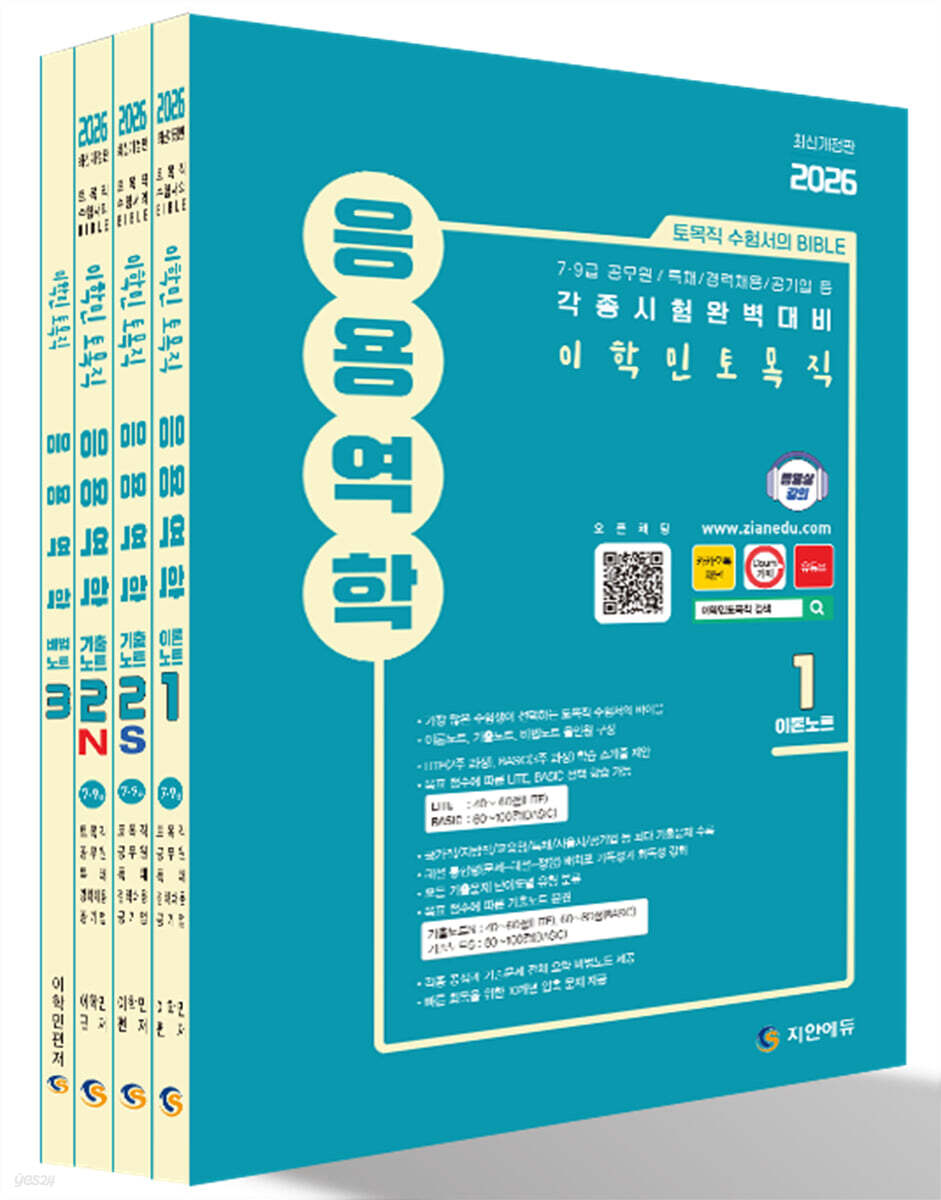
2026 Lee Hak-min, Civil Engineering Applied Mechanics
 |
Description
Book Introduction
Introducing civil engineering civil servants
The biggest topic of discussion in civil service examinations across all series is passing in a short period of time.
Academy after academy is competing to promote short-term passing as its slogan.
But the reality revealed by statistics is often cold.
It is not easy to pass the exam with competition rates of dozens to one from the beginning.
However, the logic that the remaining dozens failed because they didn't try hard or because their study methods were wrong is not valid.
This question needs to be considered from the beginning. "Is it possible to pass the exam in a short period of time, despite the competition being tens to one from the start?" The civil engineering series can provide an answer to this question.
The biggest topic of discussion in civil service examinations across all series is passing in a short period of time.
Academy after academy is competing to promote short-term passing as its slogan.
But the reality revealed by statistics is often cold.
It is not easy to pass the exam with competition rates of dozens to one from the beginning.
However, the logic that the remaining dozens failed because they didn't try hard or because their study methods were wrong is not valid.
This question needs to be considered from the beginning. "Is it possible to pass the exam in a short period of time, despite the competition being tens to one from the start?" The civil engineering series can provide an answer to this question.
- You can preview some of the book's contents.
Preview
index
01 Theory Notes
CHAPTER 01 General Applied Mechanics
SECTION 01 Scope of Applied Mechanics
SECTION 02 Basic Theory
SECTION 03 Classification of Forces
SECTION 04 Classification of Objects
SECTION 05 BEHAVIOR
SECTION 06 Discriminant
CHAPTER 02 Interpretation of Correct Information
SECTION 01 Free-body diagram concept
SECTION 02 Influence Line Concept
SECTION 03 Absolute Maximum Concept
SECTION 04 Other Bows and Friction
CHAPTER 03 Ramen, Arches, Cables, and Pulleys
SECTION 01 Ramen and Arch
SECTION 02 Cables and Pulleys
CHAPTER 04 TRUSS ANALYSIS
SECTION 01 Basic Truss Analysis
SECTION 02 Other Truss Analysis and Influence Lines
CHAPTER 05 Properties of Cross Sections
SECTION 01 Cross-sectional area, centroid, and first moment of cross-section
SECTION 02 Second moment of area, polar moment of inertia, and rising moment of area
SECTION 03 Properties of cross sections and others
CHAPTER 06 Mechanics of Materials
SECTION 01 General Mechanics of Materials
SECTION 02 Advanced Mechanics of Materials - 1
SECTION 03 Conversion of Stress and Strain
SECTION 04 Advanced Mechanics of Materials - 2
CHAPTER 07 Displacement of Structures
SECTION 01 Introduction
SECTION 02 Displacement Estimation - Geometric Method
SECTION 03 Energy
SECTION 04 Displacement Estimation - Energy Method
CHAPTER 08 Interpretation of Indefinite
SECTION 01 Introduction
SECTION 02 Displacement Matching Method
SECTION 03 Three-Moment Method and Symmetry of Continuous Beams
SECTION 04 Deflection Angle Method
SECTION 05 Distribution Method
SECTION 06 Influence lines of indeterminate structures
CHAPTER 09 Pillars
SECTION 01 Comparison of Applied Mechanics and Civil Engineering Design Columns
SECTION 02 Short story
SECTION 03 Jangju
CHAPTER 10 Elasto-plastic Analysis
SECTION 01 Yield cross-sectional strength and plastic cross-sectional strength
SECTION 02 Yield Load and Plastic Load
02 Past Exam Notes N
CHAPTER 01 General Applied Mechanics
CHAPTER 02 Interpretation of Correct Information
CHAPTER 03 Ramen, Arches, Cables, and Pulleys
CHAPTER 04 TRUSS ANALYSIS
CHAPTER 05 Properties of Cross Sections
CHAPTER 06 Mechanics of Materials
CHAPTER 07 Displacement of Structures
CHAPTER 08 Interpretation of Indefinite
CHAPTER 09 Pillars
CHAPTER 10 Elasto-plastic Analysis
02 Past Exam Notes S
CHAPTER 01 General Applied Mechanics
CHAPTER 02 Interpretation of Correct Information
CHAPTER 03 Ramen, Arches, Cables, and Pulleys
CHAPTER 04 TRUSS ANALYSIS
CHAPTER 05 Properties of Cross Sections
CHAPTER 06 Mechanics of Materials
CHAPTER 07 Displacement of Structures
CHAPTER 08 Interpretation of Indefinite
CHAPTER 09 Pillars
CHAPTER 10 Elasto-plastic Analysis
03 Secret Note
PART 01 Sisal ZIP (Official Collection)
PART 02 Problem Placement Table
CHAPTER 01 General Applied Mechanics
CHAPTER 02 Interpretation of Correct Information
CHAPTER 03 Ramen, Arches, Cables, and Pulleys
CHAPTER 04 TRUSS ANALYSIS
CHAPTER 05 Properties of Cross Sections
CHAPTER 06 Mechanics of Materials
CHAPTER 07 Displacement of Structures
CHAPTER 08 Interpretation of Indefinite
CHAPTER 09 Pillars
CHAPTER 10 Elasto-plastic Analysis
PART 03 National/Regional Grade 9 Unit-by-Unit Questions (2015-2024)
CHAPTER 01 General Applied Mechanics
CHAPTER 02 Interpretation of Correct Information
CHAPTER 03 Ramen, Arches, Cables, and Pulleys
CHAPTER 04 TRUSS ANALYSIS
CHAPTER 05 Properties of Cross Sections
CHAPTER 06 Mechanics of Materials
CHAPTER 07 Displacement of Structures
CHAPTER 08 Interpretation of Indefinite
CHAPTER 09 Pillars
CHAPTER 10 Elasto-plastic Analysis
PART 04 National/Regional Grade 9 Exam Questions by Year (2025)
01 2025 National Civil Service Grade 9
02 2025 Local Government/Office of Education/Seoul Metropolitan Government Grade 9
CHAPTER 01 General Applied Mechanics
SECTION 01 Scope of Applied Mechanics
SECTION 02 Basic Theory
SECTION 03 Classification of Forces
SECTION 04 Classification of Objects
SECTION 05 BEHAVIOR
SECTION 06 Discriminant
CHAPTER 02 Interpretation of Correct Information
SECTION 01 Free-body diagram concept
SECTION 02 Influence Line Concept
SECTION 03 Absolute Maximum Concept
SECTION 04 Other Bows and Friction
CHAPTER 03 Ramen, Arches, Cables, and Pulleys
SECTION 01 Ramen and Arch
SECTION 02 Cables and Pulleys
CHAPTER 04 TRUSS ANALYSIS
SECTION 01 Basic Truss Analysis
SECTION 02 Other Truss Analysis and Influence Lines
CHAPTER 05 Properties of Cross Sections
SECTION 01 Cross-sectional area, centroid, and first moment of cross-section
SECTION 02 Second moment of area, polar moment of inertia, and rising moment of area
SECTION 03 Properties of cross sections and others
CHAPTER 06 Mechanics of Materials
SECTION 01 General Mechanics of Materials
SECTION 02 Advanced Mechanics of Materials - 1
SECTION 03 Conversion of Stress and Strain
SECTION 04 Advanced Mechanics of Materials - 2
CHAPTER 07 Displacement of Structures
SECTION 01 Introduction
SECTION 02 Displacement Estimation - Geometric Method
SECTION 03 Energy
SECTION 04 Displacement Estimation - Energy Method
CHAPTER 08 Interpretation of Indefinite
SECTION 01 Introduction
SECTION 02 Displacement Matching Method
SECTION 03 Three-Moment Method and Symmetry of Continuous Beams
SECTION 04 Deflection Angle Method
SECTION 05 Distribution Method
SECTION 06 Influence lines of indeterminate structures
CHAPTER 09 Pillars
SECTION 01 Comparison of Applied Mechanics and Civil Engineering Design Columns
SECTION 02 Short story
SECTION 03 Jangju
CHAPTER 10 Elasto-plastic Analysis
SECTION 01 Yield cross-sectional strength and plastic cross-sectional strength
SECTION 02 Yield Load and Plastic Load
02 Past Exam Notes N
CHAPTER 01 General Applied Mechanics
CHAPTER 02 Interpretation of Correct Information
CHAPTER 03 Ramen, Arches, Cables, and Pulleys
CHAPTER 04 TRUSS ANALYSIS
CHAPTER 05 Properties of Cross Sections
CHAPTER 06 Mechanics of Materials
CHAPTER 07 Displacement of Structures
CHAPTER 08 Interpretation of Indefinite
CHAPTER 09 Pillars
CHAPTER 10 Elasto-plastic Analysis
02 Past Exam Notes S
CHAPTER 01 General Applied Mechanics
CHAPTER 02 Interpretation of Correct Information
CHAPTER 03 Ramen, Arches, Cables, and Pulleys
CHAPTER 04 TRUSS ANALYSIS
CHAPTER 05 Properties of Cross Sections
CHAPTER 06 Mechanics of Materials
CHAPTER 07 Displacement of Structures
CHAPTER 08 Interpretation of Indefinite
CHAPTER 09 Pillars
CHAPTER 10 Elasto-plastic Analysis
03 Secret Note
PART 01 Sisal ZIP (Official Collection)
PART 02 Problem Placement Table
CHAPTER 01 General Applied Mechanics
CHAPTER 02 Interpretation of Correct Information
CHAPTER 03 Ramen, Arches, Cables, and Pulleys
CHAPTER 04 TRUSS ANALYSIS
CHAPTER 05 Properties of Cross Sections
CHAPTER 06 Mechanics of Materials
CHAPTER 07 Displacement of Structures
CHAPTER 08 Interpretation of Indefinite
CHAPTER 09 Pillars
CHAPTER 10 Elasto-plastic Analysis
PART 03 National/Regional Grade 9 Unit-by-Unit Questions (2015-2024)
CHAPTER 01 General Applied Mechanics
CHAPTER 02 Interpretation of Correct Information
CHAPTER 03 Ramen, Arches, Cables, and Pulleys
CHAPTER 04 TRUSS ANALYSIS
CHAPTER 05 Properties of Cross Sections
CHAPTER 06 Mechanics of Materials
CHAPTER 07 Displacement of Structures
CHAPTER 08 Interpretation of Indefinite
CHAPTER 09 Pillars
CHAPTER 10 Elasto-plastic Analysis
PART 04 National/Regional Grade 9 Exam Questions by Year (2025)
01 2025 National Civil Service Grade 9
02 2025 Local Government/Office of Education/Seoul Metropolitan Government Grade 9
Publisher's Review
Introducing civil engineering civil servants
The biggest topic of discussion in the civil service examination in all series is passing in a short period of time.
Academy after academy is competing to promote short-term passing as its slogan.
But the reality revealed by statistics is often cold.
It is not easy to pass the exam with competition rates of dozens to one from the beginning.
However, the logic that the remaining dozens failed because they didn't try hard or because their study methods were wrong is not valid.
This question needs to be considered from the beginning. "Is it possible to pass the exam in a short period of time, despite the competition being tens to one?" The civil engineering series can provide an answer to this question.
The characteristics of the civil engineering exam from an expert's perspective are as follows.
Feature 1.
High failure rate and low passing cutoff line compared to other series
The civil service exam has a high failure rate (average 70%) compared to other series.
However, considering the special nature of the calculation subject, it cannot be said to be high compared to administrative series (average 50%) and other technical series (average 60%).
So, it is difficult to see the high failure rate as the cause of the low passing cut-off line.
Rather, the cause can be found in the low competition rate.
※Failure: If you do not obtain the basic score for 8 out of 20 questions, you will fail regardless of your average score.
Feature 2.
Large number of candidates selected compared to the number of applicants
According to statistics, the number of civil engineering civil servants selected is large (1,268 people) compared to the number of applicants (3,755 people).
In other words, the national average competition rate is very low at around 3.0 to 1.
For example, the average competition rate for “Seoul + Gyeonggi + Incheon” remains at 2.5 to 1, so the consecutive shortage of civil engineering civil servants was perhaps predictable.
This trend is bound to continue unless the competition rate exceeds 7 to 1, which is twice the current level.
※Statistics are as of 2024, excluding national civil servants and education offices.
Feature 3.
Low staff retention rate compared to other series
Because the competition rate is low, the backlog of applicants is bound to be low.
This phenomenon has continued for several years, and recently, a shortage of candidates has occurred.
※Backlog ratio: refers to the accumulated ratio of test takers.
Feature 4.
High short-term passing rate compared to other series
Because the backlog ratio is low, the spectrum of test takers is very wide, from non-majors to majors.
So, civil engineering is bound to have many changes.
There are also students who pass the exam in a very short period of time, and on the other hand, there are also some unfortunate stories.
All of these phenomena are caused by the imbalance between the number of applicants and the number of people selected.
The issuing agencies need to understand this and make efforts to do so.
A one-time shortfall is a mistake, but if it happens repeatedly, it is necessary to find a self-help solution in the exam system.
That doesn't mean that easy problems are always well-made problems.
Rather, I believe that a well-crafted problem is one that can be ranked by evaluating the level of effort put into it, while at the same time aiming to select excellent talent.
Test takers should not interpret a low passing score as meaning they do not need to prepare less.
Test takers must pour all their efforts into it.
The opportunity to pass the exam in a short period of time is only given to those who are prepared.
The instructor has a responsibility to find and present the best method.
This textbook and lectures were prepared with the goal of achieving a feasible short-term passing score.
I will impart the skills I have accumulated through my experience with the largest number of test takers, and I will do my best to work with you until the very end.
For a more detailed introduction, search for Lee Hak-min Civil Engineering on YouTube.
The biggest topic of discussion in the civil service examination in all series is passing in a short period of time.
Academy after academy is competing to promote short-term passing as its slogan.
But the reality revealed by statistics is often cold.
It is not easy to pass the exam with competition rates of dozens to one from the beginning.
However, the logic that the remaining dozens failed because they didn't try hard or because their study methods were wrong is not valid.
This question needs to be considered from the beginning. "Is it possible to pass the exam in a short period of time, despite the competition being tens to one?" The civil engineering series can provide an answer to this question.
The characteristics of the civil engineering exam from an expert's perspective are as follows.
Feature 1.
High failure rate and low passing cutoff line compared to other series
The civil service exam has a high failure rate (average 70%) compared to other series.
However, considering the special nature of the calculation subject, it cannot be said to be high compared to administrative series (average 50%) and other technical series (average 60%).
So, it is difficult to see the high failure rate as the cause of the low passing cut-off line.
Rather, the cause can be found in the low competition rate.
※Failure: If you do not obtain the basic score for 8 out of 20 questions, you will fail regardless of your average score.
Feature 2.
Large number of candidates selected compared to the number of applicants
According to statistics, the number of civil engineering civil servants selected is large (1,268 people) compared to the number of applicants (3,755 people).
In other words, the national average competition rate is very low at around 3.0 to 1.
For example, the average competition rate for “Seoul + Gyeonggi + Incheon” remains at 2.5 to 1, so the consecutive shortage of civil engineering civil servants was perhaps predictable.
This trend is bound to continue unless the competition rate exceeds 7 to 1, which is twice the current level.
※Statistics are as of 2024, excluding national civil servants and education offices.
Feature 3.
Low staff retention rate compared to other series
Because the competition rate is low, the backlog of applicants is bound to be low.
This phenomenon has continued for several years, and recently, a shortage of candidates has occurred.
※Backlog ratio: refers to the accumulated ratio of test takers.
Feature 4.
High short-term passing rate compared to other series
Because the backlog ratio is low, the spectrum of test takers is very wide, from non-majors to majors.
So, civil engineering is bound to have many changes.
There are also students who pass the exam in a very short period of time, and on the other hand, there are also some unfortunate stories.
All of these phenomena are caused by the imbalance between the number of applicants and the number of people selected.
The issuing agencies need to understand this and make efforts to do so.
A one-time shortfall is a mistake, but if it happens repeatedly, it is necessary to find a self-help solution in the exam system.
That doesn't mean that easy problems are always well-made problems.
Rather, I believe that a well-crafted problem is one that can be ranked by evaluating the level of effort put into it, while at the same time aiming to select excellent talent.
Test takers should not interpret a low passing score as meaning they do not need to prepare less.
Test takers must pour all their efforts into it.
The opportunity to pass the exam in a short period of time is only given to those who are prepared.
The instructor has a responsibility to find and present the best method.
This textbook and lectures were prepared with the goal of achieving a feasible short-term passing score.
I will impart the skills I have accumulated through my experience with the largest number of test takers, and I will do my best to work with you until the very end.
For a more detailed introduction, search for Lee Hak-min Civil Engineering on YouTube.
GOODS SPECIFICS
- Date of issue: September 1, 2025
- Page count, weight, size: 1,040 pages | Checking size
- ISBN13: 9788966113118
- ISBN10: 8966113117
You may also like
카테고리
korean


korean

![GQ KOREA Mark (Monthly): December [2025]](http://librairie.coreenne.fr/cdn/shop/files/8ef265dbbfbf186523ed75ba7319009d.jpg?v=1765340328&width=3840)


