

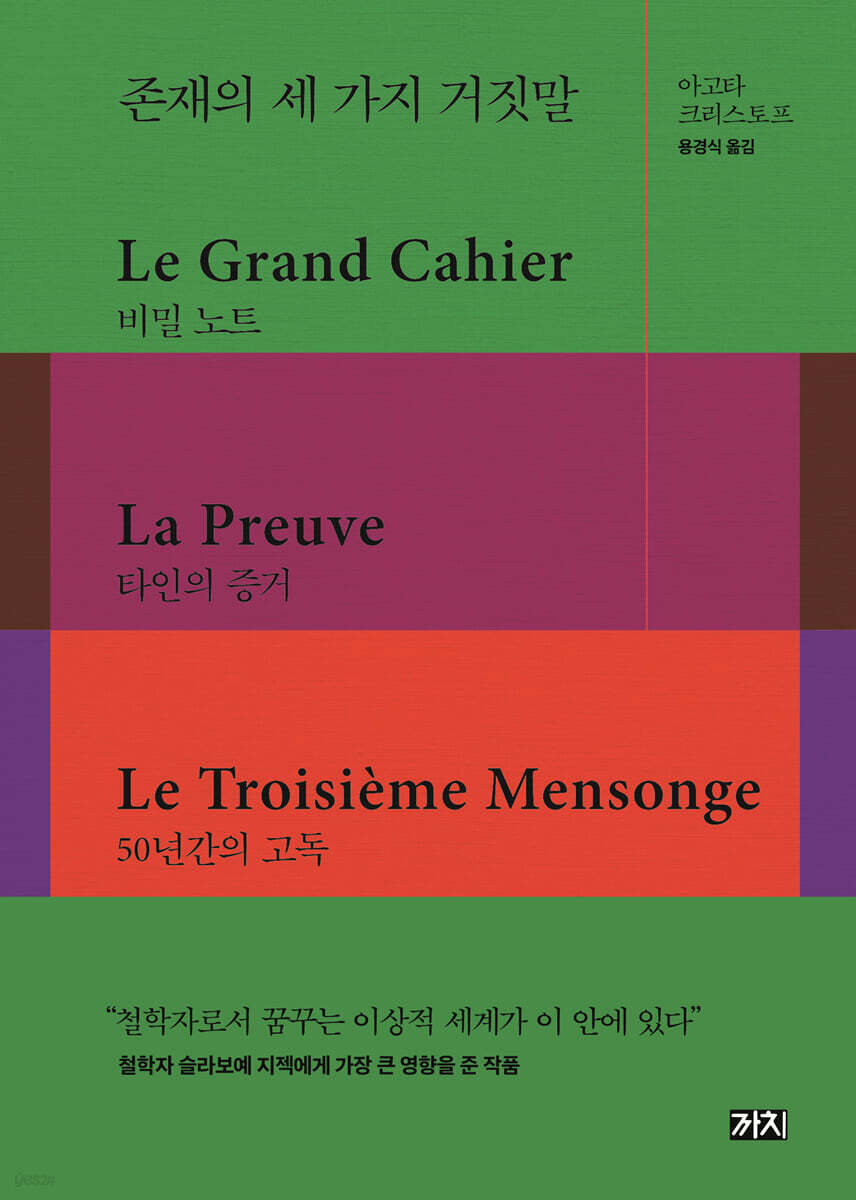
The Three Lies of Existence
 |
Description
Book Introduction
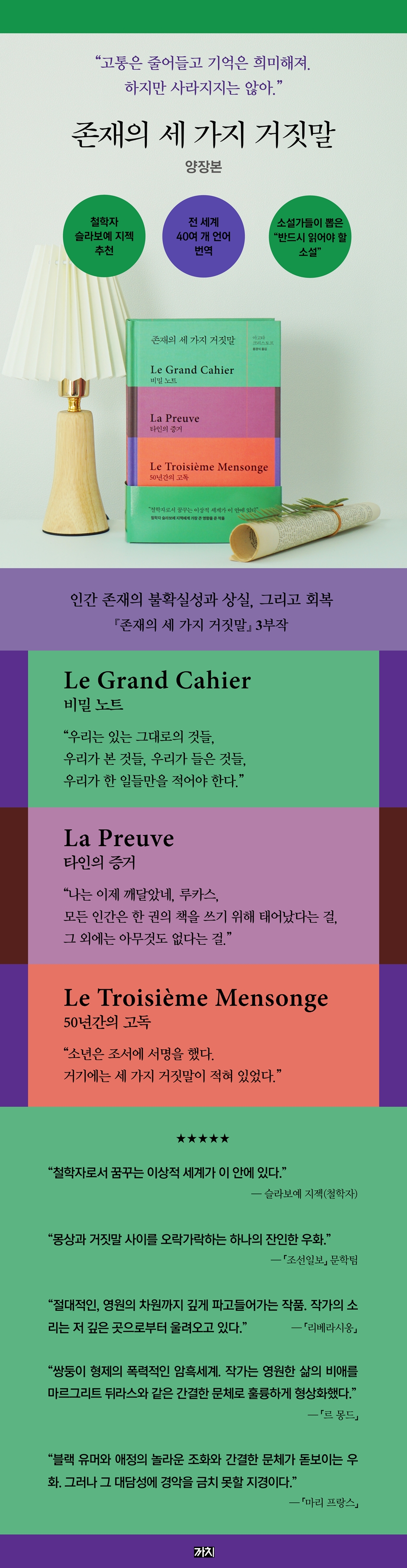
“As a philosopher, the ideal world I dream of is contained within it.” - Slavoj Zizek
The “quiet” bestseller, translated into over 40 languages, now available in hardcover.
Agota Kristoff's masterpiece trilogy, "The Three Lies of Existence," which provocatively deals with the chaos of war and revolution and the destruction of humanity within it, meets readers in a new form.
This novel, translated into over 40 languages around the world, has long established itself as one of the “novels of a lifetime” in Korea through recommendations from renowned figures at home and abroad, including world-renowned philosopher Slavoj Zizek, novelists Shin Kyung-sook, Kim Yeon-su, and Eun Hee-kyung, and critic Lee Dong-jin, as well as word-of-mouth from readers.
The newly released hardcover edition has met the expectations of many readers, increasing its collection value with a more luxurious binding and sophisticated cover.
In the trilogy, “The Three Lies of Existence,” the author manipulates images by intertwining contradictory phenomena and characters.
In the process, the work weaves a cruel yet beautiful narrative by intertwining the cruel fates of twin brothers Lucas and Claus, whose names differ only in the order of their letters.
The twins' journey to fulfill people's "true wishes" exposes the nightmarish reality they face and raises questions about human existence.
This narrative of human uncertainty, loss, and recovery, expressed dryly and precisely without emotion, will invite readers into a world of "rawness" they have never experienced before.
The “quiet” bestseller, translated into over 40 languages, now available in hardcover.
Agota Kristoff's masterpiece trilogy, "The Three Lies of Existence," which provocatively deals with the chaos of war and revolution and the destruction of humanity within it, meets readers in a new form.
This novel, translated into over 40 languages around the world, has long established itself as one of the “novels of a lifetime” in Korea through recommendations from renowned figures at home and abroad, including world-renowned philosopher Slavoj Zizek, novelists Shin Kyung-sook, Kim Yeon-su, and Eun Hee-kyung, and critic Lee Dong-jin, as well as word-of-mouth from readers.
The newly released hardcover edition has met the expectations of many readers, increasing its collection value with a more luxurious binding and sophisticated cover.
In the trilogy, “The Three Lies of Existence,” the author manipulates images by intertwining contradictory phenomena and characters.
In the process, the work weaves a cruel yet beautiful narrative by intertwining the cruel fates of twin brothers Lucas and Claus, whose names differ only in the order of their letters.
The twins' journey to fulfill people's "true wishes" exposes the nightmarish reality they face and raises questions about human existence.
This narrative of human uncertainty, loss, and recovery, expressed dryly and precisely without emotion, will invite readers into a world of "rawness" they have never experienced before.
- You can preview some of the book's contents.
Preview
index
Part 1 Secret Notes
Part 2: Evidence from Others
Part 3: Fifty Years of Solitude
Author and Work Commentary
Part 2: Evidence from Others
Part 3: Fifty Years of Solitude
Author and Work Commentary
Detailed image
Publisher's Review
Part 1: "Secret Notes" (published in 1986)
Agata sent the manuscript of this work (Le Grand Cahier) to the famous Parisian publishers Gallimard, Seuil, and Grasse at the same time, and Seuil is said to have accepted it for publication immediately without revision.
The book slowly penetrated the French readership, was dramatized, and has now been translated and published in over 40 countries.
The author said that he initially composed it as if he were creating a mosaic by writing several scenes at random.
The basis of the composition is a collection of approximately 60 writing notes that are based on cool objectivity and contain sharp and cruel scenes or farces that coldly expose the reality of the human world.
The reason the main character was referred to as plural (we) rather than singular first person was to avoid excessive expression of emotions or subjective expression.
Of course, it also means the differentiation of identity in the midst of the chaos in which the Nazis (occupying forces) and the socialist regime (liberation forces) appeared one after another.
The author is said to have portrayed her beloved older brother, who is only a year and a half younger than her, as Klaus, and herself as Lucas.
The main characters, twin brothers 'Uri', live with their grandmother in a small town near the border that is trampled by the occupiers, symbolized by the swastika, and then by the liberation army, symbolized by the sickle and hammer, during the war.
There they practice overcoming the worst situations.
There is no such thing as morality for them.
Children develop their own morals without being taught or influenced by anyone.
They meticulously record their upbringing and sins in large notebooks.
The separation of the twins signifies both the restoration and loss of their identity that they must overcome as they are divided into two.
The atmosphere of Part 1 is, in a word, a violent dark world of children, a whirlpool of demonic truth.
Part 2, "The Evidence of Others" (published in 1988)
When writing "The Secret Note," the author said he did not plan on having a sequel (La Preuve).
I left some room for it with the vague thought that I would just write it when I wanted to write continuously.
The author says that the story of Part 2 is also “an image of my life itself, which was divided in two because Europe was divided in two.”
In particular, the temporal background is the period of the Hungarian anti-regime revolution in 1956.
The loss of identity in a socialist system seems to be symbolized by the third person, 'he', in Part 2.
Of course, it is even more clear that this means the separation of 'us'.
Unlike "Secret Note" where no proper nouns appear at all, in "The Evidence of Others" all the characters, including Lucas, one of the twins, have names.
The twins, Lucas and Claus, have the same names, just with the letters reversed.
Are they really two or one? This question, which constantly confuses readers throughout Part 3, is also vividly revealed by these names.
Part 2 is the story of Lucas, who is left alone at his grandmother's house after Klaus leaves in search of freedom.
The separation of twins who lived as one body is not only sad but also painful.
The small town (K City) that served as the stage for Part 1, the grandmother's house, the bookstore-stationery store, the priest and his residence, the bars, the cemetery, and the square all appear as they are.
The interior of Lucas' grandmother's house also remains unchanged.
In the attic, the skeletons of Lucas and Klaus' mother and sister hang, and most importantly, a precious 'large notebook' is kept.
But the well where the deaf girl drew water has dried up, and the bars are quiet and deserted, unlike before.
Time passes and times change.
The small town, located in a border area where entry is not possible without special permission, was isolated and in ruins.
Even though the war is over, the social atmosphere is still heavy and painful.
Part 2, consisting of eight chapters and an epilogue, is much more multi-layered than Part 1 in terms of characters and structure.
A wandering girl giving birth to her father's child, a librarian receiving psychiatric treatment after her husband's unjust death, an alcoholic bookstore owner who is becoming a wreck while pursuing his dream of writing a book, a clever but crippled boy who doesn't know the secret of his birth, a handsome, intelligent, but timid homosexual communist party official, an old insomniac who became a victim of the social system... ... Each of these lives has a story enough to become a full-length novel.
And Klaus, who appears in Chapter 8, leaves the reader in a maze.
Inconclusive evidence for human existence.
This connects to the episode of issuing identity cards in the first chapter.
In Part 1, 'we' and 'grandmother' did not need identification.
I could even ignore the school admission notice and live.
Part 3: "Fifty Years of Solitude" (published in 1991)
What is true and what is false? Is Part 1 the first lie, Part 2 the second, and Part 3 the third? This book is a cruel fable, oscillating between fantasy and lies.
Unlike parts 1 and 2, part 3 is described using the first person singular (I) as the subject, but subjective thoughts and expressions of emotions are still restrained.
The twins are reunited with difficulty, but their separation becomes even more pronounced after Klaus's adamant denial of Lucas.
Even Lucas, who had been insisting to the embassy staff about the existence of his twin brother Klaus, ends up denying the other person.
After such a denial, Lucas commits suicide, and Klaus, who hears the news from an embassy employee, also has a premonition that he will die in the same way as Lucas.
In Part 1, the twins lived as one body, but in Part 2, they live separate lives as Lucas and Klaus. In Part 3, not only are their memories shared, but even their family relationships reveal contradictions.
What is the author's true intention in manipulating contradictions? What's notable in Part 3 is that the narrator's first-person pronoun, "I," signifies the restoration of identity brought about by the collapse of the socialist system.
In the epilogue of Parts 2 and 3, Christophe constantly hints at the uncertainty of human existence and identity by drawing readers into an unexpected maze.
― From “Writer and Work Commentary”
Agata sent the manuscript of this work (Le Grand Cahier) to the famous Parisian publishers Gallimard, Seuil, and Grasse at the same time, and Seuil is said to have accepted it for publication immediately without revision.
The book slowly penetrated the French readership, was dramatized, and has now been translated and published in over 40 countries.
The author said that he initially composed it as if he were creating a mosaic by writing several scenes at random.
The basis of the composition is a collection of approximately 60 writing notes that are based on cool objectivity and contain sharp and cruel scenes or farces that coldly expose the reality of the human world.
The reason the main character was referred to as plural (we) rather than singular first person was to avoid excessive expression of emotions or subjective expression.
Of course, it also means the differentiation of identity in the midst of the chaos in which the Nazis (occupying forces) and the socialist regime (liberation forces) appeared one after another.
The author is said to have portrayed her beloved older brother, who is only a year and a half younger than her, as Klaus, and herself as Lucas.
The main characters, twin brothers 'Uri', live with their grandmother in a small town near the border that is trampled by the occupiers, symbolized by the swastika, and then by the liberation army, symbolized by the sickle and hammer, during the war.
There they practice overcoming the worst situations.
There is no such thing as morality for them.
Children develop their own morals without being taught or influenced by anyone.
They meticulously record their upbringing and sins in large notebooks.
The separation of the twins signifies both the restoration and loss of their identity that they must overcome as they are divided into two.
The atmosphere of Part 1 is, in a word, a violent dark world of children, a whirlpool of demonic truth.
Part 2, "The Evidence of Others" (published in 1988)
When writing "The Secret Note," the author said he did not plan on having a sequel (La Preuve).
I left some room for it with the vague thought that I would just write it when I wanted to write continuously.
The author says that the story of Part 2 is also “an image of my life itself, which was divided in two because Europe was divided in two.”
In particular, the temporal background is the period of the Hungarian anti-regime revolution in 1956.
The loss of identity in a socialist system seems to be symbolized by the third person, 'he', in Part 2.
Of course, it is even more clear that this means the separation of 'us'.
Unlike "Secret Note" where no proper nouns appear at all, in "The Evidence of Others" all the characters, including Lucas, one of the twins, have names.
The twins, Lucas and Claus, have the same names, just with the letters reversed.
Are they really two or one? This question, which constantly confuses readers throughout Part 3, is also vividly revealed by these names.
Part 2 is the story of Lucas, who is left alone at his grandmother's house after Klaus leaves in search of freedom.
The separation of twins who lived as one body is not only sad but also painful.
The small town (K City) that served as the stage for Part 1, the grandmother's house, the bookstore-stationery store, the priest and his residence, the bars, the cemetery, and the square all appear as they are.
The interior of Lucas' grandmother's house also remains unchanged.
In the attic, the skeletons of Lucas and Klaus' mother and sister hang, and most importantly, a precious 'large notebook' is kept.
But the well where the deaf girl drew water has dried up, and the bars are quiet and deserted, unlike before.
Time passes and times change.
The small town, located in a border area where entry is not possible without special permission, was isolated and in ruins.
Even though the war is over, the social atmosphere is still heavy and painful.
Part 2, consisting of eight chapters and an epilogue, is much more multi-layered than Part 1 in terms of characters and structure.
A wandering girl giving birth to her father's child, a librarian receiving psychiatric treatment after her husband's unjust death, an alcoholic bookstore owner who is becoming a wreck while pursuing his dream of writing a book, a clever but crippled boy who doesn't know the secret of his birth, a handsome, intelligent, but timid homosexual communist party official, an old insomniac who became a victim of the social system... ... Each of these lives has a story enough to become a full-length novel.
And Klaus, who appears in Chapter 8, leaves the reader in a maze.
Inconclusive evidence for human existence.
This connects to the episode of issuing identity cards in the first chapter.
In Part 1, 'we' and 'grandmother' did not need identification.
I could even ignore the school admission notice and live.
Part 3: "Fifty Years of Solitude" (published in 1991)
What is true and what is false? Is Part 1 the first lie, Part 2 the second, and Part 3 the third? This book is a cruel fable, oscillating between fantasy and lies.
Unlike parts 1 and 2, part 3 is described using the first person singular (I) as the subject, but subjective thoughts and expressions of emotions are still restrained.
The twins are reunited with difficulty, but their separation becomes even more pronounced after Klaus's adamant denial of Lucas.
Even Lucas, who had been insisting to the embassy staff about the existence of his twin brother Klaus, ends up denying the other person.
After such a denial, Lucas commits suicide, and Klaus, who hears the news from an embassy employee, also has a premonition that he will die in the same way as Lucas.
In Part 1, the twins lived as one body, but in Part 2, they live separate lives as Lucas and Klaus. In Part 3, not only are their memories shared, but even their family relationships reveal contradictions.
What is the author's true intention in manipulating contradictions? What's notable in Part 3 is that the narrator's first-person pronoun, "I," signifies the restoration of identity brought about by the collapse of the socialist system.
In the epilogue of Parts 2 and 3, Christophe constantly hints at the uncertainty of human existence and identity by drawing readers into an unexpected maze.
― From “Writer and Work Commentary”
GOODS SPECIFICS
- Publication date: September 15, 2022
- Format: Hardcover book binding method guide
- Page count, weight, size: 672 pages | 864g | 137*203*35mm
- ISBN13: 9788972917793
- ISBN10: 8972917796
You may also like
카테고리
korean


korean

![ELLE 엘르 스페셜 에디션 A형 : 12월 [2025]](http://librairie.coreenne.fr/cdn/shop/files/b8e27a3de6c9538896439686c6b0e8fb.jpg?v=1766436872&width=3840)


