

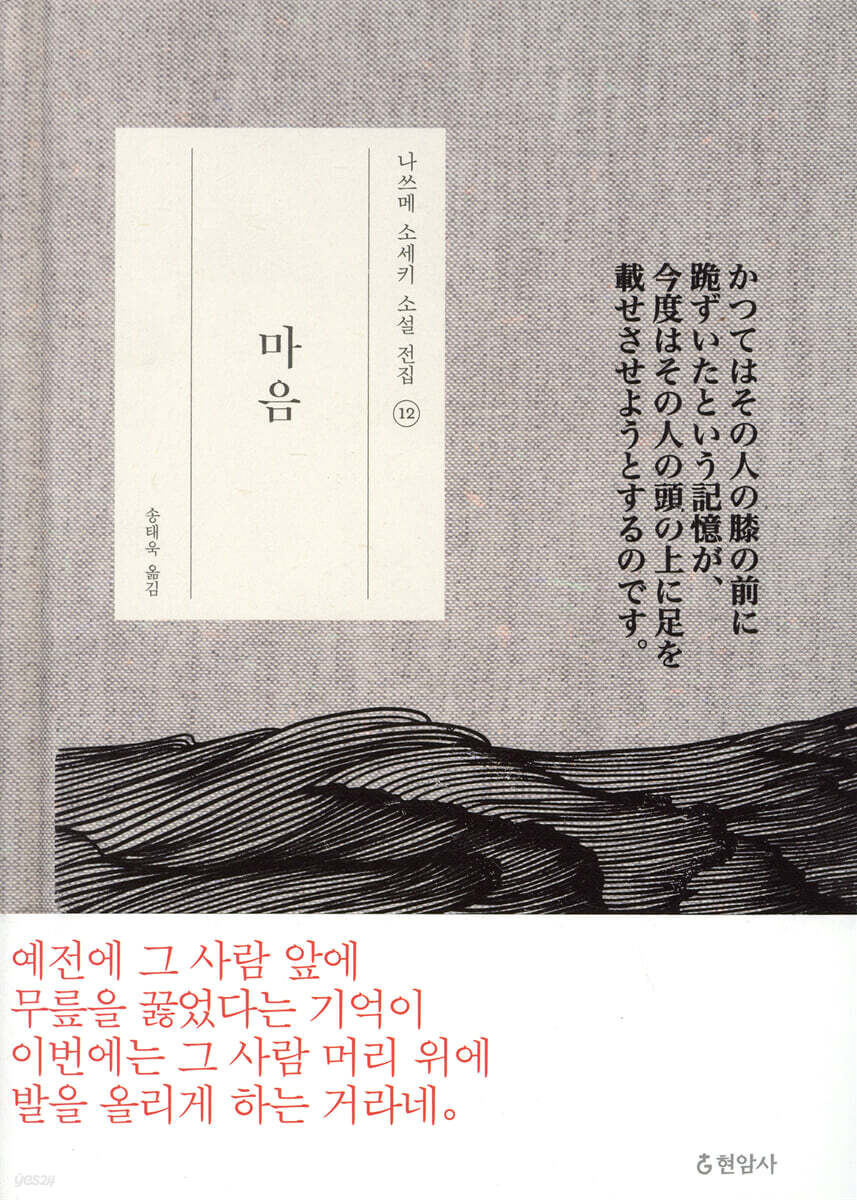
mind
 |
Description
Book Introduction
It makes me think about the loneliness that we must embrace together in order to face it.
The self discovered is not great, but rather lonely and desolate.
The pain of loneliness that we experience as we live in the present, the anxiety that comes with enduring change.
This is a rapid change in people's perception at the dawn of the modern era, and it is also the dominant theme of this entire work.
In [Heart], Soseki projected the image of our modern world through the character of a teacher who hates all human beings, including himself, and furthermore, he becomes a guide to the meaning of living, the meaning of life, and the answer to the great question of the "individual."
[The mind] is composed of three parts.
The first chapter depicts the process of 'I' and the teacher meeting for the first time and their relationship developing, and the second chapter depicts the relationship between 'I' and my family when I go back to my hometown due to my father's critical condition.
And the third chapter consists of a 'will' in which the teacher confesses about the past stigma that was placed on him and the dark shadow it cast on him.
[Heart] was serialized simultaneously in the Tokyo and Osaka Asahi Shimbun newspapers in 1914.
It is one of the most widely read novels in Japan, and has been loved by the public to the point that sales have exceeded 17 million copies.
It is also considered the best canon of modern Japanese literature in that it became the standard for modern novels.
The self discovered is not great, but rather lonely and desolate.
The pain of loneliness that we experience as we live in the present, the anxiety that comes with enduring change.
This is a rapid change in people's perception at the dawn of the modern era, and it is also the dominant theme of this entire work.
In [Heart], Soseki projected the image of our modern world through the character of a teacher who hates all human beings, including himself, and furthermore, he becomes a guide to the meaning of living, the meaning of life, and the answer to the great question of the "individual."
[The mind] is composed of three parts.
The first chapter depicts the process of 'I' and the teacher meeting for the first time and their relationship developing, and the second chapter depicts the relationship between 'I' and my family when I go back to my hometown due to my father's critical condition.
And the third chapter consists of a 'will' in which the teacher confesses about the past stigma that was placed on him and the dark shadow it cast on him.
[Heart] was serialized simultaneously in the Tokyo and Osaka Asahi Shimbun newspapers in 1914.
It is one of the most widely read novels in Japan, and has been loved by the public to the point that sales have exceeded 17 million copies.
It is also considered the best canon of modern Japanese literature in that it became the standard for modern novels.
- You can preview some of the book's contents.
Preview
index
Heartache.
Teacher and I 16
middle.
My Parents and Me 104
under.
Teacher and Will 148
Commentary: Where is the Heart? | Kang Yu-jeong 275
Natsume Soseki Chronology 283
| The Complete Novels of Natsume Soseki, Completed by Hyonamsa (14 Volumes)
Part 1 (published on September 10, 2013)
0 1.
I am a cat (I am a cat) translated by Song Tae-wook
02.
The Young Master (坊っちゃん) translated by Song Tae-wook
03.
Grass Pillow, translated by Song Tae-wook
04.
Typhoon (野分) translated by Noh Jae-myeong
Part 2 (published on September 5, 2014)
0 5.
Umiincho (虞美人草), translated by Song Tae-wook
06.
The Miner, translated by Song Tae-wook
07.
Sanshiro (三四?) translated by Song Tae-wook
Part 3 (published on August 28, 2015)
08.
After that (それから) translated by Noh Jae-myeong
0 9.
Moon (門), translated by Song Tae-wook
10.
After the Spring Equinox (Past the Other Shore?) Translated by Song Tae-wook
11.
The Passerby, translated by Song Tae-wook
4th installment (complete edition published on June 25, 2016)
12.
Heart (Heart) translated by Song Tae-wook
13.
Hannunpalgi (道草), translated by Song Tae-wook
14.
Myeongam (Light and Darkness) translated by Song Tae-wook
Teacher and I 16
middle.
My Parents and Me 104
under.
Teacher and Will 148
Commentary: Where is the Heart? | Kang Yu-jeong 275
Natsume Soseki Chronology 283
| The Complete Novels of Natsume Soseki, Completed by Hyonamsa (14 Volumes)
Part 1 (published on September 10, 2013)
0 1.
I am a cat (I am a cat) translated by Song Tae-wook
02.
The Young Master (坊っちゃん) translated by Song Tae-wook
03.
Grass Pillow, translated by Song Tae-wook
04.
Typhoon (野分) translated by Noh Jae-myeong
Part 2 (published on September 5, 2014)
0 5.
Umiincho (虞美人草), translated by Song Tae-wook
06.
The Miner, translated by Song Tae-wook
07.
Sanshiro (三四?) translated by Song Tae-wook
Part 3 (published on August 28, 2015)
08.
After that (それから) translated by Noh Jae-myeong
0 9.
Moon (門), translated by Song Tae-wook
10.
After the Spring Equinox (Past the Other Shore?) Translated by Song Tae-wook
11.
The Passerby, translated by Song Tae-wook
4th installment (complete edition published on June 25, 2016)
12.
Heart (Heart) translated by Song Tae-wook
13.
Hannunpalgi (道草), translated by Song Tae-wook
14.
Myeongam (Light and Darkness) translated by Song Tae-wook
Detailed image

Publisher's Review
“Our Story, One Hundred Years Later”
Japan's Shakespeare and a millennial literary figure
The loneliness of human life in this era, as seen through Natsume Soseki
2016 marks the 100th anniversary of Natsume Soseki's death.
Korea's first full-length novel collection (14 volumes) published
The Asahi Shimbun ranked him first in its poll of "Japanese Literary Figures of the Past Thousand Years."
Natsume Soseki, the favorite author of Haruki Murakami and Sangjung Kang
Natsume Soseki's Complete Novels, a Finalist for the Korean Publishing Culture Award's Editing Award
"During those gloomy days of youth, the one who always whispered to me was Natsume Soseki."
In a prosperous society where people chant for freedom, assert independence, and assert their own egos, why are we all so lonely?
Natsume Soseki, who portrayed the egoism, loneliness, and slivers of hope hidden within human relationships—parents and children, couples, relatives, friends, lovers, and teacher—is undoubtedly a pioneering writer not only in Japan but also in Korea.
_ Kang Sang-jung (Professor Emeritus, University of Tokyo)
Natsume Soseki's Complete Novels, First Complete Translation in Korea Published
“In 2016, ahead of the 100th anniversary of Natsume Soseki’s death, we are publishing a series of Natsume Soseki’s full-length novels for the first time in Korea.
With solid translations, meticulous editing, and design, Natsume Soseki's novels are reinterpreted with profound humor and poignant observations of life.
We invite readers of world and Korean literature to experience the power of contemplation, a journey that will allow them to joyfully experience the reasons for reading and writing novels.” - September 2013, Publisher of the Complete Works
The complete collection of Natsume Soseki's novels, which began to be published by Hyonamsa in September 2013, has finally been completed with the publication of the fourth installment, [Kkomori], [Han-glance], and [Myeong-am].
Natsume Soseki, the origin of modern Japanese literature and a novelist in an era when novels did not exist, had a great influence on modern and contemporary Japanese writers and is called the great writer of the 20th century and the Shakespeare of Japan.
His portrait was on the 1,000 yen note, the most widely used note, for the longest time, and he is also a representative Japanese writer who has had a strong influence on numerous writers, to the point that it is said, “Behind Japan’s Nobel Prize in Literature is Natsume Soseki.”
To commemorate the 100th anniversary of the death of Natsume Soseki (1867-1916), the 'father of modern Japanese literature' and 'national writer,' Hyonamsa has published the first complete translation of Natsume Soseki's novels in Korea.
In Korea, Natsume Soseki's works have been published repeatedly by various publishers, with a focus on his representative works. However, the complete collection of Soseki's novels published by Hyonamsa is the first complete collection in Korea to be translated into modern times, shedding new light on the world of Natsume Soseki's long works that he concentrated on writing for 12 years. It not only includes widely known works that are included in our textbooks, such as [I Am a Cat], [Sanshiro], [Moon], [Heart], and [Light and Shadow], but also includes hidden novels that are sometimes left out of Soseki's chronology.
During his short creative period, Soseki wrote numerous works in various fields, including Chinese poetry, haiku, essays, and novels.
There is no doubt that Soseki's works can be called classics, given the unique atmosphere each piece exudes and the unique variations in style according to the content.
Song Tae-wook's meticulous translation, which vividly portrays Soseki's writing style with the phrase "not a single unnecessary sentence," and Noh Jae-myung's deep understanding of Soseki, who translated the complete collection of Soseki's short stories, have been added to create a "Soseki translation for our time."
Furthermore, bringing Soseki's works back to life in their entirety is the life's work of Song Tae-wook ([Cat] and 11 other volumes) and Noh Jae-myeong (deceased, [Typhoon] and [After]).
Our Concerns About Living in the Present: Asking Natsume Soseki 100 Years Ago
Natsume Soseki wrote about people in the Meiji era, but the message he wanted to convey through his works transcends national borders and eras and reaches us today.
He delved deeply into human problems and reached into the abyss of the human heart.
In the midst of loneliness and anxiety, he secured vivid universality through questions and explorations such as, "How should I live?", "What is the meaning of life?", and "How can I know myself?"
Soseki wrote works with a strong autobiographical character, and his life was as dramatic and tragic as his works.
He was born the son of a second wife and was adopted twice, but was later disowned when his adoptive parents divorced.
He lost his mother when he was in middle school, and his older and younger brothers to tuberculosis. After he got married, his wife attempted suicide by jumping from a building due to the shock of a miscarriage.
He himself suffered from stomach pain, nervous breakdowns and headaches throughout his life.
He describes these countless memories of loss and suffering in his work with chilling calm and composure.
While accepting that our lives are a series of pain, misfortune, and poverty, we also long to be able to believe in life and not be anxious.
Natsume Soseki, who lived in a growth-first, militaristic society, sought to become a free and ethical 'individual' who could see through the times and was not swayed by the desires of others.
He sought a way for “lonely souls to resonate with each other in an age where individuals are scattered” (Kang Sang-jung), and he studied humanity until his death, never giving up the persistent hope that we might be able to save ourselves from our anxiety and weakness.
Japan's Shakespeare and a millennial literary figure
The loneliness of human life in this era, as seen through Natsume Soseki
2016 marks the 100th anniversary of Natsume Soseki's death.
Korea's first full-length novel collection (14 volumes) published
The Asahi Shimbun ranked him first in its poll of "Japanese Literary Figures of the Past Thousand Years."
Natsume Soseki, the favorite author of Haruki Murakami and Sangjung Kang
Natsume Soseki's Complete Novels, a Finalist for the Korean Publishing Culture Award's Editing Award
"During those gloomy days of youth, the one who always whispered to me was Natsume Soseki."
In a prosperous society where people chant for freedom, assert independence, and assert their own egos, why are we all so lonely?
Natsume Soseki, who portrayed the egoism, loneliness, and slivers of hope hidden within human relationships—parents and children, couples, relatives, friends, lovers, and teacher—is undoubtedly a pioneering writer not only in Japan but also in Korea.
_ Kang Sang-jung (Professor Emeritus, University of Tokyo)
Natsume Soseki's Complete Novels, First Complete Translation in Korea Published
“In 2016, ahead of the 100th anniversary of Natsume Soseki’s death, we are publishing a series of Natsume Soseki’s full-length novels for the first time in Korea.
With solid translations, meticulous editing, and design, Natsume Soseki's novels are reinterpreted with profound humor and poignant observations of life.
We invite readers of world and Korean literature to experience the power of contemplation, a journey that will allow them to joyfully experience the reasons for reading and writing novels.” - September 2013, Publisher of the Complete Works
The complete collection of Natsume Soseki's novels, which began to be published by Hyonamsa in September 2013, has finally been completed with the publication of the fourth installment, [Kkomori], [Han-glance], and [Myeong-am].
Natsume Soseki, the origin of modern Japanese literature and a novelist in an era when novels did not exist, had a great influence on modern and contemporary Japanese writers and is called the great writer of the 20th century and the Shakespeare of Japan.
His portrait was on the 1,000 yen note, the most widely used note, for the longest time, and he is also a representative Japanese writer who has had a strong influence on numerous writers, to the point that it is said, “Behind Japan’s Nobel Prize in Literature is Natsume Soseki.”
To commemorate the 100th anniversary of the death of Natsume Soseki (1867-1916), the 'father of modern Japanese literature' and 'national writer,' Hyonamsa has published the first complete translation of Natsume Soseki's novels in Korea.
In Korea, Natsume Soseki's works have been published repeatedly by various publishers, with a focus on his representative works. However, the complete collection of Soseki's novels published by Hyonamsa is the first complete collection in Korea to be translated into modern times, shedding new light on the world of Natsume Soseki's long works that he concentrated on writing for 12 years. It not only includes widely known works that are included in our textbooks, such as [I Am a Cat], [Sanshiro], [Moon], [Heart], and [Light and Shadow], but also includes hidden novels that are sometimes left out of Soseki's chronology.
During his short creative period, Soseki wrote numerous works in various fields, including Chinese poetry, haiku, essays, and novels.
There is no doubt that Soseki's works can be called classics, given the unique atmosphere each piece exudes and the unique variations in style according to the content.
Song Tae-wook's meticulous translation, which vividly portrays Soseki's writing style with the phrase "not a single unnecessary sentence," and Noh Jae-myung's deep understanding of Soseki, who translated the complete collection of Soseki's short stories, have been added to create a "Soseki translation for our time."
Furthermore, bringing Soseki's works back to life in their entirety is the life's work of Song Tae-wook ([Cat] and 11 other volumes) and Noh Jae-myeong (deceased, [Typhoon] and [After]).
Our Concerns About Living in the Present: Asking Natsume Soseki 100 Years Ago
Natsume Soseki wrote about people in the Meiji era, but the message he wanted to convey through his works transcends national borders and eras and reaches us today.
He delved deeply into human problems and reached into the abyss of the human heart.
In the midst of loneliness and anxiety, he secured vivid universality through questions and explorations such as, "How should I live?", "What is the meaning of life?", and "How can I know myself?"
Soseki wrote works with a strong autobiographical character, and his life was as dramatic and tragic as his works.
He was born the son of a second wife and was adopted twice, but was later disowned when his adoptive parents divorced.
He lost his mother when he was in middle school, and his older and younger brothers to tuberculosis. After he got married, his wife attempted suicide by jumping from a building due to the shock of a miscarriage.
He himself suffered from stomach pain, nervous breakdowns and headaches throughout his life.
He describes these countless memories of loss and suffering in his work with chilling calm and composure.
While accepting that our lives are a series of pain, misfortune, and poverty, we also long to be able to believe in life and not be anxious.
Natsume Soseki, who lived in a growth-first, militaristic society, sought to become a free and ethical 'individual' who could see through the times and was not swayed by the desires of others.
He sought a way for “lonely souls to resonate with each other in an age where individuals are scattered” (Kang Sang-jung), and he studied humanity until his death, never giving up the persistent hope that we might be able to save ourselves from our anxiety and weakness.
GOODS SPECIFICS
- Date of publication: June 25, 2016
- Format: Hardcover book binding method guide
- Page count, weight, size: 296 pages | 452g | 140*190*20mm
- ISBN13: 9788932317960
- ISBN10: 8932317968
You may also like
카테고리
korean


korean

![ELLE 엘르 스페셜 에디션 A형 : 12월 [2025]](http://librairie.coreenne.fr/cdn/shop/files/b8e27a3de6c9538896439686c6b0e8fb.jpg?v=1766436872&width=3840)


