

The Brain
 |
Description
Book Introduction
We rely on our brains to understand the world.
The brain is where our decisions occur and our imaginations are created.
Our dreams and waking lives arise from the activity of countless brain cells.
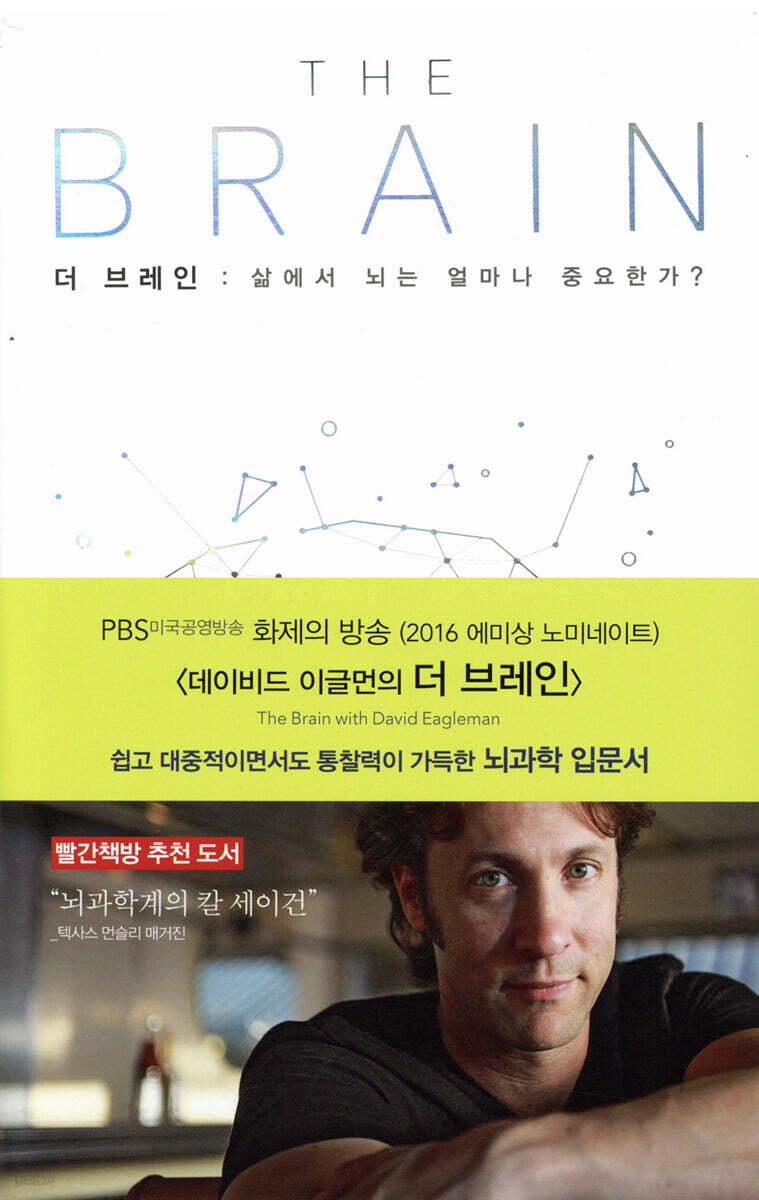
Renowned neuroscientist David Eagleman's "The Brain" is a highly accessible and accessible book on brain science. It explains who we are, how we perceive reality, how we make decisions, how our lives are orchestrated, and why we need others, all in a way that appeals to a wide audience. This book retells the core content of the popular six-part series "The Brain with David Eagleman," which aired on PBS and the BBC.
The brain is where our decisions occur and our imaginations are created.
Our dreams and waking lives arise from the activity of countless brain cells.
Renowned neuroscientist David Eagleman's "The Brain" is a highly accessible and accessible book on brain science. It explains who we are, how we perceive reality, how we make decisions, how our lives are orchestrated, and why we need others, all in a way that appeals to a wide audience. This book retells the core content of the popular six-part series "The Brain with David Eagleman," which aired on PBS and the BBC.
- You can preview some of the book's contents.
Preview
index
Preface 7
1 Who am I? ? 11
2 What is reality? ? 53
3 Who is in control? ? 99
4 How do I decide? ? 141
5 Do I need you? ? 187
6 What will we be like in the future? ? 229
Thanks? 291
Translator's Note? 294
Note ? 297
Glossary of Terms? 313
Source of the illustration? 317
Find ? 319
1 Who am I? ? 11
2 What is reality? ? 53
3 Who is in control? ? 99
4 How do I decide? ? 141
5 Do I need you? ? 187
6 What will we be like in the future? ? 229
Thanks? 291
Translator's Note? 294
Note ? 297
Glossary of Terms? 313
Source of the illustration? 317
Find ? 319
Detailed image
Into the book
“The overall shape of the gyri and grooves of the brain does not vary from person to person.
But the finer details are a personal and unique reflection of where you have been and who you are now.
Although most changes are too small to be detected with the naked eye, each of your experiences alters the physical structure of your brain—from the expression of your genes to the position of molecules and the structure of your neurons.
The family you were born into, your culture, your friends, your job, every movie you saw, every conversation you had—all these things leave traces on your nervous system.
“These indelible microscopic imprints come together to create who you are today and constrain who you will be in the future.” (p. 31)
“Each of us is on a unique trajectory (determined by our genes and experiences), and as a result, every brain has a different inner life.
Just as each snowflake is unique, so are brains.
The fact that your neurons constantly form and re-form trillions of connections, forming unique patterns, means that there has never been anything like you, nor will there ever be.
“Right now, the experience you are consciously aware of is unique to you.” (p. 52)
“What’s even more bizarre is that each individual brain is likely to tell a slightly different story.
When multiple people witness an event, each witness's brain experiences a different subjective (private) experience.
There are 7 billion human brains (and trillions of animal brains) roaming the planet, so there is no single version of reality.
“Each brain lives with its own truth.” (p. 98)
“Consciousness can act as a controller of countless interacting elements, subsystems, and circuits engraved through training.
Consciousness can plan and set goals for the entire system.
I liken consciousness to the CEO of a large, chaotic company.
The company's thousands of subdivisions collaborate, interact, and compete in a variety of ways.
Small companies don't need CEOs.
But once an organization reaches sufficient size and complexity, it needs a CEO who stays above the day-to-day details and envisions the company's long-term vision.” (p. 131)
“Decision making is at the heart of everything.
Decision-making lies at the core of who we are, what we do, and how we perceive the world around us.
Without the ability to evaluate our options, we become hostages to our most basic desires.
We will not be able to wisely direct the present or plan for the future.
You have a single identity, of course, but your mind is not single.
Rather, you are a collection of many competing desires.
By understanding how choices battle in our brains, we can learn to make better decisions for ourselves and society.” (p. 186)
"Is your boundary the outer layer of your skin? Perhaps you think so, but there's also some truth to the idea that there's no way to pinpoint where you end and the world around you begins.
Your neurons
And the neurons of every human being on Earth interact to form a huge and diverse superorganism.
“What we draw a boundary and call you is only a small network within a larger network.” (pp. 226-227)
“The body we are born with is only the starting point of our humanity.
In the distant future, we will fundamentally expand not only our physical bodies but also our sense of self.
As we become accustomed to new sensory experiences and new types of body movements, we will undergo fundamental changes.
Because our physical attributes form the basis of how we feel, how we think, and who we are.
When the constraints of our standard senses and our standard body disappear, we become different people.
Our distant descendants will probably struggle to understand who we were and what was important to us.
“At this point in human history, we may have more in common with our Stone Age ancestors than with our near-future descendants.” (p. 248)
But the finer details are a personal and unique reflection of where you have been and who you are now.
Although most changes are too small to be detected with the naked eye, each of your experiences alters the physical structure of your brain—from the expression of your genes to the position of molecules and the structure of your neurons.
The family you were born into, your culture, your friends, your job, every movie you saw, every conversation you had—all these things leave traces on your nervous system.
“These indelible microscopic imprints come together to create who you are today and constrain who you will be in the future.” (p. 31)
“Each of us is on a unique trajectory (determined by our genes and experiences), and as a result, every brain has a different inner life.
Just as each snowflake is unique, so are brains.
The fact that your neurons constantly form and re-form trillions of connections, forming unique patterns, means that there has never been anything like you, nor will there ever be.
“Right now, the experience you are consciously aware of is unique to you.” (p. 52)
“What’s even more bizarre is that each individual brain is likely to tell a slightly different story.
When multiple people witness an event, each witness's brain experiences a different subjective (private) experience.
There are 7 billion human brains (and trillions of animal brains) roaming the planet, so there is no single version of reality.
“Each brain lives with its own truth.” (p. 98)
“Consciousness can act as a controller of countless interacting elements, subsystems, and circuits engraved through training.
Consciousness can plan and set goals for the entire system.
I liken consciousness to the CEO of a large, chaotic company.
The company's thousands of subdivisions collaborate, interact, and compete in a variety of ways.
Small companies don't need CEOs.
But once an organization reaches sufficient size and complexity, it needs a CEO who stays above the day-to-day details and envisions the company's long-term vision.” (p. 131)
“Decision making is at the heart of everything.
Decision-making lies at the core of who we are, what we do, and how we perceive the world around us.
Without the ability to evaluate our options, we become hostages to our most basic desires.
We will not be able to wisely direct the present or plan for the future.
You have a single identity, of course, but your mind is not single.
Rather, you are a collection of many competing desires.
By understanding how choices battle in our brains, we can learn to make better decisions for ourselves and society.” (p. 186)
"Is your boundary the outer layer of your skin? Perhaps you think so, but there's also some truth to the idea that there's no way to pinpoint where you end and the world around you begins.
Your neurons
And the neurons of every human being on Earth interact to form a huge and diverse superorganism.
“What we draw a boundary and call you is only a small network within a larger network.” (pp. 226-227)
“The body we are born with is only the starting point of our humanity.
In the distant future, we will fundamentally expand not only our physical bodies but also our sense of self.
As we become accustomed to new sensory experiences and new types of body movements, we will undergo fundamental changes.
Because our physical attributes form the basis of how we feel, how we think, and who we are.
When the constraints of our standard senses and our standard body disappear, we become different people.
Our distant descendants will probably struggle to understand who we were and what was important to us.
“At this point in human history, we may have more in common with our Stone Age ancestors than with our near-future descendants.” (p. 248)
--- From the text
Publisher's Review
Our 'brain' that remembers, perceives, thinks, and decides
“Who you become is up to you.”
An accessible, popular, and insightful introduction to brain science.
“The brain is the perceptual apparatus we rely on to make sense of the world, the place where our decisions take place, and the foundation on which our imaginations are built.
Our dreams and waking lives arise from the activity of countless brain cells.
In this book, I wanted to focus on how we make decisions, how we perceive reality, who we are, how our lives are orchestrated, why we need others, and where humanity, now that it's just beginning to take control of its own destiny, is headed.
This book does not presuppose any specialized knowledge; only curiosity and a willingness to explore are required.”
_From the text
How important is the brain to life? Though confined within the dark, silent skull, it's a vital organ for understanding the world and creating our own identity.
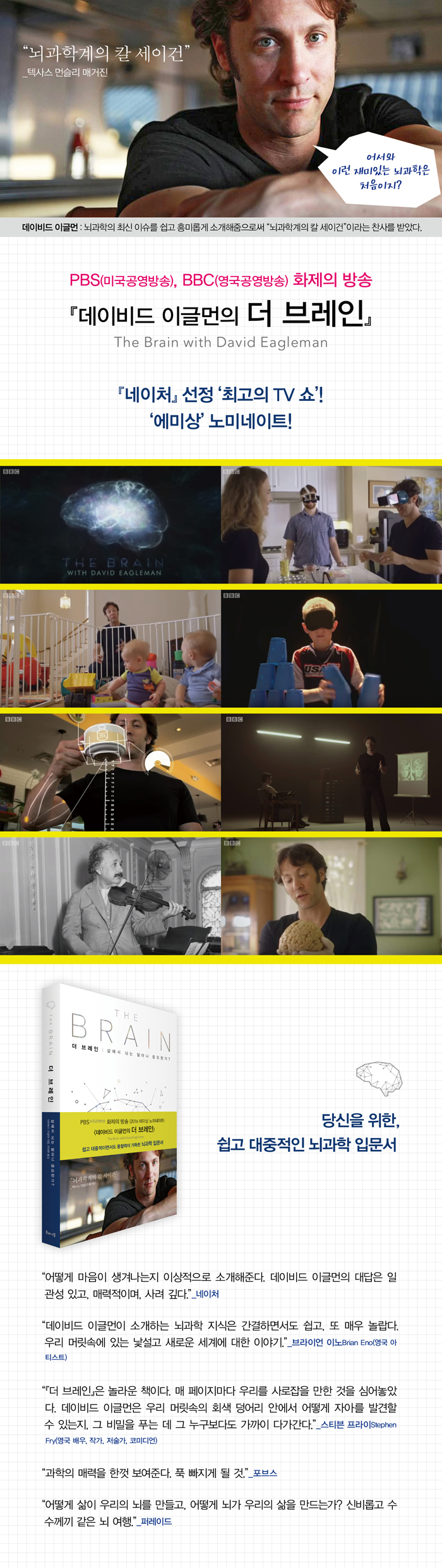
David Eagleman's "The Brain: The Story of You" is a popular science book that draws on cutting-edge neuroscience to explain what the brain does and how it works in an accessible and accessible way. This book recaps the core content of the popular six-part series "The Brain with David Eagleman," which aired on PBS and the BBC.
The author, a renowned neuroscientist and bestselling author, hosted the program and was praised as “the Carl Sagan of neuroscience” for conveying the mysteries of the brain to the general public in a simple and vivid language.
(This TV show was nominated for an Emmy Award in 2016.)
In this book, author David Eagleman introduces brain science in a way that is as accessible as possible to the general public. He focuses on six important questions that everyone is likely to ask at least once in their lives and goes over the answers that brain science provides.
The six questions are:
Who am I? What is reality? Who is in control? How do I decide? Do I need you? What will we become in the future?
In his quest to find answers to these six questions, the author tries on reversed prism goggles, competes in a cup-stacking contest with a 10-year-old boy, crosses the frigid ocean to the prison island of Alcatraz to meet criminals, and flies to Sarajevo to better understand the Bosnian genocide.
It also actively introduces and explains various topics such as extreme sports, sensory deprivation, synesthesia, split-brain surgery, artificial intelligence robots, and cryopreservation of corpses.
Moreover, the author goes beyond simply introducing the latest neuroscience issues. Instead, he presents neuroscience as a useful tool for understanding not only oneself but also others and human life, in a popular yet philosophical style.
The book also includes brilliant insights I've discovered as a neuroscientist, exploring topics such as sensation, identity, self, others, choice, and decision-making.
“There has never been a being like you, nor will there ever be one like you.”
Neuroscience on self, reality, control, others, decision-making, and the future
“We will discover much more about the human brain than our current theories can explain.
Mysteries surround us now.
There are many mysteries we have discovered, but there are also many mysteries we have yet to discover.
“Before us lies a vast sea that has not yet been mapped out on any map.” _ From the text
So, what answers does modern brain science offer to these six questions? According to the author, our identity lies in the brain, where neural networks are constantly reorganized; what we perceive as reality is merely an interpretation of our senses; and what controls us is largely the unconscious, not the conscious.
Additionally, our decisions are driven by physiological responses and desires, and every brain suffers when it is unable to interact with others.
And we are now moving towards an unpredictable future, with sensory augmentation and consciousness uploading.
Specifically, in this book, the author repeatedly emphasizes that 'your brain' is a unique brain.
The author says, “All your senses change the physical structure of your brain.
“The family you were born into, your culture, your friends, your job, the movies you watched, the conversations you had—all of these leave traces on your nervous system,” he says, emphasizing the “individuality” of every brain.
In his words, every brain has its own inner life.
Moreover, because we cannot confidently say that 'your reality' and 'my reality' are the same, the individuality of each 'brain', filled with rich sensory events such as light, sound, and scent, becomes even more prominent.
In addition, various examples are presented to demonstrate that most of our actions, beliefs, and biases are controlled by brain networks that we cannot consciously access.
For example, in one experiment, researchers showed male subjects photographs of women's faces, and these subjects rated women with dilated pupils as more attractive.
The subjects didn't know that dilated pupils were a biological signal of female arousal, but their "brains" knew it.
Similarly, men tipped dancers twice as much when they were ovulating (their fertile period), because they detected these fertility signals with a radar that was lower than their conscious awareness.
So what happens when we make decisions? The author explains that emotions and physical states play a far more decisive role than we might expect.
For example, if we are not in a state of physical state and emotions such as anxious, excited, embarrassed, or happy, we will fall into a state where we cannot make any decisions.
For example, in the case of Tammy Myers, a brain injury that left her unable to read her body's emotional signals (heartbeat, sweating, muscle tension, etc.), she appeared perfectly fine on the outside, but became mired in indecision, unable to make any decisions.
For her, no choice felt realistically different from the others, so she couldn't make a decision and spent most of the day on the couch.
This book also places great importance on ‘others.’
David Eagleman says, “Each of us is half another person,” emphasizing that we are all innately capable of imitating others, connecting with others, and caring for others.
So what happens when the brain is starved of human contact? Consider the case of Sarah Shud, who was once held captive and held in solitary confinement. Shortly after being cut off from the world, she began hallucinating.
When interaction with others was lost, the brain suffered.
This is because others play a large part in constructing one's identity.
The author describes this situation as follows:
“The self does not exist in a vacuum.”
So, what kind of beings will we become in the future? In this book, the author argues that while our current bodies limit what we can do, if "sensory augmentation" allows the brain to control a new type of body, the reality we inhabit could very well expand.
That is, in the author's view, we are now living in a moment when we are about to surpass the limits of the brain.
Neuroscience and technology are evolving together, and what happens at the intersection of these two fields is poised to transform our very nature.
Perhaps because of this, some people cryopreserve their bodies, believing that future scientists will be able to revive them, while others claim that they will be able to read the data in our brains and upload our consciousness into machines.
In this way, this book explores what it means to live as biological beings with a brain, and what limitations and possibilities we have.
He also suggests that a better understanding of the brain will allow us to answer our own questions about what we perceive as truth, how we educate ourselves, how we relate to others, and what we should do to prepare for the distant future.
Perhaps through this book, readers will be able to capture something they never expected from the countless connections between brain cells.
I'm talking about yourself.
“Who you become is up to you.”
An accessible, popular, and insightful introduction to brain science.
“The brain is the perceptual apparatus we rely on to make sense of the world, the place where our decisions take place, and the foundation on which our imaginations are built.
Our dreams and waking lives arise from the activity of countless brain cells.
In this book, I wanted to focus on how we make decisions, how we perceive reality, who we are, how our lives are orchestrated, why we need others, and where humanity, now that it's just beginning to take control of its own destiny, is headed.
This book does not presuppose any specialized knowledge; only curiosity and a willingness to explore are required.”
_From the text
How important is the brain to life? Though confined within the dark, silent skull, it's a vital organ for understanding the world and creating our own identity.
David Eagleman's "The Brain: The Story of You" is a popular science book that draws on cutting-edge neuroscience to explain what the brain does and how it works in an accessible and accessible way. This book recaps the core content of the popular six-part series "The Brain with David Eagleman," which aired on PBS and the BBC.
The author, a renowned neuroscientist and bestselling author, hosted the program and was praised as “the Carl Sagan of neuroscience” for conveying the mysteries of the brain to the general public in a simple and vivid language.
(This TV show was nominated for an Emmy Award in 2016.)
In this book, author David Eagleman introduces brain science in a way that is as accessible as possible to the general public. He focuses on six important questions that everyone is likely to ask at least once in their lives and goes over the answers that brain science provides.
The six questions are:
Who am I? What is reality? Who is in control? How do I decide? Do I need you? What will we become in the future?
In his quest to find answers to these six questions, the author tries on reversed prism goggles, competes in a cup-stacking contest with a 10-year-old boy, crosses the frigid ocean to the prison island of Alcatraz to meet criminals, and flies to Sarajevo to better understand the Bosnian genocide.
It also actively introduces and explains various topics such as extreme sports, sensory deprivation, synesthesia, split-brain surgery, artificial intelligence robots, and cryopreservation of corpses.
Moreover, the author goes beyond simply introducing the latest neuroscience issues. Instead, he presents neuroscience as a useful tool for understanding not only oneself but also others and human life, in a popular yet philosophical style.
The book also includes brilliant insights I've discovered as a neuroscientist, exploring topics such as sensation, identity, self, others, choice, and decision-making.
“There has never been a being like you, nor will there ever be one like you.”
Neuroscience on self, reality, control, others, decision-making, and the future
“We will discover much more about the human brain than our current theories can explain.
Mysteries surround us now.
There are many mysteries we have discovered, but there are also many mysteries we have yet to discover.
“Before us lies a vast sea that has not yet been mapped out on any map.” _ From the text
So, what answers does modern brain science offer to these six questions? According to the author, our identity lies in the brain, where neural networks are constantly reorganized; what we perceive as reality is merely an interpretation of our senses; and what controls us is largely the unconscious, not the conscious.
Additionally, our decisions are driven by physiological responses and desires, and every brain suffers when it is unable to interact with others.
And we are now moving towards an unpredictable future, with sensory augmentation and consciousness uploading.
Specifically, in this book, the author repeatedly emphasizes that 'your brain' is a unique brain.
The author says, “All your senses change the physical structure of your brain.
“The family you were born into, your culture, your friends, your job, the movies you watched, the conversations you had—all of these leave traces on your nervous system,” he says, emphasizing the “individuality” of every brain.
In his words, every brain has its own inner life.
Moreover, because we cannot confidently say that 'your reality' and 'my reality' are the same, the individuality of each 'brain', filled with rich sensory events such as light, sound, and scent, becomes even more prominent.
In addition, various examples are presented to demonstrate that most of our actions, beliefs, and biases are controlled by brain networks that we cannot consciously access.
For example, in one experiment, researchers showed male subjects photographs of women's faces, and these subjects rated women with dilated pupils as more attractive.
The subjects didn't know that dilated pupils were a biological signal of female arousal, but their "brains" knew it.
Similarly, men tipped dancers twice as much when they were ovulating (their fertile period), because they detected these fertility signals with a radar that was lower than their conscious awareness.
So what happens when we make decisions? The author explains that emotions and physical states play a far more decisive role than we might expect.
For example, if we are not in a state of physical state and emotions such as anxious, excited, embarrassed, or happy, we will fall into a state where we cannot make any decisions.
For example, in the case of Tammy Myers, a brain injury that left her unable to read her body's emotional signals (heartbeat, sweating, muscle tension, etc.), she appeared perfectly fine on the outside, but became mired in indecision, unable to make any decisions.
For her, no choice felt realistically different from the others, so she couldn't make a decision and spent most of the day on the couch.
This book also places great importance on ‘others.’
David Eagleman says, “Each of us is half another person,” emphasizing that we are all innately capable of imitating others, connecting with others, and caring for others.
So what happens when the brain is starved of human contact? Consider the case of Sarah Shud, who was once held captive and held in solitary confinement. Shortly after being cut off from the world, she began hallucinating.
When interaction with others was lost, the brain suffered.
This is because others play a large part in constructing one's identity.
The author describes this situation as follows:
“The self does not exist in a vacuum.”
So, what kind of beings will we become in the future? In this book, the author argues that while our current bodies limit what we can do, if "sensory augmentation" allows the brain to control a new type of body, the reality we inhabit could very well expand.
That is, in the author's view, we are now living in a moment when we are about to surpass the limits of the brain.
Neuroscience and technology are evolving together, and what happens at the intersection of these two fields is poised to transform our very nature.
Perhaps because of this, some people cryopreserve their bodies, believing that future scientists will be able to revive them, while others claim that they will be able to read the data in our brains and upload our consciousness into machines.
In this way, this book explores what it means to live as biological beings with a brain, and what limitations and possibilities we have.
He also suggests that a better understanding of the brain will allow us to answer our own questions about what we perceive as truth, how we educate ourselves, how we relate to others, and what we should do to prepare for the distant future.
Perhaps through this book, readers will be able to capture something they never expected from the countless connections between brain cells.
I'm talking about yourself.
GOODS SPECIFICS
- Date of issue: July 25, 2017
- Page count, weight, size: 328 pages | 536g | 140*220*30mm
- ISBN13: 9788956057293
- ISBN10: 895605729X
You may also like
카테고리
korean


korean

![GQ KOREA Mark (Monthly): December [2025]](http://librairie.coreenne.fr/cdn/shop/files/8ef265dbbfbf186523ed75ba7319009d.jpg?v=1765340328&width=3840)


