

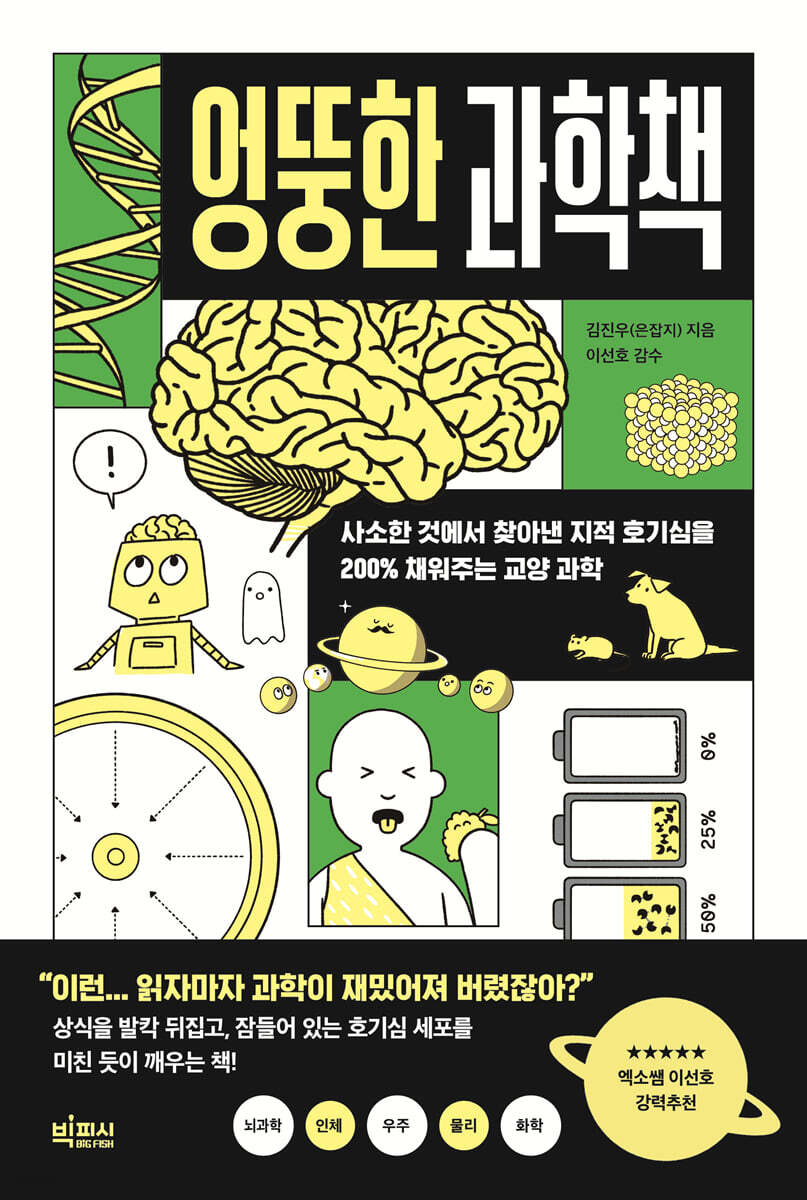
Odd Science Book
 |
Description
Book Introduction
“Oh my… As soon as I started reading, science became fun.”
A book that will turn common sense upside down and awaken your dormant curiosity cells like crazy!
The first book of "Secret Miscellaneous Knowledge," which has nurtured 420,000 science nerds, has finally been published.
'Hidden Miscellaneous Knowledge' is renowned for its easy and fun storytelling of scientific principles hidden in everyday life.
He is also famous for accurately conveying scientific facts without error, to the point that teachers show students videos from the magazine during school classes.
“If you drill a hole in the ground on Earth, can you travel to the other side?” “Why do we get drunk so quickly when we drink during the day?” “Why are all the planets in space round?” etc. Through questions that everyone has wondered at least once, the core of scientific knowledge such as ‘brain science, medicine, astronomy, physics, and chemistry’ is explained in an easy-to-understand way.
For readers who are not very knowledgeable about science but want to learn about it easily or are looking for a science book to read with their children, 『The Odd Science Book』 will be a great introduction to building scientific knowledge.
A book that will turn common sense upside down and awaken your dormant curiosity cells like crazy!
The first book of "Secret Miscellaneous Knowledge," which has nurtured 420,000 science nerds, has finally been published.
'Hidden Miscellaneous Knowledge' is renowned for its easy and fun storytelling of scientific principles hidden in everyday life.
He is also famous for accurately conveying scientific facts without error, to the point that teachers show students videos from the magazine during school classes.
“If you drill a hole in the ground on Earth, can you travel to the other side?” “Why do we get drunk so quickly when we drink during the day?” “Why are all the planets in space round?” etc. Through questions that everyone has wondered at least once, the core of scientific knowledge such as ‘brain science, medicine, astronomy, physics, and chemistry’ is explained in an easy-to-understand way.
For readers who are not very knowledgeable about science but want to learn about it easily or are looking for a science book to read with their children, 『The Odd Science Book』 will be a great introduction to building scientific knowledge.
- You can preview some of the book's contents.
Preview
index
Prologue│The Science Story You Never Knew Was Hidden in Odd Questions
PART 01.
The mysteries of the human body that everyone has wondered about at least once in their lives.
Could a brain transplant also transfer memories?
Why do I always lose when I watch a game and cheer for my team?
Why does the phenomenon of something floating in front of one's eyes occur?
Why are we addicted to sweets?
Why does it suddenly feel like someone is there?
Why do I feel sicker at night than during the day?
Why does our body feel itchy?
Why does the brain have wrinkles?
Why was humanity able to conquer the Earth?
You can taste it with your testicles?
What happens if you don't sleep?
Scientific reasons why I am a road idiot?
Why do fists come out slowly in dreams?
Why do mosquitoes suddenly disappear from sight?
PART 02.
The more you know, the more wondrous the mysteries of the universe become.
What happens if you vomit in space?
Why are there no heart-shaped planets?
If there is a bright sun, why is the universe dark?
Could we throw all our trash into a volcano and have it melt away?
If you dig a hole in the ground, can you get to the other side of the world?
Is it possible to grow potatoes on Mars like in the movies?
Can we use Wi-Fi in space?
What if Earth had rings like Saturn?
What happens when you are exposed to radiation?
Why do typhoons always come in summer and fall?
Why doesn't our country have oil?
Why does lightning strike in a zigzag pattern?
PART 03.
Secrets of our body that will surprise you when you know them
Where does something go when it gets into your eye?
What was the first infectious disease eradicated by humans?
What happens if you stay in the water?
Why is pee harder to hold than poop?
Is it okay to drink the blood that has been shed when there is excessive bleeding?
If I keep holding my breath, will I eventually die?
Why is my nose blocked on only one side?
Why do I taste blood in my throat when I run?
Are silent farts really that bad?
Can people hibernate?
If I watch a lot of porn, will my hair grow faster?
Why is marriage between family members prohibited?
How does exercise make muscles grow?
What happens if you don't blink?
PART 04.
The working principles of things that are around us but we didn't know about
How does noise cancellation eliminate ambient noise?
Why does my smartphone's battery life decrease as I use it?
Is there a way to turn a boiled egg back into a raw egg?
How can a breathalyzer detect alcohol consumption just by blowing on it?
Pencils can be erased with an eraser, but why can't ballpoint pens be erased with an eraser?
Is it true that birds hear what is said during the day and rats hear what is said at night?
Who the hell turns the streetlights on and off?
Why do I feel like I'm floating when I ride an amusement park ride?
How do X-rays show the inside of the body?
How can you get warm just by shaking a hot pack?
How can you tell if you're pregnant from your urine?
If I turn up the air conditioner temperature in the winter, will it be warmer?
Why doesn't the salt in the oil dissolve?
Why are revolving doors installed at the entrances of high-rise buildings?
PART 05.
Quirky and quirky science facts about odd questions
Why can't I urinate in a public restroom when there are a lot of people?
Can you dodge an incoming bullet by seeing it with your eyes?
What happens if you keep looking at the sun?
Why does my nose run when I eat spicy food?
If I run without stopping, will my heart burst?
If a person falls into magma, will their body float?
Why do I get drunk so quickly when I drink during the day?
If you get burned by going into boiling water, why is it okay to go into a sauna?
Why do my joints hurt when it rains?
The scientific reason why you can't help but hate cucumbers?
How is human gender determined?
References
PART 01.
The mysteries of the human body that everyone has wondered about at least once in their lives.
Could a brain transplant also transfer memories?
Why do I always lose when I watch a game and cheer for my team?
Why does the phenomenon of something floating in front of one's eyes occur?
Why are we addicted to sweets?
Why does it suddenly feel like someone is there?
Why do I feel sicker at night than during the day?
Why does our body feel itchy?
Why does the brain have wrinkles?
Why was humanity able to conquer the Earth?
You can taste it with your testicles?
What happens if you don't sleep?
Scientific reasons why I am a road idiot?
Why do fists come out slowly in dreams?
Why do mosquitoes suddenly disappear from sight?
PART 02.
The more you know, the more wondrous the mysteries of the universe become.
What happens if you vomit in space?
Why are there no heart-shaped planets?
If there is a bright sun, why is the universe dark?
Could we throw all our trash into a volcano and have it melt away?
If you dig a hole in the ground, can you get to the other side of the world?
Is it possible to grow potatoes on Mars like in the movies?
Can we use Wi-Fi in space?
What if Earth had rings like Saturn?
What happens when you are exposed to radiation?
Why do typhoons always come in summer and fall?
Why doesn't our country have oil?
Why does lightning strike in a zigzag pattern?
PART 03.
Secrets of our body that will surprise you when you know them
Where does something go when it gets into your eye?
What was the first infectious disease eradicated by humans?
What happens if you stay in the water?
Why is pee harder to hold than poop?
Is it okay to drink the blood that has been shed when there is excessive bleeding?
If I keep holding my breath, will I eventually die?
Why is my nose blocked on only one side?
Why do I taste blood in my throat when I run?
Are silent farts really that bad?
Can people hibernate?
If I watch a lot of porn, will my hair grow faster?
Why is marriage between family members prohibited?
How does exercise make muscles grow?
What happens if you don't blink?
PART 04.
The working principles of things that are around us but we didn't know about
How does noise cancellation eliminate ambient noise?
Why does my smartphone's battery life decrease as I use it?
Is there a way to turn a boiled egg back into a raw egg?
How can a breathalyzer detect alcohol consumption just by blowing on it?
Pencils can be erased with an eraser, but why can't ballpoint pens be erased with an eraser?
Is it true that birds hear what is said during the day and rats hear what is said at night?
Who the hell turns the streetlights on and off?
Why do I feel like I'm floating when I ride an amusement park ride?
How do X-rays show the inside of the body?
How can you get warm just by shaking a hot pack?
How can you tell if you're pregnant from your urine?
If I turn up the air conditioner temperature in the winter, will it be warmer?
Why doesn't the salt in the oil dissolve?
Why are revolving doors installed at the entrances of high-rise buildings?
PART 05.
Quirky and quirky science facts about odd questions
Why can't I urinate in a public restroom when there are a lot of people?
Can you dodge an incoming bullet by seeing it with your eyes?
What happens if you keep looking at the sun?
Why does my nose run when I eat spicy food?
If I run without stopping, will my heart burst?
If a person falls into magma, will their body float?
Why do I get drunk so quickly when I drink during the day?
If you get burned by going into boiling water, why is it okay to go into a sauna?
Why do my joints hurt when it rains?
The scientific reason why you can't help but hate cucumbers?
How is human gender determined?
References
Detailed image

Into the book
We live our lives with many questions, even in our daily lives.
But because it's so trivial or you think it's a stupid question, you don't ask anyone and you just pass it by without knowing the answer.
"The Odd Science Book" is a book that answers these questions and helps you see the world from a new perspective.
It will make you realize how easy and fun science, which may seem difficult and complicated, is actually.
"The Odd Science Book" contains not the rigid theories you learn in textbooks, but rather scientific stories that are closely related to everyday life and that anyone can relate to and have thought about at least once.
Above all, we made maximum use of photos and illustrations so that even those who are not interested in science can understand at a glance, and we wrote the text so that difficult scientific terms are explained separately through a glossary to help the reader understand the text as much as possible.
--- From "Prologue | The Science Story You Didn't Know Hidden in Odd Questions"
Taste receptors are found not only on the tongue, but also in the digestive tract, respiratory tract, and testicles.
Taste receptors in the intestines help us detect sweetness and help us absorb glucose better, while taste receptors in the airways and lungs detect bitterness and activate cells that protect us from harmful substances.
It is said that taste receptors in the testes play a role in producing healthy sperm and controlling sperm quantity.
Even sperm produced this way have taste receptors that can sense taste.
Although there are taste receptors in many organs of the body, including the testicles, they are not connected to the brain like the taste receptors on the tongue, so we cannot taste them directly.
Moreover, it is said that it is impossible to taste food even if it is placed on the testicles because it is the testicles that sense taste, not the skin that surrounds the testicles called the 'scrotum'.
--- From "Can you taste it with your testicles?"
In the 2015 film The Martian, there is a scene where the protagonist, left alone on Mars, grows potatoes to solve the food problem.
After trial and error, the protagonist succeeds in growing potatoes and is able to survive until rescue arrives.
So, is it actually possible to grow potatoes on Mars? Mars has a very different environment than Earth: atmospheric pressure is 160 times lower, carbon dioxide concentration is high (about 95 percent of the atmosphere), and the average temperature is around -60 degrees Celsius.
Plants need the right amount of light, temperature, moisture, soil, and atmosphere to grow, but Mars does not have these conditions, so it is known that plants cannot grow there.
However, potatoes appear to have some potential, as they are one of the representative famine relief crops that grow well even under adverse conditions.
--- From "Is it possible to grow potatoes on Mars like in the movies?"
The inoculation method and the cowpox method, which are used to inoculate people to prevent smallpox, are collectively called the 'smallpox method.'
In Korea, Jeong Yak-yong and Park Je-ga widely promoted the importance of the inoculation method introduced from China, and the cowpox method was introduced through the efforts of medical doctor Ji Seok-yeong.
The World Health Organization launched an operation to eradicate the smallpox virus through a smallpox vaccine.
Since smallpox does not affect animals other than humans, if all humans on Earth were vaccinated and developed immunity, smallpox would completely disappear.
If an epidemic broke out, a system was set up to receive reports within a week, and when a smallpox outbreak began, treatment was gradually carried out in a wider area centered on that area.
Additionally, when a smallpox patient occurred, everyone living in the area, even those who had previously received the smallpox vaccine, was vaccinated again without exception, thereby eradicating the smallpox epidemic.
--- From "What was the first infectious disease eradicated by mankind?"
Active noise cancellation, which uses waves to block out noise, is the technology commonly referred to as noise cancellation. It is a technology that emits sound that is opposite to the sound transmitted through the earphones, ultimately eliminating that sound.
For example, if someone pushes a rock with a force of 10, the rock will be pushed.
Let's define the noise as the rock being pushed like this.
But if I push the rock with the same force of 10 from the opposite side, the rock will not be pushed and will remain still.
If you push with the same force, there will be no noise.
This is how noise canceling works.
--- From "How does noise canceling eliminate ambient noise?"
The reason they dislike cucumbers is because of the unique taste and smell they give off.
The bitter taste you feel when you eat a cucumber is due to a component called 'cucurbitacin' found at both ends of the cucumber.
Cucurbitacin is a type of steroid found in cucurbitaceous plants and is found not only in cucumbers but also in plants such as watermelon and melon.
Cucurbitacins are not only bitter but also toxic, and experiments on rats have shown that cucurbitacins can cause death when eaten.
In other words, the reason plants have cucurbitacin is to protect themselves from pests and animals.
In a similar vein, the caffeine in coffee is a toxic substance created by plants to protect themselves from natural enemies.
But because it's so trivial or you think it's a stupid question, you don't ask anyone and you just pass it by without knowing the answer.
"The Odd Science Book" is a book that answers these questions and helps you see the world from a new perspective.
It will make you realize how easy and fun science, which may seem difficult and complicated, is actually.
"The Odd Science Book" contains not the rigid theories you learn in textbooks, but rather scientific stories that are closely related to everyday life and that anyone can relate to and have thought about at least once.
Above all, we made maximum use of photos and illustrations so that even those who are not interested in science can understand at a glance, and we wrote the text so that difficult scientific terms are explained separately through a glossary to help the reader understand the text as much as possible.
--- From "Prologue | The Science Story You Didn't Know Hidden in Odd Questions"
Taste receptors are found not only on the tongue, but also in the digestive tract, respiratory tract, and testicles.
Taste receptors in the intestines help us detect sweetness and help us absorb glucose better, while taste receptors in the airways and lungs detect bitterness and activate cells that protect us from harmful substances.
It is said that taste receptors in the testes play a role in producing healthy sperm and controlling sperm quantity.
Even sperm produced this way have taste receptors that can sense taste.
Although there are taste receptors in many organs of the body, including the testicles, they are not connected to the brain like the taste receptors on the tongue, so we cannot taste them directly.
Moreover, it is said that it is impossible to taste food even if it is placed on the testicles because it is the testicles that sense taste, not the skin that surrounds the testicles called the 'scrotum'.
--- From "Can you taste it with your testicles?"
In the 2015 film The Martian, there is a scene where the protagonist, left alone on Mars, grows potatoes to solve the food problem.
After trial and error, the protagonist succeeds in growing potatoes and is able to survive until rescue arrives.
So, is it actually possible to grow potatoes on Mars? Mars has a very different environment than Earth: atmospheric pressure is 160 times lower, carbon dioxide concentration is high (about 95 percent of the atmosphere), and the average temperature is around -60 degrees Celsius.
Plants need the right amount of light, temperature, moisture, soil, and atmosphere to grow, but Mars does not have these conditions, so it is known that plants cannot grow there.
However, potatoes appear to have some potential, as they are one of the representative famine relief crops that grow well even under adverse conditions.
--- From "Is it possible to grow potatoes on Mars like in the movies?"
The inoculation method and the cowpox method, which are used to inoculate people to prevent smallpox, are collectively called the 'smallpox method.'
In Korea, Jeong Yak-yong and Park Je-ga widely promoted the importance of the inoculation method introduced from China, and the cowpox method was introduced through the efforts of medical doctor Ji Seok-yeong.
The World Health Organization launched an operation to eradicate the smallpox virus through a smallpox vaccine.
Since smallpox does not affect animals other than humans, if all humans on Earth were vaccinated and developed immunity, smallpox would completely disappear.
If an epidemic broke out, a system was set up to receive reports within a week, and when a smallpox outbreak began, treatment was gradually carried out in a wider area centered on that area.
Additionally, when a smallpox patient occurred, everyone living in the area, even those who had previously received the smallpox vaccine, was vaccinated again without exception, thereby eradicating the smallpox epidemic.
--- From "What was the first infectious disease eradicated by mankind?"
Active noise cancellation, which uses waves to block out noise, is the technology commonly referred to as noise cancellation. It is a technology that emits sound that is opposite to the sound transmitted through the earphones, ultimately eliminating that sound.
For example, if someone pushes a rock with a force of 10, the rock will be pushed.
Let's define the noise as the rock being pushed like this.
But if I push the rock with the same force of 10 from the opposite side, the rock will not be pushed and will remain still.
If you push with the same force, there will be no noise.
This is how noise canceling works.
--- From "How does noise canceling eliminate ambient noise?"
The reason they dislike cucumbers is because of the unique taste and smell they give off.
The bitter taste you feel when you eat a cucumber is due to a component called 'cucurbitacin' found at both ends of the cucumber.
Cucurbitacin is a type of steroid found in cucurbitaceous plants and is found not only in cucumbers but also in plants such as watermelon and melon.
Cucurbitacins are not only bitter but also toxic, and experiments on rats have shown that cucurbitacins can cause death when eaten.
In other words, the reason plants have cucurbitacin is to protect themselves from pests and animals.
In a similar vein, the caffeine in coffee is a toxic substance created by plants to protect themselves from natural enemies.
--- From "Scientific Reasons Why You Can't Help But Hate Cucumbers"
Publisher's Review
★Highly recommended by science communicator EXO Teacher Lee Seon-ho!
★Eun Magazine, the popular channel that created 420,000 science nerds
★Publication requests flooding in! The science channel trusted and shown in schools!
√ Will you get motion sickness in space?
√ Why do I feel sicker at night than during the day?
√ Can we throw trash into a volcano and have it all melt away?
√ Why does the brain have wrinkles?
From the recent global AI craze to the climate crisis threatening the future of humanity, it's nearly impossible to truly understand our rapidly changing world without a basic understanding of science.
To truly understand the increasingly complex world, we need to understand the scientific principles behind it.
However, most people think that science is not fun because they learned 'water, chemistry, life, and earth' from rigid textbooks during their school days, or they have lived their whole lives as 'science illiterate' and are at a loss as to where to start studying science.
"Secret Miscellaneous Knowledge," which appeared like a comet on the knowledge channel world, broke the prejudice of people who thought science was difficult and boring and created 420,000 science nerds.
In 'Eun Magazine', for those who find formulas confusing, scientific knowledge is explained in an easy-to-understand way using cute illustrations instead of difficult scientific symbols.
The magazine's intriguing storytelling is packed with scientific principles, leading to a flurry of reviews from subscribers, such as, "I wish Eun Magazine was my science teacher" and "Thanks to Eun Magazine, I can easily understand scientific content when reading newspaper articles."
“This is the first science book that makes me curious about the next page!”
Discover 100% pure, real science that you'll never find in textbooks!
★★★“Wow, thank you so much for answering only the questions I was really curious about!”
★★★“I first started reading it as a school assignment, and it was so fun that I finished it in no time!”
★★★“Wow, so much scientific knowledge can be packed into one book!”
'Eun Magazine', which unravels scientific knowledge through interesting storytelling, has become a popular channel among parents as a channel that quickly awakens the charm of science even for children who are not interested in science.
In addition, it is also famous as a YouTube channel that school teachers show to students during class. The reason it was able to gain the trust of subscribers is because it creates high-quality content by going through a process of multiple reviews to ensure that there are no errors in the scientific knowledge it introduces.
In fact, it is said that they spare no effort in searching for various overseas papers and the latest materials to create a single video.
Among the videos that were carefully produced one by one, the 'Legendary Science Questions' that received great responses from subscribers and received over 2 million views were collected to create 'The Odd Science Book'.
“Can we melt all the trash by throwing it into a volcano?” “Can people hibernate?” “What happens if you keep looking at the sun?” This book covers the science stories hidden in our daily lives through questions that everyone has thought about at least once in their lives.
Covering a wide range of fields including 'brain science, human body, space, physics, and chemistry', 'The Odd Science Book' contains only the essential scientific knowledge that is essential to know in this day and age, as if 100 science books were compressed into one volume, and is packed with essential scientific concepts.
Additionally, this book includes over 150 illustrations and explanations of scientific terms to help readers understand the content more easily.
Here, Dr. Lee Seon-ho, a graduate of Seoul National University College of Medicine and famous as a science mentor for elementary school students under the name of 'Exo Teacher', took on the role of reviewer of 'The Odd Science Book', thereby increasing the completeness of the book.
★Brain Science X Human Body X Space X Physics X Chemistry★
An outrageous question thrown from the corner of the room
Stretching out from DNA to the universe without hesitation!
This book is divided into five parts.
The first part covers brain science, which still has much to be discovered.
From the 'presence phenomenon', which makes you feel like someone is there when no one is there, to 'phantom pain', which makes you feel an itch in a severed body part, readers are invited into the amazing world of brain science.
The second part takes us on a journey into the vastness of space, a world still unknown.
Just reading the titles, such as 'Will you get motion sickness in space?' and 'Is it possible to grow potatoes on Mars?', is enough to pique your curiosity.
The third part covers various common sense concepts about the human body, assuming how our bodies react in extreme environments, such as 'What happens if you stay underwater for a long time?'
The fourth part reveals the scientific principles behind everyday objects, such as smartphone batteries and noise-canceling earphones.
Finally, the fifth part contains scientific facts that are even more interesting once you know them, such as whether it is true that drinking during the day makes you drunk quickly and why some people dislike cucumbers.
"The Odd Science Book" instantly immerses readers into the world of science they would never see in textbooks. It is a book that is both fun and educational, so that even readers with a strong scientific curiosity and those in the liberal arts who have no interest in science at all can read it without realizing the passage of time.
Reading just this one book feels like reading 100 science books!
A captivating and engaging educational storytelling!
Knowing science is like having a lens that allows you to see the world 180 degrees differently.
When we see news stories like 'radioactive leak damage,' 'Elon Musk's plan to colonize Mars,' or 'electric car battery explosion accidents,' to people without a scientific background, they just seem like simple news.
But if you knew how serious a radiation leak is, what conditions would be needed for humans to live on Mars, and how electric car batteries work, you could see the world in a completely different light.
The more we learn about the science hidden in our daily lives, the more we can predict how the world will change in the future based on scientific thinking.
It is no exaggeration to say that there is nothing in the world we live in today that can be understood without knowing science.
"The Odd Science Book" is a book that helps us understand the world we live in more precisely, from artificial intelligence to the climate crisis, through the lens of science.
I hope that even readers who weren't able to become familiar with science during their school days will find it interesting again through this book.
★Eun Magazine, the popular channel that created 420,000 science nerds
★Publication requests flooding in! The science channel trusted and shown in schools!
√ Will you get motion sickness in space?
√ Why do I feel sicker at night than during the day?
√ Can we throw trash into a volcano and have it all melt away?
√ Why does the brain have wrinkles?
From the recent global AI craze to the climate crisis threatening the future of humanity, it's nearly impossible to truly understand our rapidly changing world without a basic understanding of science.
To truly understand the increasingly complex world, we need to understand the scientific principles behind it.
However, most people think that science is not fun because they learned 'water, chemistry, life, and earth' from rigid textbooks during their school days, or they have lived their whole lives as 'science illiterate' and are at a loss as to where to start studying science.
"Secret Miscellaneous Knowledge," which appeared like a comet on the knowledge channel world, broke the prejudice of people who thought science was difficult and boring and created 420,000 science nerds.
In 'Eun Magazine', for those who find formulas confusing, scientific knowledge is explained in an easy-to-understand way using cute illustrations instead of difficult scientific symbols.
The magazine's intriguing storytelling is packed with scientific principles, leading to a flurry of reviews from subscribers, such as, "I wish Eun Magazine was my science teacher" and "Thanks to Eun Magazine, I can easily understand scientific content when reading newspaper articles."
“This is the first science book that makes me curious about the next page!”
Discover 100% pure, real science that you'll never find in textbooks!
★★★“Wow, thank you so much for answering only the questions I was really curious about!”
★★★“I first started reading it as a school assignment, and it was so fun that I finished it in no time!”
★★★“Wow, so much scientific knowledge can be packed into one book!”
'Eun Magazine', which unravels scientific knowledge through interesting storytelling, has become a popular channel among parents as a channel that quickly awakens the charm of science even for children who are not interested in science.
In addition, it is also famous as a YouTube channel that school teachers show to students during class. The reason it was able to gain the trust of subscribers is because it creates high-quality content by going through a process of multiple reviews to ensure that there are no errors in the scientific knowledge it introduces.
In fact, it is said that they spare no effort in searching for various overseas papers and the latest materials to create a single video.
Among the videos that were carefully produced one by one, the 'Legendary Science Questions' that received great responses from subscribers and received over 2 million views were collected to create 'The Odd Science Book'.
“Can we melt all the trash by throwing it into a volcano?” “Can people hibernate?” “What happens if you keep looking at the sun?” This book covers the science stories hidden in our daily lives through questions that everyone has thought about at least once in their lives.
Covering a wide range of fields including 'brain science, human body, space, physics, and chemistry', 'The Odd Science Book' contains only the essential scientific knowledge that is essential to know in this day and age, as if 100 science books were compressed into one volume, and is packed with essential scientific concepts.
Additionally, this book includes over 150 illustrations and explanations of scientific terms to help readers understand the content more easily.
Here, Dr. Lee Seon-ho, a graduate of Seoul National University College of Medicine and famous as a science mentor for elementary school students under the name of 'Exo Teacher', took on the role of reviewer of 'The Odd Science Book', thereby increasing the completeness of the book.
★Brain Science X Human Body X Space X Physics X Chemistry★
An outrageous question thrown from the corner of the room
Stretching out from DNA to the universe without hesitation!
This book is divided into five parts.
The first part covers brain science, which still has much to be discovered.
From the 'presence phenomenon', which makes you feel like someone is there when no one is there, to 'phantom pain', which makes you feel an itch in a severed body part, readers are invited into the amazing world of brain science.
The second part takes us on a journey into the vastness of space, a world still unknown.
Just reading the titles, such as 'Will you get motion sickness in space?' and 'Is it possible to grow potatoes on Mars?', is enough to pique your curiosity.
The third part covers various common sense concepts about the human body, assuming how our bodies react in extreme environments, such as 'What happens if you stay underwater for a long time?'
The fourth part reveals the scientific principles behind everyday objects, such as smartphone batteries and noise-canceling earphones.
Finally, the fifth part contains scientific facts that are even more interesting once you know them, such as whether it is true that drinking during the day makes you drunk quickly and why some people dislike cucumbers.
"The Odd Science Book" instantly immerses readers into the world of science they would never see in textbooks. It is a book that is both fun and educational, so that even readers with a strong scientific curiosity and those in the liberal arts who have no interest in science at all can read it without realizing the passage of time.
Reading just this one book feels like reading 100 science books!
A captivating and engaging educational storytelling!
Knowing science is like having a lens that allows you to see the world 180 degrees differently.
When we see news stories like 'radioactive leak damage,' 'Elon Musk's plan to colonize Mars,' or 'electric car battery explosion accidents,' to people without a scientific background, they just seem like simple news.
But if you knew how serious a radiation leak is, what conditions would be needed for humans to live on Mars, and how electric car batteries work, you could see the world in a completely different light.
The more we learn about the science hidden in our daily lives, the more we can predict how the world will change in the future based on scientific thinking.
It is no exaggeration to say that there is nothing in the world we live in today that can be understood without knowing science.
"The Odd Science Book" is a book that helps us understand the world we live in more precisely, from artificial intelligence to the climate crisis, through the lens of science.
I hope that even readers who weren't able to become familiar with science during their school days will find it interesting again through this book.
GOODS SPECIFICS
- Date of issue: November 20, 2024
- Page count, weight, size: 336 pages | 586g | 148*220*22mm
- ISBN13: 9791194033400
- ISBN10: 1194033407
You may also like
카테고리
korean


korean

![GQ KOREA Mark (Monthly): December [2025]](http://librairie.coreenne.fr/cdn/shop/files/8ef265dbbfbf186523ed75ba7319009d.jpg?v=1765340328&width=3840)


