

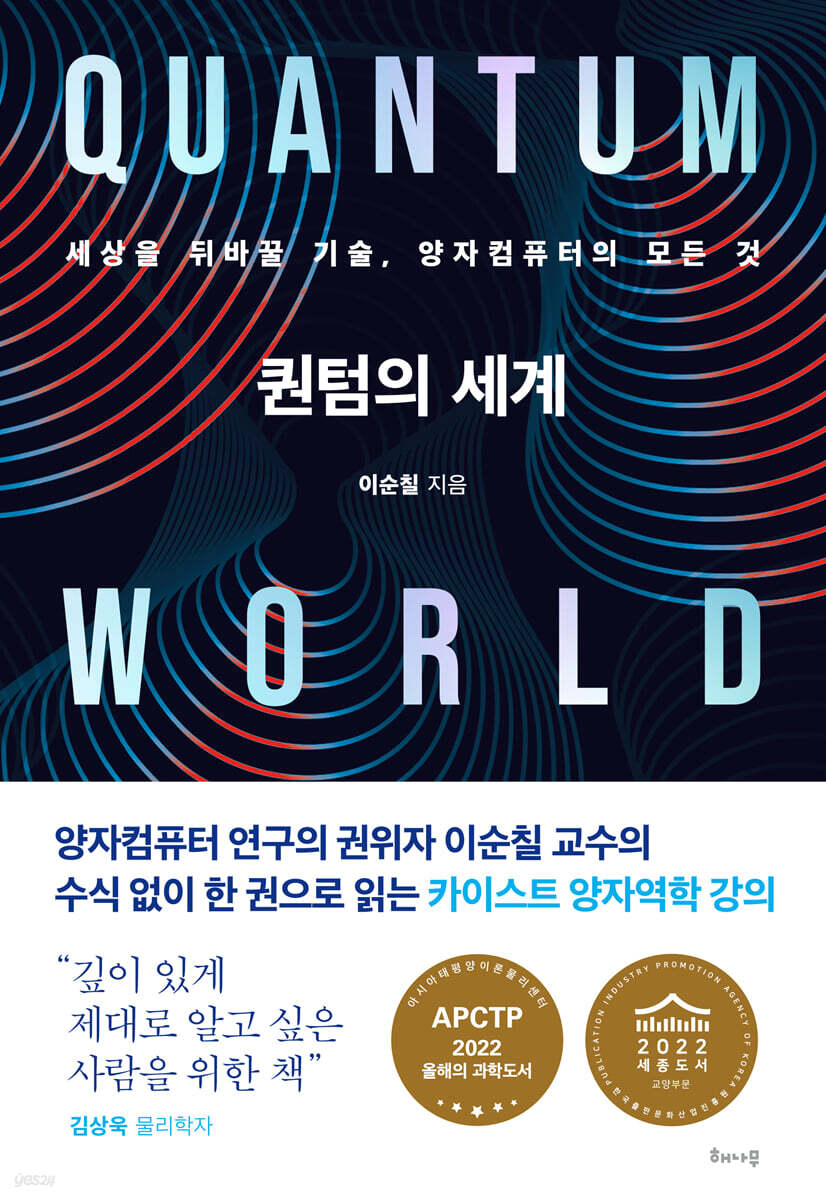
The World of Quantum
 |
Description
Book Introduction
An introductory textbook on quantum mechanics and quantum computing written by Professor Lee Soon-chil of KAIST, Korea's leading authority on quantum computing research. This book is designed to faithfully explain and easily understand the principles and uses of quantum computers to readers without specialized knowledge. Everything you need to know about quantum computers, from the basics of quantum mechanics to the cutting edge of quantum information technology, is included. Professor Lee Soon-chil is a first-generation quantum information researcher in Korea. He is recognized as “the physicist who pioneered quantum computer research in Korea” for developing the first parallel processing quantum computer in Korea. This book contains the essence of the author's 30-year-long lectures on quantum mechanics at KAIST, transforming quantum mechanics and quantum computers, which may seem difficult to understand, into easy-to-understand and engaging subjects. Through creative metaphors and engaging storytelling, the amazing phenomena of the world of quantum information are explained in a way that anyone who knows the four basic arithmetic operations can understand. Quantum computers will definitely be created someday. Quantum computers are now a knowledge that we all need to know, as they are a technology that will shake up the entire foundation of the world once they are developed. While we've encountered numerous quantum computing issues over the years, there have been few opportunities to truly delve into their essence. This book will be a valuable opportunity for readers who have been thirsty for a deeper understanding of this future technology. |
- You can preview some of the book's contents.
Preview
index
Prologue | AD 2037
Part 1: First Seminar | The Golden Age of Quantum
Chapter 1 | Quantum Physics Doesn't Make Sense
Chapter 2 | The Birth of Quantum Physics
Chapter 3 | Wave Nature of Particles
Chapter 4 | Superposition and the Basic Hypothesis
Chapter 5 | Uncertainty Principle
Part 2, Second Seminar | The Dark Ages of Quantum
Chapter 6 | Entanglement
Chapter 7 | The Dark Ages
Part 3, Third Seminar | The Renaissance of Quantum
Chapter 8 | The Birth of Quantum Information Technology
Chapter 9 | Teleportation
Chapter 10 | The Emergence of Quantum Computers
Chapter 11 | Basic Operations of Quantum Computers
Chapter 12 | Quantum Computer Hardware
Chapter 13 | Quantum Computer Software
Part 4, Fourth Seminar | Password
Chapter 14 | The Story of Passwords
Chapter 15 | Grover's Data Search Algorithm
Chapter 16 | Quantum Cryptography
Part 5, Seminar 5 | The Present and Future of Quantum Computers
Chapter 17 | The Current State of Quantum Technology
Chapter 18 | The Future of Quantum Technology
Epilogue | Late 2037 AD
Acknowledgements
supplement
Search
Part 1: First Seminar | The Golden Age of Quantum
Chapter 1 | Quantum Physics Doesn't Make Sense
Chapter 2 | The Birth of Quantum Physics
Chapter 3 | Wave Nature of Particles
Chapter 4 | Superposition and the Basic Hypothesis
Chapter 5 | Uncertainty Principle
Part 2, Second Seminar | The Dark Ages of Quantum
Chapter 6 | Entanglement
Chapter 7 | The Dark Ages
Part 3, Third Seminar | The Renaissance of Quantum
Chapter 8 | The Birth of Quantum Information Technology
Chapter 9 | Teleportation
Chapter 10 | The Emergence of Quantum Computers
Chapter 11 | Basic Operations of Quantum Computers
Chapter 12 | Quantum Computer Hardware
Chapter 13 | Quantum Computer Software
Part 4, Fourth Seminar | Password
Chapter 14 | The Story of Passwords
Chapter 15 | Grover's Data Search Algorithm
Chapter 16 | Quantum Cryptography
Part 5, Seminar 5 | The Present and Future of Quantum Computers
Chapter 17 | The Current State of Quantum Technology
Chapter 18 | The Future of Quantum Technology
Epilogue | Late 2037 AD
Acknowledgements
supplement
Search
Detailed image
.jpg)
Into the book
“There are two and a half important messages I want to convey throughout this book, the first of which is that quantum physics, which I am now dedicating precious space to discussing, is something that no one can understand.
If only this fact were conveyed properly, I feel it would have been worth the price of the book.
It's natural that you don't understand, and if you think you understand quantum physics when you read to the end, you haven't read the book properly.
You have to accept that no matter how many times you hear about the taste of an apple, you can never get the feeling of actually eating it.
If you give up on understanding, it might be as fun as reading Alice in Wonderland.”
--- p.31~32, from “Chapter 1”
“Quantum computing is a field of research that combines physics, mathematics, philosophy, electrical engineering, and computer engineering.
…If you try to explain it simply and leave out the essence, you will end up not understanding it properly, so I did not avoid explaining the core topics even if they were difficult.
However, it explains all the knowledge necessary to understand the principles of quantum computers so that it can be read even without prior knowledge.”
--- p.32, from Chapter 1
"Why are we rambling on about how complex and difficult quantum physics is that no one understands it? Readers will now want to challenge themselves to see if they can grasp this difficult subject.
Now, are you ready for the terrifyingly difficult topic? The core of quantum physics, while difficult, is simple.
“Everything in this world is both a particle and a wave.”
--- p.33, from Chapter 2
"How should we understand the superposition of objects? Does it mean that a chair and a desk overlap? How could such a thing even be imagined?
This is where the trouble begins.
“The second most important message I want to convey in this book is about superposition: the reason quantum computers are so dramatically faster than classical computers is because of the superposition properties of the quantum world.”
--- p.73~74, from “Chapter 4”
"If you were to play the tonic chord on a piano in the quantum world, which note would you hear—C, E, or G? According to the fundamental assumptions of quantum physics, which note you hear is completely random.
However, the probability may vary from note to note, but the probability of hearing a sound that is struck hard, that is, a sound with a large amplitude of sound waves, is higher.
Therefore, if you repeatedly play the tonic chord on a piano in the quantum world, you will hear a different note each time.
“Sol, sol, mi, do, sol… … like this.”
--- p.79, from Chapter 4
“Of all the incomprehensible phenomena caused by superposition, entanglement is the most bizarre, the most quantum.
Entanglement creates situations that seem illogical in many ways, which is why quantum information technology feels like science fiction.
…Quantum computing is fast because it utilizes superposition states, and if the algorithm is designed to handle entangled states among the superposition states, classical computers have no way of imitating quantum computers.
The third message the book wants to convey is that the reason quantum computing is faster than classical computing is because it utilizes entanglement, a phenomenon caused by superposition.”
--- p.119, from Chapter 6
“It is said that the EPR paper was accepted for publication the day after it was received and went into print immediately.
The editor who received the paper decided to publish it without even returning it to the editors or reviewers.
How delighted he must have been as an editor to have Einstein's name on the paper.
It would not have been a situation where they would have done something like a verbal and physical examination.
Even if a peer review had been conducted, who would have judged Einstein's paper to be flawed and unpublishable? It's no coincidence that the paper begins on page 777."
--- p.136~137, from Chapter 7
“A colleague of mine who had studied as an international student in the chemical engineering department at Caltech when Feynman was a professor there used to proudly say that Feynman had asked him a question.
I naively wondered what a genius physics professor would ask a chemical engineering graduate student, so I asked my friend what the question was.
Then, the friend said that he happened to run into Feynman on campus, and that Feynman asked him where the student center was.
In fact, Feynman had been working at the university for over 30 years at the time, so he could not have been unaware of where the student union was.
My friend's interpretation was that he was probably lost in thought, walking around campus, and then suddenly came to his senses and couldn't remember where the student union building was."
--- p.172, from Chapter 10
“Of all the presentations I attended at the 2014 American Physical Society, the best was definitely the presentation on quantum annealing calculations.
That's the calculation method that reportedly powers the quantum computer that Canadian company D-Wave sold to Google for $15 million.
…The American Physical Society meets every March, attracting about 10,000 physicists from around the world.
“If someone were to detonate a bomb here, humanity’s level of physics would be set back by ten years.”
--- p.283, from Chapter 17
“Quantum computers are no longer science fiction.
There is no theoretical barrier to creating a quantum computer, so it will be created someday.
However, since it is the ultimate nanotechnology, it is difficult, and we just need to be patient and develop it consistently.”
--- p.301~302, from “Chapter 18”
"Now, readers, do you have a solid understanding of the principles of quantum physics and quantum computers? If not, you've read this book correctly.
That was the case with particle physicist Murray Gell-Mann, who first coined the term quark.
The difference between someone who knows quantum physics and someone who doesn't is greater than the difference between someone who doesn't know and a monkey.
"Anyone who doesn't know quantum physics is no better than a goldfish." Readers who persevere through this book will at least be rewarded with a goldfish-free existence."
If only this fact were conveyed properly, I feel it would have been worth the price of the book.
It's natural that you don't understand, and if you think you understand quantum physics when you read to the end, you haven't read the book properly.
You have to accept that no matter how many times you hear about the taste of an apple, you can never get the feeling of actually eating it.
If you give up on understanding, it might be as fun as reading Alice in Wonderland.”
--- p.31~32, from “Chapter 1”
“Quantum computing is a field of research that combines physics, mathematics, philosophy, electrical engineering, and computer engineering.
…If you try to explain it simply and leave out the essence, you will end up not understanding it properly, so I did not avoid explaining the core topics even if they were difficult.
However, it explains all the knowledge necessary to understand the principles of quantum computers so that it can be read even without prior knowledge.”
--- p.32, from Chapter 1
"Why are we rambling on about how complex and difficult quantum physics is that no one understands it? Readers will now want to challenge themselves to see if they can grasp this difficult subject.
Now, are you ready for the terrifyingly difficult topic? The core of quantum physics, while difficult, is simple.
“Everything in this world is both a particle and a wave.”
--- p.33, from Chapter 2
"How should we understand the superposition of objects? Does it mean that a chair and a desk overlap? How could such a thing even be imagined?
This is where the trouble begins.
“The second most important message I want to convey in this book is about superposition: the reason quantum computers are so dramatically faster than classical computers is because of the superposition properties of the quantum world.”
--- p.73~74, from “Chapter 4”
"If you were to play the tonic chord on a piano in the quantum world, which note would you hear—C, E, or G? According to the fundamental assumptions of quantum physics, which note you hear is completely random.
However, the probability may vary from note to note, but the probability of hearing a sound that is struck hard, that is, a sound with a large amplitude of sound waves, is higher.
Therefore, if you repeatedly play the tonic chord on a piano in the quantum world, you will hear a different note each time.
“Sol, sol, mi, do, sol… … like this.”
--- p.79, from Chapter 4
“Of all the incomprehensible phenomena caused by superposition, entanglement is the most bizarre, the most quantum.
Entanglement creates situations that seem illogical in many ways, which is why quantum information technology feels like science fiction.
…Quantum computing is fast because it utilizes superposition states, and if the algorithm is designed to handle entangled states among the superposition states, classical computers have no way of imitating quantum computers.
The third message the book wants to convey is that the reason quantum computing is faster than classical computing is because it utilizes entanglement, a phenomenon caused by superposition.”
--- p.119, from Chapter 6
“It is said that the EPR paper was accepted for publication the day after it was received and went into print immediately.
The editor who received the paper decided to publish it without even returning it to the editors or reviewers.
How delighted he must have been as an editor to have Einstein's name on the paper.
It would not have been a situation where they would have done something like a verbal and physical examination.
Even if a peer review had been conducted, who would have judged Einstein's paper to be flawed and unpublishable? It's no coincidence that the paper begins on page 777."
--- p.136~137, from Chapter 7
“A colleague of mine who had studied as an international student in the chemical engineering department at Caltech when Feynman was a professor there used to proudly say that Feynman had asked him a question.
I naively wondered what a genius physics professor would ask a chemical engineering graduate student, so I asked my friend what the question was.
Then, the friend said that he happened to run into Feynman on campus, and that Feynman asked him where the student center was.
In fact, Feynman had been working at the university for over 30 years at the time, so he could not have been unaware of where the student union was.
My friend's interpretation was that he was probably lost in thought, walking around campus, and then suddenly came to his senses and couldn't remember where the student union building was."
--- p.172, from Chapter 10
“Of all the presentations I attended at the 2014 American Physical Society, the best was definitely the presentation on quantum annealing calculations.
That's the calculation method that reportedly powers the quantum computer that Canadian company D-Wave sold to Google for $15 million.
…The American Physical Society meets every March, attracting about 10,000 physicists from around the world.
“If someone were to detonate a bomb here, humanity’s level of physics would be set back by ten years.”
--- p.283, from Chapter 17
“Quantum computers are no longer science fiction.
There is no theoretical barrier to creating a quantum computer, so it will be created someday.
However, since it is the ultimate nanotechnology, it is difficult, and we just need to be patient and develop it consistently.”
--- p.301~302, from “Chapter 18”
"Now, readers, do you have a solid understanding of the principles of quantum physics and quantum computers? If not, you've read this book correctly.
That was the case with particle physicist Murray Gell-Mann, who first coined the term quark.
The difference between someone who knows quantum physics and someone who doesn't is greater than the difference between someone who doesn't know and a monkey.
"Anyone who doesn't know quantum physics is no better than a goldfish." Readers who persevere through this book will at least be rewarded with a goldfish-free existence."
--- p.309~310, from “Chapter 18”
Publisher's Review
The quantum age is coming soon!
A book that captures the essence of quantum computing.
★★★★★ 2022 Sejong Book Culture Category
★★★★★ Asia Pacific Center for Theoretical Physics 2022 Science Book of the Year
★★★★★ Highly recommended by Professors Jeong Jae-seung, Kim Sang-wook, and Kim Jae-wan
★★★★★ Sylvia Sorkin Greenfield Award Winner
★★★★★ Development of Korea's first parallel processing quantum computer
Professor Jeong Jae-seung taught quantum mechanics to Professor Kim Sang-wook.
Korea's leading authority on quantum computer research
Understanding Quantum Computers Without Equations by Professor Lee Soon-chil of KAIST
“I learned quantum mechanics from Professor Lee Soon-chil.
The lectures were published as a book.
“Everything about quantum mechanics is explained in an interesting way with ingenious analogies.”
Jaeseung Jeong (neuroscientist, author of "Jaeseung Jeong's Science Concert" and "Twelve Footsteps")
“I learned quantum mechanics by listening to the author’s lectures.
From the fundamentals of quantum mechanics to the cutting edge of quantum information.
“This book is for those who want to know deeply and properly.”
Kim Sang-wook (physicist, author of "Trembling and Echoing" and "Kim Sang-wook's Quantum Studies")
An introductory textbook on quantum mechanics and quantum computing written by Professor Lee Soon-chil of KAIST, Korea's leading authority on quantum computing research.
This book is designed to faithfully explain and easily understand the principles and uses of quantum computers to readers without specialized knowledge.
Quantum computers are computational machines that process information by utilizing quantum mechanical phenomena such as superposition and entanglement. They are considered a next-generation technology that will change the paradigm of the information society and shake the foundations of all aspects of society.
Quantum computers have always attracted a lot of attention.
Whenever issues related to the development of quantum computing technology arise, numerous media outlets compete to report on them, leading domestic and international companies are actively pursuing new businesses, and public interest in quantum computing-related stocks is also high.
Quantum computers are something that everyone has probably heard of at least once.
However, there is no suitable general information book that the general public can refer to to learn what quantum computers are, how they work, and what they can be used for.
Most books simply provide information on industry trends, or even if they do explain the principles, they cover them briefly and superficially. To learn more, you have to immediately study the textbook.
“The physicist who pioneered quantum computer research in South Korea.”
Kim Jae-wan (physicist, vice president of the Korea Advanced Institute of Science and Technology)
To bridge this knowledge gap between academia and the public, Professor Lee Soon-chil of KAIST wrote a general education book.
Professor Lee Soon-chil is a first-generation quantum information researcher in Korea. He is recognized as “the physicist who pioneered quantum computer research in Korea” for developing the first parallel processing quantum computer in Korea.
This book contains the essence of the author's 30-year-long lectures on quantum mechanics at KAIST, transforming quantum mechanics and quantum computers, which may seem difficult to understand, into easy-to-understand and engaging subjects.
From the fundamentals of quantum mechanics to the core principles of quantum computers and quantum cryptography, and the trends and prospects of quantum information technology, readers can fully grasp the essence of quantum computing with just this one book.
From the fundamentals of quantum mechanics to the cutting edge of quantum information technology.
Everything You Need to Know About Quantum Computers
“Everything you need to know to understand quantum computers has been explained.”
A look at the book's structure clearly reveals that it covers quantum computing from A to Z.
The first two parts cover the basics of quantum mechanics that are essential to understanding quantum computers.
Part 1 begins by pointing out that quantum mechanics is something that no one can understand.
Next, the book explains the scientific fact that all things in the world are both particles and waves, and explains the core principles of quantum mechanics, superposition and probabilistic interpretation, in an easy-to-understand way using the unique metaphor of a quantum piano.
Part 2 mainly explains a strange quantum mechanical phenomenon called 'entanglement'.
When multiple particle states are superimposed, the particles are said to be 'entangled', and this phenomenon is the basis of science fiction technologies such as quantum teleportation and quantum computers.
The latter part, Parts 3, 4, and 5, explains in detail the operating principles and uses of quantum computers.
Part 3 begins by examining the background of the emergence of quantum computers, and provides an easy-to-understand explanation of the development of quantum computers led by quantum information scientists such as Richard Feynman and Charles Bennett.
Next, based on that background knowledge, we will look into how the basic operations of quantum computers differ from those of general computers and why quantum computers boast processing speeds that are much faster than general computers.
One of the reasons why quantum computers are difficult to understand is because they operate through the behavior of particles that are invisible to our eyes.
However, the author introduces a situation called a 'rotating magnet' that can be easily imagined in one's mind and uses it to easily explain the principles of quantum computers.
Part 4 examines how quantum computers can defeat both secret-key and public-key cryptography by explaining the principles of quantum computer software, such as data search algorithms and factorization algorithms.
Modern society operates on the foundation of internet encryption and authentication systems, and as quantum computers improve in performance, cryptographic systems will face greater threats, making it crucial to examine this.
Part 5 examines the current state of rapidly developing quantum information technology and looks ahead to its future.
The appendix contains in-depth coverage of several topics for readers who would like to know more about the content of the main text.
If you want to know specifically about the logic of Einstein's monumental paper "EPR Paradox," in which other physicists criticized quantum mechanics in relation to entanglement, how quantum operations are physically implemented, and how quantum computers solve public key cryptography, please refer to the appendix.
Ingenious metaphors, engaging storytelling
If you know how to do basic arithmetic, you can understand it.
Amazing Phenomena in the World of Quantum Information
"The World of Quantum" surprisingly explains everything without using formulas, but with ingenious metaphors.
Quantum mechanics is difficult, but it is extremely difficult to clearly explain the principles of quantum computers, which apply it, to non-specialists.
However, the author uses unique metaphors at the right places to make it easy to understand the content if you know only the four basic arithmetic operations.
At first glance, it explains the seemingly bizarre superposition and probabilistic interpretation of the quantum world by comparing it to playing piano chords, and it clearly explains strange and complex quantum phenomena such as entanglement by comparing it to a ballroom dance between a man and a woman.
The humorous writing style, which is unusual for a typical science book, and the narrative style, which makes it seem as if the author is having a conversation with the reader, also play a significant role in making it easy to accept unfamiliar concepts.
Another great feature of this book is that it increases accessibility for readers by adding exciting storytelling.
Uniquely, this book adopts a frame-like structure.
The external story is that in a future country, the head of a quantum computer development team will hold five seminars with the president as the audience, and the contents of those seminars will unfold as an internal story, explaining quantum mechanics and quantum computers in detail.
This framed story, which instantly captivates readers like a novel, is also the author's prediction of what will happen when quantum computers are first developed.
The book also includes a section at the end of each chapter called "The World Physicists Live In."
The author has written an interesting account of his experiences as a physicist, and it is a fun glimpse into the daily life of a physicist.
In particular, the article in which the author shares his experience of attending and hearing at the American Physical Society meeting in 2014 (“The American Physical Society President’s D-Wave,” p. 283) is definitely an interesting read for readers who are curious about what is happening at the forefront of quantum computer research.
“Quantum computers will definitely be built.”
For those who will live in the quantum era
An outstanding guide from the front lines of quantum information.
According to the author, quantum computers will definitely be created someday.
“Quantum computers are no longer science fiction,” he said. Universities, research institutes, and large corporations around the world are already actively developing them, and there are no theoretical barriers to creating quantum computers, so they are bound to be created.
Quantum computers are now a knowledge that we all need to know, as they are a technology that will shake up the entire foundation of the world once they are developed.
While we've encountered numerous quantum computing issues over the years, there have been few opportunities to truly delve into their essence. "The World of Quantum" will be a valuable opportunity for readers who have been thirsty for a deeper understanding of this future technology.
Here is the first guide you should open to understand and live in the quantum information technology society that will soon arrive.
A book that captures the essence of quantum computing.
★★★★★ 2022 Sejong Book Culture Category
★★★★★ Asia Pacific Center for Theoretical Physics 2022 Science Book of the Year
★★★★★ Highly recommended by Professors Jeong Jae-seung, Kim Sang-wook, and Kim Jae-wan
★★★★★ Sylvia Sorkin Greenfield Award Winner
★★★★★ Development of Korea's first parallel processing quantum computer
Professor Jeong Jae-seung taught quantum mechanics to Professor Kim Sang-wook.
Korea's leading authority on quantum computer research
Understanding Quantum Computers Without Equations by Professor Lee Soon-chil of KAIST
“I learned quantum mechanics from Professor Lee Soon-chil.
The lectures were published as a book.
“Everything about quantum mechanics is explained in an interesting way with ingenious analogies.”
Jaeseung Jeong (neuroscientist, author of "Jaeseung Jeong's Science Concert" and "Twelve Footsteps")
“I learned quantum mechanics by listening to the author’s lectures.
From the fundamentals of quantum mechanics to the cutting edge of quantum information.
“This book is for those who want to know deeply and properly.”
Kim Sang-wook (physicist, author of "Trembling and Echoing" and "Kim Sang-wook's Quantum Studies")
An introductory textbook on quantum mechanics and quantum computing written by Professor Lee Soon-chil of KAIST, Korea's leading authority on quantum computing research.
This book is designed to faithfully explain and easily understand the principles and uses of quantum computers to readers without specialized knowledge.
Quantum computers are computational machines that process information by utilizing quantum mechanical phenomena such as superposition and entanglement. They are considered a next-generation technology that will change the paradigm of the information society and shake the foundations of all aspects of society.
Quantum computers have always attracted a lot of attention.
Whenever issues related to the development of quantum computing technology arise, numerous media outlets compete to report on them, leading domestic and international companies are actively pursuing new businesses, and public interest in quantum computing-related stocks is also high.
Quantum computers are something that everyone has probably heard of at least once.
However, there is no suitable general information book that the general public can refer to to learn what quantum computers are, how they work, and what they can be used for.
Most books simply provide information on industry trends, or even if they do explain the principles, they cover them briefly and superficially. To learn more, you have to immediately study the textbook.
“The physicist who pioneered quantum computer research in South Korea.”
Kim Jae-wan (physicist, vice president of the Korea Advanced Institute of Science and Technology)
To bridge this knowledge gap between academia and the public, Professor Lee Soon-chil of KAIST wrote a general education book.
Professor Lee Soon-chil is a first-generation quantum information researcher in Korea. He is recognized as “the physicist who pioneered quantum computer research in Korea” for developing the first parallel processing quantum computer in Korea.
This book contains the essence of the author's 30-year-long lectures on quantum mechanics at KAIST, transforming quantum mechanics and quantum computers, which may seem difficult to understand, into easy-to-understand and engaging subjects.
From the fundamentals of quantum mechanics to the core principles of quantum computers and quantum cryptography, and the trends and prospects of quantum information technology, readers can fully grasp the essence of quantum computing with just this one book.
From the fundamentals of quantum mechanics to the cutting edge of quantum information technology.
Everything You Need to Know About Quantum Computers
“Everything you need to know to understand quantum computers has been explained.”
A look at the book's structure clearly reveals that it covers quantum computing from A to Z.
The first two parts cover the basics of quantum mechanics that are essential to understanding quantum computers.
Part 1 begins by pointing out that quantum mechanics is something that no one can understand.
Next, the book explains the scientific fact that all things in the world are both particles and waves, and explains the core principles of quantum mechanics, superposition and probabilistic interpretation, in an easy-to-understand way using the unique metaphor of a quantum piano.
Part 2 mainly explains a strange quantum mechanical phenomenon called 'entanglement'.
When multiple particle states are superimposed, the particles are said to be 'entangled', and this phenomenon is the basis of science fiction technologies such as quantum teleportation and quantum computers.
The latter part, Parts 3, 4, and 5, explains in detail the operating principles and uses of quantum computers.
Part 3 begins by examining the background of the emergence of quantum computers, and provides an easy-to-understand explanation of the development of quantum computers led by quantum information scientists such as Richard Feynman and Charles Bennett.
Next, based on that background knowledge, we will look into how the basic operations of quantum computers differ from those of general computers and why quantum computers boast processing speeds that are much faster than general computers.
One of the reasons why quantum computers are difficult to understand is because they operate through the behavior of particles that are invisible to our eyes.
However, the author introduces a situation called a 'rotating magnet' that can be easily imagined in one's mind and uses it to easily explain the principles of quantum computers.
Part 4 examines how quantum computers can defeat both secret-key and public-key cryptography by explaining the principles of quantum computer software, such as data search algorithms and factorization algorithms.
Modern society operates on the foundation of internet encryption and authentication systems, and as quantum computers improve in performance, cryptographic systems will face greater threats, making it crucial to examine this.
Part 5 examines the current state of rapidly developing quantum information technology and looks ahead to its future.
The appendix contains in-depth coverage of several topics for readers who would like to know more about the content of the main text.
If you want to know specifically about the logic of Einstein's monumental paper "EPR Paradox," in which other physicists criticized quantum mechanics in relation to entanglement, how quantum operations are physically implemented, and how quantum computers solve public key cryptography, please refer to the appendix.
Ingenious metaphors, engaging storytelling
If you know how to do basic arithmetic, you can understand it.
Amazing Phenomena in the World of Quantum Information
"The World of Quantum" surprisingly explains everything without using formulas, but with ingenious metaphors.
Quantum mechanics is difficult, but it is extremely difficult to clearly explain the principles of quantum computers, which apply it, to non-specialists.
However, the author uses unique metaphors at the right places to make it easy to understand the content if you know only the four basic arithmetic operations.
At first glance, it explains the seemingly bizarre superposition and probabilistic interpretation of the quantum world by comparing it to playing piano chords, and it clearly explains strange and complex quantum phenomena such as entanglement by comparing it to a ballroom dance between a man and a woman.
The humorous writing style, which is unusual for a typical science book, and the narrative style, which makes it seem as if the author is having a conversation with the reader, also play a significant role in making it easy to accept unfamiliar concepts.
Another great feature of this book is that it increases accessibility for readers by adding exciting storytelling.
Uniquely, this book adopts a frame-like structure.
The external story is that in a future country, the head of a quantum computer development team will hold five seminars with the president as the audience, and the contents of those seminars will unfold as an internal story, explaining quantum mechanics and quantum computers in detail.
This framed story, which instantly captivates readers like a novel, is also the author's prediction of what will happen when quantum computers are first developed.
The book also includes a section at the end of each chapter called "The World Physicists Live In."
The author has written an interesting account of his experiences as a physicist, and it is a fun glimpse into the daily life of a physicist.
In particular, the article in which the author shares his experience of attending and hearing at the American Physical Society meeting in 2014 (“The American Physical Society President’s D-Wave,” p. 283) is definitely an interesting read for readers who are curious about what is happening at the forefront of quantum computer research.
“Quantum computers will definitely be built.”
For those who will live in the quantum era
An outstanding guide from the front lines of quantum information.
According to the author, quantum computers will definitely be created someday.
“Quantum computers are no longer science fiction,” he said. Universities, research institutes, and large corporations around the world are already actively developing them, and there are no theoretical barriers to creating quantum computers, so they are bound to be created.
Quantum computers are now a knowledge that we all need to know, as they are a technology that will shake up the entire foundation of the world once they are developed.
While we've encountered numerous quantum computing issues over the years, there have been few opportunities to truly delve into their essence. "The World of Quantum" will be a valuable opportunity for readers who have been thirsty for a deeper understanding of this future technology.
Here is the first guide you should open to understand and live in the quantum information technology society that will soon arrive.
GOODS SPECIFICS
- Date of issue: October 10, 2023
- Page count, weight, size: 368 pages | 568g | 148*215*30mm
- ISBN13: 9791164051403
- ISBN10: 1164051407
You may also like
카테고리
korean


korean

![GQ KOREA Mark (Monthly): December [2025]](http://librairie.coreenne.fr/cdn/shop/files/8ef265dbbfbf186523ed75ba7319009d.jpg?v=1765340328&width=3840)


