

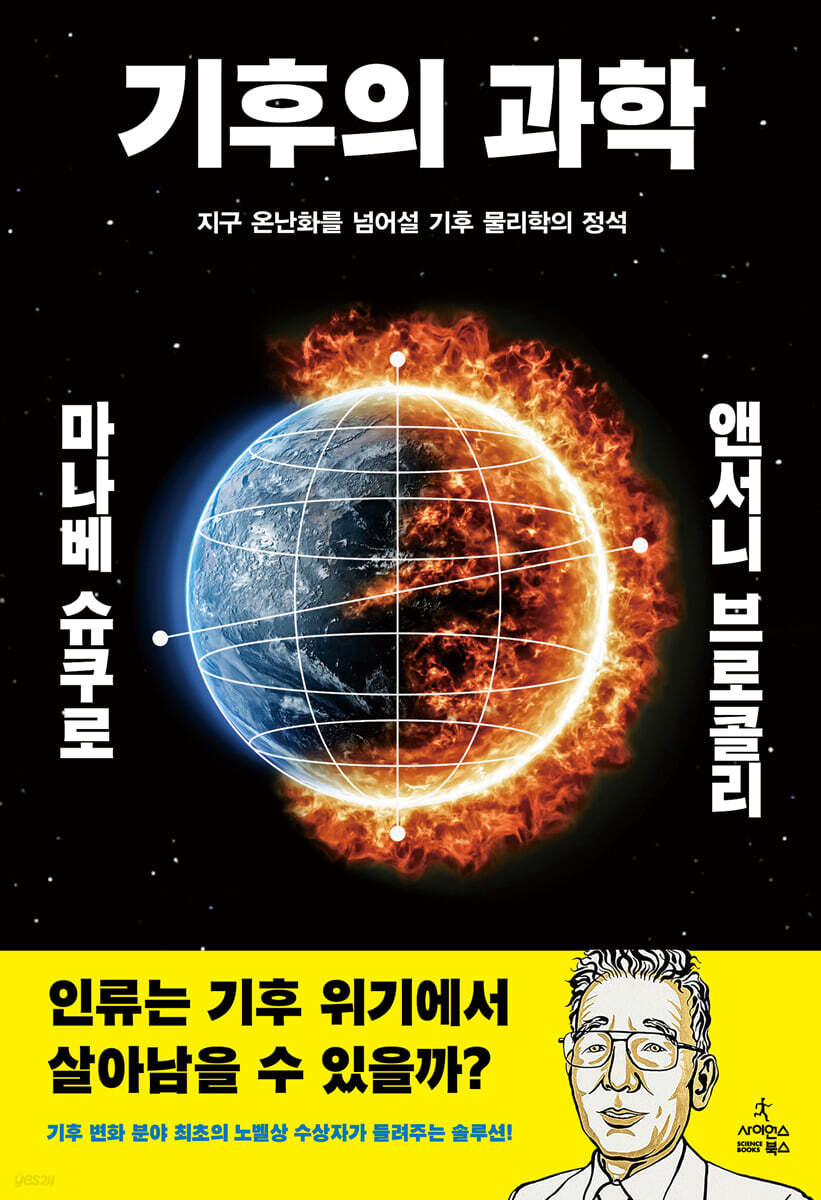
The Science of Climate
 |
Description
Book Introduction
The first Nobel Prize winner in Physics for climate change research
The one and only climate model guidebook!
The severity of global warming is increasing year by year, with rising average global temperatures, an increase in extreme weather events, and indistinct seasonal changes.
The Intergovernmental Panel on Climate Change's Fifth Assessment Report stated that "it is extremely likely that human influence has been the dominant cause of the warming observed since the mid-20th century," and declared that changes in the Earth's climate have resulted from human activities since the Industrial Revolution.
Decades of biased and misunderstandings about global warming have been clearly proven through scientific evidence to be human responsibility.
There are people who have proven the relationship between human activities and global climate change through physical model research.
The protagonist is Syukuro Manabe, who won the 2021 Nobel Prize in Physics “for his contributions to the physical modeling of Earth’s climate, quantifying its variability, and reliably predicting global warming.”
Science Books' new book, "The Science of Climate: The Classics of Climate Physics Beyond Global Warming," is the unique culmination of over 60 years of climate science research by Shukuro Manabe, the first Nobel Prize winner in the field of climate change, and is a climate model commentary that organizes the most scientific research that humanity should refer to in the era of global warming.
This book contains over 60 years of research directly conducted by Manabe Shukuro and the history of climate science that influenced his thinking.
Known as the only popular book by a Nobel Prize-winning physics author, this book was written by Anthony J. Broccoli, a distinguished professor of atmospheric sciences at Rutgers University.
Broccoli) participated as a co-author and supplemented the content.
This book will serve as a landmark, explaining why and how the climate has changed in the past and how it will change in the future, as global warming accelerates.
The one and only climate model guidebook!
The severity of global warming is increasing year by year, with rising average global temperatures, an increase in extreme weather events, and indistinct seasonal changes.
The Intergovernmental Panel on Climate Change's Fifth Assessment Report stated that "it is extremely likely that human influence has been the dominant cause of the warming observed since the mid-20th century," and declared that changes in the Earth's climate have resulted from human activities since the Industrial Revolution.
Decades of biased and misunderstandings about global warming have been clearly proven through scientific evidence to be human responsibility.
There are people who have proven the relationship between human activities and global climate change through physical model research.
The protagonist is Syukuro Manabe, who won the 2021 Nobel Prize in Physics “for his contributions to the physical modeling of Earth’s climate, quantifying its variability, and reliably predicting global warming.”
Science Books' new book, "The Science of Climate: The Classics of Climate Physics Beyond Global Warming," is the unique culmination of over 60 years of climate science research by Shukuro Manabe, the first Nobel Prize winner in the field of climate change, and is a climate model commentary that organizes the most scientific research that humanity should refer to in the era of global warming.
This book contains over 60 years of research directly conducted by Manabe Shukuro and the history of climate science that influenced his thinking.
Known as the only popular book by a Nobel Prize-winning physics author, this book was written by Anthony J. Broccoli, a distinguished professor of atmospheric sciences at Rutgers University.
Broccoli) participated as a co-author and supplemented the content.
This book will serve as a landmark, explaining why and how the climate has changed in the past and how it will change in the future, as global warming accelerates.
- You can preview some of the book's contents.
Preview
index
Introduction to the Book 5 / Acknowledgments 8
Chapter 1 Introduction 13
Chapter 2 Early Research 37
Chapter 3 One-Dimensional Model 53
Chapter 4: Atmospheric General Circulation Model 71
Chapter 5: Early Numerical Experiments 93
Chapter 6: Climate Sensitivity 125
Chapter 7: Glacial and Interglacial Contrast 165
Chapter 8: The Ocean's Role in Climate Change 185
Chapter 9 Cold Climates and the Formation of Deep Waters 231
Chapter 10: Changes in Water Availability Across the Globe 245
Conclusion 277 / Postscript 279 / References 288 / After Translation 316 / Index 319
Chapter 1 Introduction 13
Chapter 2 Early Research 37
Chapter 3 One-Dimensional Model 53
Chapter 4: Atmospheric General Circulation Model 71
Chapter 5: Early Numerical Experiments 93
Chapter 6: Climate Sensitivity 125
Chapter 7: Glacial and Interglacial Contrast 165
Chapter 8: The Ocean's Role in Climate Change 185
Chapter 9 Cold Climates and the Formation of Deep Waters 231
Chapter 10: Changes in Water Availability Across the Globe 245
Conclusion 277 / Postscript 279 / References 288 / After Translation 316 / Index 319
Detailed image

Publisher's Review
Our world is full of complex systems characterized by randomness and disorder.
One of the most important complex systems for humanity is the Earth's climate.
Shukuro Manabe explained the process by which increasing atmospheric carbon dioxide concentrations lead to rising temperatures on the Earth's surface.
In the 1960s, he led the development of physical models of Earth's climate and pioneered the exploration of the interplay between radiative equilibrium and vertical air mass transport.
His research laid the foundation for the development of modern climate models.
―On awarding the Nobel Prize to Shukuro Manabe, the 2021 Nobel Prize Committee
The first Nobel Prize winner in Physics for climate change research
The one and only climate model guidebook!
There is no doubt that the composition of the atmosphere and the Earth's climate have changed since the Industrial Revolution, and that human activity is the primary cause.
Carbon dioxide concentrations in the atmosphere have increased by more than 40% since pre-industrial times, largely due to the burning of fossil fuels for energy.
The average temperature of the Earth's surface has remained relatively stable for 1,000 years, but has already increased by about 1℃ compared to pre-industrial times.
Unless there is a major shift in energy production activities, these changes will inevitably continue.
The global average temperature is expected to rise by another 2 to 3°C within the 21st century, with warming over land being significantly greater than over the oceans and the Arctic being significantly greater than the tropics.
- In the text
The severity of global warming is increasing year by year, with rising average global temperatures, an increase in extreme weather events, and indistinct seasonal changes.
The Intergovernmental Panel on Climate Change's Fifth Assessment Report stated that "it is extremely likely that human influence has been the dominant cause of the warming observed since the mid-20th century," and declared that changes in the Earth's climate have resulted from human activities since the Industrial Revolution.
Decades of biased and misunderstandings about global warming have been clearly proven through scientific evidence to be human responsibility.
There are people who have proven the relationship between human activities and global climate change through physical model research.
The protagonist is none other than Syukuro Manabe, winner of the 2021 Nobel Prize in Physics for “contributions to the physical modeling of Earth’s climate, quantification of its variability, and reliable prediction of global warming.”
Science Books' new book, "The Science of Climate: Beyond Global Warming: The Essentials of Climate Physics," is the culmination of over 60 years of climate science research by Shukuro Manabe, the first Nobel Prize winner in the field of climate change, and is a climate model commentary that compiles the most scientific research that humanity should refer to in the era of global warming.
Shukuro Manabe, who made the observation during his childhood that “if typhoons don’t come, Japan’s rainfall will decrease,” earned his master’s and doctoral degrees in meteorology from the University of Tokyo based on his interest in weather and meteorological phenomena.
After receiving his doctorate, Shukuro Manabe, who was struggling to find work in post-war Japan in the late 1950s, joined the General Circulation Research Division of the National Weather Service at the request of Joseph Smagorinsky, who would later become the founding director of the Geophysical Fluid Dynamics Laboratory (GFDL) of the National Oceanic and Atmospheric Administration (NOAA).
This decision became a blueprint for the development of climate models, which would later become essential for climate change predictions.
Through climate modeling research, Manabe Shukuro explored the influence of greenhouse gases such as water vapor, carbon dioxide, and ozone on maintaining the thermal structure of the Earth's atmosphere, laying the foundation for the atmospheric general circulation model.
In the late 1960s, Richard T.
Wetherald) and developed a one-dimensional radiation-convection model focusing on the positive feedback effect of water vapor.
This model found that as the concentration of carbon dioxide in the atmosphere changes, temperatures increase at the surface and in the troposphere, but decrease in the stratosphere.
This discovery led to the development of a comprehensive atmospheric general circulation model, and with Kirk Bryan, a coupled ocean-atmosphere model to analyze the role of the ocean in climate change.
This analysis became the first model to explicitly integrate atmospheric general circulation with ocean turbulence, convection, and large-scale circulation, forming the backbone of climate simulations.
Their research was named one of the top 10 innovations in NOAA's first 200 years.
Afterwards, Shukuro Manabe continued his research in the United States for a long time, acquired American citizenship, and led his own research group in the 1990s and 2000s, publishing important papers simulating the climate's response to changing concentrations of greenhouse gases in the atmosphere using ocean-atmosphere models.
Currently, Shukuro Manabe is a member of the National Academy of Sciences (NAS), the American Meteorological Society (AMS), and the American Geophysical Union (AGU), and is a senior meteorologist in the Atmospheric and Oceanic Sciences Program at Princeton University, where he has pioneered computational simulations of global warming.
In addition to winning the 2021 Nobel Prize in Physics, he has also received the Milutin Milankovic Medal in 1998, the Benjamin Franklin Medal in 2015, and the Crafoord Prize in 2018 for his research in the field of long-term climate change and modeling.
The recently published book, "Climate Science: The Essentials of Climate Physics Beyond Global Warming," contains over 60 years of research in which Manabe Shukuro has personally participated, as well as the history of climate science that has influenced his thinking.
Known as the only popular book by a Nobel Prize-winning physics author, this book was written by Anthony J. Broccoli, Distinguished Professor of Atmospheric Sciences at Rutgers University.
Broccoli) participated as a co-author and supplemented the content.
This book will serve as a landmark, explaining why and how the climate has changed in the past and how it will change in the future, as global warming accelerates.
The most powerful tool for predicting global warming
The best starting point for anyone interested in climate models
Climate models are the most powerful tool for predicting human-caused global warming.
Harnessing the vast computational resources of the world's most powerful supercomputers, climate models are used to predict future climate change and its impacts, providing valuable information to policymakers.
Climate models have been useful not only for predicting climate change but also for understanding it.
Climate models serve as 'virtual laboratories' of the coupled atmosphere-ocean-land system, and controlled experiments with these models have proven very effective in systematically explaining the physical mechanisms involved in climate change.
- In the text
The two authors of "The Science of Climate: The Essentials of Climate Physics Beyond Global Warming" state in the introduction that climate models are the most powerful tool for predicting human-caused global warming.
The following ten chapters examine the history of modeling and related research findings in climate change research.
Analysis of numerous numerical experiments conducted with climate models of increasing complexity, from simple to multi-layered, allows us to understand the fundamental physical processes that govern not only global warming but also climate change throughout the geological past.
Since the mid-19th century, the temperature of the Earth's surface has been steadily increasing, and since the mid-20th century, it has been rising rapidly.
Chapter 1, “Introduction,” explains the greenhouse effect and global warming, which cause the Earth’s surface temperature to rise.
It introduces the physical processes by which long-wave radiation emitted from the Earth's surface is trapped within the atmosphere, such as blackbody radiation and Kirchhoff's law, and the mechanism by which increased concentrations of greenhouse gases in the atmosphere, such as carbon dioxide, increase the temperature of the Earth's surface and troposphere, helping to understand the basic concepts of climate models.
Chapter 2, “Early Research,” introduces early pioneering research conducted in the 19th and early 20th centuries, such as the work of Svante August Arrhenius, who speculated that a two- to three-fold increase in the concentration of carbon dioxide in the atmosphere could cause climate change that would cause the average temperature of the Earth’s surface to change to a degree comparable to the difference between an glacial and an interglacial period, and the work of Guy Stewart Callender, who simplified the various factors of warming and constructed a simple model.
In addition, it points out the significance and limitations of early research that can be discovered in the process of estimating the relationship between greenhouse gas concentration and changes in surface temperature, and shows the development of climate model research that started from simple theoretical models and expanded to complex numerical models.
Based on earlier research, Shukuro Manabe was motivated to build a model to calculate the heat exchange between the Earth's surface and the atmosphere by Robert F.
We design a one-dimensional radiation-convection model with Strickler.
Chapter 3, “One-Dimensional Model,” focuses on the structure of Manabe and Strickler’s radiation-convection model and evaluates the model’s ability to reproduce the vertical distribution of temperature in the atmosphere.
In particular, we can examine in detail the process of obtaining estimates of global average temperature changes in the atmosphere and land surface due to changes in greenhouse gas concentrations by analyzing how the surface temperature rise and stratospheric cooling response change when carbon dioxide concentration doubles.
Chapter 4, “Atmospheric General Circulation Model,” covers the concept and early development of the Atmospheric General Circulation Model (GCM), which can be considered the core of climate model research.
Since the late 1950s, several research groups have begun developing GCMs to reproduce the key features of atmospheric circulation that determine the Earth's climate distribution, and leading attempts such as the UCLA model and the GFDL model have emerged in this process.
This chapter illustrates how early models, including annual and seasonal models that are variants of the GFDL model, reproduce the distributions of wind, temperature, and precipitation, demonstrating how GCMs evolved from mere experimental tools to powerful scientific tools for studying and predicting climate change.
Chapter 5, “Early Numerical Experiments,” covers early numerical experiments, including a doubling of atmospheric carbon dioxide concentration, a numerical experiment based on changes in solar irradiance, and a study of global warming amplification due to seasonal variations.
As simulation experiments under various conditions became possible, attempts to explore global climate change became more active.
However, in the process, differences in climate sensitivity emerged for each model.
This chapter highlights the inter-model differences that arise when different factors are applied, and illustrates the evolution of climate modeling research, which aims to produce reliable data beyond simply measuring phenomena.
Climate sensitivity is the response of the Earth's average surface temperature to a specific thermal forcing over a sufficiently long period of time, and reliably estimating climate sensitivity is a key task in climate science.
Chapter 6, “Climate Sensitivity,” analyzes the interactions between various radiative feedback processes that determine climate sensitivity, including lapse rate feedback, water vapor feedback, and albedo feedback.
The latter part of the chapter points out differences in sensitivity between climate models and provides a glimpse into the scientific trend of attempting to estimate reliable sensitivity using past climate change data.
Given that climate models have significantly different sensitivities, it is difficult to estimate climate sensitivity based on numerical experiment results alone.
For this reason, it is desirable to estimate sensitivity using other independent information.
Another promising approach to estimating climate sensitivity is to use data from the geological past.
Chapter 7, “Glacial-Interglacial Climate Change,” discusses several attempts to simulate glacial-interglacial differences in sea surface temperature using climate models with known climate sensitivities.
This allows us to estimate specific climate sensitivity by comparing temperature change patterns based on geological evidence such as ice sheets and sediments with model experiments that reproduce these patterns.
Chapter 8, “The Role of the Ocean in Climate Change,” focuses on the impact of the ocean on the climate system.
We describe ocean thermal inertia, coupled atmosphere-ocean models, initialization and flux corrections, and ocean response to global warming experiments.
Simulations in the Atlantic and Southern Oceans also demonstrate the asymmetric magnitude of warming observed in the Northern and Southern Hemispheres.
While the previous chapters examined the transient response of climate to gradual increases in atmospheric carbon dioxide concentration, Chapter 9, “Cold Climate and the Formation of Deep Water,” examines the overall equilibrium response of climate to changes in atmospheric carbon dioxide concentration, based on the work of Stopper and Manabe.
We analyze the impact of feedbacks operating in the Southern Ocean, such as the internal ocean circulation, particularly the albedo feedback of sea ice, and the circulation of deep waters, which were essential for the development of glacial climate, on climate change.
As global warming occurs, not only temperature but also evaporation and precipitation rates change.
In other words, as evaporation increases, precipitation also increases, accelerating the water cycle across the Earth.
The final chapter of the book, "Changes in Global Water Availability," analyzes the impact of global warming on the water cycle through numerical experiments.
In addition, the differences in water availability between the Northern and Southern Hemispheres are revealed through comparison of precipitation and evaporation rates according to latitudinal distribution, the influence of rivers on soil drying, and analysis of soil moisture models in arid and semi-arid regions.
Throughout this process, the illustrations and diagrams placed throughout the book allow readers to experience firsthand the principles and research process of climate modeling.
In addition, the eight-page color pictorial attached to the text helps readers intuitively understand the meaning of climate models by capturing global climate change trends, such as changes in the Earth's average surface temperature, precipitation rates, and carbon dioxide concentrations.
The Secret Hidden in the Asymmetric Warming of the Northern and Southern Hemispheres
"Climate Science": Scientifically Proving the Mysteries of Global Warming
If greenhouse gas concentrations continue to rise, under a so-called “business-as-usual” scenario, soil moisture declines in many arid and semi-arid regions of the world will become increasingly pronounced during the 21st century.
By the late 22nd century, soil moisture loss in these regions is expected to become more severe and the frequency of droughts to increase significantly.
Unfortunately, river discharge in these areas may not increase significantly or may actually decrease due to climate warming.
Therefore, water shortages in this region could become very serious in the next few centuries.
- In the text
As Manabe Shukuro explains in his "Conclusion," this book examines various climate modeling studies in historical order, beginning with Arrhenius's pioneering research in the late 19th century.
These studies use increasingly complex layers of climate models, including energy balance models, one-dimensional radiation-convection models, and three-dimensional GCM models of coupled atmosphere-ocean-land systems.
These models are very useful not only for predicting climate change, but also for understanding the problems that arise from climate change.
For example, in Chapter 8, “The Role of the Ocean in Climate Change,” Shukuro Manabe points out that the scale of warming on the Earth’s surface is asymmetrical between the two hemispheres.
Global warming is usually more dramatic in the Northern Hemisphere than in the Southern Hemisphere.
The authors argue that in the high latitudes of the Northern Hemisphere, much of the incoming solar radiation is reflected back to Earth by Arctic sea ice and snow cover, accelerating warming, but in the high latitudes of the Southern Hemisphere, deep convection near the Southern Ocean coast and over vast areas of the Southern Ocean increases the ocean's thermal inertia, significantly slowing the surface temperature response to atmospheric carbon dioxide concentrations.
Although the climate model presented by the author is comprised of past data, it provides a clear guide to understanding future climate due to increasing greenhouse gas concentrations.
In the book, Shukuro Manabe does not say what humanity should do to prevent global warming.
We only present clearly organized data and the precise simulation results derived from it.
Just by examining climate models, packed with vast formulas and figures, readers will understand the principles of global warming and be able to ask the questions necessary for the climate crisis we face today.
In other words, the climate model presented by Manabe Shukuro is not a simple prediction, but a guideline that allows us to scientifically understand global warming.
"The Science of Climate: The Essentials of Climate Physics Beyond Global Warming" contains all the climate modeling research that clearly shows where we are headed based on past climate data.
If we seek answers that will fundamentally change our perspective on living in an era of climate crisis, it's time to open the book of a master who stands at the pinnacle of scientific understanding of climate change.
Whether it's global warming or a climate crisis, we need to examine the scientific facts and logic that support these predictions, which are already unfolding before our eyes.
The author begins the book by briefly mentioning the need to reduce greenhouse gases, then walks readers through the bricks of climate science, building from the ground up to the currently accepted conclusions.
The rigorous science behind this vast debate can be found in this book.
―Kim Hee-bong (translator)
Useful for those who want to understand the future impacts of global warming.
―Andrew Robinson (Nature)
Useful and enlightening.
… … The knowledge derived from the process of building climate models is clear and detailed, and helps us better understand the climate system.
The purpose of this book is to guide the reader through the research that Shukuro Manabe and Anthony Broccoli have undertaken to date, to show the methods and motivations behind each study, and to explain and contextualize their findings.
Each serves its purpose well.
―Eimear Dunne (The Holocene)
One of the most important complex systems for humanity is the Earth's climate.
Shukuro Manabe explained the process by which increasing atmospheric carbon dioxide concentrations lead to rising temperatures on the Earth's surface.
In the 1960s, he led the development of physical models of Earth's climate and pioneered the exploration of the interplay between radiative equilibrium and vertical air mass transport.
His research laid the foundation for the development of modern climate models.
―On awarding the Nobel Prize to Shukuro Manabe, the 2021 Nobel Prize Committee
The first Nobel Prize winner in Physics for climate change research
The one and only climate model guidebook!
There is no doubt that the composition of the atmosphere and the Earth's climate have changed since the Industrial Revolution, and that human activity is the primary cause.
Carbon dioxide concentrations in the atmosphere have increased by more than 40% since pre-industrial times, largely due to the burning of fossil fuels for energy.
The average temperature of the Earth's surface has remained relatively stable for 1,000 years, but has already increased by about 1℃ compared to pre-industrial times.
Unless there is a major shift in energy production activities, these changes will inevitably continue.
The global average temperature is expected to rise by another 2 to 3°C within the 21st century, with warming over land being significantly greater than over the oceans and the Arctic being significantly greater than the tropics.
- In the text
The severity of global warming is increasing year by year, with rising average global temperatures, an increase in extreme weather events, and indistinct seasonal changes.
The Intergovernmental Panel on Climate Change's Fifth Assessment Report stated that "it is extremely likely that human influence has been the dominant cause of the warming observed since the mid-20th century," and declared that changes in the Earth's climate have resulted from human activities since the Industrial Revolution.
Decades of biased and misunderstandings about global warming have been clearly proven through scientific evidence to be human responsibility.
There are people who have proven the relationship between human activities and global climate change through physical model research.
The protagonist is none other than Syukuro Manabe, winner of the 2021 Nobel Prize in Physics for “contributions to the physical modeling of Earth’s climate, quantification of its variability, and reliable prediction of global warming.”
Science Books' new book, "The Science of Climate: Beyond Global Warming: The Essentials of Climate Physics," is the culmination of over 60 years of climate science research by Shukuro Manabe, the first Nobel Prize winner in the field of climate change, and is a climate model commentary that compiles the most scientific research that humanity should refer to in the era of global warming.
Shukuro Manabe, who made the observation during his childhood that “if typhoons don’t come, Japan’s rainfall will decrease,” earned his master’s and doctoral degrees in meteorology from the University of Tokyo based on his interest in weather and meteorological phenomena.
After receiving his doctorate, Shukuro Manabe, who was struggling to find work in post-war Japan in the late 1950s, joined the General Circulation Research Division of the National Weather Service at the request of Joseph Smagorinsky, who would later become the founding director of the Geophysical Fluid Dynamics Laboratory (GFDL) of the National Oceanic and Atmospheric Administration (NOAA).
This decision became a blueprint for the development of climate models, which would later become essential for climate change predictions.
Through climate modeling research, Manabe Shukuro explored the influence of greenhouse gases such as water vapor, carbon dioxide, and ozone on maintaining the thermal structure of the Earth's atmosphere, laying the foundation for the atmospheric general circulation model.
In the late 1960s, Richard T.
Wetherald) and developed a one-dimensional radiation-convection model focusing on the positive feedback effect of water vapor.
This model found that as the concentration of carbon dioxide in the atmosphere changes, temperatures increase at the surface and in the troposphere, but decrease in the stratosphere.
This discovery led to the development of a comprehensive atmospheric general circulation model, and with Kirk Bryan, a coupled ocean-atmosphere model to analyze the role of the ocean in climate change.
This analysis became the first model to explicitly integrate atmospheric general circulation with ocean turbulence, convection, and large-scale circulation, forming the backbone of climate simulations.
Their research was named one of the top 10 innovations in NOAA's first 200 years.
Afterwards, Shukuro Manabe continued his research in the United States for a long time, acquired American citizenship, and led his own research group in the 1990s and 2000s, publishing important papers simulating the climate's response to changing concentrations of greenhouse gases in the atmosphere using ocean-atmosphere models.
Currently, Shukuro Manabe is a member of the National Academy of Sciences (NAS), the American Meteorological Society (AMS), and the American Geophysical Union (AGU), and is a senior meteorologist in the Atmospheric and Oceanic Sciences Program at Princeton University, where he has pioneered computational simulations of global warming.
In addition to winning the 2021 Nobel Prize in Physics, he has also received the Milutin Milankovic Medal in 1998, the Benjamin Franklin Medal in 2015, and the Crafoord Prize in 2018 for his research in the field of long-term climate change and modeling.
The recently published book, "Climate Science: The Essentials of Climate Physics Beyond Global Warming," contains over 60 years of research in which Manabe Shukuro has personally participated, as well as the history of climate science that has influenced his thinking.
Known as the only popular book by a Nobel Prize-winning physics author, this book was written by Anthony J. Broccoli, Distinguished Professor of Atmospheric Sciences at Rutgers University.
Broccoli) participated as a co-author and supplemented the content.
This book will serve as a landmark, explaining why and how the climate has changed in the past and how it will change in the future, as global warming accelerates.
The most powerful tool for predicting global warming
The best starting point for anyone interested in climate models
Climate models are the most powerful tool for predicting human-caused global warming.
Harnessing the vast computational resources of the world's most powerful supercomputers, climate models are used to predict future climate change and its impacts, providing valuable information to policymakers.
Climate models have been useful not only for predicting climate change but also for understanding it.
Climate models serve as 'virtual laboratories' of the coupled atmosphere-ocean-land system, and controlled experiments with these models have proven very effective in systematically explaining the physical mechanisms involved in climate change.
- In the text
The two authors of "The Science of Climate: The Essentials of Climate Physics Beyond Global Warming" state in the introduction that climate models are the most powerful tool for predicting human-caused global warming.
The following ten chapters examine the history of modeling and related research findings in climate change research.
Analysis of numerous numerical experiments conducted with climate models of increasing complexity, from simple to multi-layered, allows us to understand the fundamental physical processes that govern not only global warming but also climate change throughout the geological past.
Since the mid-19th century, the temperature of the Earth's surface has been steadily increasing, and since the mid-20th century, it has been rising rapidly.
Chapter 1, “Introduction,” explains the greenhouse effect and global warming, which cause the Earth’s surface temperature to rise.
It introduces the physical processes by which long-wave radiation emitted from the Earth's surface is trapped within the atmosphere, such as blackbody radiation and Kirchhoff's law, and the mechanism by which increased concentrations of greenhouse gases in the atmosphere, such as carbon dioxide, increase the temperature of the Earth's surface and troposphere, helping to understand the basic concepts of climate models.
Chapter 2, “Early Research,” introduces early pioneering research conducted in the 19th and early 20th centuries, such as the work of Svante August Arrhenius, who speculated that a two- to three-fold increase in the concentration of carbon dioxide in the atmosphere could cause climate change that would cause the average temperature of the Earth’s surface to change to a degree comparable to the difference between an glacial and an interglacial period, and the work of Guy Stewart Callender, who simplified the various factors of warming and constructed a simple model.
In addition, it points out the significance and limitations of early research that can be discovered in the process of estimating the relationship between greenhouse gas concentration and changes in surface temperature, and shows the development of climate model research that started from simple theoretical models and expanded to complex numerical models.
Based on earlier research, Shukuro Manabe was motivated to build a model to calculate the heat exchange between the Earth's surface and the atmosphere by Robert F.
We design a one-dimensional radiation-convection model with Strickler.
Chapter 3, “One-Dimensional Model,” focuses on the structure of Manabe and Strickler’s radiation-convection model and evaluates the model’s ability to reproduce the vertical distribution of temperature in the atmosphere.
In particular, we can examine in detail the process of obtaining estimates of global average temperature changes in the atmosphere and land surface due to changes in greenhouse gas concentrations by analyzing how the surface temperature rise and stratospheric cooling response change when carbon dioxide concentration doubles.
Chapter 4, “Atmospheric General Circulation Model,” covers the concept and early development of the Atmospheric General Circulation Model (GCM), which can be considered the core of climate model research.
Since the late 1950s, several research groups have begun developing GCMs to reproduce the key features of atmospheric circulation that determine the Earth's climate distribution, and leading attempts such as the UCLA model and the GFDL model have emerged in this process.
This chapter illustrates how early models, including annual and seasonal models that are variants of the GFDL model, reproduce the distributions of wind, temperature, and precipitation, demonstrating how GCMs evolved from mere experimental tools to powerful scientific tools for studying and predicting climate change.
Chapter 5, “Early Numerical Experiments,” covers early numerical experiments, including a doubling of atmospheric carbon dioxide concentration, a numerical experiment based on changes in solar irradiance, and a study of global warming amplification due to seasonal variations.
As simulation experiments under various conditions became possible, attempts to explore global climate change became more active.
However, in the process, differences in climate sensitivity emerged for each model.
This chapter highlights the inter-model differences that arise when different factors are applied, and illustrates the evolution of climate modeling research, which aims to produce reliable data beyond simply measuring phenomena.
Climate sensitivity is the response of the Earth's average surface temperature to a specific thermal forcing over a sufficiently long period of time, and reliably estimating climate sensitivity is a key task in climate science.
Chapter 6, “Climate Sensitivity,” analyzes the interactions between various radiative feedback processes that determine climate sensitivity, including lapse rate feedback, water vapor feedback, and albedo feedback.
The latter part of the chapter points out differences in sensitivity between climate models and provides a glimpse into the scientific trend of attempting to estimate reliable sensitivity using past climate change data.
Given that climate models have significantly different sensitivities, it is difficult to estimate climate sensitivity based on numerical experiment results alone.
For this reason, it is desirable to estimate sensitivity using other independent information.
Another promising approach to estimating climate sensitivity is to use data from the geological past.
Chapter 7, “Glacial-Interglacial Climate Change,” discusses several attempts to simulate glacial-interglacial differences in sea surface temperature using climate models with known climate sensitivities.
This allows us to estimate specific climate sensitivity by comparing temperature change patterns based on geological evidence such as ice sheets and sediments with model experiments that reproduce these patterns.
Chapter 8, “The Role of the Ocean in Climate Change,” focuses on the impact of the ocean on the climate system.
We describe ocean thermal inertia, coupled atmosphere-ocean models, initialization and flux corrections, and ocean response to global warming experiments.
Simulations in the Atlantic and Southern Oceans also demonstrate the asymmetric magnitude of warming observed in the Northern and Southern Hemispheres.
While the previous chapters examined the transient response of climate to gradual increases in atmospheric carbon dioxide concentration, Chapter 9, “Cold Climate and the Formation of Deep Water,” examines the overall equilibrium response of climate to changes in atmospheric carbon dioxide concentration, based on the work of Stopper and Manabe.
We analyze the impact of feedbacks operating in the Southern Ocean, such as the internal ocean circulation, particularly the albedo feedback of sea ice, and the circulation of deep waters, which were essential for the development of glacial climate, on climate change.
As global warming occurs, not only temperature but also evaporation and precipitation rates change.
In other words, as evaporation increases, precipitation also increases, accelerating the water cycle across the Earth.
The final chapter of the book, "Changes in Global Water Availability," analyzes the impact of global warming on the water cycle through numerical experiments.
In addition, the differences in water availability between the Northern and Southern Hemispheres are revealed through comparison of precipitation and evaporation rates according to latitudinal distribution, the influence of rivers on soil drying, and analysis of soil moisture models in arid and semi-arid regions.
Throughout this process, the illustrations and diagrams placed throughout the book allow readers to experience firsthand the principles and research process of climate modeling.
In addition, the eight-page color pictorial attached to the text helps readers intuitively understand the meaning of climate models by capturing global climate change trends, such as changes in the Earth's average surface temperature, precipitation rates, and carbon dioxide concentrations.
The Secret Hidden in the Asymmetric Warming of the Northern and Southern Hemispheres
"Climate Science": Scientifically Proving the Mysteries of Global Warming
If greenhouse gas concentrations continue to rise, under a so-called “business-as-usual” scenario, soil moisture declines in many arid and semi-arid regions of the world will become increasingly pronounced during the 21st century.
By the late 22nd century, soil moisture loss in these regions is expected to become more severe and the frequency of droughts to increase significantly.
Unfortunately, river discharge in these areas may not increase significantly or may actually decrease due to climate warming.
Therefore, water shortages in this region could become very serious in the next few centuries.
- In the text
As Manabe Shukuro explains in his "Conclusion," this book examines various climate modeling studies in historical order, beginning with Arrhenius's pioneering research in the late 19th century.
These studies use increasingly complex layers of climate models, including energy balance models, one-dimensional radiation-convection models, and three-dimensional GCM models of coupled atmosphere-ocean-land systems.
These models are very useful not only for predicting climate change, but also for understanding the problems that arise from climate change.
For example, in Chapter 8, “The Role of the Ocean in Climate Change,” Shukuro Manabe points out that the scale of warming on the Earth’s surface is asymmetrical between the two hemispheres.
Global warming is usually more dramatic in the Northern Hemisphere than in the Southern Hemisphere.
The authors argue that in the high latitudes of the Northern Hemisphere, much of the incoming solar radiation is reflected back to Earth by Arctic sea ice and snow cover, accelerating warming, but in the high latitudes of the Southern Hemisphere, deep convection near the Southern Ocean coast and over vast areas of the Southern Ocean increases the ocean's thermal inertia, significantly slowing the surface temperature response to atmospheric carbon dioxide concentrations.
Although the climate model presented by the author is comprised of past data, it provides a clear guide to understanding future climate due to increasing greenhouse gas concentrations.
In the book, Shukuro Manabe does not say what humanity should do to prevent global warming.
We only present clearly organized data and the precise simulation results derived from it.
Just by examining climate models, packed with vast formulas and figures, readers will understand the principles of global warming and be able to ask the questions necessary for the climate crisis we face today.
In other words, the climate model presented by Manabe Shukuro is not a simple prediction, but a guideline that allows us to scientifically understand global warming.
"The Science of Climate: The Essentials of Climate Physics Beyond Global Warming" contains all the climate modeling research that clearly shows where we are headed based on past climate data.
If we seek answers that will fundamentally change our perspective on living in an era of climate crisis, it's time to open the book of a master who stands at the pinnacle of scientific understanding of climate change.
Whether it's global warming or a climate crisis, we need to examine the scientific facts and logic that support these predictions, which are already unfolding before our eyes.
The author begins the book by briefly mentioning the need to reduce greenhouse gases, then walks readers through the bricks of climate science, building from the ground up to the currently accepted conclusions.
The rigorous science behind this vast debate can be found in this book.
―Kim Hee-bong (translator)
Useful for those who want to understand the future impacts of global warming.
―Andrew Robinson (Nature)
Useful and enlightening.
… … The knowledge derived from the process of building climate models is clear and detailed, and helps us better understand the climate system.
The purpose of this book is to guide the reader through the research that Shukuro Manabe and Anthony Broccoli have undertaken to date, to show the methods and motivations behind each study, and to explain and contextualize their findings.
Each serves its purpose well.
―Eimear Dunne (The Holocene)
GOODS SPECIFICS
- Date of issue: September 30, 2025
- Format: Hardcover book binding method guide
- Page count, weight, size: 332 pages | 570g | 141*204*25mm
- ISBN13: 9791194087274
- ISBN10: 1194087272
You may also like
카테고리
korean


korean

![GQ KOREA Mark (Monthly): December [2025]](http://librairie.coreenne.fr/cdn/shop/files/8ef265dbbfbf186523ed75ba7319009d.jpg?v=1765340328&width=3840)


