

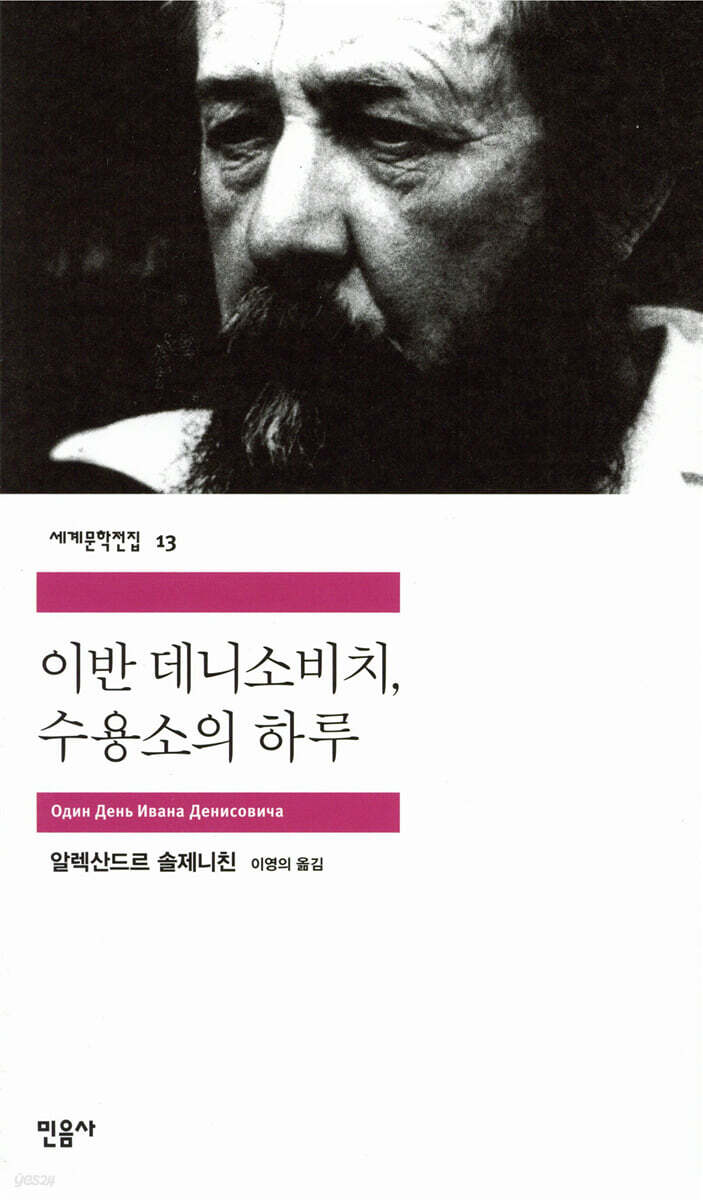
A Day in the Life of Ivan Denisovich
 |
Description
Book Introduction
|
Aleksandr Solzhenitsyn, the conscience of Russia who overcame oppression to become a world-renowned writer Based on realistic descriptions from real experiences, striking sarcasm, and concise sentences, one A novel that exposes the illusion of ruling power through the tragic fate of a person. “It wasn’t a day where everything was dark, it was a day that could almost be called happy.” In 1951, Ivan Denisovich Shukhov, an ordinary farmer, was captured during the German-Soviet War, mistakenly accused of spying and sent to a forced labor camp on charges of betraying his country, where he has been imprisoned for eight years. As usual, Shukhov tries to wake up at 5 a.m., but strangely, he feels a chill running down his body. But he has to go out and do the work given to him. And that evening, he falls asleep with a satisfied heart, thinking, “This is the kind of day you could almost call happy.” Shukhov spent a full ten years, or three days in leap years, totaling 3,653 days in the camp. This work depicts a day in a labor camp, a life the author experienced firsthand, in a refined and restrained manner. In this work, the author, through the ordinary and pitiful character of Ivan Denisovich, shows a sublime affection for the powerless and weak who suffer innocently at the hands of the ruling powers, and emphasizes that it is the author's calling to speak on behalf of such weak people and reveal the truth, and that such art is the ultimate goal of art. ─ Lee Young-ui, from “Commentary on the Work” |
- You can preview some of the book's contents.
Preview
Into the book
How can those with warm bellies understand the feelings of those who shiver together? The bitter cold makes their entire body shiver.
The biting cold air hit Shukhov so hard that he started coughing.
The temperature was minus twenty-seven degrees, and Shukhov had a fever of thirty-seven.
Now, who will win against whom?
--- p.31
Since entering the camp, Shukhov has often recalled the times when he used to eat well in his home village.
I remembered eating several baked potatoes in a frying pan, eating whole pots of vegetable porridge, and in the old days when food was abundant, eating quite large pieces of meat, and drinking milk until my stomach was about to burst.
I regret not eating like that.
Food is something that you can truly appreciate only when you eat it slowly, savoring its flavor.
In other words, you have to eat it like you are eating a piece of bread right now.
Put a little bit in your mouth, roll it around with the tip of your tongue to get some saliva on it, and then chew it.
Then, you wouldn't know how fragrant even unripe bread is.
--- p.60
It's not so bad when I hear those people pointing at Shukhov and saying that he doesn't have much time left until he's released.
But Shukhov himself is somehow not very trustworthy.
As Shukhov himself saw, during the old war, all prisoners who had served their sentences were held without any reason [until further instructions were given from above], that is, until 1949.
What's worse, there was a case where someone was sentenced to three years, but after serving his sentence, he was given an additional five years.
The law is not something to be trusted at all.
After living for ten years, who knows whether he will be told, "You little punk, live another ten years," or whether he will be sent into exile?
--- p.82
Then he covers himself with a thin, soiled blanket, covering his head.
Before I knew it, the aisle between the beds was filled with students from the next class waiting for roll call.
But I don't care about that.
Shukhov falls asleep with a very satisfied heart.
Today was a very lucky day for him.
He didn't go into prison, didn't go out to work at the [Socialist Living Complex], and at lunchtime he cheated and ate an extra bowl of porridge.
And the foreman was good at adjusting the workload, so we happily laid bricks in the afternoon.
The pieces of the knife were brought in safely without being detected during inspection.
In the evening, he took turns taking turns instead of taking the cheque, and earned a lot of money, and he also bought some tobacco leaves.
And my body, which had been sore, is now completely healed as if it had been washed.
In this way, Shukhov spent a full ten years, or 3,613 days, from the beginning to the end of his sentence.
The reason he spent three more days in the camp was because there was a leap year in between.
The biting cold air hit Shukhov so hard that he started coughing.
The temperature was minus twenty-seven degrees, and Shukhov had a fever of thirty-seven.
Now, who will win against whom?
--- p.31
Since entering the camp, Shukhov has often recalled the times when he used to eat well in his home village.
I remembered eating several baked potatoes in a frying pan, eating whole pots of vegetable porridge, and in the old days when food was abundant, eating quite large pieces of meat, and drinking milk until my stomach was about to burst.
I regret not eating like that.
Food is something that you can truly appreciate only when you eat it slowly, savoring its flavor.
In other words, you have to eat it like you are eating a piece of bread right now.
Put a little bit in your mouth, roll it around with the tip of your tongue to get some saliva on it, and then chew it.
Then, you wouldn't know how fragrant even unripe bread is.
--- p.60
It's not so bad when I hear those people pointing at Shukhov and saying that he doesn't have much time left until he's released.
But Shukhov himself is somehow not very trustworthy.
As Shukhov himself saw, during the old war, all prisoners who had served their sentences were held without any reason [until further instructions were given from above], that is, until 1949.
What's worse, there was a case where someone was sentenced to three years, but after serving his sentence, he was given an additional five years.
The law is not something to be trusted at all.
After living for ten years, who knows whether he will be told, "You little punk, live another ten years," or whether he will be sent into exile?
--- p.82
Then he covers himself with a thin, soiled blanket, covering his head.
Before I knew it, the aisle between the beds was filled with students from the next class waiting for roll call.
But I don't care about that.
Shukhov falls asleep with a very satisfied heart.
Today was a very lucky day for him.
He didn't go into prison, didn't go out to work at the [Socialist Living Complex], and at lunchtime he cheated and ate an extra bowl of porridge.
And the foreman was good at adjusting the workload, so we happily laid bricks in the afternoon.
The pieces of the knife were brought in safely without being detected during inspection.
In the evening, he took turns taking turns instead of taking the cheque, and earned a lot of money, and he also bought some tobacco leaves.
And my body, which had been sore, is now completely healed as if it had been washed.
In this way, Shukhov spent a full ten years, or 3,613 days, from the beginning to the end of his sentence.
The reason he spent three more days in the camp was because there was a leap year in between.
--- pp.207-208
GOODS SPECIFICS
- Date of issue: April 30, 2000
- Page count, weight, size: 223 pages | 305g | 132*225*20mm
- ISBN13: 9788937460135
- ISBN10: 8937460130
You may also like
카테고리
korean


korean

![ELLE 엘르 스페셜 에디션 A형 : 12월 [2025]](http://librairie.coreenne.fr/cdn/shop/files/b8e27a3de6c9538896439686c6b0e8fb.jpg?v=1766436872&width=3840)


