

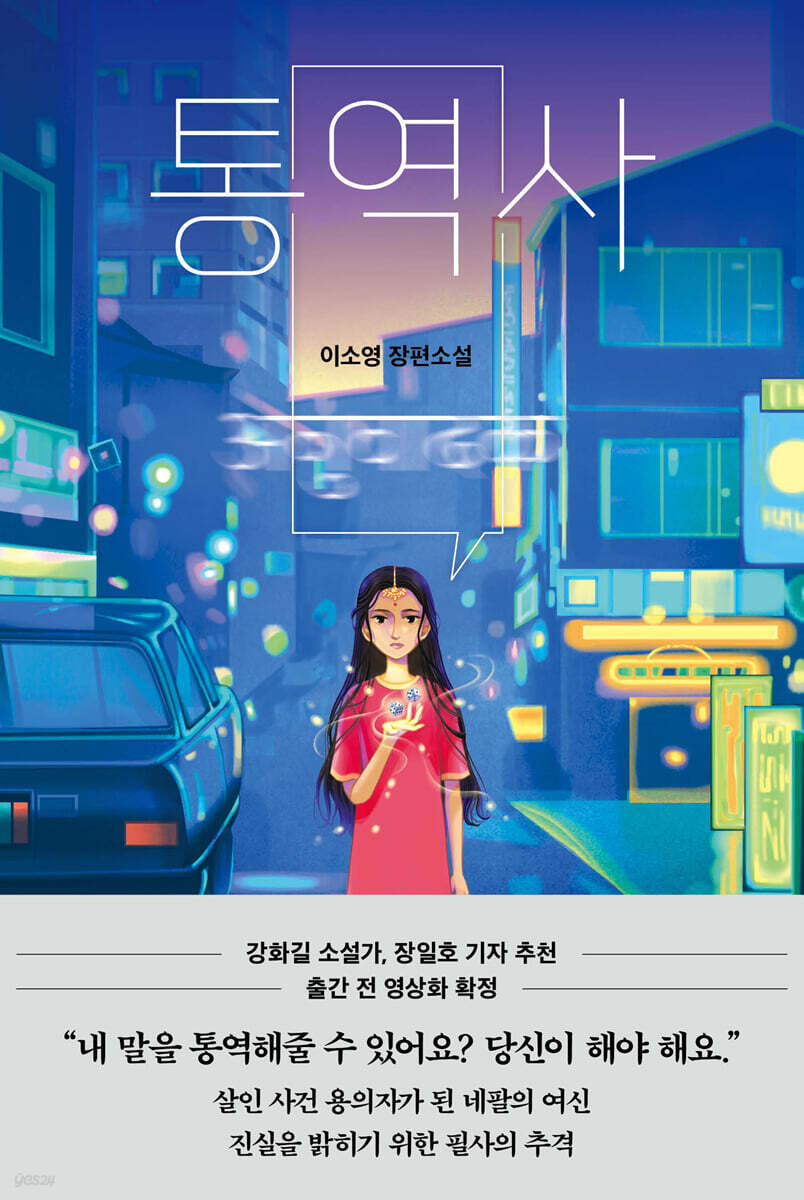
interpreter
 |
Description
Book Introduction
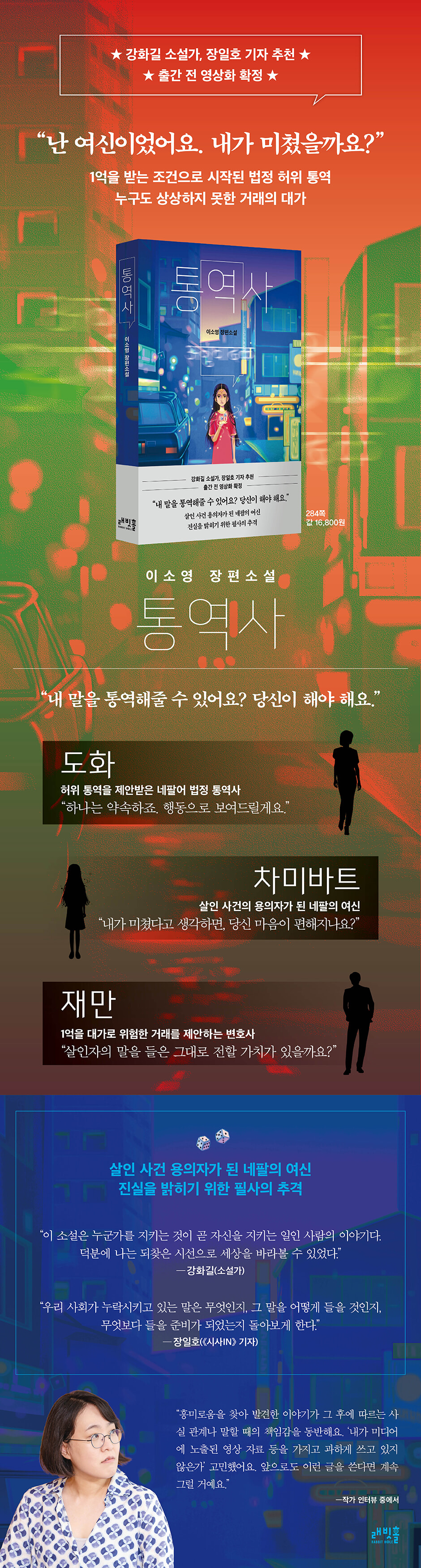
“Can you interpret what I'm saying? You have to do it.”
★Recommended by novelist Kang Hwa-gil and reporter Jang Il-ho★
★Video adaptation confirmed before publication★
Nepalese goddess becomes suspect in murder case
A desperate pursuit to uncover the truth
The new novel “The Interpreter” by author Lee So-young, a screenwriter with 25 years of experience who has written screenplays for films such as “Ghost of Oksu Station,” “Robot, Sound,” “Unidentified Video - Do Not Click,” “Apartment,” and “Whispering Corridors 3: The Fox Stairs,” and whose first novel “Alaska Oriental Medicine Clinic” quickly rose to the bestseller rankings, has been published.
This work, which sharply targets the issues facing Korean society with a high level of immersion, creates another sophisticated and vivid world, and has been confirmed for film adaptation before publication.
Kumari, the most popular goddess living in Nepal.
A woman who was once a Kumari is identified as a suspect in a murder case that has shocked South Korea.
A phone call came to Dohwa, who was working two jobs, one as a wine attendant at a large supermarket and the other as a Nepali court interpreter, to make a living.
The lawyer who made the call, Jae-man, offers to provide false interpretation in court for the defendant, Chamibat, in exchange for 100 million won.
The evidence and confession are both clear, but the defendant is now talking nonsense, so please help us serve justice by receiving the maximum sentence.
Dohwa, suffering from personal bankruptcy and the aftereffects of cancer surgery, accepts a risky deal despite her uneasiness.
Dohwa ignores Chamibat, who only repeats unknown stories throughout the trial, and proceeds with the false interpretation as planned.
As we follow Chamibat's testimony, which haunts us even after the trial, we are confronted with the truth behind the deal.
As a novel that began with the question, “What does it mean to truly listen?” (Author Interview), “The Interpreter” delves deeply into issues in modern society that have long been neglected, such as married immigrant women, migrant workers, and nuclear waste.
In the process, dignity and justice, which had been trampled by the logic of capital and merciless violence, begin to gain a voice, resonating clearly with readers.
In that it “makes us reflect on what words our society has been missing, how we will listen to them, and above all, whether we are ready to listen” (Jang Il-ho), this novel provides a special space for resonating with the words that the community has been missing.
★Recommended by novelist Kang Hwa-gil and reporter Jang Il-ho★
★Video adaptation confirmed before publication★
Nepalese goddess becomes suspect in murder case
A desperate pursuit to uncover the truth
The new novel “The Interpreter” by author Lee So-young, a screenwriter with 25 years of experience who has written screenplays for films such as “Ghost of Oksu Station,” “Robot, Sound,” “Unidentified Video - Do Not Click,” “Apartment,” and “Whispering Corridors 3: The Fox Stairs,” and whose first novel “Alaska Oriental Medicine Clinic” quickly rose to the bestseller rankings, has been published.
This work, which sharply targets the issues facing Korean society with a high level of immersion, creates another sophisticated and vivid world, and has been confirmed for film adaptation before publication.
Kumari, the most popular goddess living in Nepal.
A woman who was once a Kumari is identified as a suspect in a murder case that has shocked South Korea.
A phone call came to Dohwa, who was working two jobs, one as a wine attendant at a large supermarket and the other as a Nepali court interpreter, to make a living.
The lawyer who made the call, Jae-man, offers to provide false interpretation in court for the defendant, Chamibat, in exchange for 100 million won.
The evidence and confession are both clear, but the defendant is now talking nonsense, so please help us serve justice by receiving the maximum sentence.
Dohwa, suffering from personal bankruptcy and the aftereffects of cancer surgery, accepts a risky deal despite her uneasiness.
Dohwa ignores Chamibat, who only repeats unknown stories throughout the trial, and proceeds with the false interpretation as planned.
As we follow Chamibat's testimony, which haunts us even after the trial, we are confronted with the truth behind the deal.
As a novel that began with the question, “What does it mean to truly listen?” (Author Interview), “The Interpreter” delves deeply into issues in modern society that have long been neglected, such as married immigrant women, migrant workers, and nuclear waste.
In the process, dignity and justice, which had been trampled by the logic of capital and merciless violence, begin to gain a voice, resonating clearly with readers.
In that it “makes us reflect on what words our society has been missing, how we will listen to them, and above all, whether we are ready to listen” (Jang Il-ho), this novel provides a special space for resonating with the words that the community has been missing.
- You can preview some of the book's contents.
Preview
index
prolog
Chapter 1: The Mad Woman and the Purple Butterfly
Chapter 2: The Blue Man
Chapter 3 Teeth and Dice
Author's Note? Recommendation
Chapter 1: The Mad Woman and the Purple Butterfly
Chapter 2: The Blue Man
Chapter 3 Teeth and Dice
Author's Note? Recommendation
Detailed image
Into the book
“Please provide a false interpretation.”
The sound of summer leaves rustling in the hot wind filled Dohwa's mind.
Dohwa responded without moving an inch.
“If false interpretation is discovered in court, the minimum penalty is five years in prison.
“The same goes for teachers.”
“If you are a teacher, do you mean me?”
“I guess so.
Because you just gave me a suggestion.
“That’s a teacher.”
The painter spoke clearly and bluntly, taking a sip of latte, but Jae-man remained unshaken.
“Okay.
“To continue what we were saying, you only need to falsely interpret about twenty words.”
Dohwa returned the business card and half stood up.
“Please stop.
I'm going."
“I’ll give you about 5 million won for one word.”
Against Dohwa's will, her buttocks were stuck back onto the chair.
Twenty words, one hundred million.
--- p.28 「Chapter 1.
From "The Mad Woman and the Purple Butterfly"
“Why is the butterfly purple?”
“If you get bruised, it turns purple.
“It’s just a little bruised, it doesn’t mean it’s broken.”
Dohwa lightly touched the purple butterfly logo.
It was cold.
No matter how much I thought about it, the only person who could explain this strange situation was Chamibat.
If you don't ask, you'll never know.
--- p.72 「Chapter 1.
From "The Mad Woman and the Purple Butterfly"
“The Air Force says that there is absolutely no way that contaminated water will leak into the groundwater from the radioactive waste disposal site.
But the former team leader didn't believe it from the beginning.
So, I decided to distribute a questionnaire to those who had even the slightest doubt, collect the results, and then raise the issue with the Air Force.
Of course, it's like throwing an egg at a rock.
The former team leader was on the aggressive side.
Well, it couldn't be helped."
"why?"
“The former team leader had a young son who passed away from acute leukemia.
After that, I worked at a public corporation and then transferred here.
“I think the team leader also had a vague suspicion about the water.”
“Suspicion that contaminated water has flowed into the groundwater?”
“Yes, but that’s just a guess.
This is a problem that can only be solved by forming a research team and producing precise results.
“Just the number of residents in that area… … .”
“16,000 people.”
--- p.100 「Chapter 1.
From "The Mad Woman and the Purple Butterfly"
“Radiation is invisible and odorless.
So proving a relationship? That would be difficult.
And depending on the person's body, diseases appear in various forms.
Thyroid, leukemia… whatever.
“It would be unreasonable to trace it and conclude that radiation is the cause… … but we can’t say that there is no connection at all.”
Dohwa didn't want to make a claim, but rather wanted to make a small crack.
As the people started to murmur, Cheon Baek-woo asked back as if appealing.
"Why are you pursuing that? There's no reason to do that. Stop spreading conspiracy theories! Do you believe that, people?"
--- pp.113-114 「Chapter 2.
From "Blue Man"
“Hanaheris and Nike are cell phone parts factories.
There was a leak of hazardous gases during the manufacturing process, but it was covered up and passed over.
Do you know the American livestock industry? It's the livestock industry.
There was a time when there was a problem with children being kept in greenhouses like livestock.
And they didn't even pay my wages.
Lastly, the water industry.
It's a shredding company.
Looks the most gentle.
“They pay me properly and on time, and they even apply the minimum wage.”
(…)
“Hazardous gas leak, livestock greenhouse.
I get the dirty feeling, but… …what about the shredding company?”
“What is shredding?
It's like destroying documents and hard drives to pieces.
I don't think that much manpower will be needed.
Pick out quite a few kids.
I found it strange so I looked into it.
But they are sending a field dispatch again.
But I don't know where that is.
“It’s a black hole.”
Recruit people from a staffing agency.
And then send that person to another place again.
Meanwhile, traces of labor are washed away.
--- p.134 「Chapter 2.
From "Blue Man"
I searched the local newspaper to check the results of the referendum on the construction of the second radioactive waste storage facility.
A re-election was decided with 13% of the votes invalid, 43% against, and 44% in favor.
Twenty years ago, the referendum law was introduced and the first referendum on the construction of a radioactive waste storage facility was held.
At that time, the votes in favor were over 90 percent.
So the low and intermediate level radioactive waste disposal facility was completed with ease.
At that time, there was a widespread belief that if only that building was built, even the neighborhood dogs would be rich enough to walk around carrying ten thousand won bills in their mouths.
But over the years, people have learned that very few people make money from radioactive waste disposal, and that it creates bad rumors in the neighborhood.
While Dohwa was surprised by the fact that many people were in favor of hosting the radioactive waste storage facility, the bell rang.
--- pp.148-149 「Chapter 2.
From "Blue Man"
“If you’re Nepali, you should be ashamed! Do you really trust that woman?”
"who?"
“I’m talking about Chamibat.”
“What are you talking about?”
Kisho's whole face was grimacing in disgust.
“I wish that woman would die.”
Thamel was confused and couldn't understand what Kisho was saying.
“At first, I thought she was crazy.
But… …I have to help.
“It’s the same Nepali.”
“I’m not crazy.
“That woman!”
"uh?"
“That woman was the goddess Kumari.
When I was interpreting, I thought it was nonsense.
But it was true.
"Our goddess is involved in a crime on Korean soil? Murder at that?"
The sound of summer leaves rustling in the hot wind filled Dohwa's mind.
Dohwa responded without moving an inch.
“If false interpretation is discovered in court, the minimum penalty is five years in prison.
“The same goes for teachers.”
“If you are a teacher, do you mean me?”
“I guess so.
Because you just gave me a suggestion.
“That’s a teacher.”
The painter spoke clearly and bluntly, taking a sip of latte, but Jae-man remained unshaken.
“Okay.
“To continue what we were saying, you only need to falsely interpret about twenty words.”
Dohwa returned the business card and half stood up.
“Please stop.
I'm going."
“I’ll give you about 5 million won for one word.”
Against Dohwa's will, her buttocks were stuck back onto the chair.
Twenty words, one hundred million.
--- p.28 「Chapter 1.
From "The Mad Woman and the Purple Butterfly"
“Why is the butterfly purple?”
“If you get bruised, it turns purple.
“It’s just a little bruised, it doesn’t mean it’s broken.”
Dohwa lightly touched the purple butterfly logo.
It was cold.
No matter how much I thought about it, the only person who could explain this strange situation was Chamibat.
If you don't ask, you'll never know.
--- p.72 「Chapter 1.
From "The Mad Woman and the Purple Butterfly"
“The Air Force says that there is absolutely no way that contaminated water will leak into the groundwater from the radioactive waste disposal site.
But the former team leader didn't believe it from the beginning.
So, I decided to distribute a questionnaire to those who had even the slightest doubt, collect the results, and then raise the issue with the Air Force.
Of course, it's like throwing an egg at a rock.
The former team leader was on the aggressive side.
Well, it couldn't be helped."
"why?"
“The former team leader had a young son who passed away from acute leukemia.
After that, I worked at a public corporation and then transferred here.
“I think the team leader also had a vague suspicion about the water.”
“Suspicion that contaminated water has flowed into the groundwater?”
“Yes, but that’s just a guess.
This is a problem that can only be solved by forming a research team and producing precise results.
“Just the number of residents in that area… … .”
“16,000 people.”
--- p.100 「Chapter 1.
From "The Mad Woman and the Purple Butterfly"
“Radiation is invisible and odorless.
So proving a relationship? That would be difficult.
And depending on the person's body, diseases appear in various forms.
Thyroid, leukemia… whatever.
“It would be unreasonable to trace it and conclude that radiation is the cause… … but we can’t say that there is no connection at all.”
Dohwa didn't want to make a claim, but rather wanted to make a small crack.
As the people started to murmur, Cheon Baek-woo asked back as if appealing.
"Why are you pursuing that? There's no reason to do that. Stop spreading conspiracy theories! Do you believe that, people?"
--- pp.113-114 「Chapter 2.
From "Blue Man"
“Hanaheris and Nike are cell phone parts factories.
There was a leak of hazardous gases during the manufacturing process, but it was covered up and passed over.
Do you know the American livestock industry? It's the livestock industry.
There was a time when there was a problem with children being kept in greenhouses like livestock.
And they didn't even pay my wages.
Lastly, the water industry.
It's a shredding company.
Looks the most gentle.
“They pay me properly and on time, and they even apply the minimum wage.”
(…)
“Hazardous gas leak, livestock greenhouse.
I get the dirty feeling, but… …what about the shredding company?”
“What is shredding?
It's like destroying documents and hard drives to pieces.
I don't think that much manpower will be needed.
Pick out quite a few kids.
I found it strange so I looked into it.
But they are sending a field dispatch again.
But I don't know where that is.
“It’s a black hole.”
Recruit people from a staffing agency.
And then send that person to another place again.
Meanwhile, traces of labor are washed away.
--- p.134 「Chapter 2.
From "Blue Man"
I searched the local newspaper to check the results of the referendum on the construction of the second radioactive waste storage facility.
A re-election was decided with 13% of the votes invalid, 43% against, and 44% in favor.
Twenty years ago, the referendum law was introduced and the first referendum on the construction of a radioactive waste storage facility was held.
At that time, the votes in favor were over 90 percent.
So the low and intermediate level radioactive waste disposal facility was completed with ease.
At that time, there was a widespread belief that if only that building was built, even the neighborhood dogs would be rich enough to walk around carrying ten thousand won bills in their mouths.
But over the years, people have learned that very few people make money from radioactive waste disposal, and that it creates bad rumors in the neighborhood.
While Dohwa was surprised by the fact that many people were in favor of hosting the radioactive waste storage facility, the bell rang.
--- pp.148-149 「Chapter 2.
From "Blue Man"
“If you’re Nepali, you should be ashamed! Do you really trust that woman?”
"who?"
“I’m talking about Chamibat.”
“What are you talking about?”
Kisho's whole face was grimacing in disgust.
“I wish that woman would die.”
Thamel was confused and couldn't understand what Kisho was saying.
“At first, I thought she was crazy.
But… …I have to help.
“It’s the same Nepali.”
“I’m not crazy.
“That woman!”
"uh?"
“That woman was the goddess Kumari.
When I was interpreting, I thought it was nonsense.
But it was true.
"Our goddess is involved in a crime on Korean soil? Murder at that?"
--- p.181 「Chapter 2.
From "Blue Man"
From "Blue Man"
Publisher's Review
“I was a goddess.
“Am I crazy?”
False interpretation in court began with the condition of receiving 100 million won
The price of a deal no one could have imagined
This novel is about a person who believes that protecting others is also protecting oneself.
Thanks to that, I was able to look at the world with renewed perspective.
I hope this novel serves as a textbook for everyone. _Kang Hwa-gil (novelist)
"The Interpreter" makes us reflect on what words our society is missing, how we listen to them, and, above all, whether we are ready to listen.
A story firmly grounded in reality that never loses its appeal. _Jang Il-ho (Reporter, Sisa IN)
Since entering the film industry at the age of eighteen with the original draft of the film "The Man Who Went to Mars," author So-Young Lee has expanded her scope to include film scripts for science fiction, horror, mystery, and thrillers, and novels with her first full-length novel, "Alaska Oriental Medicine Clinic," in 2023, delivering high appeal and fantastic fun. Now, she is publishing a new full-length novel, "The Interpreter."
While previous works were set in the snowy Alaska (Alaska Oriental Medicine Clinic) and the near future of 2050 (Super League), this work seamlessly weaves together exotic elements such as Nepali language, religion, and culture, centering on a brutal murder case that occurred in a small Korean town, to present a unique socially accusatory mystery.
In Nepal, where there are more gods than people, Kumari is the only national institution that selects and worships an existing goddess.
Chamivat, who was once a Nepali Kumari but was stripped of her status as a goddess, came to Korea as a married immigrant woman.
The only person who can hear him clearly in court is Dohwa, the Nepali court interpreter, but since she has already been paid 100 million won to provide false interpretation, Chamivat's words are distorted and echo throughout the courtroom.
After the first trial of the murder case is concluded, Dohwa plays the court interpretation file she recorded and replays Chamibat's testimony.
And only then did I hear Chamibat's words properly.
'The blue man was stabbing with a knife.' 'We have to chase the purple butterfly until the end.' During the on-site investigation, Chamibat claims that he only reenacted what he had witnessed, and that when he came to, the victims were already dead.
The clues fit together in a strange way that makes it difficult to simply dismiss it as schizophrenia.
Dohwa, who suddenly realizes that he too has become entangled in a massive conspiracy, embarks on the greatest counterattack of his life to set everything right.
“The Interpreter,” which was first completed as a screenplay before being published as a novel, is currently being adapted into a film by Studio Mondo, the company that produced the film “The Killers” and the drama “A Week Before I Die.”
A new multicultural narrative vividly reflecting the realities of immigrants.
A chilling rebuke to the violence of capitalism
When the incident was reported, an atmosphere of hatred against Nepalis arose.
Nepalese people, who were in a legal blind spot, became the target of verbal abuse.
There were also employers who refused to accept Nepalese workers.
Among Nepalese living in Korea, this incident has become an unwanted public affair that they hope will disappear quickly.
(〈Chapter 1.
The Mad Woman and the Purple Butterfly〉, p.
31)
"Shouldn't there be a place to dispose of waste? Bad? To me, it's a spring that never dries up.
Once you have a job, it will keep creating jobs.
I guarantee that the government will provide you with a lot of money.
“It will become a leading company that creates the most jobs.” (Chapter 2.
Blue Man〉, pp.
111~112)
As of 2024, the number of foreigners residing in Korea is expected to reach 2.7 million, and Korea has already entered a multicultural society where one in 20 people is a foreigner.
Beginning with Kim Ryeo-ryeong's novel "Wandeukie," Son Hong-gyu's "Islamic Butcher Shop," and Cheon Un-yeong's "Goodbye, Circus," novels that tell the story of the lives of immigrants have been published since the early 2010s. However, novels that deal with multicultural discourse within Korean society have not received much attention for a long time.
By vividly exposing the blatant prejudice and oppressive gaze directed at immigrants through their own words, "The Interpreter" breathes new life into the vanished multicultural narrative.
When a Nepali immigrant woman was identified as the perpetrator of the murder of a Korean, people were outraged, asking, “Why did she come to another country to commit murder?” and the video of Chamibat’s on-site verification spread uncontrollably under the name “Nepali Mad Woman.”
The novel also depicts the process by which a climate of hatred against Nepalis was formed throughout society in the aftermath of the Chamivat incident.
The situation in which immigrants, who fall into a legal blind spot, become the target of verbal abuse reflects the reality in which ridicule and contempt are rampant against married immigrant women, migrant workers, and those of certain nationalities, races, genders, and generations, and paradoxically emphasizes the need for understanding and harmony toward others.
Meanwhile, this novel captures the dark side of modern society, which blindly pursues only 'money' and 'growth', and points out the fundamental problem of capitalism, where 'life' and 'human rights' are pushed to the back burner.
The novel depicts a scene where residents vote to decide whether or not to build a second radioactive waste storage facility, and shows a scene where only optimism prevails, saying that if the facility is built, "the government will provide a lot of money and a 100% employment rate" will be guaranteed, allowing people to escape from depopulated areas.
In this atmosphere, concerns about the potential dangers and safety issues of radioactive waste disposal sites are easily dismissed as "conspiracy theories."
Add to this the collusion of corrupt media, corporations, and powerful groups that pour their wealth and connections into personal gain, and the "uncomfortable figures" of radiation are erased with bribes, and the management of unsafe radioactive disposal sites is outsourced to subcontractors.
The scene, which exposes the reality of a society lacking a filter to detect and respond to danger, goes beyond exposing the reality of serial violence and leads us on a path to exploring practical concerns for correcting the structural crisis.
A responsible voice that fiercely explores structural conflicts.
A sophisticated mystery that will create a necessary rift in society.
“At the time, I thought I heard the right thing, but what I really should have heard was, ‘I want to see the sea.’
I heard you on television.
That phrase about wanting to see the sea.
This time I thought I should follow those words.
“That’s all there is to it.” (Chapter 3.
Teeth and Dice〉, pp.
264~265)
“The stories I discovered out of curiosity are accompanied by a sense of responsibility when telling them and the facts that follow.
(…) I was worried, ‘Am I overusing the visual materials I’ve been exposed to in the media?’
“If I continue to write like this, I will continue to do so.” (Author Interview, from “Interesting Stories Come with a Sense of Responsibility”)
The author, who stated in an interview that "stories discovered for their interest are accompanied by subsequent factual relationships and a sense of responsibility when telling them," fiercely explores the structural conflicts, disputes, and absurdities of modern society and tells us in a clear voice.
The reality of violence that persists by exploiting social minorities and the story of “a person for whom protecting others is protecting oneself” (novelist Kang Hwa-gil) come together, and readers are given another sense of responsibility and the opportunity to concretely imagine a future where they will live with others.
This work, which deftly navigates between sharp social issues and ethical concerns, and delivers sophisticated twists and unpredictable tension, offers a unique mystery and will likely serve as the starting point for the "small cracks" our society needs.
“Am I crazy?”
False interpretation in court began with the condition of receiving 100 million won
The price of a deal no one could have imagined
This novel is about a person who believes that protecting others is also protecting oneself.
Thanks to that, I was able to look at the world with renewed perspective.
I hope this novel serves as a textbook for everyone. _Kang Hwa-gil (novelist)
"The Interpreter" makes us reflect on what words our society is missing, how we listen to them, and, above all, whether we are ready to listen.
A story firmly grounded in reality that never loses its appeal. _Jang Il-ho (Reporter, Sisa IN)
Since entering the film industry at the age of eighteen with the original draft of the film "The Man Who Went to Mars," author So-Young Lee has expanded her scope to include film scripts for science fiction, horror, mystery, and thrillers, and novels with her first full-length novel, "Alaska Oriental Medicine Clinic," in 2023, delivering high appeal and fantastic fun. Now, she is publishing a new full-length novel, "The Interpreter."
While previous works were set in the snowy Alaska (Alaska Oriental Medicine Clinic) and the near future of 2050 (Super League), this work seamlessly weaves together exotic elements such as Nepali language, religion, and culture, centering on a brutal murder case that occurred in a small Korean town, to present a unique socially accusatory mystery.
In Nepal, where there are more gods than people, Kumari is the only national institution that selects and worships an existing goddess.
Chamivat, who was once a Nepali Kumari but was stripped of her status as a goddess, came to Korea as a married immigrant woman.
The only person who can hear him clearly in court is Dohwa, the Nepali court interpreter, but since she has already been paid 100 million won to provide false interpretation, Chamivat's words are distorted and echo throughout the courtroom.
After the first trial of the murder case is concluded, Dohwa plays the court interpretation file she recorded and replays Chamibat's testimony.
And only then did I hear Chamibat's words properly.
'The blue man was stabbing with a knife.' 'We have to chase the purple butterfly until the end.' During the on-site investigation, Chamibat claims that he only reenacted what he had witnessed, and that when he came to, the victims were already dead.
The clues fit together in a strange way that makes it difficult to simply dismiss it as schizophrenia.
Dohwa, who suddenly realizes that he too has become entangled in a massive conspiracy, embarks on the greatest counterattack of his life to set everything right.
“The Interpreter,” which was first completed as a screenplay before being published as a novel, is currently being adapted into a film by Studio Mondo, the company that produced the film “The Killers” and the drama “A Week Before I Die.”
A new multicultural narrative vividly reflecting the realities of immigrants.
A chilling rebuke to the violence of capitalism
When the incident was reported, an atmosphere of hatred against Nepalis arose.
Nepalese people, who were in a legal blind spot, became the target of verbal abuse.
There were also employers who refused to accept Nepalese workers.
Among Nepalese living in Korea, this incident has become an unwanted public affair that they hope will disappear quickly.
(〈Chapter 1.
The Mad Woman and the Purple Butterfly〉, p.
31)
"Shouldn't there be a place to dispose of waste? Bad? To me, it's a spring that never dries up.
Once you have a job, it will keep creating jobs.
I guarantee that the government will provide you with a lot of money.
“It will become a leading company that creates the most jobs.” (Chapter 2.
Blue Man〉, pp.
111~112)
As of 2024, the number of foreigners residing in Korea is expected to reach 2.7 million, and Korea has already entered a multicultural society where one in 20 people is a foreigner.
Beginning with Kim Ryeo-ryeong's novel "Wandeukie," Son Hong-gyu's "Islamic Butcher Shop," and Cheon Un-yeong's "Goodbye, Circus," novels that tell the story of the lives of immigrants have been published since the early 2010s. However, novels that deal with multicultural discourse within Korean society have not received much attention for a long time.
By vividly exposing the blatant prejudice and oppressive gaze directed at immigrants through their own words, "The Interpreter" breathes new life into the vanished multicultural narrative.
When a Nepali immigrant woman was identified as the perpetrator of the murder of a Korean, people were outraged, asking, “Why did she come to another country to commit murder?” and the video of Chamibat’s on-site verification spread uncontrollably under the name “Nepali Mad Woman.”
The novel also depicts the process by which a climate of hatred against Nepalis was formed throughout society in the aftermath of the Chamivat incident.
The situation in which immigrants, who fall into a legal blind spot, become the target of verbal abuse reflects the reality in which ridicule and contempt are rampant against married immigrant women, migrant workers, and those of certain nationalities, races, genders, and generations, and paradoxically emphasizes the need for understanding and harmony toward others.
Meanwhile, this novel captures the dark side of modern society, which blindly pursues only 'money' and 'growth', and points out the fundamental problem of capitalism, where 'life' and 'human rights' are pushed to the back burner.
The novel depicts a scene where residents vote to decide whether or not to build a second radioactive waste storage facility, and shows a scene where only optimism prevails, saying that if the facility is built, "the government will provide a lot of money and a 100% employment rate" will be guaranteed, allowing people to escape from depopulated areas.
In this atmosphere, concerns about the potential dangers and safety issues of radioactive waste disposal sites are easily dismissed as "conspiracy theories."
Add to this the collusion of corrupt media, corporations, and powerful groups that pour their wealth and connections into personal gain, and the "uncomfortable figures" of radiation are erased with bribes, and the management of unsafe radioactive disposal sites is outsourced to subcontractors.
The scene, which exposes the reality of a society lacking a filter to detect and respond to danger, goes beyond exposing the reality of serial violence and leads us on a path to exploring practical concerns for correcting the structural crisis.
A responsible voice that fiercely explores structural conflicts.
A sophisticated mystery that will create a necessary rift in society.
“At the time, I thought I heard the right thing, but what I really should have heard was, ‘I want to see the sea.’
I heard you on television.
That phrase about wanting to see the sea.
This time I thought I should follow those words.
“That’s all there is to it.” (Chapter 3.
Teeth and Dice〉, pp.
264~265)
“The stories I discovered out of curiosity are accompanied by a sense of responsibility when telling them and the facts that follow.
(…) I was worried, ‘Am I overusing the visual materials I’ve been exposed to in the media?’
“If I continue to write like this, I will continue to do so.” (Author Interview, from “Interesting Stories Come with a Sense of Responsibility”)
The author, who stated in an interview that "stories discovered for their interest are accompanied by subsequent factual relationships and a sense of responsibility when telling them," fiercely explores the structural conflicts, disputes, and absurdities of modern society and tells us in a clear voice.
The reality of violence that persists by exploiting social minorities and the story of “a person for whom protecting others is protecting oneself” (novelist Kang Hwa-gil) come together, and readers are given another sense of responsibility and the opportunity to concretely imagine a future where they will live with others.
This work, which deftly navigates between sharp social issues and ethical concerns, and delivers sophisticated twists and unpredictable tension, offers a unique mystery and will likely serve as the starting point for the "small cracks" our society needs.
GOODS SPECIFICS
- Date of issue: October 29, 2025
- Page count, weight, size: 284 pages | 134*200*20mm
- ISBN13: 9791168343290
- ISBN10: 1168343291
You may also like
카테고리
korean


korean

![GQ KOREA Mark (Monthly): December [2025]](http://librairie.coreenne.fr/cdn/shop/files/8ef265dbbfbf186523ed75ba7319009d.jpg?v=1765340328&width=3840)


