

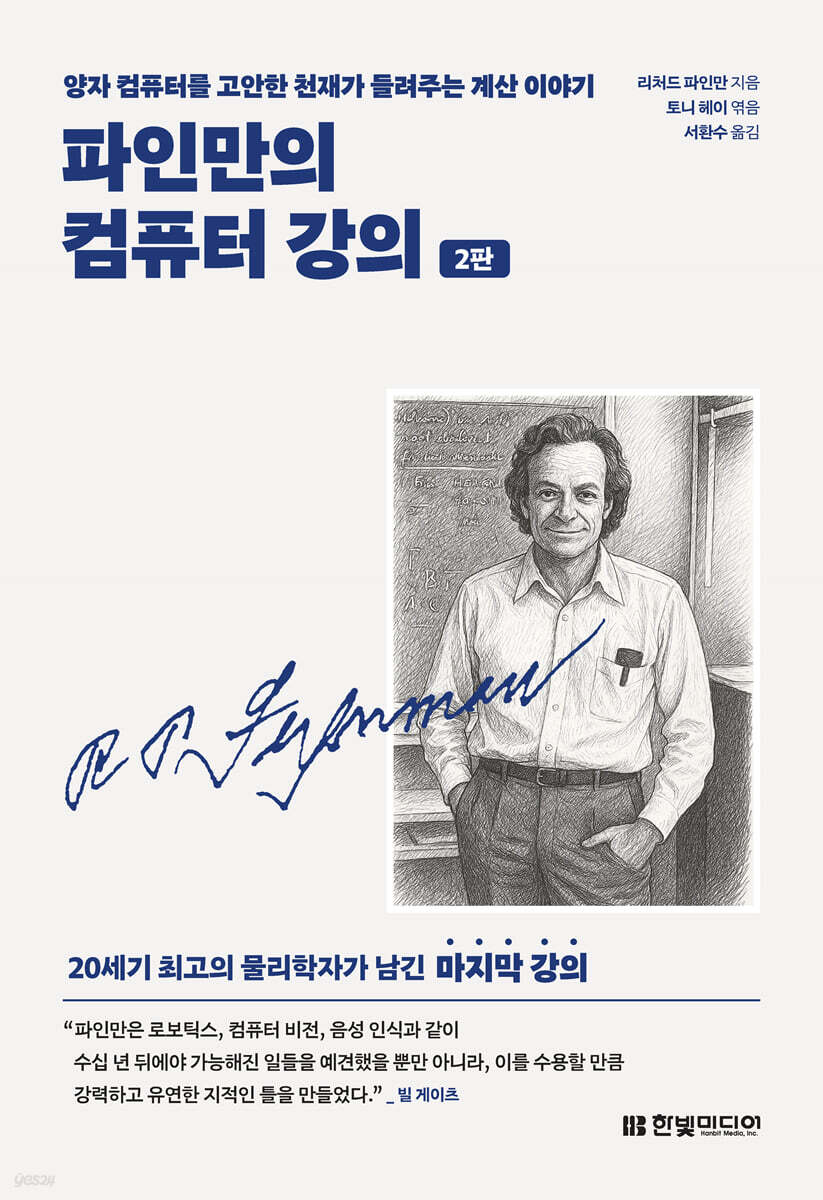
Feynman's Computer Lectures
 |
Description
Book Introduction
AI, quantum computers, robotics
Revisit the lecture of a physicist who envisioned the future of computers.
“Computer science forces us to reconsider what we can and cannot know about the world around us.” - Richard Feynman The last subject that Nobel Prize winner in physics Richard Feynman taught was none other than computer science.
From 1983 to 1986, he studied at the California Institute of Technology, starting from the physical nature of computation and exploring the entire range of computer theory, and deeply contemplated the question, "What is a computer?" with his own unique perspective.
The second edition, presented to commemorate the 20th anniversary of the first edition, reexamines modern computer science from Feynman's perspective.
We examine the impact of Feynman's concept of a "quantum mechanical computer" on today's "quantum computers," and add key issues in modern computer science, such as what Feynman said about AI.
Let's meet the master's final lecture, which shines even brighter as time passes.
Revisit the lecture of a physicist who envisioned the future of computers.
“Computer science forces us to reconsider what we can and cannot know about the world around us.” - Richard Feynman The last subject that Nobel Prize winner in physics Richard Feynman taught was none other than computer science.
From 1983 to 1986, he studied at the California Institute of Technology, starting from the physical nature of computation and exploring the entire range of computer theory, and deeply contemplated the question, "What is a computer?" with his own unique perspective.
The second edition, presented to commemorate the 20th anniversary of the first edition, reexamines modern computer science from Feynman's perspective.
We examine the impact of Feynman's concept of a "quantum mechanical computer" on today's "quantum computers," and add key issues in modern computer science, such as what Feynman said about AI.
Let's meet the master's final lecture, which shines even brighter as time passes.
- You can preview some of the book's contents.
Preview
index
CHAPTER 1 Introduction to Computers
_1.1 Document Organizer Model
_1.2 Command set
_1.3 Conclusion
CHAPTER 2 COMPUTER ARCHITECTURE
_2.1 Logic Gates and Combinational Logic
_2.2 Binary Decoder
_2.3 Other Gates: Reversible Gates
_2.4 Complete set of operators
_2.5 Flip-flops and computer memory
_2.6 Timing and Shift Registers
CHAPTER 3 Computational Theory
_3.1 Validity and Computability
_3.2 Finite State Machine
_3.3 Limitations of Finite State Machines
_3.4 Turing Machine 1
_3.5 Turing Machine 2
_3.6 Universal Turing Machines and the Termination Problem
_3.7 Computability
CHAPTER 4 Coding and Information Theory
_4.1 Computation and Communication Theory
_4.2 Error Detection and Correction Code
_4.3 Shannon's theorem
_4.4 Geometry of the Message Space
_4.5 Data Compression and Information
_4.6 Information Theory
_4.7 Other Coding Techniques
_4.8 Analog signal transmission
CHAPTER 5 Reversible Computation and the Thermodynamics of Computation
_5.1 Physics of Information
_5.2 Reversible Computation and Thermodynamics of Computation
_5.3 Calculation: Energy Cost vs.
speed
_5.4 General Reversible Computer
_5.5 Billiard Ball Computer
_5.6 Quantum Computation
CHAPTER 6 Quantum Mechanical Computers
_6.1 Introduction
_6.2 Calculation using a reversible computer
_6.3 Quantum mechanical computer
_6.4 Incompleteness and irreversible free energy loss
_6.5 How to simplify implementation
_6.6 Conclusion
_6.7 References
CHAPTER 7 Quantum Computing 40 Years Later
_7.1 Feynman and Quantum Computing
_7.2 Where we go, where we are
_7.3 Quantum Information
_7.4 What is a quantum computer?
_7.5 Quantum Dynamics Simulation
_7.6 Energy Eigenvalues and Eigenstates
_7.7 Quantum Error Correction
_7.8 Outlook
_7.9 References
CHAPTER 8 Physical Aspects of Computation
_From the editor
_8.1 Semiconductor Device Physics
_8.2 Energy Use and Heat Dissipation in Computers
_8.3 Building VLSI Circuits
_8.4 Some additional constraints related to computer design
CHAPTER 9: The Future of Computing Beyond Moore's Law
_9.1 Introduction
_9.2 Complementary role of new computational models
_9.3 Specialized design
_9.4 CMOS Replacement: Inventing a 'New Transistor'
_9.5 Reversibility Review
_9.6 Conclusion
_9.7 References
CHAPTER 10 Feynman and Artificial Intelligence
_10.1 Introduction
_10.2 Neural networks similar to physics from the 1980s
_10.3 Spring of AI/ML
_10.4 AI/ML for Computational Science
_10.5 Mathematical Synthesis and a Return to Symbolic AI?
_10.6 Conclusion
_10.7 References
EPILOGUE Memories with Feynman
Feynman at Caltech
Physics and Computation: What We Learned from Feynman, Hopfield, and Sussman
_Remembering Feynman
_1.1 Document Organizer Model
_1.2 Command set
_1.3 Conclusion
CHAPTER 2 COMPUTER ARCHITECTURE
_2.1 Logic Gates and Combinational Logic
_2.2 Binary Decoder
_2.3 Other Gates: Reversible Gates
_2.4 Complete set of operators
_2.5 Flip-flops and computer memory
_2.6 Timing and Shift Registers
CHAPTER 3 Computational Theory
_3.1 Validity and Computability
_3.2 Finite State Machine
_3.3 Limitations of Finite State Machines
_3.4 Turing Machine 1
_3.5 Turing Machine 2
_3.6 Universal Turing Machines and the Termination Problem
_3.7 Computability
CHAPTER 4 Coding and Information Theory
_4.1 Computation and Communication Theory
_4.2 Error Detection and Correction Code
_4.3 Shannon's theorem
_4.4 Geometry of the Message Space
_4.5 Data Compression and Information
_4.6 Information Theory
_4.7 Other Coding Techniques
_4.8 Analog signal transmission
CHAPTER 5 Reversible Computation and the Thermodynamics of Computation
_5.1 Physics of Information
_5.2 Reversible Computation and Thermodynamics of Computation
_5.3 Calculation: Energy Cost vs.
speed
_5.4 General Reversible Computer
_5.5 Billiard Ball Computer
_5.6 Quantum Computation
CHAPTER 6 Quantum Mechanical Computers
_6.1 Introduction
_6.2 Calculation using a reversible computer
_6.3 Quantum mechanical computer
_6.4 Incompleteness and irreversible free energy loss
_6.5 How to simplify implementation
_6.6 Conclusion
_6.7 References
CHAPTER 7 Quantum Computing 40 Years Later
_7.1 Feynman and Quantum Computing
_7.2 Where we go, where we are
_7.3 Quantum Information
_7.4 What is a quantum computer?
_7.5 Quantum Dynamics Simulation
_7.6 Energy Eigenvalues and Eigenstates
_7.7 Quantum Error Correction
_7.8 Outlook
_7.9 References
CHAPTER 8 Physical Aspects of Computation
_From the editor
_8.1 Semiconductor Device Physics
_8.2 Energy Use and Heat Dissipation in Computers
_8.3 Building VLSI Circuits
_8.4 Some additional constraints related to computer design
CHAPTER 9: The Future of Computing Beyond Moore's Law
_9.1 Introduction
_9.2 Complementary role of new computational models
_9.3 Specialized design
_9.4 CMOS Replacement: Inventing a 'New Transistor'
_9.5 Reversibility Review
_9.6 Conclusion
_9.7 References
CHAPTER 10 Feynman and Artificial Intelligence
_10.1 Introduction
_10.2 Neural networks similar to physics from the 1980s
_10.3 Spring of AI/ML
_10.4 AI/ML for Computational Science
_10.5 Mathematical Synthesis and a Return to Symbolic AI?
_10.6 Conclusion
_10.7 References
EPILOGUE Memories with Feynman
Feynman at Caltech
Physics and Computation: What We Learned from Feynman, Hopfield, and Sussman
_Remembering Feynman
Detailed image

Publisher's Review
Richard Feynman, a giant in physics,
Uncover the principles of computers and calculations!
“A master of explanations that vividly convey the beauty and order of the universe even to those who are not familiar with science.” - BBC
“One of the most brilliant, creative, and influential theoretical physicists of the postwar generation” - The New York Times
This book, which compiles lectures given by Nobel Prize winner in physics Richard Feynman, provides unique insights into the principles of computers and computation.
Beyond simply understanding how computers work, it delves into how the concept of computation connects to the laws of physics and what we can and cannot do, explaining complex theories in an accessible way that anyone can understand.
It explains the fundamental principles of computers, such as logic gates, information theory, and Turing machines, in everyday language, and goes beyond technical topics like logic circuits and programming languages to explain computations by connecting them to physics, information theory, artificial intelligence, and quantum computing.
Even in the 1980s, Feynman foresaw the potential of technologies that are gaining traction today, such as quantum computers, neural networks, and artificial intelligence.
This second edition also includes cutting-edge topics such as quantum computing, the future after Moore's Law, AI, and machine learning.
Feynman emphasizes the attitude that "you can't explain what you don't understand," and this book makes readers reflect on their own assumptions and thoughts beyond the topic of computers.
It's a book like a 'map of thought' that will change the way we understand the world.
Target audience
● Undergraduate and graduate students who want to build a solid foundation in hardware architecture and computational theory
● Developers who want to explore the limits of computing from a physics perspective with Feynman's unique perspective.
● Anyone who wants to have a 'deep' understanding of how computers work and what they can do.
Uncover the principles of computers and calculations!
“A master of explanations that vividly convey the beauty and order of the universe even to those who are not familiar with science.” - BBC
“One of the most brilliant, creative, and influential theoretical physicists of the postwar generation” - The New York Times
This book, which compiles lectures given by Nobel Prize winner in physics Richard Feynman, provides unique insights into the principles of computers and computation.
Beyond simply understanding how computers work, it delves into how the concept of computation connects to the laws of physics and what we can and cannot do, explaining complex theories in an accessible way that anyone can understand.
It explains the fundamental principles of computers, such as logic gates, information theory, and Turing machines, in everyday language, and goes beyond technical topics like logic circuits and programming languages to explain computations by connecting them to physics, information theory, artificial intelligence, and quantum computing.
Even in the 1980s, Feynman foresaw the potential of technologies that are gaining traction today, such as quantum computers, neural networks, and artificial intelligence.
This second edition also includes cutting-edge topics such as quantum computing, the future after Moore's Law, AI, and machine learning.
Feynman emphasizes the attitude that "you can't explain what you don't understand," and this book makes readers reflect on their own assumptions and thoughts beyond the topic of computers.
It's a book like a 'map of thought' that will change the way we understand the world.
Target audience
● Undergraduate and graduate students who want to build a solid foundation in hardware architecture and computational theory
● Developers who want to explore the limits of computing from a physics perspective with Feynman's unique perspective.
● Anyone who wants to have a 'deep' understanding of how computers work and what they can do.
GOODS SPECIFICS
- Date of issue: June 25, 2025
- Page count, weight, size: 522 pages | 722g | 153*223*29mm
- ISBN13: 9791169213974
- ISBN10: 1169213979
You may also like
카테고리
korean


korean

![GQ KOREA Mark (Monthly): December [2025]](http://librairie.coreenne.fr/cdn/shop/files/8ef265dbbfbf186523ed75ba7319009d.jpg?v=1765340328&width=3840)


