

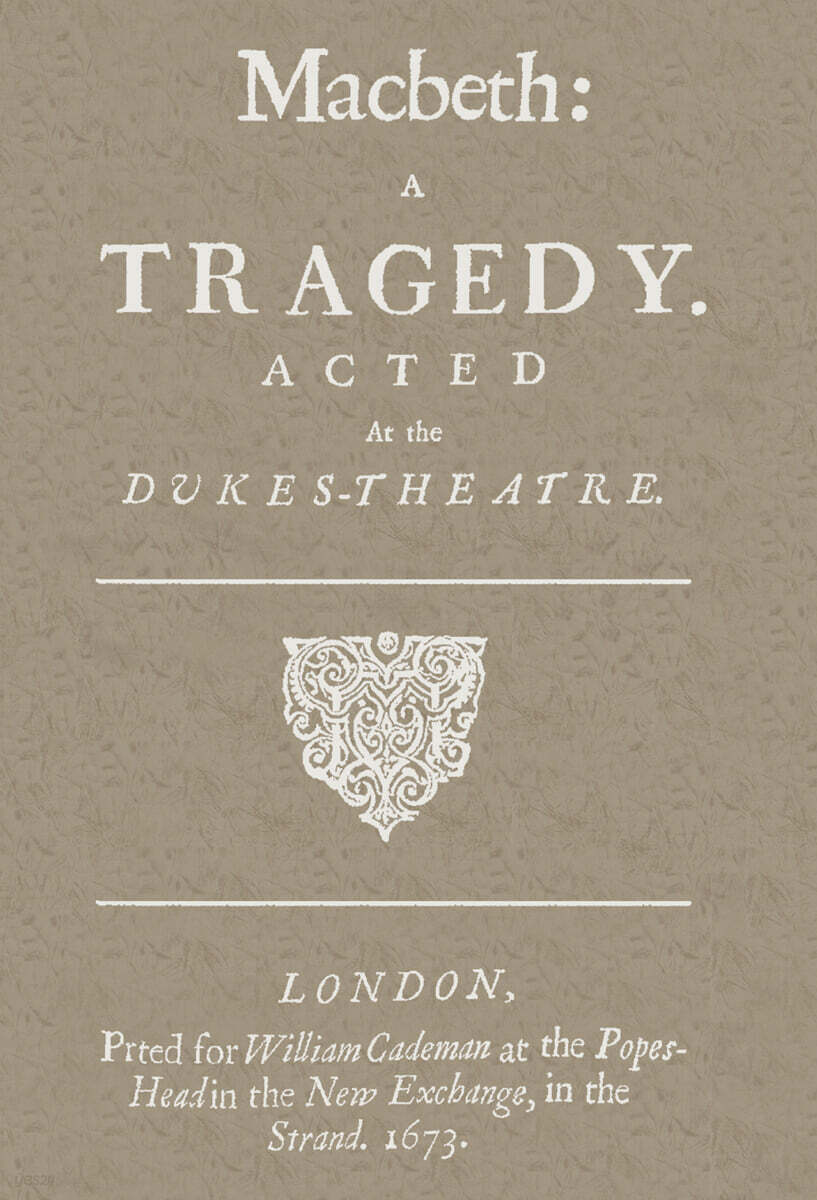
First edition of Macbeth
 |
Description
Book Introduction
The catastrophic outcome brought about by vain human greed
One of the four major tragedies of the great British writer Shakespeare
The most acclaimed Macbeth
England in Shakespeare's time was politically, socially, and culturally stable.
It was inevitable that a cultural revival would occur, as Queen Elizabeth demonstrated stable political ability and raised her military power to the highest level in Europe.
This is the biggest reason why Shakespeare was able to display his literary genius and write many works in such a historical context.
According to Aristotle, who discussed classical tragedy, a tragic hero should be “a person who avoids both extremes, neither being eminently good nor attributing his misfortunes to any wickedness or depravity, but rather to some mistake or defect of character (hamartia).”
Another Shakespearean scholar, Bradley (A.
C. Bradley) defined Shakespeare's tragedy as "a story of a special misfortune or convulsion that leads to the death of a person of high rank."
Macbeth is a heroic tragedy and one of the high tragedies in which the logic of tragedy is applied.
Additionally, the types of protagonists that appear in Shakespeare's tragedies are largely divided into two types.
The first is when a good person is tempted by evil due to a character flaw and commits evil, and the second is when a good person accidentally forms a close relationship with an evil person.
Macbeth falls into the former category.
Macbeth is the shortest of Shakespeare's four major tragedies, but it contains all the elements of tragedy, with the plot largely focused on Macbeth and Lady Macbeth.
The protagonist, Macbeth, is a loyal and honest Scottish general, but he lacks ambition and is indecisive.
He hears the witches' prophecy that he will become king in the future, and he plots treason with his choleric and greedy wife, and eventually ascends to the throne, but he meets a tragic end when he is killed by nobles and the princes of the previous king.
These characteristics of the protagonist in Macbeth make the audience feel both 'pity' and 'catharsis' at the same time.
Regardless of social status, whether noble or king, human nature is good, and the fact that they struggle between good and evil (desire), commit evil to achieve their ambitions, and ultimately suffer mental pain such as hallucinations or sleepwalking due to guilt makes us realize that they were ultimately human like us.
It also resolves the ethical dissatisfaction that even good people who commit evil that disrupts the 'order' must pay the price for correcting the order by dying.
The core of Renaissance literature is ‘human-centeredness.’
European medieval literature before the Renaissance was a reflection of the turbulent times of the time, and was church-centered or God-centered literature, such as the dehumanization of humanity and the praise of God.
Then, as Britain became a politically and militarily powerful nation and regained social stability, people's attention naturally shifted from God to us, that is, to 'humans'.
Moreover, a way of thinking has become widespread throughout the scientific community, creating an atmosphere in which not only all natural and social phenomena, but also humans, especially the mind, are scientifically interpreted.
The reason Shakespeare's tragedies are loved by people all over the world and performed on stage even after time passes is because of their 'modernity.'
In other words, Shakespeare knew that universal human emotions do not change.
Let's admire Shakespeare's genius in leading the common literary theme of good triumphing over evil to a tragic ending rather than a happy one, and meet "Macbeth" through the original first edition cover design of The Story.
One of the four major tragedies of the great British writer Shakespeare
The most acclaimed Macbeth
England in Shakespeare's time was politically, socially, and culturally stable.
It was inevitable that a cultural revival would occur, as Queen Elizabeth demonstrated stable political ability and raised her military power to the highest level in Europe.
This is the biggest reason why Shakespeare was able to display his literary genius and write many works in such a historical context.
According to Aristotle, who discussed classical tragedy, a tragic hero should be “a person who avoids both extremes, neither being eminently good nor attributing his misfortunes to any wickedness or depravity, but rather to some mistake or defect of character (hamartia).”
Another Shakespearean scholar, Bradley (A.
C. Bradley) defined Shakespeare's tragedy as "a story of a special misfortune or convulsion that leads to the death of a person of high rank."
Macbeth is a heroic tragedy and one of the high tragedies in which the logic of tragedy is applied.
Additionally, the types of protagonists that appear in Shakespeare's tragedies are largely divided into two types.
The first is when a good person is tempted by evil due to a character flaw and commits evil, and the second is when a good person accidentally forms a close relationship with an evil person.
Macbeth falls into the former category.
Macbeth is the shortest of Shakespeare's four major tragedies, but it contains all the elements of tragedy, with the plot largely focused on Macbeth and Lady Macbeth.
The protagonist, Macbeth, is a loyal and honest Scottish general, but he lacks ambition and is indecisive.
He hears the witches' prophecy that he will become king in the future, and he plots treason with his choleric and greedy wife, and eventually ascends to the throne, but he meets a tragic end when he is killed by nobles and the princes of the previous king.
These characteristics of the protagonist in Macbeth make the audience feel both 'pity' and 'catharsis' at the same time.
Regardless of social status, whether noble or king, human nature is good, and the fact that they struggle between good and evil (desire), commit evil to achieve their ambitions, and ultimately suffer mental pain such as hallucinations or sleepwalking due to guilt makes us realize that they were ultimately human like us.
It also resolves the ethical dissatisfaction that even good people who commit evil that disrupts the 'order' must pay the price for correcting the order by dying.
The core of Renaissance literature is ‘human-centeredness.’
European medieval literature before the Renaissance was a reflection of the turbulent times of the time, and was church-centered or God-centered literature, such as the dehumanization of humanity and the praise of God.
Then, as Britain became a politically and militarily powerful nation and regained social stability, people's attention naturally shifted from God to us, that is, to 'humans'.
Moreover, a way of thinking has become widespread throughout the scientific community, creating an atmosphere in which not only all natural and social phenomena, but also humans, especially the mind, are scientifically interpreted.
The reason Shakespeare's tragedies are loved by people all over the world and performed on stage even after time passes is because of their 'modernity.'
In other words, Shakespeare knew that universal human emotions do not change.
Let's admire Shakespeare's genius in leading the common literary theme of good triumphing over evil to a tragic ending rather than a happy one, and meet "Macbeth" through the original first edition cover design of The Story.
- You can preview some of the book's contents.
Preview
index
Act 1
Act 2
Act 3
Act 4
Act 5
Commentary | Why We Should Read King Lear Now
Author's chronology
Shakespeare's works
Act 2
Act 3
Act 4
Act 5
Commentary | Why We Should Read King Lear Now
Author's chronology
Shakespeare's works
GOODS SPECIFICS
- Date of issue: September 30, 2025
- Page count, weight, size: 188 pages | 128*188*20mm
- ISBN13: 9791175240599
- ISBN10: 1175240591
You may also like
카테고리
korean


korean

![GQ KOREA Mark (Monthly): December [2025]](http://librairie.coreenne.fr/cdn/shop/files/8ef265dbbfbf186523ed75ba7319009d.jpg?v=1765340328&width=3840)


