

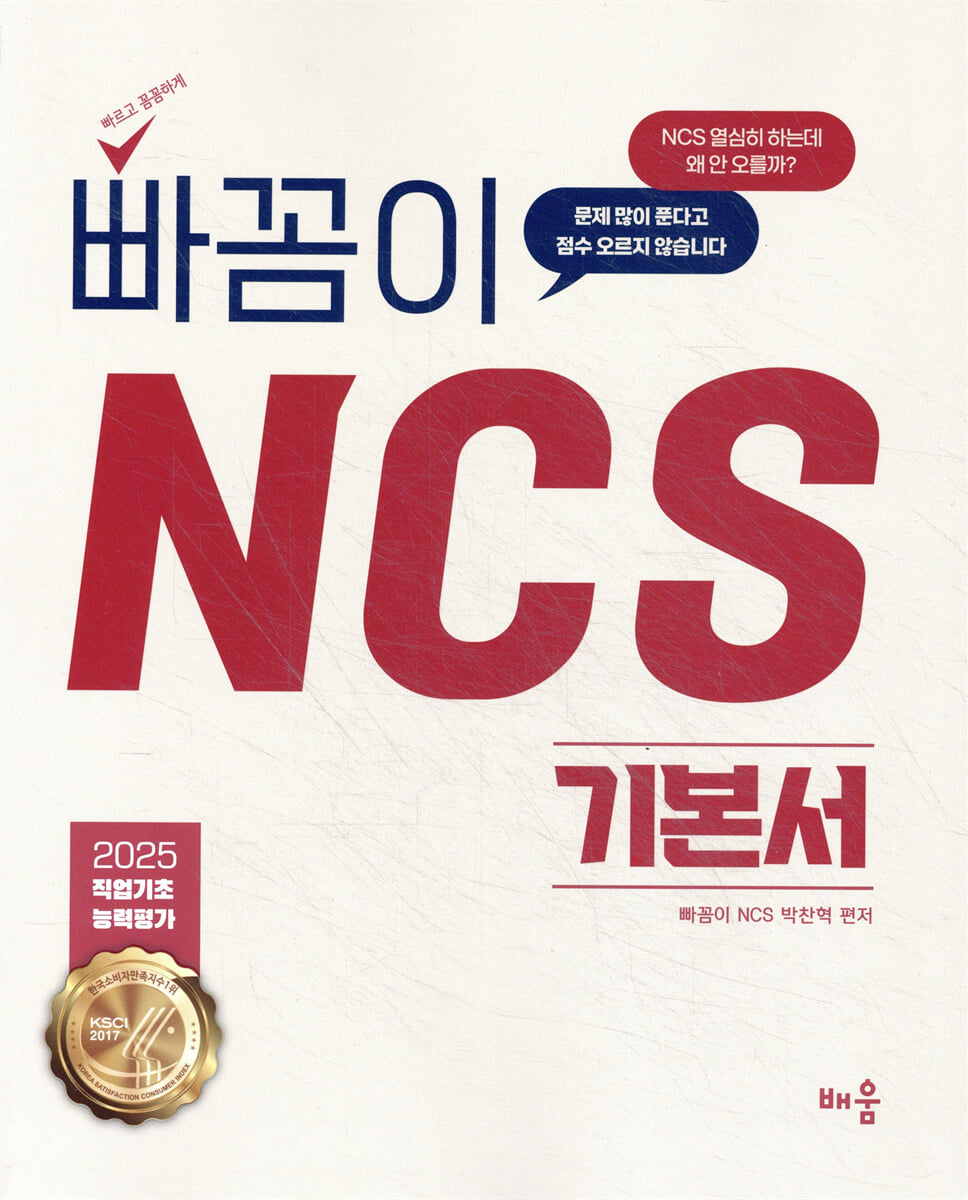
2025 Ppakkomi NCS Basic Book: Vocational Basic Ability Assessment
 |
Description
Book Introduction
* Quick and concise, just the key points!
* A new solution method presented to shorten the time
* Includes PSAT-style questions
* Modular, latest exam questions included and approaches presented
* Video lectures
Bbaggum NCS www.bbaggum2.com
The most important things in NCS are ‘time’ and ‘correct answer rate’.
Given enough time, most students can achieve a score of 90 or higher.
In the early stages of taking the exam, you will feel a great sense of 'lack of time' and focus on 'speed', but if you try to solve the problems quickly without knowing the correct method, your accuracy will drop sharply.
In this state, solving a lot of problems alone does not increase your score, so you have to start over from scratch and go through trial and error to figure out how to solve problems.
You need to approach learning with a method that can increase both ‘speed’ and ‘accuracy’ at the same time.
If you build a solid foundation so that you can approach it quickly but thoroughly, I think you will be able to get a passing score.
* A new solution method presented to shorten the time
* Includes PSAT-style questions
* Modular, latest exam questions included and approaches presented
* Video lectures
Bbaggum NCS www.bbaggum2.com
The most important things in NCS are ‘time’ and ‘correct answer rate’.
Given enough time, most students can achieve a score of 90 or higher.
In the early stages of taking the exam, you will feel a great sense of 'lack of time' and focus on 'speed', but if you try to solve the problems quickly without knowing the correct method, your accuracy will drop sharply.
In this state, solving a lot of problems alone does not increase your score, so you have to start over from scratch and go through trial and error to figure out how to solve problems.
You need to approach learning with a method that can increase both ‘speed’ and ‘accuracy’ at the same time.
If you build a solid foundation so that you can approach it quickly but thoroughly, I think you will be able to get a passing score.
- You can preview some of the book's contents.
Preview
index
PART 1.
mathematical ability
I.
Applied mathematics
Chapter 1.
Relative vs. Absolute Values
Chapter 2.
Average, salt water
Chapter 3.
rate, age, hour and minute hands, substitution, ratio
Chapter 4.
speed
Chapter 5.
probability
II.
Sequence (numerical reasoning)
Chapter 1.
simple sequence
Chapter 2.
Compound sequence
Chapter 3.
Sequence application
III.
Data interpretation
Chapter 1.
Choices to solve with your eyes and hands
Chapter 2.
Choices that are solved with the head
Chapter 3.
Characteristics of tables and graphs
IV.
Estimated and matching type
Chapter 1.
Eorimsan Mountain
Chapter 2.
Matching type
PART 2.
communication skills
Chapter 1 Topic, Title
Chapter 2 Contents Check
Chapter 3 Paragraph order, expressions, and vocabulary
Chapter 4 Complex Types
PART 3.
problem-solving skills
I.
Language area
1.
Language area
II.
Reasoning area
Chapter 1.
proposition
Chapter 2.
True or false
Chapter 3.
Language reasoning
PART 4.
Resource management capabilities
Chapter 1.
Addition and Comparison
Chapter 2.
Multiplication comparison
Chapter 3.
calculate
PART 5.
modular
I. NCS Theory
Chapter 0.
What is modular?
Chapter 1.
communication skills
Chapter 2.
problem-solving skills
Chapter 3.
Self-development ability
Chapter 4.
Resource management capabilities
Chapter 5.
interpersonal skills
Chapter 6.
Organizational understanding ability
Chapter 7.
Professional ethics
ㆍ 1 modular mock exam
ㆍ 2 modular mock exams
Ⅱ. NCS representative examples
Chapter 1.
Information capabilities
Chapter 2.
Organizational understanding ability
Chapter 3.
Technical skills
Chapter 4.
Resource management capabilities
Chapter 5.
problem-solving skills
mathematical ability
I.
Applied mathematics
Chapter 1.
Relative vs. Absolute Values
Chapter 2.
Average, salt water
Chapter 3.
rate, age, hour and minute hands, substitution, ratio
Chapter 4.
speed
Chapter 5.
probability
II.
Sequence (numerical reasoning)
Chapter 1.
simple sequence
Chapter 2.
Compound sequence
Chapter 3.
Sequence application
III.
Data interpretation
Chapter 1.
Choices to solve with your eyes and hands
Chapter 2.
Choices that are solved with the head
Chapter 3.
Characteristics of tables and graphs
IV.
Estimated and matching type
Chapter 1.
Eorimsan Mountain
Chapter 2.
Matching type
PART 2.
communication skills
Chapter 1 Topic, Title
Chapter 2 Contents Check
Chapter 3 Paragraph order, expressions, and vocabulary
Chapter 4 Complex Types
PART 3.
problem-solving skills
I.
Language area
1.
Language area
II.
Reasoning area
Chapter 1.
proposition
Chapter 2.
True or false
Chapter 3.
Language reasoning
PART 4.
Resource management capabilities
Chapter 1.
Addition and Comparison
Chapter 2.
Multiplication comparison
Chapter 3.
calculate
PART 5.
modular
I. NCS Theory
Chapter 0.
What is modular?
Chapter 1.
communication skills
Chapter 2.
problem-solving skills
Chapter 3.
Self-development ability
Chapter 4.
Resource management capabilities
Chapter 5.
interpersonal skills
Chapter 6.
Organizational understanding ability
Chapter 7.
Professional ethics
ㆍ 1 modular mock exam
ㆍ 2 modular mock exams
Ⅱ. NCS representative examples
Chapter 1.
Information capabilities
Chapter 2.
Organizational understanding ability
Chapter 3.
Technical skills
Chapter 4.
Resource management capabilities
Chapter 5.
problem-solving skills
Publisher's Review
Learning by Type
1) Identify the problem type
The problem types are divided into PSAT type and modular type, and the solving method is completely different depending on the problem type.
The two types can be distinguished by their shape, so it is not difficult to distinguish them.
The modular type is closer to simple memorization, and the problem-solving skills overlap with the PSAT type.
Therefore, it is recommended that you study the PSAT format as a base and memorize the parts that come out in the modular format separately.
I think it's a good idea to devote more than 80% of your study time to the PSAT.
2) Overcoming mathematical and problem-solving skills
The NCS has 10 domains, but not all domains are of equal importance.
I believe that the most important areas that determine whether you pass or fail are mathematical ability and problem-solving ability.
If you are weak in these two areas, you will lose both your score and time, which will put you further away from passing.
Unfortunately, these two areas are the ones that most test takers find difficult, but paradoxically, if you have good scores in these two areas, you can get one step closer to passing.
3) Familiarize yourself with tables (figures) and choice options.
Since the contents of the table (figure) change each time, you should study the ‘type’ rather than the contents of the table.
The reason for creating a table (figure) instead of text is to better express the author's 'purpose'.
Since you choose the 'type' of table that best expresses your purpose, you can infer the author's 'purpose' by looking at the 'type' of the table (figure).
Since the choices that fit this purpose will definitely appear on the test, studying the 'types' in the table means studying the choices according to the 'type' in advance.
If you know the choices that will be given in advance, the time will naturally be reduced.
During the test, most of the time is spent solving multiple choice questions.
Read and understand the content of the choices first, then solve (calculate).
Most students focus on learning how to calculate.
But it takes more time to read and understand than to calculate the options.
If you don't spend enough time reading and understanding the options, you'll have a hard time passing.
The choices that come out of NCS are already decided.
Since only the content that always appears is included, you can study in advance.
What always comes up here is not the subject, but the 'predicate'.
Studying a lot of 'predicates' can save you a lot of time.
① Subject
The subject must clearly distinguish between where to read and where not to read.
You should not read 'Table Title', 'Scope Limiting Content', etc.
You also have to decide whether to read the details in their entirety or treat them as pronouns without understanding them.
If you remove these unnecessary bits, the actual reading material is reduced to less than half of the total selection.
② Predicate (regular expression)
The predicate is an expression (a common expression) that is repeated in previous exams.
Learning about 30 common expressions can improve both the speed and accuracy of your ability to understand choices.
③ Difficulty/Importance Analysis
Difficulty analysis should be done based on common expressions.
If you can analyze the difficulty and importance (high probability of being the answer) of the choices based on common expressions, it will be of great help when determining the order in which to solve the problem.
Repetitive learning for 'embodiment'
The most important things I tell students when studying are embodied and double-reading.
In order to embody something, repeated learning is necessary, and the most important thing in that process is reading it twice.
The form of the table (figure) and the standard expressions of the choices are repeated.
So there is no reason to solve too many problems blindly.
You must thoroughly analyze and become familiar with the past exam questions in the textbook.
The most efficient way to do this is to repeatedly review the past exam questions learned in class.
After taking the class, the level of understanding varies from 30% to 70%.
If you study on your own without understanding the textbook at least 60%, you will be stressed and not be able to make progress.
Many students break down at this stage and give up on reviewing, focusing solely on solving problems.
Most students will have a 60% understanding of the textbook after reading it twice, so it won't be too difficult to study on your own from the third reading onwards.
The second reading should be done quickly and intensively.
I am confident that if you follow the 2-month curriculum provided by the Bbaggum2 website (bbaggum2.com) and repeat it every 2 months until you reach a certain level, your grades will definitely improve.
1) Identify the problem type
The problem types are divided into PSAT type and modular type, and the solving method is completely different depending on the problem type.
The two types can be distinguished by their shape, so it is not difficult to distinguish them.
The modular type is closer to simple memorization, and the problem-solving skills overlap with the PSAT type.
Therefore, it is recommended that you study the PSAT format as a base and memorize the parts that come out in the modular format separately.
I think it's a good idea to devote more than 80% of your study time to the PSAT.
2) Overcoming mathematical and problem-solving skills
The NCS has 10 domains, but not all domains are of equal importance.
I believe that the most important areas that determine whether you pass or fail are mathematical ability and problem-solving ability.
If you are weak in these two areas, you will lose both your score and time, which will put you further away from passing.
Unfortunately, these two areas are the ones that most test takers find difficult, but paradoxically, if you have good scores in these two areas, you can get one step closer to passing.
3) Familiarize yourself with tables (figures) and choice options.
Since the contents of the table (figure) change each time, you should study the ‘type’ rather than the contents of the table.
The reason for creating a table (figure) instead of text is to better express the author's 'purpose'.
Since you choose the 'type' of table that best expresses your purpose, you can infer the author's 'purpose' by looking at the 'type' of the table (figure).
Since the choices that fit this purpose will definitely appear on the test, studying the 'types' in the table means studying the choices according to the 'type' in advance.
If you know the choices that will be given in advance, the time will naturally be reduced.
During the test, most of the time is spent solving multiple choice questions.
Read and understand the content of the choices first, then solve (calculate).
Most students focus on learning how to calculate.
But it takes more time to read and understand than to calculate the options.
If you don't spend enough time reading and understanding the options, you'll have a hard time passing.
The choices that come out of NCS are already decided.
Since only the content that always appears is included, you can study in advance.
What always comes up here is not the subject, but the 'predicate'.
Studying a lot of 'predicates' can save you a lot of time.
① Subject
The subject must clearly distinguish between where to read and where not to read.
You should not read 'Table Title', 'Scope Limiting Content', etc.
You also have to decide whether to read the details in their entirety or treat them as pronouns without understanding them.
If you remove these unnecessary bits, the actual reading material is reduced to less than half of the total selection.
② Predicate (regular expression)
The predicate is an expression (a common expression) that is repeated in previous exams.
Learning about 30 common expressions can improve both the speed and accuracy of your ability to understand choices.
③ Difficulty/Importance Analysis
Difficulty analysis should be done based on common expressions.
If you can analyze the difficulty and importance (high probability of being the answer) of the choices based on common expressions, it will be of great help when determining the order in which to solve the problem.
Repetitive learning for 'embodiment'
The most important things I tell students when studying are embodied and double-reading.
In order to embody something, repeated learning is necessary, and the most important thing in that process is reading it twice.
The form of the table (figure) and the standard expressions of the choices are repeated.
So there is no reason to solve too many problems blindly.
You must thoroughly analyze and become familiar with the past exam questions in the textbook.
The most efficient way to do this is to repeatedly review the past exam questions learned in class.
After taking the class, the level of understanding varies from 30% to 70%.
If you study on your own without understanding the textbook at least 60%, you will be stressed and not be able to make progress.
Many students break down at this stage and give up on reviewing, focusing solely on solving problems.
Most students will have a 60% understanding of the textbook after reading it twice, so it won't be too difficult to study on your own from the third reading onwards.
The second reading should be done quickly and intensively.
I am confident that if you follow the 2-month curriculum provided by the Bbaggum2 website (bbaggum2.com) and repeat it every 2 months until you reach a certain level, your grades will definitely improve.
GOODS SPECIFICS
- Date of issue: June 10, 2024
- Page count, weight, size: 832 pages | 210*260*40mm
- ISBN13: 9791194002123
- ISBN10: 1194002129
You may also like
카테고리
korean


korean

![GQ KOREA Mark (Monthly): December [2025]](http://librairie.coreenne.fr/cdn/shop/files/8ef265dbbfbf186523ed75ba7319009d.jpg?v=1765340328&width=3840)


