

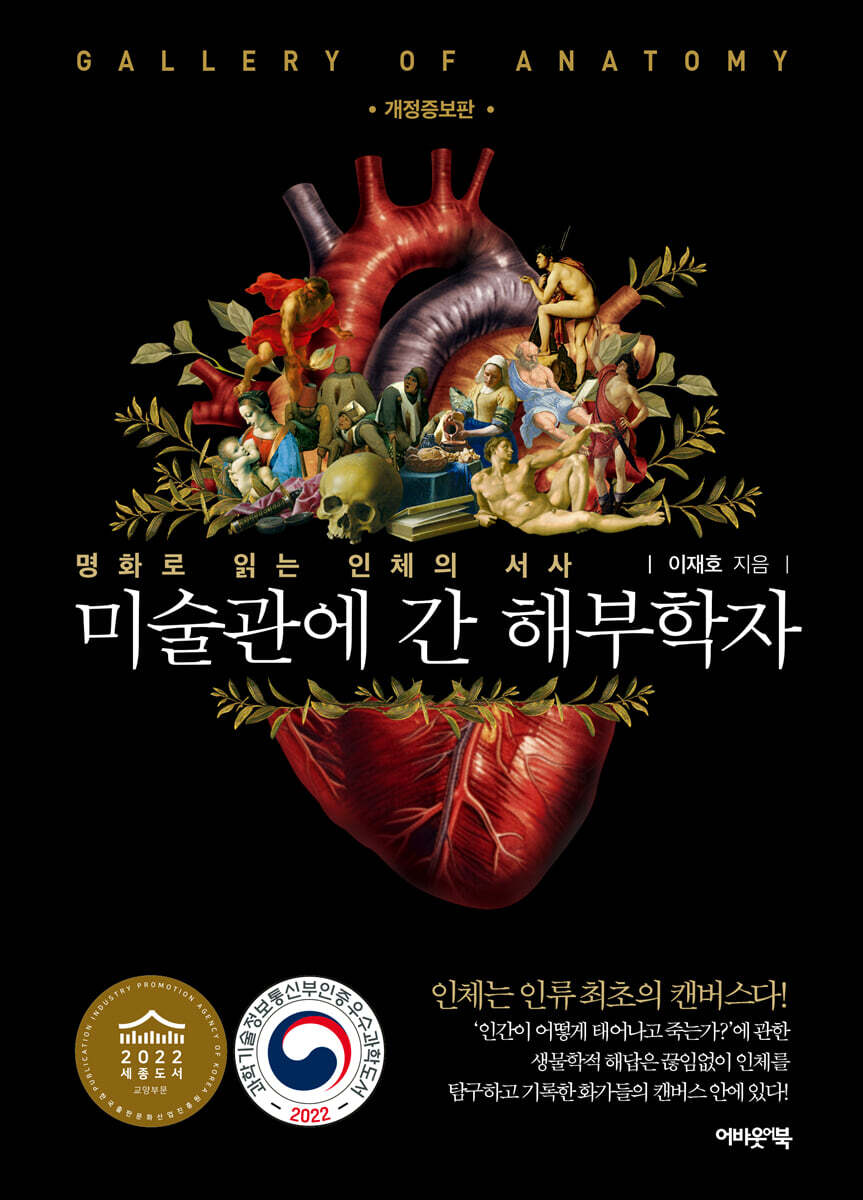
Anatomist goes to the art museum
 |
Description
Book Introduction
Praised by all walks of life, including the medical and educational communities, as a premier book that fuses medicine, art, and the humanities!
A must-read for medical school students preparing for the MMI interview, personal statement, and essay!
『The Anatomist Who Went to the Art Museum』 has returned in a revised and expanded edition four years after its publication.
It has been highly praised by people from all walks of life as the best book that combines medicine, art, and humanities, including being selected as an 'Excellent Science Book' by the Ministry of Science and ICT, a 'Sejong Book' by the Ministry of Culture, Sports and Tourism, and a 'Recommended Book' by Seoul National University's Gifted Education Center and Happy Morning Reading.
Above all, it has established itself as a must-read for prospective medical students hoping to advance to medical school in preparation for medical school MMI interviews, medical school personal statements, and essays.
In the revised and expanded edition, [Special Edition: Anatomy & Architecture] is included as a special feature at the end of the book, which delves into the anatomical codes contained in the architectural art of world-renowned architect Antoni Gaudí.
The author personally visited and explored Gaudi's buildings, including Casa Batlló and Park Güell in Barcelona, and analyzed the principles of architectural mechanics and ergonomics related to the structure of our body.
Artists, including Gaudí, were as obsessed with the human body as anatomists, and the results of their research are fully reflected in their works.
The brachialis muscle depicted by Vermeer in [The Milkmaid], the lungs hidden by Botticelli in [Spring], the biceps femoris muscle depicted by David in [Oath of the Horatii], the gluteus maximus muscle depicted by Raimondi in [The Judgement of Paris]… … .
When you look at a work of art through the eyes of an anatomist, you can see every nook and cranny of the human body, including muscles, bones, blood vessels, and organs.
The artwork hanging in the museum is like a cadaver.
Many of the organs of the human body, such as the lymph, mitral ducts, labyrinth, and canines, have their names borrowed from mythological figures or their likenesses.
Artworks that contain diverse stories from mythology, religion, and history are excellent textbooks that can explain anatomy in an easy and fun way.
The intersection of art and anatomy helps us explore aspects of the human body that we normally overlook.
Art museums around the world are anatomy classrooms where you can explore every inch of the human body without having to weep over the smell of formalin.
Each and every piece of art left behind by artists who have passionately explored the human body will serve as a cadaver to aid in the exploration of the human body.
A must-read for medical school students preparing for the MMI interview, personal statement, and essay!
『The Anatomist Who Went to the Art Museum』 has returned in a revised and expanded edition four years after its publication.
It has been highly praised by people from all walks of life as the best book that combines medicine, art, and humanities, including being selected as an 'Excellent Science Book' by the Ministry of Science and ICT, a 'Sejong Book' by the Ministry of Culture, Sports and Tourism, and a 'Recommended Book' by Seoul National University's Gifted Education Center and Happy Morning Reading.
Above all, it has established itself as a must-read for prospective medical students hoping to advance to medical school in preparation for medical school MMI interviews, medical school personal statements, and essays.
In the revised and expanded edition, [Special Edition: Anatomy & Architecture] is included as a special feature at the end of the book, which delves into the anatomical codes contained in the architectural art of world-renowned architect Antoni Gaudí.
The author personally visited and explored Gaudi's buildings, including Casa Batlló and Park Güell in Barcelona, and analyzed the principles of architectural mechanics and ergonomics related to the structure of our body.
Artists, including Gaudí, were as obsessed with the human body as anatomists, and the results of their research are fully reflected in their works.
The brachialis muscle depicted by Vermeer in [The Milkmaid], the lungs hidden by Botticelli in [Spring], the biceps femoris muscle depicted by David in [Oath of the Horatii], the gluteus maximus muscle depicted by Raimondi in [The Judgement of Paris]… … .
When you look at a work of art through the eyes of an anatomist, you can see every nook and cranny of the human body, including muscles, bones, blood vessels, and organs.
The artwork hanging in the museum is like a cadaver.
Many of the organs of the human body, such as the lymph, mitral ducts, labyrinth, and canines, have their names borrowed from mythological figures or their likenesses.
Artworks that contain diverse stories from mythology, religion, and history are excellent textbooks that can explain anatomy in an easy and fun way.
The intersection of art and anatomy helps us explore aspects of the human body that we normally overlook.
Art museums around the world are anatomy classrooms where you can explore every inch of the human body without having to weep over the smell of formalin.
Each and every piece of art left behind by artists who have passionately explored the human body will serve as a cadaver to aid in the exploration of the human body.
- You can preview some of the book's contents.
Preview
index
Preface _ The hidden contributors to the advancement of anatomy are artists!
Chapter 1.
Solving the Mystery in the Painting with Anatomy
01.
Finding the brain anatomy hidden in Michelangelo's paintings
02.
A man holding a pen next to a rotting corpse
03.
Memento Mori
04.
Dog-like philosophers and canines
05.
Lymph, the water spirit that protects our bodies
06.
Medusa's head moved from the shield to the navel
07.
Botticelli's love that was full of lungs
08.
The diamond shape of the face that determines the impression
09.
The muscular bodies of warriors who dared not die
10.
Joy and sorrow seeping into my spine
Chapter 2.
Human body maps found in famous paintings
11.
Cronus's Scythe that separates life and death
12.
Denying the Father and Developing Anatomy
13.
Breastless Woman, Amazon
14.
Hidden Accomplice in the Murder of the Austrian Empress
15.
Cheers to your eyes!
16.
Draw what you can't see
17.
An apple that balances the body
18.
The 'star portrait artist' lifted the wrong muscle
19.
The shining beauty of the most ordinary existence
Chapter 3.
Stories left behind in the human body
20.
The monk's symbol engraved on the body
21.
Punishment and gifts received for stealing fire
22.
The 'Weight of Life' Carried by Atlas
23.
The feet of a man staggering in the whirlpool of fate
24.
The hand that holds both war and harmony
25.
A labyrinth in the ear from which one can never escape
26.
An unparalleled emperor born from his mother's womb
27.
The Achilles tendon, the greatest contributor to upright walking
28.
Arachne's spider web in the brain
29.
Laocoon's muscles that astonished the world
30.
[Special Edition: Anatomy & Architecture] A "House of the Human Body" Designed with Deep Imagination
Browse works
Chapter 1.
Solving the Mystery in the Painting with Anatomy
01.
Finding the brain anatomy hidden in Michelangelo's paintings
02.
A man holding a pen next to a rotting corpse
03.
Memento Mori
04.
Dog-like philosophers and canines
05.
Lymph, the water spirit that protects our bodies
06.
Medusa's head moved from the shield to the navel
07.
Botticelli's love that was full of lungs
08.
The diamond shape of the face that determines the impression
09.
The muscular bodies of warriors who dared not die
10.
Joy and sorrow seeping into my spine
Chapter 2.
Human body maps found in famous paintings
11.
Cronus's Scythe that separates life and death
12.
Denying the Father and Developing Anatomy
13.
Breastless Woman, Amazon
14.
Hidden Accomplice in the Murder of the Austrian Empress
15.
Cheers to your eyes!
16.
Draw what you can't see
17.
An apple that balances the body
18.
The 'star portrait artist' lifted the wrong muscle
19.
The shining beauty of the most ordinary existence
Chapter 3.
Stories left behind in the human body
20.
The monk's symbol engraved on the body
21.
Punishment and gifts received for stealing fire
22.
The 'Weight of Life' Carried by Atlas
23.
The feet of a man staggering in the whirlpool of fate
24.
The hand that holds both war and harmony
25.
A labyrinth in the ear from which one can never escape
26.
An unparalleled emperor born from his mother's womb
27.
The Achilles tendon, the greatest contributor to upright walking
28.
Arachne's spider web in the brain
29.
Laocoon's muscles that astonished the world
30.
[Special Edition: Anatomy & Architecture] A "House of the Human Body" Designed with Deep Imagination
Browse works
Detailed image

Publisher's Review
ㆍSelected as an 'Excellent Science Book' by the Ministry of Science and ICT
ㆍSelected as a 'Sejong Book' by the Ministry of Culture, Sports and Tourism
ㆍSelected as a 'Recommended Book' by Seoul National University Gifted Education Center
ㆍSelected as a 'Recommended Book' by Happy Morning Reading
◎ From Da Vinci, Michelangelo, and David to Kahlo and Basquiat
Follow the artist's fingertips and interpret the anatomical codes contained in famous paintings!
The artwork hanging in the museum is like a cadaver.
Artists have been as obsessed with the human body as anatomists, and the results of their research are fully reflected in their work.
American painter Robert Henri (1865-1929) said, “Knowledge of anatomy is like a good brush to an artist.”
Many artists have explored the human body to obtain good brushes, sometimes even taking up the scalpel themselves.
Da Vinci was an empiricist who valued knowledge acquired through experience more than knowledge gained through writing and speech.
He explored the human body by personally dissecting over 30 corpses.
The reason da Vinci, who was neither a doctor nor a scientist, dissected human bodies was to draw the human body more accurately.
Because dissecting a human body was against church law at the time, da Vinci handled the scalpel with caution.
He spent a week examining each corpse in the stench of decaying corpses.
As a result, he was not only the first to accurately capture the coronary artery, but also the first to confirm that the optic nerve is connected to the brain.
The 1,800 or so anatomical drawings he left behind provide detailed information on every nook and cranny of the human body, surprising modern anatomists (p. 47).
Michelangelo's Pieta is considered the best work expressing the same subject.
This is because his “Pieta” accurately reflects the Renaissance spirit of “harmonious balance between idealism and naturalism.”
He depicted the human body so realistically that he even carved the muscles and blood vessels of Jesus' saggy arms.
Having studied anatomy under the patronage of the Medici family, he even rescued and dissected unidentified corpses himself (p. 24).
Michelangelo hid anatomical diagrams in his works to avoid the prying eyes of the church, which prohibited dissection.
The Sistine Chapel ceiling painting in the Vatican, “The Creation of Adam,” includes a cross-section of the brain (page 25).
David, a representative painter of 'Neoclassicism' who advocated a return to classicism along with the Renaissance, tried to depict the perfect human body in his works.
He meticulously sketched each muscle to accurately depict the bodies of the three men embracing each other in “The Tennis Court Oath.”
In the sketch, which depicts even the muscles that would otherwise be covered by clothing in detail, one can feel how much effort David put into realistically expressing the human body (page 140).
Dissecting the human body has long been taboo, regardless of time or place.
Artists studied the human body, breaking taboos to create the perfect human figure in their works.
Sometimes, I explored the human body with a more scientific perspective than scientists.
◎ Every single piece of art hanging in art galleries around the world is a cadaver!
When you look at a work of art through the eyes of an anatomist, you can see every nook and cranny of the human body, including muscles, bones, blood vessels, and organs.
The Milkmaid, painted by Dutch genre painter Vermeer, contains traces of repetitive housework.
The woman's left arm supports a heavy kettle.
The prominent muscle on her left arm is the brachialis muscle.
It is used when lifting something like the woman in the painting, bending the elbow joint.
The brachialis muscle originates on the outside of the humerus and attaches to the humerus, the outer bone of the forearm.
This muscle is used to lift a beer mug, hence its nickname 'beer raising' (p. 285).
The most famous painting depicting the birth of Aphrodite is Botticelli's The Birth of Venus.
The anatomically noteworthy point in this work is the left shoulder.
Botticelli's Aphrodite has a particularly drooping left shoulder.
The reason is that Botticelli's Aphrodite was modeled after his first love, who died early from tuberculosis (p. 109).
Tuberculosis occurs more often in the left lung due to the nature of the bronchial tubes.
Because her left lung was damaged by tuberculosis bacteria, her left shoulder slumped like Botticelli's Aphrodite (p. 118).
Botticelli, who never forgot his first love throughout his life, even drew a windpipe behind Aphrodite in “Spring” (p. 113).
In the "Laocoon Group," which vividly depicts the Laocoon father and son writhing in pain after being bitten by a snake, the "serratus anterior" muscle can be found.
The anterior serratus anterior muscle connects the shoulder blade and ribs, and the side that attaches to the ribs is shaped like a saw tooth.
Lift your shoulders and upper arms, and lift your ribs to help you inhale air.
It also helps rotate the shoulders by bringing the shoulder blades forward so that the arms can be extended forward.
The anterior serratus anterior muscle is well developed in boxers who make a lot of hand-extending movements, and is therefore also called the 'boxer's muscle' (p. 419).
Many of the organs in the body, such as the lymphatic system and the mitral duct, have names borrowed from mythological figures or their likenesses.
Artworks that contain diverse stories from mythology, religion, and history are excellent teaching materials that can explain anatomy in an easy and fun way.
The monster 'Medusa', who turns everyone who meets her eyes to stone, also exists within us.
When the liver hardens and cannot function properly, blood that should be returning to the heart through the liver instead seeks an alternative blood vessel, resulting in the veins near the navel bulging to the point where they are visible through the skin.
Because this appearance resembles Medusa transformed into a monster, this disease is called 'Medusa's head (caput medusa).'
The head of Medusa appearing around the navel resembles the “Head of Medusa” painted by Caravaggio (p. 96).
Around the time I get off work, my muscles feel particularly sore.
This is the 'trapezius muscle' that protrudes above the shoulder.
This muscle is called the trapezius because it resembles the cap of a Franciscan monk's habit, the 'capuchin'.
The trapezius muscle has a flat, triangular shape that is identical to the part of the capuchin's head that touches the shoulder when the cap is removed.
This scene is well depicted in the painting “Saint Francis” by Zurbarán, the “painter of monks” (p. 307).
The logical conclusion of Darwin's theory of evolution is that 'all living things have a common ancestor.'
All living things on Earth, whether humans or dogs, come from the same ancestors.
He has evidence in his mouth to support his claims.
It is a 'canine tooth' that tears food into small pieces.
Canines are more developed in carnivores such as dogs, and are also called 'canine teeth' in English.
These very canines are the link between humans and dogs (page 75).
◎ The human body is mankind's first canvas!
The first canvas for mankind is the human body.
All humans go through the process of birth, aging, illness, and death.
The traces remain on the human body like a picture.
Anatomy is the study of the canvas called the human body.
The ultimate purpose of dissecting the human body is to properly understand 'humanity'.
Knowing 'myself' is the starting point for understanding the world.
Anatomy is a subject that is necessary not only for the specific profession of doctors, but for all humans.
The intersection of art and anatomy helps us explore aspects of the human body that we normally overlook.
Art museums around the world are anatomy classrooms where you can explore every inch of the human body without having to weep over the smell of formalin.
Each piece of art left behind by artists who scientifically explored the human body will serve as a cadaver to aid us in our exploration of the human body.
ㆍSelected as a 'Sejong Book' by the Ministry of Culture, Sports and Tourism
ㆍSelected as a 'Recommended Book' by Seoul National University Gifted Education Center
ㆍSelected as a 'Recommended Book' by Happy Morning Reading
◎ From Da Vinci, Michelangelo, and David to Kahlo and Basquiat
Follow the artist's fingertips and interpret the anatomical codes contained in famous paintings!
The artwork hanging in the museum is like a cadaver.
Artists have been as obsessed with the human body as anatomists, and the results of their research are fully reflected in their work.
American painter Robert Henri (1865-1929) said, “Knowledge of anatomy is like a good brush to an artist.”
Many artists have explored the human body to obtain good brushes, sometimes even taking up the scalpel themselves.
Da Vinci was an empiricist who valued knowledge acquired through experience more than knowledge gained through writing and speech.
He explored the human body by personally dissecting over 30 corpses.
The reason da Vinci, who was neither a doctor nor a scientist, dissected human bodies was to draw the human body more accurately.
Because dissecting a human body was against church law at the time, da Vinci handled the scalpel with caution.
He spent a week examining each corpse in the stench of decaying corpses.
As a result, he was not only the first to accurately capture the coronary artery, but also the first to confirm that the optic nerve is connected to the brain.
The 1,800 or so anatomical drawings he left behind provide detailed information on every nook and cranny of the human body, surprising modern anatomists (p. 47).
Michelangelo's Pieta is considered the best work expressing the same subject.
This is because his “Pieta” accurately reflects the Renaissance spirit of “harmonious balance between idealism and naturalism.”
He depicted the human body so realistically that he even carved the muscles and blood vessels of Jesus' saggy arms.
Having studied anatomy under the patronage of the Medici family, he even rescued and dissected unidentified corpses himself (p. 24).
Michelangelo hid anatomical diagrams in his works to avoid the prying eyes of the church, which prohibited dissection.
The Sistine Chapel ceiling painting in the Vatican, “The Creation of Adam,” includes a cross-section of the brain (page 25).
David, a representative painter of 'Neoclassicism' who advocated a return to classicism along with the Renaissance, tried to depict the perfect human body in his works.
He meticulously sketched each muscle to accurately depict the bodies of the three men embracing each other in “The Tennis Court Oath.”
In the sketch, which depicts even the muscles that would otherwise be covered by clothing in detail, one can feel how much effort David put into realistically expressing the human body (page 140).
Dissecting the human body has long been taboo, regardless of time or place.
Artists studied the human body, breaking taboos to create the perfect human figure in their works.
Sometimes, I explored the human body with a more scientific perspective than scientists.
◎ Every single piece of art hanging in art galleries around the world is a cadaver!
When you look at a work of art through the eyes of an anatomist, you can see every nook and cranny of the human body, including muscles, bones, blood vessels, and organs.
The Milkmaid, painted by Dutch genre painter Vermeer, contains traces of repetitive housework.
The woman's left arm supports a heavy kettle.
The prominent muscle on her left arm is the brachialis muscle.
It is used when lifting something like the woman in the painting, bending the elbow joint.
The brachialis muscle originates on the outside of the humerus and attaches to the humerus, the outer bone of the forearm.
This muscle is used to lift a beer mug, hence its nickname 'beer raising' (p. 285).
The most famous painting depicting the birth of Aphrodite is Botticelli's The Birth of Venus.
The anatomically noteworthy point in this work is the left shoulder.
Botticelli's Aphrodite has a particularly drooping left shoulder.
The reason is that Botticelli's Aphrodite was modeled after his first love, who died early from tuberculosis (p. 109).
Tuberculosis occurs more often in the left lung due to the nature of the bronchial tubes.
Because her left lung was damaged by tuberculosis bacteria, her left shoulder slumped like Botticelli's Aphrodite (p. 118).
Botticelli, who never forgot his first love throughout his life, even drew a windpipe behind Aphrodite in “Spring” (p. 113).
In the "Laocoon Group," which vividly depicts the Laocoon father and son writhing in pain after being bitten by a snake, the "serratus anterior" muscle can be found.
The anterior serratus anterior muscle connects the shoulder blade and ribs, and the side that attaches to the ribs is shaped like a saw tooth.
Lift your shoulders and upper arms, and lift your ribs to help you inhale air.
It also helps rotate the shoulders by bringing the shoulder blades forward so that the arms can be extended forward.
The anterior serratus anterior muscle is well developed in boxers who make a lot of hand-extending movements, and is therefore also called the 'boxer's muscle' (p. 419).
Many of the organs in the body, such as the lymphatic system and the mitral duct, have names borrowed from mythological figures or their likenesses.
Artworks that contain diverse stories from mythology, religion, and history are excellent teaching materials that can explain anatomy in an easy and fun way.
The monster 'Medusa', who turns everyone who meets her eyes to stone, also exists within us.
When the liver hardens and cannot function properly, blood that should be returning to the heart through the liver instead seeks an alternative blood vessel, resulting in the veins near the navel bulging to the point where they are visible through the skin.
Because this appearance resembles Medusa transformed into a monster, this disease is called 'Medusa's head (caput medusa).'
The head of Medusa appearing around the navel resembles the “Head of Medusa” painted by Caravaggio (p. 96).
Around the time I get off work, my muscles feel particularly sore.
This is the 'trapezius muscle' that protrudes above the shoulder.
This muscle is called the trapezius because it resembles the cap of a Franciscan monk's habit, the 'capuchin'.
The trapezius muscle has a flat, triangular shape that is identical to the part of the capuchin's head that touches the shoulder when the cap is removed.
This scene is well depicted in the painting “Saint Francis” by Zurbarán, the “painter of monks” (p. 307).
The logical conclusion of Darwin's theory of evolution is that 'all living things have a common ancestor.'
All living things on Earth, whether humans or dogs, come from the same ancestors.
He has evidence in his mouth to support his claims.
It is a 'canine tooth' that tears food into small pieces.
Canines are more developed in carnivores such as dogs, and are also called 'canine teeth' in English.
These very canines are the link between humans and dogs (page 75).
◎ The human body is mankind's first canvas!
The first canvas for mankind is the human body.
All humans go through the process of birth, aging, illness, and death.
The traces remain on the human body like a picture.
Anatomy is the study of the canvas called the human body.
The ultimate purpose of dissecting the human body is to properly understand 'humanity'.
Knowing 'myself' is the starting point for understanding the world.
Anatomy is a subject that is necessary not only for the specific profession of doctors, but for all humans.
The intersection of art and anatomy helps us explore aspects of the human body that we normally overlook.
Art museums around the world are anatomy classrooms where you can explore every inch of the human body without having to weep over the smell of formalin.
Each piece of art left behind by artists who scientifically explored the human body will serve as a cadaver to aid us in our exploration of the human body.
GOODS SPECIFICS
- Date of issue: June 9, 2025
- Page count, weight, size: 456 pages | 150*210*30mm
- ISBN13: 9791192229621
- ISBN10: 1192229622
You may also like
카테고리
korean


korean

![GQ KOREA Mark (Monthly): December [2025]](http://librairie.coreenne.fr/cdn/shop/files/8ef265dbbfbf186523ed75ba7319009d.jpg?v=1765340328&width=3840)


