

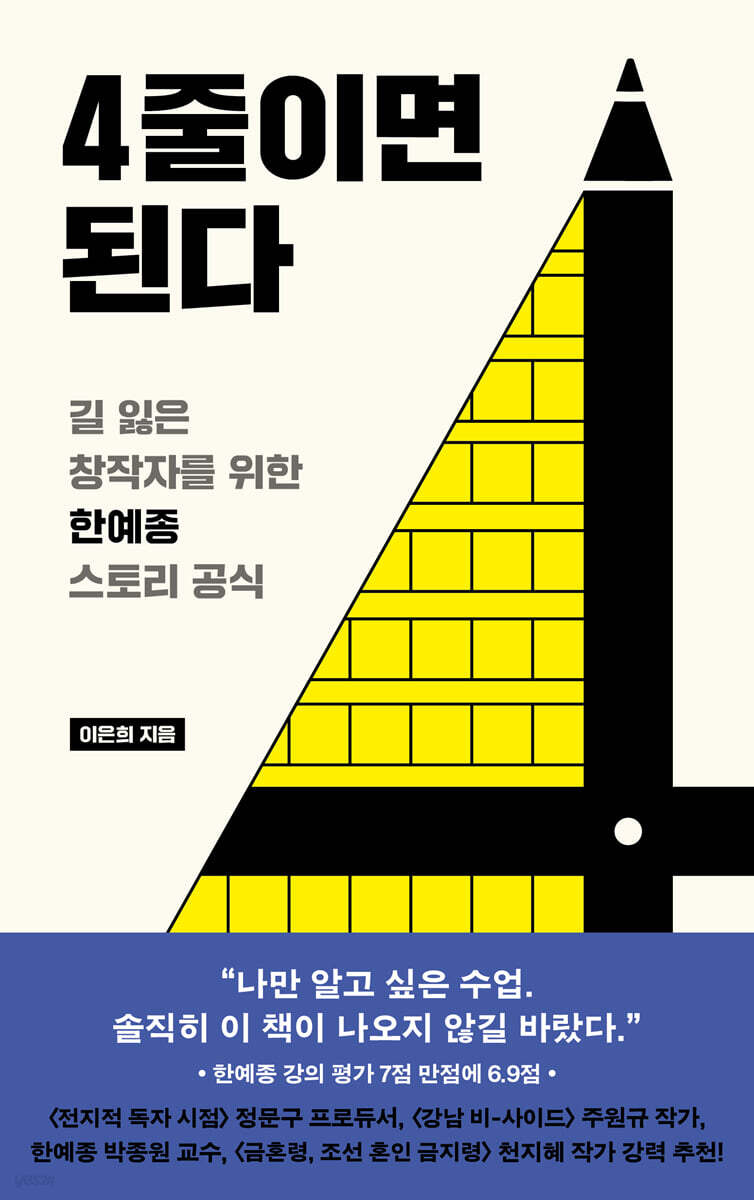
4 lines will do
 |
Description
Book Introduction
- A word from MD
- [The Secret Book of Writing Real Stories] A writing secret book from a film director and writer.
Beyond just writing well, we introduce fundamental writing techniques that can be expanded into various forms such as movies, dramas, webtoons, and web novels.
Breaking away from the predictable introduction, development, turn, and conclusion, the '4-line formula' that provides a solid framework for the story will turn your writing into a 'dragon head dragon beauty' work.
- Ahn Hyun-jae, art producer
“A class that only I want to know about.
“Honestly, I wished this book never came out.”
Han Ye Jong lecture evaluation score of 6.9 out of 7!
***Producer Jeong Moon-goo of “Omniscient Reader’s Viewpoint,” “The Attorney,” and “The Thieves,”
"Marriage Ban, Joseon Marriage Ban" author Cheon Ji-hye, professor at Han Ye-jong, and film director Park Jong-won
Strongly recommended by Joo Won-gyu, author of "Gangnam B-side" and "Argon"***
I will reduce the wasted effort and effort of those who want to become writers.
Han Ye-jong Story Secret Book
What kind of classes are offered at Hanyeong High School, the dream school for writers? Here's your chance to take a storytelling class at Hanyeong High School without having to go there.
This book, which was completed based on a class that students unanimously praised, saying, “I’ve been looking for a class like this” and “Now I think I understand what a story is,” does not use the obvious formulas commonly found in many writing books.
It's not just about learning how to write well, but it also teaches you how to get your hands on a story that can be turned into a movie, drama, webtoon, or web novel.
How to become a real writer who writes stories.
The author, a film director and writer, has been writing tirelessly for 20 years and has finally realized the definition of story and the fastest way to find the story through encounters on film sets.
The secret lies in the '4 lines'.
It teaches you very specifically and precisely how to ask questions, write a one-line goal, apply it to a four-line format that focuses on the protagonist's inner transformation, and write a treatment.
I personally verified the power of these four lines while teaching students.
If you've ever read numerous writing books on the market and attended lectures that were considered good, but felt lost and didn't know where to start or how to apply them to your own writing, you'll find this book incredibly helpful.
By following the author's guidance, you will gain the strong confidence and courage to write a story that sells, and you will also gain tangible results.
“Honestly, I wished this book never came out.”
Han Ye Jong lecture evaluation score of 6.9 out of 7!
***Producer Jeong Moon-goo of “Omniscient Reader’s Viewpoint,” “The Attorney,” and “The Thieves,”
"Marriage Ban, Joseon Marriage Ban" author Cheon Ji-hye, professor at Han Ye-jong, and film director Park Jong-won
Strongly recommended by Joo Won-gyu, author of "Gangnam B-side" and "Argon"***
I will reduce the wasted effort and effort of those who want to become writers.
Han Ye-jong Story Secret Book
What kind of classes are offered at Hanyeong High School, the dream school for writers? Here's your chance to take a storytelling class at Hanyeong High School without having to go there.
This book, which was completed based on a class that students unanimously praised, saying, “I’ve been looking for a class like this” and “Now I think I understand what a story is,” does not use the obvious formulas commonly found in many writing books.
It's not just about learning how to write well, but it also teaches you how to get your hands on a story that can be turned into a movie, drama, webtoon, or web novel.
How to become a real writer who writes stories.
The author, a film director and writer, has been writing tirelessly for 20 years and has finally realized the definition of story and the fastest way to find the story through encounters on film sets.
The secret lies in the '4 lines'.
It teaches you very specifically and precisely how to ask questions, write a one-line goal, apply it to a four-line format that focuses on the protagonist's inner transformation, and write a treatment.
I personally verified the power of these four lines while teaching students.
If you've ever read numerous writing books on the market and attended lectures that were considered good, but felt lost and didn't know where to start or how to apply them to your own writing, you'll find this book incredibly helpful.
By following the author's guidance, you will gain the strong confidence and courage to write a story that sells, and you will also gain tangible results.
- You can preview some of the book's contents.
Preview
index
Recommendation
Prologue_You must know me before the 4th line
Part 1, Line 4 - The story begins with a question.
Chapter 1: The Story: No One Is Unfamiliar with It, No One Really Knows It
Chapter 2: Five Essential Conditions for Asking Useful Questions
· Useful Questions Workshop | Netflix Drama "The Glory"
Chapter 3, Line 1: Entering the Target Point
Part 2, 4 lines - Story, 4 lines is enough
Chapter 4: The story is about the protagonist's journey.
· Finding the Main Character Workshop | Film "Emergency Declaration"
Chapter 5, Line 1: The moment when the protagonist's inner self changes
Chapter 6, Line 2: The protagonist moves forward as he has decided.
Chapter 7, Line 3: When the protagonist's situation and feelings change suddenly
Chapter 8, Line 4: The protagonist's decision is fulfilled.
· 4-Line Writing Workshop | Extreme Job, The Glory, Suriname, Spring in Seoul, Giant, Anna
Part 3, Line 4 onwards - Time to move forward with the story
Chapter 9: The Difference Between Narrative and Description
Chapter 10: The Last and First Button: Treatment
· Practical Treatment Writing Workshop | Creative Screenplay
Chapter 11: The Dignity of Description
Epilogue_I will continue writing and moving forward.
main
Prologue_You must know me before the 4th line
Part 1, Line 4 - The story begins with a question.
Chapter 1: The Story: No One Is Unfamiliar with It, No One Really Knows It
Chapter 2: Five Essential Conditions for Asking Useful Questions
· Useful Questions Workshop | Netflix Drama "The Glory"
Chapter 3, Line 1: Entering the Target Point
Part 2, 4 lines - Story, 4 lines is enough
Chapter 4: The story is about the protagonist's journey.
· Finding the Main Character Workshop | Film "Emergency Declaration"
Chapter 5, Line 1: The moment when the protagonist's inner self changes
Chapter 6, Line 2: The protagonist moves forward as he has decided.
Chapter 7, Line 3: When the protagonist's situation and feelings change suddenly
Chapter 8, Line 4: The protagonist's decision is fulfilled.
· 4-Line Writing Workshop | Extreme Job, The Glory, Suriname, Spring in Seoul, Giant, Anna
Part 3, Line 4 onwards - Time to move forward with the story
Chapter 9: The Difference Between Narrative and Description
Chapter 10: The Last and First Button: Treatment
· Practical Treatment Writing Workshop | Creative Screenplay
Chapter 11: The Dignity of Description
Epilogue_I will continue writing and moving forward.
main
Detailed image

Into the book
Chapter 1: The Story: No One Is Unfamiliar with It, No One Really Knows It
Becoming a writer is not about writing, but about putting into the world the journey of asking questions and finding answers.
So your commitment to "talk" is closer to "asking questions" than to "writing."
It can neither be taught nor learned.
The writer's question is the seed of all writing.
This seed is like a small life, it can grow into a scenario or a novel.
Of course it is attempted and dramatized.
And that 'story' that has life doesn't just pass away, but remains deep in someone's heart, and sometimes makes them live and rise up.
--- p.31
Chapter 2: Five Essential Conditions for Asking Useful Questions
“Can a first-class killer also be a good parent?” The desire to be a good parent is absurdly kind and sophisticated.
So, as explained above, it is a really useless question for the writer.
But this question becomes problematic the moment it is posed by the most unpleasant person in the world.
A killer subject dreaming of being a good parent! Now he'll do whatever it takes to be a good parent.
Whether it's a cool action story or a smart crime thriller, a killer can do what a questioning writer can never do.
It's a simple question, but when you meet the right protagonist, it becomes a great question that you can't help but wonder about.
A 'proper protagonist' is one where the greater the irony between the protagonist's present and the protagonist's desires, the better.
This gap creates a tremendous synergy between them, transforming even the protagonist's ordinary desires into very great desires.
It's easy to think which would be more interesting: a story about a school teacher wishing to be a good parent, or a story about a killer wishing to be a good parent.
--- p.47~48
Chapter 3, Line 1: Entering the Target Point
Typically, beginning writers spend a tremendous amount of time and space introducing the protagonist's history when they say they are writing a story.
The worst case I've seen was one where 30 out of 33 pages were devoted to introducing and explaining the main character.
The actual story begins on page 31.
This is what happens when you mistake a piece of writing that introduces the main character for a story.
All the writer needs now is a critical condition that provides the cause for the protagonist to have desire.
This state becomes the cause, reason, and driving force for this story to begin.
So, don't hesitate and just think about what to write here.
--- p.82
Chapter 4: The story is about the protagonist's journey.
To grow, everyone needs a beginning of growth.
It is the first step, a running step, to run towards the person I will grow into, not the original me.
If there is no moment, nothing will happen in the future.
So, in this story of growth, the most important thing is that small, unforeseen event that must occur.
That is the 'incident'.
So writing a story is like keeping a log of events from the beginning to the end.
--- p.110
Chapter 5, Line 1: The moment the protagonist's inner self changes
We desire what we do not have.
It's like that in my real life, but it's even worse in the story.
Never! Never! No matter what! I'm even more enthusiastic about a protagonist who desires something they can't have.
Those who are perceptive will have noticed why the two films performed so differently.
Yes, that's right.
There is a protagonist who, while in the same situation as us, desires the position of king that he can never surpass, and a protagonist who, while already in the position of king, wants to become a slave and live a good life with good people.
Which protagonist is more intriguing? This directly correlates to what the audience desires more.
Clearly, both films are full of interesting episodes and good acting.
But we want to see more of the thrill of a slave becoming a king and ruling over the nobles.
You might want to argue that the pleasure of being beaten like a slave is the same, but that's not true.
The audience takes their side as soon as the main character appears.
There is no audience that would feel pleasure watching their own side get beaten up.
--- p.143~144
Chapter 6, Line 2: The protagonist moves forward as he has decided.
In fact, many writers neglect development.
I'm anxious to get to the advanced stage and torment the protagonist to entertain the users.
But the fact that the protagonist faces difficulties is in itself a relative and extremely ambiguous matter.
Since there are no standards, there is no way to know how much harassment is needed to satisfy consumers.
I just end up thinking of ways to harass the protagonist a little more, a little more.
The standard for that level of intensification is ‘development.’
Both the protagonist and the audience need to see that the protagonist is doing quite well in a changed state.
That way, even if the brakes are applied, you know that it is a brake.
If everyone knows the 'stages where things are going well', the 'stages where things are not going well' will become clearer.
So, this step should not be taken lightly.
Here, the author must demonstrate that the protagonist has the strength and desire to go all the way and sketch out a blueprint for success.
So that consumers know what to cheer for!
--- p.150
Chapter 7, Line 3: When the protagonist's situation and feelings change suddenly
The magnitude of the ordeal reveals the character of the work.
The writer must be astute in understanding what the audience wants from the story.
As I was making it, it turned out to be anchovy sauce instead of anchovy stock. Then just sell it as anchovy sauce! That kind of thing doesn't happen.
This is not how a story is obtained.
Understanding who will consume your product is a very fundamental task for anyone who creates a product.
Because the size of the ordeal I give my clients is a matter of how much of a sense of accomplishment it will give them.
A great sense of accomplishment may seem great, but it is absolutely not.
That is extremely consequential.
Great achievements are always accompanied by great effort, great hard work, and great desire.
In the case of romantic comedy dramas, heavy trials are burdensome.
Just like you wouldn't paint a cute toy black.
--- p.181
Chapter 8, Line 4: The protagonist's decision is fulfilled.
The writer must be suspicious.
Is this story really a happy ending?
And we must somehow interpret that difficult-to-explain 'happy'.
If you just lump together good things and say they are good, the work will also be lumped together.
What would be a happy ending for the male protagonist who attempted to rob a bank? It would be the realization of the protagonist's resolve, which runs through the story.
Throughout the story, what the protagonist has been yearning for with all his heart and soul finally comes true! That's the happy ending.
What he decided to do was rob a bank and protect his father's house.
Even though he claimed to have found 'true love', which was far more valuable than 'father's house', his resolution was essentially not realized.
I just forgot for a moment the reason for its realization.
The protagonist's resolution was not fulfilled, but he stopped because he was preoccupied with marriage.
So whenever he comes up again, he'll go out and rob a bank again.
So, although the main character is smiling at the end of this story, it is difficult to see it as a happy ending.
--- p.192
Chapter 9: The Difference Between Narrative and Description
Even if it is the same story of escape, it ends up looking like a completely different story depending on which elements are combined.
We can call these flesh-like settings that surround the bones and complete a person 'salgeul'.
If the story is about a subway train that is in danger of falling into a sinkhole, then the bone structure is the escape skeleton.
Here, 'sinkhole' and 'subway' are not settings that can be easily changed to describe bone text.
You can understand it as the same principle that when your body changes, you become a completely different person.
Salgeul is a description that literally strengthens the bone structure, and it is a 'description (skin)' that is clearly different from the usual 'description (clothes)'.
The 'salgeul' mentioned here is actually closer to bones than clothes.
It is a description closer to the essence that proves the identity of the story, rather than something that can be thrown away and bought new like clothes.
--- p.217
Chapter 10: The Last and First Button: Treatment
It's heartbreaking to see a story that spends almost 80 percent of its length writing about the protagonist's history.
Why are you putting so much effort into something so unnecessary? For a warrior to be meaningful within a story, he or she must somehow be integrated into it.
No one is curious about the protagonist's past before the story begins.
Yet, many writers sit down to write a treatment and spend a tremendous amount of time writing about things that happened before the story even began.
What was it like when you were young and what happened… … .
Of course, it can be said to be an important clue in explaining the character.
But the writer must not pick up the entire life of the character, but only the history of the character who will respond to this story.
It should be kept in mind that even a movie like The Truman Show, which depicts the protagonist's entire life, does not show everything.
--- p.226
Chapter 11: The Dignity of Description
It is only through description that the protagonist reveals the characteristics of the protagonist that he possesses.
The way he treats the old man who collects waste paper and the way he treats his unfair boss reveals what kind of person the main character is.
In such cases, the protagonist should neither be overly righteous nor overly polite.
In the movie “The Villainess,” Jang Dong-soo (played by Ma Dong-seok) gives his umbrella to a middle school girl walking without an umbrella on a rainy day.
In the movie Memories of Murder, Kim Tae-yoon (played by Kim Sang-kyung) puts a bandage on the wound of a middle school girl he meets on a rainy day.
In both works, the middle school girl is later killed by the villain, and serves as a medium through which the protagonist vents his final rage on the villain.
The death of a middle school girl should provoke such great anger in the protagonist that it seems like there should be a complex relationship with the middle school girl, but this is enough.
You don't have to drive the child all the way home in the car, making sure he doesn't get wet, or carry him to the emergency room because he's so frightened by his injuries.
No, if that were the case, the charm would have been halved.
Excessive kindness would be burdensome and would have stretched out the story.
Becoming a writer is not about writing, but about putting into the world the journey of asking questions and finding answers.
So your commitment to "talk" is closer to "asking questions" than to "writing."
It can neither be taught nor learned.
The writer's question is the seed of all writing.
This seed is like a small life, it can grow into a scenario or a novel.
Of course it is attempted and dramatized.
And that 'story' that has life doesn't just pass away, but remains deep in someone's heart, and sometimes makes them live and rise up.
--- p.31
Chapter 2: Five Essential Conditions for Asking Useful Questions
“Can a first-class killer also be a good parent?” The desire to be a good parent is absurdly kind and sophisticated.
So, as explained above, it is a really useless question for the writer.
But this question becomes problematic the moment it is posed by the most unpleasant person in the world.
A killer subject dreaming of being a good parent! Now he'll do whatever it takes to be a good parent.
Whether it's a cool action story or a smart crime thriller, a killer can do what a questioning writer can never do.
It's a simple question, but when you meet the right protagonist, it becomes a great question that you can't help but wonder about.
A 'proper protagonist' is one where the greater the irony between the protagonist's present and the protagonist's desires, the better.
This gap creates a tremendous synergy between them, transforming even the protagonist's ordinary desires into very great desires.
It's easy to think which would be more interesting: a story about a school teacher wishing to be a good parent, or a story about a killer wishing to be a good parent.
--- p.47~48
Chapter 3, Line 1: Entering the Target Point
Typically, beginning writers spend a tremendous amount of time and space introducing the protagonist's history when they say they are writing a story.
The worst case I've seen was one where 30 out of 33 pages were devoted to introducing and explaining the main character.
The actual story begins on page 31.
This is what happens when you mistake a piece of writing that introduces the main character for a story.
All the writer needs now is a critical condition that provides the cause for the protagonist to have desire.
This state becomes the cause, reason, and driving force for this story to begin.
So, don't hesitate and just think about what to write here.
--- p.82
Chapter 4: The story is about the protagonist's journey.
To grow, everyone needs a beginning of growth.
It is the first step, a running step, to run towards the person I will grow into, not the original me.
If there is no moment, nothing will happen in the future.
So, in this story of growth, the most important thing is that small, unforeseen event that must occur.
That is the 'incident'.
So writing a story is like keeping a log of events from the beginning to the end.
--- p.110
Chapter 5, Line 1: The moment the protagonist's inner self changes
We desire what we do not have.
It's like that in my real life, but it's even worse in the story.
Never! Never! No matter what! I'm even more enthusiastic about a protagonist who desires something they can't have.
Those who are perceptive will have noticed why the two films performed so differently.
Yes, that's right.
There is a protagonist who, while in the same situation as us, desires the position of king that he can never surpass, and a protagonist who, while already in the position of king, wants to become a slave and live a good life with good people.
Which protagonist is more intriguing? This directly correlates to what the audience desires more.
Clearly, both films are full of interesting episodes and good acting.
But we want to see more of the thrill of a slave becoming a king and ruling over the nobles.
You might want to argue that the pleasure of being beaten like a slave is the same, but that's not true.
The audience takes their side as soon as the main character appears.
There is no audience that would feel pleasure watching their own side get beaten up.
--- p.143~144
Chapter 6, Line 2: The protagonist moves forward as he has decided.
In fact, many writers neglect development.
I'm anxious to get to the advanced stage and torment the protagonist to entertain the users.
But the fact that the protagonist faces difficulties is in itself a relative and extremely ambiguous matter.
Since there are no standards, there is no way to know how much harassment is needed to satisfy consumers.
I just end up thinking of ways to harass the protagonist a little more, a little more.
The standard for that level of intensification is ‘development.’
Both the protagonist and the audience need to see that the protagonist is doing quite well in a changed state.
That way, even if the brakes are applied, you know that it is a brake.
If everyone knows the 'stages where things are going well', the 'stages where things are not going well' will become clearer.
So, this step should not be taken lightly.
Here, the author must demonstrate that the protagonist has the strength and desire to go all the way and sketch out a blueprint for success.
So that consumers know what to cheer for!
--- p.150
Chapter 7, Line 3: When the protagonist's situation and feelings change suddenly
The magnitude of the ordeal reveals the character of the work.
The writer must be astute in understanding what the audience wants from the story.
As I was making it, it turned out to be anchovy sauce instead of anchovy stock. Then just sell it as anchovy sauce! That kind of thing doesn't happen.
This is not how a story is obtained.
Understanding who will consume your product is a very fundamental task for anyone who creates a product.
Because the size of the ordeal I give my clients is a matter of how much of a sense of accomplishment it will give them.
A great sense of accomplishment may seem great, but it is absolutely not.
That is extremely consequential.
Great achievements are always accompanied by great effort, great hard work, and great desire.
In the case of romantic comedy dramas, heavy trials are burdensome.
Just like you wouldn't paint a cute toy black.
--- p.181
Chapter 8, Line 4: The protagonist's decision is fulfilled.
The writer must be suspicious.
Is this story really a happy ending?
And we must somehow interpret that difficult-to-explain 'happy'.
If you just lump together good things and say they are good, the work will also be lumped together.
What would be a happy ending for the male protagonist who attempted to rob a bank? It would be the realization of the protagonist's resolve, which runs through the story.
Throughout the story, what the protagonist has been yearning for with all his heart and soul finally comes true! That's the happy ending.
What he decided to do was rob a bank and protect his father's house.
Even though he claimed to have found 'true love', which was far more valuable than 'father's house', his resolution was essentially not realized.
I just forgot for a moment the reason for its realization.
The protagonist's resolution was not fulfilled, but he stopped because he was preoccupied with marriage.
So whenever he comes up again, he'll go out and rob a bank again.
So, although the main character is smiling at the end of this story, it is difficult to see it as a happy ending.
--- p.192
Chapter 9: The Difference Between Narrative and Description
Even if it is the same story of escape, it ends up looking like a completely different story depending on which elements are combined.
We can call these flesh-like settings that surround the bones and complete a person 'salgeul'.
If the story is about a subway train that is in danger of falling into a sinkhole, then the bone structure is the escape skeleton.
Here, 'sinkhole' and 'subway' are not settings that can be easily changed to describe bone text.
You can understand it as the same principle that when your body changes, you become a completely different person.
Salgeul is a description that literally strengthens the bone structure, and it is a 'description (skin)' that is clearly different from the usual 'description (clothes)'.
The 'salgeul' mentioned here is actually closer to bones than clothes.
It is a description closer to the essence that proves the identity of the story, rather than something that can be thrown away and bought new like clothes.
--- p.217
Chapter 10: The Last and First Button: Treatment
It's heartbreaking to see a story that spends almost 80 percent of its length writing about the protagonist's history.
Why are you putting so much effort into something so unnecessary? For a warrior to be meaningful within a story, he or she must somehow be integrated into it.
No one is curious about the protagonist's past before the story begins.
Yet, many writers sit down to write a treatment and spend a tremendous amount of time writing about things that happened before the story even began.
What was it like when you were young and what happened… … .
Of course, it can be said to be an important clue in explaining the character.
But the writer must not pick up the entire life of the character, but only the history of the character who will respond to this story.
It should be kept in mind that even a movie like The Truman Show, which depicts the protagonist's entire life, does not show everything.
--- p.226
Chapter 11: The Dignity of Description
It is only through description that the protagonist reveals the characteristics of the protagonist that he possesses.
The way he treats the old man who collects waste paper and the way he treats his unfair boss reveals what kind of person the main character is.
In such cases, the protagonist should neither be overly righteous nor overly polite.
In the movie “The Villainess,” Jang Dong-soo (played by Ma Dong-seok) gives his umbrella to a middle school girl walking without an umbrella on a rainy day.
In the movie Memories of Murder, Kim Tae-yoon (played by Kim Sang-kyung) puts a bandage on the wound of a middle school girl he meets on a rainy day.
In both works, the middle school girl is later killed by the villain, and serves as a medium through which the protagonist vents his final rage on the villain.
The death of a middle school girl should provoke such great anger in the protagonist that it seems like there should be a complex relationship with the middle school girl, but this is enough.
You don't have to drive the child all the way home in the car, making sure he doesn't get wet, or carry him to the emergency room because he's so frightened by his injuries.
No, if that were the case, the charm would have been halved.
Excessive kindness would be burdensome and would have stretched out the story.
--- p.257~258
Publisher's Review
“Forget the predictable plot development.”
The '4-Line' Formula: The Key to Selling Stories
There's a saying in the film industry: "You have to steal the audience's heart within 15 minutes."
This means that within 15 minutes of the audience sitting in the theater, you have to tell them exactly what they can expect and then rush off to have fun.
If the 'event' is pushed back here, the story becomes stretched out and people lose interest.
Many writers know that events are important.
The problem is that we write according to the conventional structure of introduction, development, turn, and conclusion without knowing exactly what the event means.
An event, as we commonly know, refers to an unexpected event that happens externally, but in a story, an event refers to an 'unexpected event that happens to the protagonist's inner self.'
As we live, we may witness a traffic accident or encounter a horrific incident like a burglar breaking into our neighbor's house. However, if nothing changes in our lives because of it, it is not an event for us. In the same way, we should focus on the 'change' that occurs in the protagonist's inner self, not the external event itself.
Let's take an example.
The film director took the subway to go to school to teach a screenwriting class.
But then suddenly the subway stopped and the car fell over onto its side.
An unprecedented subway accident occurred.
They say a sinkhole has been discovered.
The tracks are tilting more and more towards the sinkhole, and if things continue this way, the car body will be sucked into the sinkhole.
The director, who is the main character, is worried.
Should I accept death and pray to go to heaven, say a final goodbye to my family, or try to break down the broken subway door and escape?
What does "occurrence of an incident" mean here? According to the commonly known definition, it would be the subway collapsing, but that's not the case in the story.
Whether it's praying, making a phone call, or escaping, the protagonist makes a decision he or she wouldn't normally make, and wishes for something he or she wouldn't normally wish for - that's an 'incident.'
The author of this book, who teaches a highly praised scenario class at Hanyeong High School, a cradle of creative writers, emphasizes the special "4-line" formula that can only be applied to stories, based on a new definition of events, rather than the stereotypical introduction, development, turn, and conclusion that applies to all writing.
These '4 lines', which focus on the changes in the protagonist's inner self, are the core, or rather, the entire story, that the author discovered through 20 years of writing and direct experience on film sets.
Students who experienced the power of the four lines firsthand discouraged the publication of the book, saying they did not want to share this information with others. However, the author wrote the book in the hope that many new writers would grow together with him.
“A story begins with a question.”
Why Questions Should Be Bad
The first step to the 4-line begins with a 'question'.
Saying you're going to talk about something is more like asking a question than writing.
So, can all questions become stories?
There is an important prerequisite here.
The question is, should it be 'bad'?
The worse the questions, the better, to lead the writer to a good story.
Let's think about which question you're more curious about: "Can a man born in a stream succeed and become a dragon?" or "Can a man born in a stream succeed and become a dragon greater than his father?"
Of course it's the latter.
The former brings to mind some economic logic, but the latter has a hurdle called 'father'.
The hurdle of being my ‘father’, who is neither my friend nor my competitor, but my foundation and my grace, makes this question bad.
What if the father were a gangster or a corporate CEO who perpetrated domestic violence? The story becomes even more intriguing.
I don't need to hear the cool, good, and good questions as a story, I can just ask them.
People gather around questions that are so secretive and bad that it's hard for me to come forward.
Why? Because the desire is hidden.
It's something that everyone dreams of and wants, but is difficult to express honestly, so when someone tells you about it, you get excited and want to listen. That's the question that makes storytelling possible.
The popular Netflix original drama "The Glory" begins with the question, "Can a victim of school violence get back on track by exacting perfect revenge on the still-popular perpetrators?"
It seems like a good question, but it harbors a bad desire.
There are ways to return to the starting point, such as forgiveness or turning away, but the premise is that 'perfect revenge' must be achieved.
The protagonist is a 'victim of school violence' who is 'allowed to take revenge' and is permitted to take the most perfect revenge against the perpetrator.
Of course, it could be a 'life sentence inmate who was wrongfully imprisoned' or a 'parent who lost a child', but timeliness was at work here.
At a time when the issue of school violence was at the forefront of discussion, the term ‘victim of school violence’ would have been appropriate for someone who could take revenge.
If you try to 'create' a plausible protagonist without focusing on the question itself, the story will go astray.
The protagonist is not created by looking around, but rather by looking deeply into questions and encountering them.
The exquisite protagonist who will answer my question on my behalf is within the question.
So the first thing to do is to ask a question.
When the question is right, the story is right.
“Four lines will do.”
A milestone for lost creators
Now, the protagonist carries the questions posed by the author and moves forward, fighting against numerous obstacles and changing.
The four lines are a diary of the protagonist's growth and events.
If we apply 〈The Glory〉 to 4 lines, it is the process of the protagonist, who is a victim of school violence, harboring a desire for revenge to return to the starting point (first line - the protagonist's internal change occurs), carrying out his decided revenge (second line - the protagonist moves forward with his decision), encountering obstacles from the group of perpetrators (third line - the protagonist's situation and feelings change rapidly and intensify), and after many twists and turns, succeeding in his revenge, but realizing that what can return him to the starting point is not revenge but 'love' in the end, he changes into a character who returns the love he received from the person he loves (fourth line - the protagonist's decision is resolved).
At first glance, the introduction, development, climax, and conclusion may seem similar, but there is a big difference here.
If you focus on the traditional introduction, development, turn, and conclusion, you can easily get caught up in events or elements that seem powerful but are superficial and deviate from the protagonist's core desires.
Let's think about the protagonist's mother, who appears as a nuisance no less than the perpetrators.
If the author had given too much weight to the protagonist's mother, who is the protagonist's Achilles' heel, the group of school bullies who perpetrate school violence on the victim suffering from domestic abuse would have been nothing more than a secondary distraction, and the protagonist as an adult would have no reason to get involved with them at all.
Judging by the fact that she has provoked the anger of viewers with just a few appearances, it is clear that from the writer's perspective, this mother is a villain that he wants to further utilize for dramatic development.
You'll be dying to see more of this character's sabotage.
But the moment it starts like that, it becomes a completely different story from what was originally planned.
In a story where the main character is a victim of school violence, the mother is actually an unexpected obstacle.
That's why it becomes a more painful story.
In addition to the mother, this drama is filled with obstacles that add to the hesitation of the woman's stubborn desire to continue her revenge, such as the polite husband who is the perpetrator and the man who offers to be her helper.
The reason why we can move forward without being swayed by these things is because of the ‘4 lines’.
To stay focused on the questions you need to address while fighting against distractions, you must stick to these four lines.
The story is quite mathematical, more so than you might think.
At first glance, it may seem reasonable and persuasive, but no one who spends time and money to enjoy a story will even look at it briefly.
If one corner is off, consumers will notice it right away and kick the conversation away.
In order to accurately arrange the story, it is essential to clearly divide it into four lines and check the necessary elements for each line to structure the story.
If you ever get lost while writing, come back to these four lines.
This way, you can avoid going astray and head straight back towards your destination quickly.
"An open ending is different from a no ending."
If you don't want your story to be a flash in the pan
There are so many works that start off well but then fall apart at the end.
It's only at the end that the story ends up being a complete waste of time and affection by ending with an ambiguous ending that leaves the audience who have been rooting for the protagonist until now feeling like it was all a dream, or by making it unclear what message it was trying to convey.
You can reveal or hide the answer, but if you ask a question, you must provide your own answer.
That is what the author ultimately wants to say through the story, the message he wants to send to the world.
There are writers who often pose questions and then don't follow through with the lame excuse of "open endings."
If the author had truly created a story with an open ending, there would have to be both an ending A and an ending B.
And people don't question the ending.
Because we would have already stood at the crossroads that the author had opened and walked towards our own conclusions.
Otherwise, the ending would likely have been a 'no ending' rather than an open ending.
This isn't the only thing writers easily overlook when contemplating endings.
We also need to consider the question of who is the 'happy subject' when we talk about a happy ending.
If the protagonist dies or becomes unhappy, is it a sad ending? If they survive or become happy, is it a happy ending? While it seems simple, a writer should think differently.
In the movie Train to Busan, many characters loved by the audience die.
Even the main character.
But people don't say this movie has a sad ending.
Rather, there is no doubt that it is a happy ending.
The reason is that the protagonist's wish to 'bring his daughter back to Busan safely' has come true.
He never desired to live.
The fact that one 'dies' is sad, but a writer should not be immersed in the word 'die'.
As a writer, you need to be able to focus on the protagonist's desires rather than the physical outcome of death.
This ending is a happy ending because the protagonist has achieved what he wanted to achieve.
The reason the story ends up being a flash in the pan is because it is too hasty to resolve the situation rather than changing the protagonist while trying to resolve the incident.
If you are a true writer, you must not take your eyes off the protagonist's transformation until the very end.
The story only ends when the protagonist, who harbors desires, finally reaches the desired state.
The writer must fulfill his responsibility to ensure that the audience accompanies the protagonist's journey to the end, so as not to make the protagonist suffer in vain.
The '4-Line' Formula: The Key to Selling Stories
There's a saying in the film industry: "You have to steal the audience's heart within 15 minutes."
This means that within 15 minutes of the audience sitting in the theater, you have to tell them exactly what they can expect and then rush off to have fun.
If the 'event' is pushed back here, the story becomes stretched out and people lose interest.
Many writers know that events are important.
The problem is that we write according to the conventional structure of introduction, development, turn, and conclusion without knowing exactly what the event means.
An event, as we commonly know, refers to an unexpected event that happens externally, but in a story, an event refers to an 'unexpected event that happens to the protagonist's inner self.'
As we live, we may witness a traffic accident or encounter a horrific incident like a burglar breaking into our neighbor's house. However, if nothing changes in our lives because of it, it is not an event for us. In the same way, we should focus on the 'change' that occurs in the protagonist's inner self, not the external event itself.
Let's take an example.
The film director took the subway to go to school to teach a screenwriting class.
But then suddenly the subway stopped and the car fell over onto its side.
An unprecedented subway accident occurred.
They say a sinkhole has been discovered.
The tracks are tilting more and more towards the sinkhole, and if things continue this way, the car body will be sucked into the sinkhole.
The director, who is the main character, is worried.
Should I accept death and pray to go to heaven, say a final goodbye to my family, or try to break down the broken subway door and escape?
What does "occurrence of an incident" mean here? According to the commonly known definition, it would be the subway collapsing, but that's not the case in the story.
Whether it's praying, making a phone call, or escaping, the protagonist makes a decision he or she wouldn't normally make, and wishes for something he or she wouldn't normally wish for - that's an 'incident.'
The author of this book, who teaches a highly praised scenario class at Hanyeong High School, a cradle of creative writers, emphasizes the special "4-line" formula that can only be applied to stories, based on a new definition of events, rather than the stereotypical introduction, development, turn, and conclusion that applies to all writing.
These '4 lines', which focus on the changes in the protagonist's inner self, are the core, or rather, the entire story, that the author discovered through 20 years of writing and direct experience on film sets.
Students who experienced the power of the four lines firsthand discouraged the publication of the book, saying they did not want to share this information with others. However, the author wrote the book in the hope that many new writers would grow together with him.
“A story begins with a question.”
Why Questions Should Be Bad
The first step to the 4-line begins with a 'question'.
Saying you're going to talk about something is more like asking a question than writing.
So, can all questions become stories?
There is an important prerequisite here.
The question is, should it be 'bad'?
The worse the questions, the better, to lead the writer to a good story.
Let's think about which question you're more curious about: "Can a man born in a stream succeed and become a dragon?" or "Can a man born in a stream succeed and become a dragon greater than his father?"
Of course it's the latter.
The former brings to mind some economic logic, but the latter has a hurdle called 'father'.
The hurdle of being my ‘father’, who is neither my friend nor my competitor, but my foundation and my grace, makes this question bad.
What if the father were a gangster or a corporate CEO who perpetrated domestic violence? The story becomes even more intriguing.
I don't need to hear the cool, good, and good questions as a story, I can just ask them.
People gather around questions that are so secretive and bad that it's hard for me to come forward.
Why? Because the desire is hidden.
It's something that everyone dreams of and wants, but is difficult to express honestly, so when someone tells you about it, you get excited and want to listen. That's the question that makes storytelling possible.
The popular Netflix original drama "The Glory" begins with the question, "Can a victim of school violence get back on track by exacting perfect revenge on the still-popular perpetrators?"
It seems like a good question, but it harbors a bad desire.
There are ways to return to the starting point, such as forgiveness or turning away, but the premise is that 'perfect revenge' must be achieved.
The protagonist is a 'victim of school violence' who is 'allowed to take revenge' and is permitted to take the most perfect revenge against the perpetrator.
Of course, it could be a 'life sentence inmate who was wrongfully imprisoned' or a 'parent who lost a child', but timeliness was at work here.
At a time when the issue of school violence was at the forefront of discussion, the term ‘victim of school violence’ would have been appropriate for someone who could take revenge.
If you try to 'create' a plausible protagonist without focusing on the question itself, the story will go astray.
The protagonist is not created by looking around, but rather by looking deeply into questions and encountering them.
The exquisite protagonist who will answer my question on my behalf is within the question.
So the first thing to do is to ask a question.
When the question is right, the story is right.
“Four lines will do.”
A milestone for lost creators
Now, the protagonist carries the questions posed by the author and moves forward, fighting against numerous obstacles and changing.
The four lines are a diary of the protagonist's growth and events.
If we apply 〈The Glory〉 to 4 lines, it is the process of the protagonist, who is a victim of school violence, harboring a desire for revenge to return to the starting point (first line - the protagonist's internal change occurs), carrying out his decided revenge (second line - the protagonist moves forward with his decision), encountering obstacles from the group of perpetrators (third line - the protagonist's situation and feelings change rapidly and intensify), and after many twists and turns, succeeding in his revenge, but realizing that what can return him to the starting point is not revenge but 'love' in the end, he changes into a character who returns the love he received from the person he loves (fourth line - the protagonist's decision is resolved).
At first glance, the introduction, development, climax, and conclusion may seem similar, but there is a big difference here.
If you focus on the traditional introduction, development, turn, and conclusion, you can easily get caught up in events or elements that seem powerful but are superficial and deviate from the protagonist's core desires.
Let's think about the protagonist's mother, who appears as a nuisance no less than the perpetrators.
If the author had given too much weight to the protagonist's mother, who is the protagonist's Achilles' heel, the group of school bullies who perpetrate school violence on the victim suffering from domestic abuse would have been nothing more than a secondary distraction, and the protagonist as an adult would have no reason to get involved with them at all.
Judging by the fact that she has provoked the anger of viewers with just a few appearances, it is clear that from the writer's perspective, this mother is a villain that he wants to further utilize for dramatic development.
You'll be dying to see more of this character's sabotage.
But the moment it starts like that, it becomes a completely different story from what was originally planned.
In a story where the main character is a victim of school violence, the mother is actually an unexpected obstacle.
That's why it becomes a more painful story.
In addition to the mother, this drama is filled with obstacles that add to the hesitation of the woman's stubborn desire to continue her revenge, such as the polite husband who is the perpetrator and the man who offers to be her helper.
The reason why we can move forward without being swayed by these things is because of the ‘4 lines’.
To stay focused on the questions you need to address while fighting against distractions, you must stick to these four lines.
The story is quite mathematical, more so than you might think.
At first glance, it may seem reasonable and persuasive, but no one who spends time and money to enjoy a story will even look at it briefly.
If one corner is off, consumers will notice it right away and kick the conversation away.
In order to accurately arrange the story, it is essential to clearly divide it into four lines and check the necessary elements for each line to structure the story.
If you ever get lost while writing, come back to these four lines.
This way, you can avoid going astray and head straight back towards your destination quickly.
"An open ending is different from a no ending."
If you don't want your story to be a flash in the pan
There are so many works that start off well but then fall apart at the end.
It's only at the end that the story ends up being a complete waste of time and affection by ending with an ambiguous ending that leaves the audience who have been rooting for the protagonist until now feeling like it was all a dream, or by making it unclear what message it was trying to convey.
You can reveal or hide the answer, but if you ask a question, you must provide your own answer.
That is what the author ultimately wants to say through the story, the message he wants to send to the world.
There are writers who often pose questions and then don't follow through with the lame excuse of "open endings."
If the author had truly created a story with an open ending, there would have to be both an ending A and an ending B.
And people don't question the ending.
Because we would have already stood at the crossroads that the author had opened and walked towards our own conclusions.
Otherwise, the ending would likely have been a 'no ending' rather than an open ending.
This isn't the only thing writers easily overlook when contemplating endings.
We also need to consider the question of who is the 'happy subject' when we talk about a happy ending.
If the protagonist dies or becomes unhappy, is it a sad ending? If they survive or become happy, is it a happy ending? While it seems simple, a writer should think differently.
In the movie Train to Busan, many characters loved by the audience die.
Even the main character.
But people don't say this movie has a sad ending.
Rather, there is no doubt that it is a happy ending.
The reason is that the protagonist's wish to 'bring his daughter back to Busan safely' has come true.
He never desired to live.
The fact that one 'dies' is sad, but a writer should not be immersed in the word 'die'.
As a writer, you need to be able to focus on the protagonist's desires rather than the physical outcome of death.
This ending is a happy ending because the protagonist has achieved what he wanted to achieve.
The reason the story ends up being a flash in the pan is because it is too hasty to resolve the situation rather than changing the protagonist while trying to resolve the incident.
If you are a true writer, you must not take your eyes off the protagonist's transformation until the very end.
The story only ends when the protagonist, who harbors desires, finally reaches the desired state.
The writer must fulfill his responsibility to ensure that the audience accompanies the protagonist's journey to the end, so as not to make the protagonist suffer in vain.
GOODS SPECIFICS
- Date of issue: March 12, 2025
- Page count, weight, size: 292 pages | 418g | 132*210*19mm
- ISBN13: 9791193528525
- ISBN10: 1193528526
You may also like
카테고리
korean


korean

![ELLE 엘르 스페셜 에디션 A형 : 12월 [2025]](http://librairie.coreenne.fr/cdn/shop/files/b8e27a3de6c9538896439686c6b0e8fb.jpg?v=1766436872&width=3840)


