

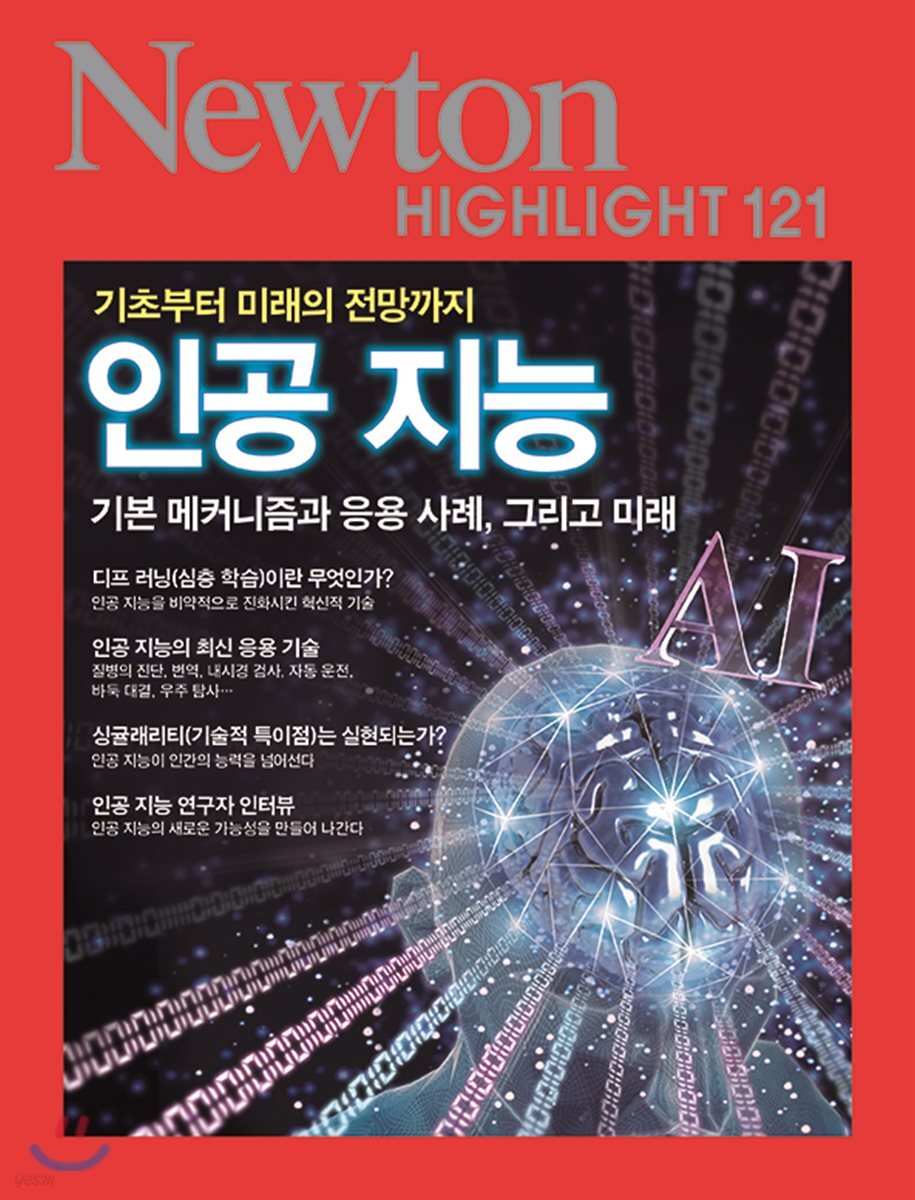
NEWTON HIGHLIGHT Newton Highlights 121 Artificial Intelligence
 |
Description
Book Introduction
The day is coming when artificial intelligence surpasses humans.
It is no longer surprising that an artificial intelligence specialized in Go can beat the world's best professional Go players.
This also means that artificial intelligence has become deeply entrenched in our lives.
As artificial intelligence advances, there are two main things we need to think about.
First, what are the principles of artificial intelligence and what is its current level?
And the second question is how far artificial intelligence will evolve.
Based on this perspective, this book covers everything from the fundamental principles of artificial intelligence to application cases, security issues to prevent the misuse of artificial intelligence, privacy issues when handling personal information, and the prospect of a "singularity" (a technological singularity) that will surpass human capabilities.
The reason artificial intelligence is 'smart' is because it can learn the characteristics and concepts of objects from large amounts of data based on groundbreaking methods called 'deep learning' and 'machine learning'.
In Chapter 1, we will learn about the basic mechanisms of these artificial intelligences.
Chapter 2 introduces the latest applications of artificial intelligence.
The areas where artificial intelligence is currently active are expanding into areas related to our lives.
Development is underway toward practical application in various fields, including diagnostic assistance in hospitals, autonomous driving, and damage detection in various facilities such as roads and bridges.
We take a look at the cutting edge of rapidly developing artificial intelligence applications.
Chapter 3 considers various issues surrounding artificial intelligence currently under discussion.
Representative examples include security issues and privacy issues related to artificial intelligence.
It also examines the issue of "singularity," where "general artificial intelligence" capable of responding to various tasks and situations catches up with human capabilities and evolves to a level that humans cannot predict.
In Chapter 4, we hear from seven experts researching artificial intelligence.
You can get a glimpse into the nature of artificial intelligence, its application in each field, and the future that artificial intelligence and humans will create together.
It is no longer surprising that an artificial intelligence specialized in Go can beat the world's best professional Go players.
This also means that artificial intelligence has become deeply entrenched in our lives.
As artificial intelligence advances, there are two main things we need to think about.
First, what are the principles of artificial intelligence and what is its current level?
And the second question is how far artificial intelligence will evolve.
Based on this perspective, this book covers everything from the fundamental principles of artificial intelligence to application cases, security issues to prevent the misuse of artificial intelligence, privacy issues when handling personal information, and the prospect of a "singularity" (a technological singularity) that will surpass human capabilities.
The reason artificial intelligence is 'smart' is because it can learn the characteristics and concepts of objects from large amounts of data based on groundbreaking methods called 'deep learning' and 'machine learning'.
In Chapter 1, we will learn about the basic mechanisms of these artificial intelligences.
Chapter 2 introduces the latest applications of artificial intelligence.
The areas where artificial intelligence is currently active are expanding into areas related to our lives.
Development is underway toward practical application in various fields, including diagnostic assistance in hospitals, autonomous driving, and damage detection in various facilities such as roads and bridges.
We take a look at the cutting edge of rapidly developing artificial intelligence applications.
Chapter 3 considers various issues surrounding artificial intelligence currently under discussion.
Representative examples include security issues and privacy issues related to artificial intelligence.
It also examines the issue of "singularity," where "general artificial intelligence" capable of responding to various tasks and situations catches up with human capabilities and evolves to a level that humans cannot predict.
In Chapter 4, we hear from seven experts researching artificial intelligence.
You can get a glimpse into the nature of artificial intelligence, its application in each field, and the future that artificial intelligence and humans will create together.
- You can preview some of the book's contents.
Preview
index
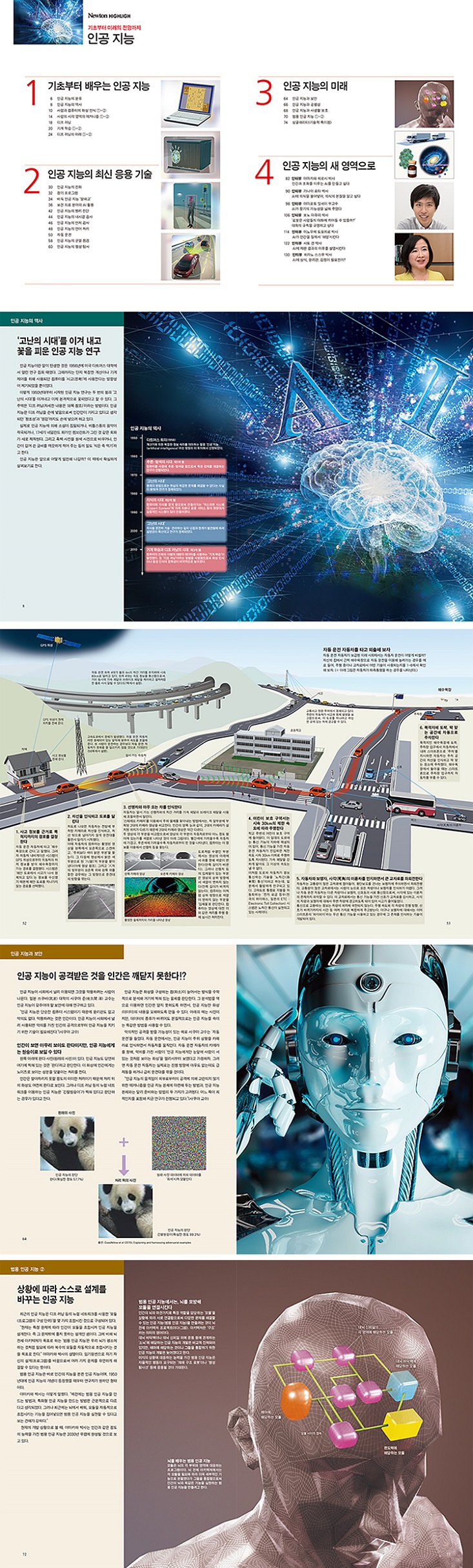
Chapter 1: Learning Artificial Intelligence from the Basics
Classification of AI / History of AI / Human and Computer Image Recognition ①~② / Mechanisms of the Human Visual Domain ①~② / Deep Learning / Machine Learning ①~② / The Future of Deep Learning ①~②
Chapter 2: Latest Applications of Artificial Intelligence
Evolution of AI / Long-term programming / AlphaGo, the AI for Go / Use of AI in healthcare / AI pathology diagnosis / AI endoscopy / AI fundus examination / AI language processing / Autonomous driving / AI crack detection / AI planetary exploration
Chapter 3: The Future of Artificial Intelligence
AI and Security / AI and Fairness / AI and Privacy / General AI ①~② / Singularity (Technological Singularity)
Chapter 4: Towards a New Frontier in Artificial Intelligence
* Interview with Dr. Hiroshi Yamakawa
I want to create AI that is in harmony with humans.
* Interview: Dr. Ryota Kanai
I want to breathe consciousness into AI and understand the nature of consciousness.
* Interview: Associate Professor Issei Yamamoto
AI expands the possibilities of long-term care
* Interview with Dr. Mayumi Bono
'Can robots join human conversations?'
I want to figure out the rules of conversation
* Interview: Dr. Tomohiro Inoue
AI 'liberates' humans from work
* Interview: Dr. Gen Sato
Explaining the reasons for a trial outcome to AI
* Interview: Dr. Susumu Hirano
Does AI need common sense, ethics, and emotions?
Classification of AI / History of AI / Human and Computer Image Recognition ①~② / Mechanisms of the Human Visual Domain ①~② / Deep Learning / Machine Learning ①~② / The Future of Deep Learning ①~②
Chapter 2: Latest Applications of Artificial Intelligence
Evolution of AI / Long-term programming / AlphaGo, the AI for Go / Use of AI in healthcare / AI pathology diagnosis / AI endoscopy / AI fundus examination / AI language processing / Autonomous driving / AI crack detection / AI planetary exploration
Chapter 3: The Future of Artificial Intelligence
AI and Security / AI and Fairness / AI and Privacy / General AI ①~② / Singularity (Technological Singularity)
Chapter 4: Towards a New Frontier in Artificial Intelligence
* Interview with Dr. Hiroshi Yamakawa
I want to create AI that is in harmony with humans.
* Interview: Dr. Ryota Kanai
I want to breathe consciousness into AI and understand the nature of consciousness.
* Interview: Associate Professor Issei Yamamoto
AI expands the possibilities of long-term care
* Interview with Dr. Mayumi Bono
'Can robots join human conversations?'
I want to figure out the rules of conversation
* Interview: Dr. Tomohiro Inoue
AI 'liberates' humans from work
* Interview: Dr. Gen Sato
Explaining the reasons for a trial outcome to AI
* Interview: Dr. Susumu Hirano
Does AI need common sense, ethics, and emotions?
Detailed image
Publisher's Review
Fundamentals of artificial intelligence, including image recognition methods for artificial intelligence, deep learning and neural networks, machine learning, and the future of deep learning.
Artificial intelligence has made great strides thanks to the development of new technologies such as deep learning.
In the past, researchers had to teach artificial intelligence the characteristics of each object one by one.
However, deep learning acquires features using a system called a neural network that mimics the structure of the human brain.
The introductory section of this book delves into the core of deep learning, which directly fueled the development of artificial intelligence, and various related technologies.
The latest applications of artificial intelligence include disease diagnosis, translation, endoscopy, autonomous driving, Go competition, and space exploration.
The artificial intelligence AlphaGo surprised the world by beating the world's best players.
Even now, artificial intelligence specialized in each field is demonstrating abilities that surpass those of humans.
There are other fields where artificial intelligence is achieving outstanding results by assisting human activities.
Learn how artificial intelligence is being used in disease diagnosis, endoscopy, autonomous driving, space exploration, and more.
The future of AI: AI and security, privacy, AI general intelligence, singularity, and more.
There are two important challenges related to artificial intelligence.
It's a security issue and a human jobs issue.
How to prevent crimes and privacy violations that exploit the characteristics of artificial intelligence will be a major challenge going forward.
Additionally, many people worry that artificial intelligence, armed with its superior capabilities, will take away human jobs.
There are also problems that arise as artificial intelligence continues to develop and completely surpasses human capabilities.
Learn about the future of artificial intelligence.
Explanation of new areas of human intelligence, including the creation of artificial intelligence, related technologies of artificial intelligence, and its relationship with humans.
Research on artificial intelligence is actively underway in various fields.
We will hear about the technical aspects of artificial intelligence, as well as the research of scholars who are trying to create new areas of artificial intelligence, such as artificial intelligence used in trials and artificial intelligence that can converse with humans.
We also explore various research topics, including the principles of creating general artificial intelligence, efforts to make artificial intelligence conscious, and the issues surrounding the employment of artificial intelligence and humans.
The 'Newton Highlights Series', published one volume each month.
NEWTON publishes one volume of the "Newton Highlights Series" every month, a scientific monograph that presents the latest developments in all fields of science, including physics, chemistry, biology, and earth science, with high-quality commentary articles and sophisticated graphics.
[Artificial Intelligence] is the 121st book in the series, and its sister books, [Theory of Relativity], [Quantum Theory], and [Differential and Integral Calculus], are also selling well.
List of collaborators
Ryota Kanai 金井良太 / Representative Director, Araya Co., Ltd., Ph.D.
(Cum Laude)
Norio Narita / Ph.D. in Astronomy, Graduate School of Science, University of Tokyo, Japan
Hiroshi Nakagawa / Professor, Information Infrastructure Center, University of Tokyo, Japan, Ph.D. in Engineering
Yutaka Matsuo / Associate Professor, Department of Technology Management Strategy, Graduate School of Engineering, University of Tokyo, Japan, Ph.D. in Engineering
Masahiro Murakawa / Ph.D. in Engineering, Chief Planning Officer, Artificial Intelligence Research Strategy Department, National Institute of Advanced Industrial Science and Technology, Japan
Mayumi Bono / Associate Professor, Content Science Research Division, National Institute of Informatics, Japan, Ph.D.
Jun Sakuma / Professor, Department of Systems Information Engineering, University of Tsukuba, Japan, Ph.D. in Engineering
Ken Sato / Professor, Ph.D., Department of Information Science, National Institute of Informatics, Japan
Takayuki Sato / Researcher, Brain Integration Function Research Team, Brain Science Research Center, RIKEN, Japan; Doctor of Neuroscience
Yoshihiro Suda / Professor, Institute of Production Technology, University of Tokyo, Japan, Ph.D. in Engineering
Keiji Aoki / Representative Director, Japan Advanced Mobility Co., Ltd.
Masayoshi Yamada / PhD, Endoscopy, National Cancer Center, Central Hospital, Japan
Issei Yamamoto / Specially Appointed Associate Professor, Aichi Gakuin University, Japan; Engineer, HEROZ Corporation
Hiroshi Yamakawa / Director of DWANGO AI Research Institute, DWANGO Co., Ltd., Doctor of Engineering
Takashi Oguchi / Professor, Institute of Production Technology, University of Tokyo, Japan, Doctor of Engineering
Shohei Osawa / Special Assistant Professor, Department of Technology Management and Strategy, Graduate School of Engineering, University of Tokyo, Japan, Ph.D. in Engineering
Yuki Kenya / Doctor of Medicine, Full-time Lecturer, Department of Ophthalmology, Keio University School of Medicine, Japan
Tomohiro Inoue / Associate Professor, Department of Economics, Komazawa University, Japan, Ph.D. in Economics
Kentaro Inui / Professor, Graduate School of Information Science, Tohoku University, Japan, Doctor of Engineering
Hoki Kunihito / Associate Professor, Department of Information Science and Engineering, Electro-Communications University, Japan, Ph.D.
Susumu Hirano / Professor, Department of Policy Studies, Chuo University, Japan; Doctor of Comprehensive Policy
Artificial intelligence has made great strides thanks to the development of new technologies such as deep learning.
In the past, researchers had to teach artificial intelligence the characteristics of each object one by one.
However, deep learning acquires features using a system called a neural network that mimics the structure of the human brain.
The introductory section of this book delves into the core of deep learning, which directly fueled the development of artificial intelligence, and various related technologies.
The latest applications of artificial intelligence include disease diagnosis, translation, endoscopy, autonomous driving, Go competition, and space exploration.
The artificial intelligence AlphaGo surprised the world by beating the world's best players.
Even now, artificial intelligence specialized in each field is demonstrating abilities that surpass those of humans.
There are other fields where artificial intelligence is achieving outstanding results by assisting human activities.
Learn how artificial intelligence is being used in disease diagnosis, endoscopy, autonomous driving, space exploration, and more.
The future of AI: AI and security, privacy, AI general intelligence, singularity, and more.
There are two important challenges related to artificial intelligence.
It's a security issue and a human jobs issue.
How to prevent crimes and privacy violations that exploit the characteristics of artificial intelligence will be a major challenge going forward.
Additionally, many people worry that artificial intelligence, armed with its superior capabilities, will take away human jobs.
There are also problems that arise as artificial intelligence continues to develop and completely surpasses human capabilities.
Learn about the future of artificial intelligence.
Explanation of new areas of human intelligence, including the creation of artificial intelligence, related technologies of artificial intelligence, and its relationship with humans.
Research on artificial intelligence is actively underway in various fields.
We will hear about the technical aspects of artificial intelligence, as well as the research of scholars who are trying to create new areas of artificial intelligence, such as artificial intelligence used in trials and artificial intelligence that can converse with humans.
We also explore various research topics, including the principles of creating general artificial intelligence, efforts to make artificial intelligence conscious, and the issues surrounding the employment of artificial intelligence and humans.
The 'Newton Highlights Series', published one volume each month.
NEWTON publishes one volume of the "Newton Highlights Series" every month, a scientific monograph that presents the latest developments in all fields of science, including physics, chemistry, biology, and earth science, with high-quality commentary articles and sophisticated graphics.
[Artificial Intelligence] is the 121st book in the series, and its sister books, [Theory of Relativity], [Quantum Theory], and [Differential and Integral Calculus], are also selling well.
List of collaborators
Ryota Kanai 金井良太 / Representative Director, Araya Co., Ltd., Ph.D.
(Cum Laude)
Norio Narita / Ph.D. in Astronomy, Graduate School of Science, University of Tokyo, Japan
Hiroshi Nakagawa / Professor, Information Infrastructure Center, University of Tokyo, Japan, Ph.D. in Engineering
Yutaka Matsuo / Associate Professor, Department of Technology Management Strategy, Graduate School of Engineering, University of Tokyo, Japan, Ph.D. in Engineering
Masahiro Murakawa / Ph.D. in Engineering, Chief Planning Officer, Artificial Intelligence Research Strategy Department, National Institute of Advanced Industrial Science and Technology, Japan
Mayumi Bono / Associate Professor, Content Science Research Division, National Institute of Informatics, Japan, Ph.D.
Jun Sakuma / Professor, Department of Systems Information Engineering, University of Tsukuba, Japan, Ph.D. in Engineering
Ken Sato / Professor, Ph.D., Department of Information Science, National Institute of Informatics, Japan
Takayuki Sato / Researcher, Brain Integration Function Research Team, Brain Science Research Center, RIKEN, Japan; Doctor of Neuroscience
Yoshihiro Suda / Professor, Institute of Production Technology, University of Tokyo, Japan, Ph.D. in Engineering
Keiji Aoki / Representative Director, Japan Advanced Mobility Co., Ltd.
Masayoshi Yamada / PhD, Endoscopy, National Cancer Center, Central Hospital, Japan
Issei Yamamoto / Specially Appointed Associate Professor, Aichi Gakuin University, Japan; Engineer, HEROZ Corporation
Hiroshi Yamakawa / Director of DWANGO AI Research Institute, DWANGO Co., Ltd., Doctor of Engineering
Takashi Oguchi / Professor, Institute of Production Technology, University of Tokyo, Japan, Doctor of Engineering
Shohei Osawa / Special Assistant Professor, Department of Technology Management and Strategy, Graduate School of Engineering, University of Tokyo, Japan, Ph.D. in Engineering
Yuki Kenya / Doctor of Medicine, Full-time Lecturer, Department of Ophthalmology, Keio University School of Medicine, Japan
Tomohiro Inoue / Associate Professor, Department of Economics, Komazawa University, Japan, Ph.D. in Economics
Kentaro Inui / Professor, Graduate School of Information Science, Tohoku University, Japan, Doctor of Engineering
Hoki Kunihito / Associate Professor, Department of Information Science and Engineering, Electro-Communications University, Japan, Ph.D.
Susumu Hirano / Professor, Department of Policy Studies, Chuo University, Japan; Doctor of Comprehensive Policy
GOODS SPECIFICS
- Date of issue: July 15, 2018
- Page count, weight, size: 144 pages | 472g | 210*275*20mm
- ISBN13: 9791161960357
- ISBN10: 116196035X
You may also like
카테고리
korean


korean

![GQ KOREA Mark (Monthly): December [2025]](http://librairie.coreenne.fr/cdn/shop/files/8ef265dbbfbf186523ed75ba7319009d.jpg?v=1765340328&width=3840)


