

A mathematician's excuse
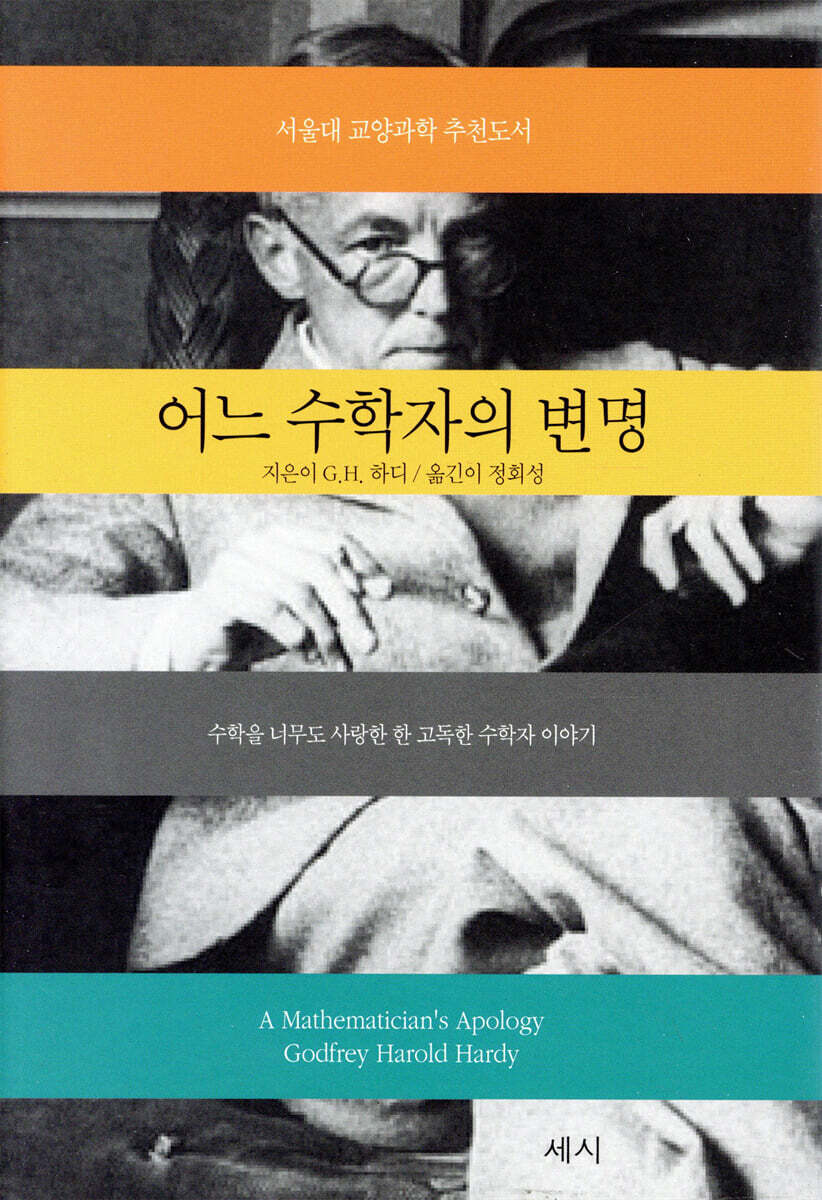 |
Description
Book Introduction
The only book written by Hardy, the main character of the movie The Man Who Knew Infinity!
The shining testimony of Hardy, the eccentric mathematician who discovered Ramanujan and made him the mathematician of the century!
The story of a lonely mathematician who loved mathematics so much.
"A Mathematician's Apology" is a memoir written in the later years of Godfrey Harold Hardy, a leading British mathematician of the early 20th century who played a leading role in introducing modern rigor to mathematical concepts and left behind outstanding achievements.
It consists of a collection of short essays numbered 1 to 29.
Although the volume is small, it leaves a very strong impression as it is stated in concise, refined terms without any unnecessary details, reminiscent of a neat mathematical theorem.
In fact, the author develops his argument about mathematics in a way similar to mathematical proof.
For Hardy, the core of mathematics was aesthetic beauty, which is why he constantly compares mathematics to art.
“I am interested in mathematics, but it is mathematics as a creative art.”
In short, mathematics should be beautiful, and in that sense, it is not essentially different from art, music, or poetry.
His consistent argument is that the patterns of mathematicians, like those of painters and poets, should be beautiful.
He says that ideas, like colors and words, should come together in a harmonious way.
But for him, beauty is the most important thing.
From Hardy's perspective, there is no place in the world where mathematics in its ugly form can permanently settle.
Another key characteristic of mathematics that Hardy identified was seriousness.
Perhaps Hardy's assertion that mathematics is beautiful or that mathematics should be an art may sound like the self-righteousness of a mathematician.
However, through this book, Hardy speaks about the true meaning and value of mathematics from the perspective of a professional mathematician.
From this perspective, "A Mathematician's Apology" is a book that reveals a serious attitude toward scholarship, a deep love for mathematics, and a keen analysis of things, and makes us ponder what a scholar's life and pride are.
The shining testimony of Hardy, the eccentric mathematician who discovered Ramanujan and made him the mathematician of the century!
The story of a lonely mathematician who loved mathematics so much.
"A Mathematician's Apology" is a memoir written in the later years of Godfrey Harold Hardy, a leading British mathematician of the early 20th century who played a leading role in introducing modern rigor to mathematical concepts and left behind outstanding achievements.
It consists of a collection of short essays numbered 1 to 29.
Although the volume is small, it leaves a very strong impression as it is stated in concise, refined terms without any unnecessary details, reminiscent of a neat mathematical theorem.
In fact, the author develops his argument about mathematics in a way similar to mathematical proof.
For Hardy, the core of mathematics was aesthetic beauty, which is why he constantly compares mathematics to art.
“I am interested in mathematics, but it is mathematics as a creative art.”
In short, mathematics should be beautiful, and in that sense, it is not essentially different from art, music, or poetry.
His consistent argument is that the patterns of mathematicians, like those of painters and poets, should be beautiful.
He says that ideas, like colors and words, should come together in a harmonious way.
But for him, beauty is the most important thing.
From Hardy's perspective, there is no place in the world where mathematics in its ugly form can permanently settle.
Another key characteristic of mathematics that Hardy identified was seriousness.
Perhaps Hardy's assertion that mathematics is beautiful or that mathematics should be an art may sound like the self-righteousness of a mathematician.
However, through this book, Hardy speaks about the true meaning and value of mathematics from the perspective of a professional mathematician.
From this perspective, "A Mathematician's Apology" is a book that reveals a serious attitude toward scholarship, a deep love for mathematics, and a keen analysis of things, and makes us ponder what a scholar's life and pride are.
- You can preview some of the book's contents.
Preview
Into the book
The Greeks were the first mathematicians to have a real influence on us today.
If ancient Eastern mathematics is an object of interesting curiosity, Greek mathematics is practical mathematics.
The Greeks were the first to use a language that is understandable to modern mathematics today.
As Professor Littlewood once said, the Greeks were not bright students or scholarly provincials, but rather fellow researchers at other universities.
Therefore, Greek mathematics can be said to be more enduring than literature.
Aeschylus may be forgotten, but Archimedes will be remembered forever.
Because languages perish, but mathematical ideas are immortal.
Perhaps the word immortality may sound far-fetched.
Even so, perhaps no one is more likely to achieve immortality than a mathematician.
--- p.42
Indeed, few disciplines are more popular than mathematics.
Just as people enjoy beautiful melodies, most people recognize the charm of mathematics.
Maybe there are more people who are interested in math than in music.
It may not seem so on the surface, but this can be easily proven.
Music can stimulate public emotions, while mathematics cannot.
Not having musical talent is considered a bit shameful (though of course it's not).
In contrast, most people freak out at the mere mention of math and naively exaggerate how bad they are at it.
If ancient Eastern mathematics is an object of interesting curiosity, Greek mathematics is practical mathematics.
The Greeks were the first to use a language that is understandable to modern mathematics today.
As Professor Littlewood once said, the Greeks were not bright students or scholarly provincials, but rather fellow researchers at other universities.
Therefore, Greek mathematics can be said to be more enduring than literature.
Aeschylus may be forgotten, but Archimedes will be remembered forever.
Because languages perish, but mathematical ideas are immortal.
Perhaps the word immortality may sound far-fetched.
Even so, perhaps no one is more likely to achieve immortality than a mathematician.
--- p.42
Indeed, few disciplines are more popular than mathematics.
Just as people enjoy beautiful melodies, most people recognize the charm of mathematics.
Maybe there are more people who are interested in math than in music.
It may not seem so on the surface, but this can be easily proven.
Music can stimulate public emotions, while mathematics cannot.
Not having musical talent is considered a bit shameful (though of course it's not).
In contrast, most people freak out at the mere mention of math and naively exaggerate how bad they are at it.
--- p.50
GOODS SPECIFICS
- Date of publication: November 11, 2016
- Format: Hardcover book binding method guide
- Page count, weight, size: 208 pages | 355g | 132*193*18mm
- ISBN13: 9788998853297
- ISBN10: 8998853299
You may also like
카테고리
korean


korean

![GQ KOREA Mark (Monthly): December [2025]](http://librairie.coreenne.fr/cdn/shop/files/8ef265dbbfbf186523ed75ba7319009d.jpg?v=1765340328&width=3840)


