

NEWTON HIGHLIGHT Newton Highlights: The Three Major Theories of Modern Physics
 |
Description
Book Introduction
Physics is a discipline that seeks to discover and explain the laws behind various phenomena occurring in nature.
Many of these subjects are related to phenomena we see every day.
However, physics extends its scope of explanation to areas that are difficult to perceive with our naked eyes.
The 'theory of relativity' and 'quantum theory', which emerged in the early 20th century, are representative examples, and can be said to be theories that well explain the secrets of the natural world.
The theory of relativity is a theory about space and time, and gravity, created by physicist Einstein, and quantum theory is a physical theory that explains the movement of extremely small particles such as atoms and electrons.
However, it could not explain everything in nature, so an 'ultimate theory' that integrates these two theories is required.
The theory currently considered the most promising candidate among them is 'string theory'.
String theory is a theory that explains that all matter in nature is made of 'strings' that are approximately 10-34 meters long.
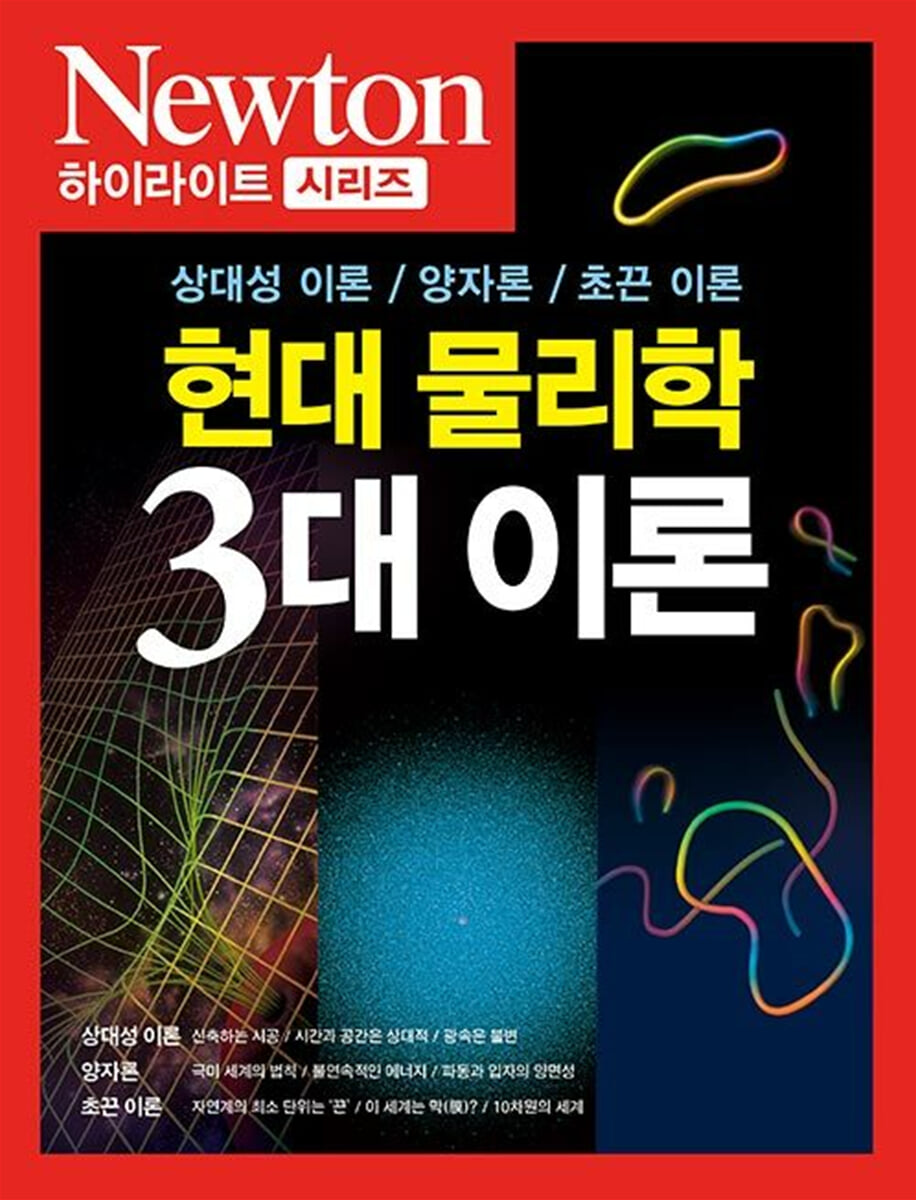
This book explains the "three major theories" that can be considered the foundation of modern physics: relativity, quantum theory, and string theory.
It is a composition that summarizes the core contents of three theories in one volume.
Many of these subjects are related to phenomena we see every day.
However, physics extends its scope of explanation to areas that are difficult to perceive with our naked eyes.
The 'theory of relativity' and 'quantum theory', which emerged in the early 20th century, are representative examples, and can be said to be theories that well explain the secrets of the natural world.
The theory of relativity is a theory about space and time, and gravity, created by physicist Einstein, and quantum theory is a physical theory that explains the movement of extremely small particles such as atoms and electrons.
However, it could not explain everything in nature, so an 'ultimate theory' that integrates these two theories is required.
The theory currently considered the most promising candidate among them is 'string theory'.
String theory is a theory that explains that all matter in nature is made of 'strings' that are approximately 10-34 meters long.
This book explains the "three major theories" that can be considered the foundation of modern physics: relativity, quantum theory, and string theory.
It is a composition that summarizes the core contents of three theories in one volume.
index
Part 1 Theory of Relativity
special theory of relativity
The principle of the constancy of the speed of light / The inconsistency of simultaneity ①~② / The slowing of time ①~③ / Column What experiments have confirmed the principle of the constancy of the speed of light? / The shrinking of space ①~② / The increase of mass ①~② / Mass = energy / Column There is a particle that proves the shrinking of space according to the theory of relativity
general theory of relativity
Challenges to Gravity ①~② / Equivalence Principle ①~② / Space is Curved ①~② / Curved Space and Light ①~② / What is Gravity? / Gravity and the Slowing of Time ①~② / Column From Relativity to Cosmology / Column New Evidence Showing that Relativity is Correct
Part 2 Quantum Theory
The Birth of Quantum Theory
The 'explanatory scope' of quantum theory / The discontinuous world / Quantum hypothesis ①~② / Light quantum hypothesis / The 'wave-particle duality' of light / Column Einstein, who thought of light as a collection of photons / Column The reason why soap bubbles appear rainbow-colored is because light has wave properties / Bohr's atomic model ①~② / The 'wave-particle duality' of electrons / Column The 'double-slit experiment' that determined the 'wave-particle duality' of electrons
The Mysteries of Quantum Theory
Contraction of waves / Electron waves / Schrödinger's equation / Uncertainty principle / Column: Controversy surrounding the interpretation of quantum theory / Column: Will quantum theory give birth to a 'half-life-and-half-reflective cat'?
Applications of quantum theory
Atoms/molecules and bonding forces/large matter/quantum gravity theory and quantum computers/column What is the 'band theory' of physical properties essential to understanding the properties of metals, insulators, and semiconductors?
Rewriting the Uncertainty Principle ①~④
Part 3 Superstring Theory
Introduction to String Theory
The building blocks of all things are 'strings' / A candidate for the 'ultimate theory' / Column: 'Elementary particles', the smallest building blocks of nature / What are 'strings'? / Hidden dimensions ①~② / Column: Four-dimensional 'space' and four-dimensional 'spacetime' / The 'membrane' to which strings are attached / Cosmic strings / Column: Cosmic strings can also be detected by gravitational waves
Development of superstring theory
The History of Superstring Theory / The Artificial Creation of Black Holes / Expanding Applications / Column: The Ultimate Theory's Aim: "Unification of Force"
Special Interview
Dr. Brian Greene
Find the 'Invisible Dimension'! ①~④
special theory of relativity
The principle of the constancy of the speed of light / The inconsistency of simultaneity ①~② / The slowing of time ①~③ / Column What experiments have confirmed the principle of the constancy of the speed of light? / The shrinking of space ①~② / The increase of mass ①~② / Mass = energy / Column There is a particle that proves the shrinking of space according to the theory of relativity
general theory of relativity
Challenges to Gravity ①~② / Equivalence Principle ①~② / Space is Curved ①~② / Curved Space and Light ①~② / What is Gravity? / Gravity and the Slowing of Time ①~② / Column From Relativity to Cosmology / Column New Evidence Showing that Relativity is Correct
Part 2 Quantum Theory
The Birth of Quantum Theory
The 'explanatory scope' of quantum theory / The discontinuous world / Quantum hypothesis ①~② / Light quantum hypothesis / The 'wave-particle duality' of light / Column Einstein, who thought of light as a collection of photons / Column The reason why soap bubbles appear rainbow-colored is because light has wave properties / Bohr's atomic model ①~② / The 'wave-particle duality' of electrons / Column The 'double-slit experiment' that determined the 'wave-particle duality' of electrons
The Mysteries of Quantum Theory
Contraction of waves / Electron waves / Schrödinger's equation / Uncertainty principle / Column: Controversy surrounding the interpretation of quantum theory / Column: Will quantum theory give birth to a 'half-life-and-half-reflective cat'?
Applications of quantum theory
Atoms/molecules and bonding forces/large matter/quantum gravity theory and quantum computers/column What is the 'band theory' of physical properties essential to understanding the properties of metals, insulators, and semiconductors?
Rewriting the Uncertainty Principle ①~④
Part 3 Superstring Theory
Introduction to String Theory
The building blocks of all things are 'strings' / A candidate for the 'ultimate theory' / Column: 'Elementary particles', the smallest building blocks of nature / What are 'strings'? / Hidden dimensions ①~② / Column: Four-dimensional 'space' and four-dimensional 'spacetime' / The 'membrane' to which strings are attached / Cosmic strings / Column: Cosmic strings can also be detected by gravitational waves
Development of superstring theory
The History of Superstring Theory / The Artificial Creation of Black Holes / Expanding Applications / Column: The Ultimate Theory's Aim: "Unification of Force"
Special Interview
Dr. Brian Greene
Find the 'Invisible Dimension'! ①~④
Publisher's Review
Special feature
Time and space are elastic, and mass warps space and creates gravity.
The long-held 'truth' that time flows at a constant rate for everyone and that the size of space is also constant was shaken to its roots in the 20th century with the announcement of Einstein's theory of relativity.
Einstein's theory that the only constant in the universe is the speed of light, and that for the speed of light to be constant, the length of time and space must expand or contract depending on the observer's perspective, opened a new door in physics.
He also created a new theoretical system by explaining that gravity, which was previously explained by universal gravitation, is the result of mass warping space.
Electrons are both particles and waves, and their position and velocity cannot be determined simultaneously.
Another theory that stands in stark contrast to the theory of relativity is quantum theory.
Quantum theory explains how the world of microscopic particles such as atoms, protons, neutrons, and electrons move.
One such example is the surprising explanation that electrons have both particle and wave properties, and that their position and velocity cannot be determined simultaneously.
Although it is difficult to accept in everyday senses, quantum theory has become widely accepted because it can well explain the movement of electrons and other things when interpreted in that way.
This book provides an easy introduction to the core of quantum theory, which is used in various fields such as chemistry and pharmaceuticals, as well as in the development of various electronic products and computers that have become inseparable from our lives.
The smallest unit in nature is a string with a length of 10-34 m, and this world is 10-dimensional.
What is the ultimate composition of all matter in this world? It has long been understood that molecules, atoms, protons, and neutrons are ultimately made of quarks, which, along with clusters of electrons, constitute matter.
However, string theory states that everything in this world is made of strings 10-34 meters long.
Also, it is said that our world is not a 4-dimensional space-time (3-dimensional space + 1-dimensional time) that we see and feel on a daily basis, but a 10- or 11-dimensional world.
Let's hear string theory's interpretation of where the remaining dimensions are and why we can't see them.
All of this is explained in 180 color illustrations and easy-to-understand explanations by experts.
Seeing is believing.
It is a maxim that fits perfectly with understanding the core of 20th century physics.
These theories may seem difficult at first glance, but they are actually much easier to understand because you can visually confirm their core through over 180 color illustrations.
In addition, detailed explanations from experts in the field make all the content 'my own.'
Newton's unique pride is its world-class graphics that hit the nail on the head, and its know-how in explaining potentially difficult content in an easy-to-understand way so that anyone can understand it.
A new format for science books: the Newton Highlights Series
The 'Newton Highlights Series' is a scientific monograph that has been reorganized by topic, carefully selecting only the best content from the scientific magazine 'Newton', famous for its high-quality commentary and world-class graphics.
More than 80 sister volumes on various topics such as physics, chemistry, biology, earth science, and space science are selling like hotcakes.
Time and space are elastic, and mass warps space and creates gravity.
The long-held 'truth' that time flows at a constant rate for everyone and that the size of space is also constant was shaken to its roots in the 20th century with the announcement of Einstein's theory of relativity.
Einstein's theory that the only constant in the universe is the speed of light, and that for the speed of light to be constant, the length of time and space must expand or contract depending on the observer's perspective, opened a new door in physics.
He also created a new theoretical system by explaining that gravity, which was previously explained by universal gravitation, is the result of mass warping space.
Electrons are both particles and waves, and their position and velocity cannot be determined simultaneously.
Another theory that stands in stark contrast to the theory of relativity is quantum theory.
Quantum theory explains how the world of microscopic particles such as atoms, protons, neutrons, and electrons move.
One such example is the surprising explanation that electrons have both particle and wave properties, and that their position and velocity cannot be determined simultaneously.
Although it is difficult to accept in everyday senses, quantum theory has become widely accepted because it can well explain the movement of electrons and other things when interpreted in that way.
This book provides an easy introduction to the core of quantum theory, which is used in various fields such as chemistry and pharmaceuticals, as well as in the development of various electronic products and computers that have become inseparable from our lives.
The smallest unit in nature is a string with a length of 10-34 m, and this world is 10-dimensional.
What is the ultimate composition of all matter in this world? It has long been understood that molecules, atoms, protons, and neutrons are ultimately made of quarks, which, along with clusters of electrons, constitute matter.
However, string theory states that everything in this world is made of strings 10-34 meters long.
Also, it is said that our world is not a 4-dimensional space-time (3-dimensional space + 1-dimensional time) that we see and feel on a daily basis, but a 10- or 11-dimensional world.
Let's hear string theory's interpretation of where the remaining dimensions are and why we can't see them.
All of this is explained in 180 color illustrations and easy-to-understand explanations by experts.
Seeing is believing.
It is a maxim that fits perfectly with understanding the core of 20th century physics.
These theories may seem difficult at first glance, but they are actually much easier to understand because you can visually confirm their core through over 180 color illustrations.
In addition, detailed explanations from experts in the field make all the content 'my own.'
Newton's unique pride is its world-class graphics that hit the nail on the head, and its know-how in explaining potentially difficult content in an easy-to-understand way so that anyone can understand it.
A new format for science books: the Newton Highlights Series
The 'Newton Highlights Series' is a scientific monograph that has been reorganized by topic, carefully selecting only the best content from the scientific magazine 'Newton', famous for its high-quality commentary and world-class graphics.
More than 80 sister volumes on various topics such as physics, chemistry, biology, earth science, and space science are selling like hotcakes.
GOODS SPECIFICS
- Date of publication: December 10, 2013
- Page count, weight, size: 160 pages | 542g | 210*275*20mm
- ISBN13: 9788955378818
- ISBN10: 8955378815
You may also like
카테고리
korean


korean

![GQ KOREA Mark (Monthly): December [2025]](http://librairie.coreenne.fr/cdn/shop/files/8ef265dbbfbf186523ed75ba7319009d.jpg?v=1765340328&width=3840)


