

New song
 |
Description
Book Introduction
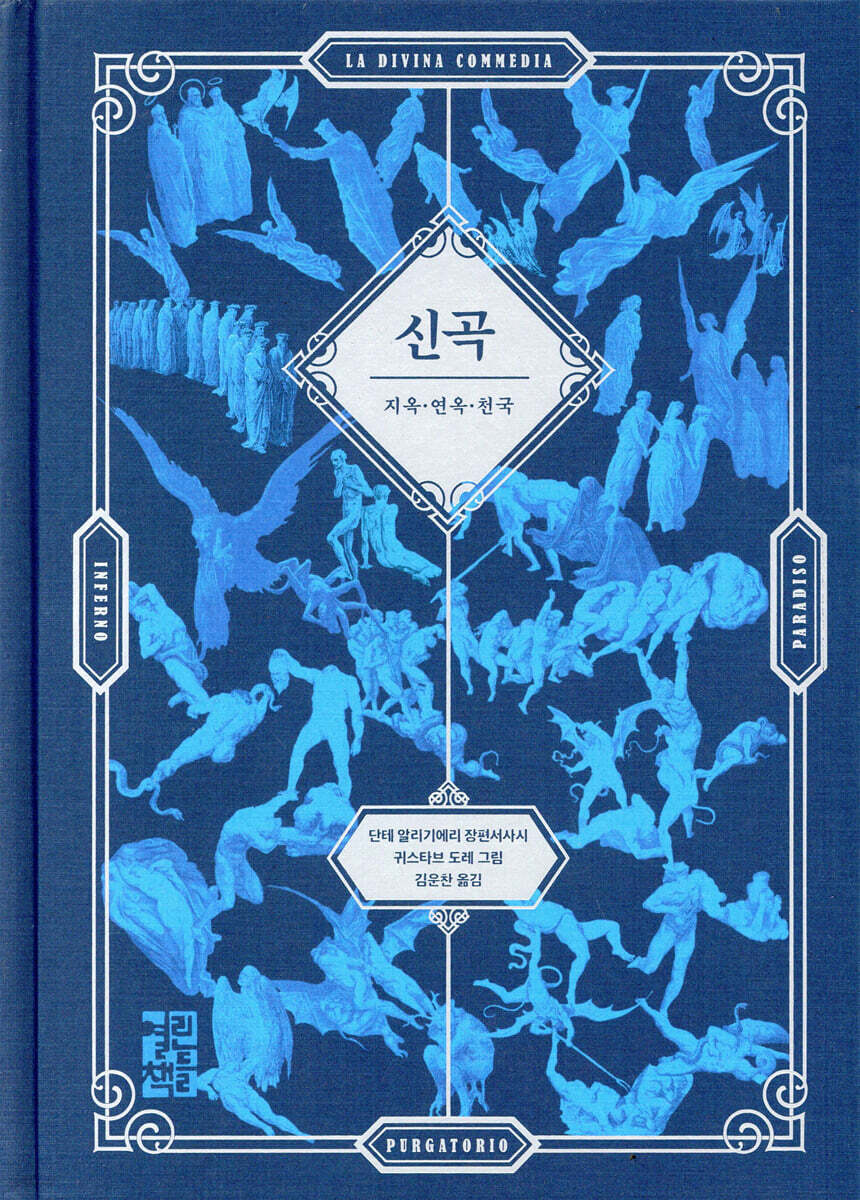
Includes all of Gustave Doré's illustrations Professor Kim Un-chan's complete Italian translation A revised edition of Dante Alighieri's Divine Comedy, featuring beautiful illustrations by Gustave Doré. This revised edition is a completely revised version of the Italian translation of the Divine Comedy, translated by Professor Kim Un-chan of the Franciscan College of Daegu Catholic University and published in 2007, with a complete overhaul of the translation, editing, and design. In particular, Gustave Doré's illustrations of the Divine Comedy were included to enhance the visual richness. It contains 135 illustrations, 75 of which are from Hell, 42 from Purgatory, and 18 from Paradise, and includes a portrait of Dante by Doré, for a total of 136 illustrations. Professor Kim Un-chan's comprehensive revision work has further enhanced the quality of the translation and annotations, and with a sturdy binding and a classic cover featuring luxurious silver foil and illustrations, we aim to present a book worthy of its status as a "classic among classics" to readers. The Divine Comedy is a masterpiece by Dante, who is considered a master of European literature along with Shakespeare and Goethe. It is a long epic poem that contains the story of Dante's journey to the afterlife. It is written in the format of Dante, the author and protagonist, telling what he saw and heard while traveling through Hell, Purgatory, and Heaven for a week while still alive. With a massive volume of 14,233 lines, it constructs the underworld in a surprisingly systematic and geometrical manner, and vividly and realistically depicts the unique joys and sorrows of life of the countless souls encountered there, like a panorama. It is a classic among classics that comprehensively encapsulates the thoughts, ideas, and consciousness of medieval Europe, and it is also a work that heralds the advent of the modern era along with the Renaissance that concluded the Middle Ages. |
- You can preview some of the book's contents.
Preview
index
To the revised edition
hell
purgatory
heaven
Translator's Note: On Dante and the Divine Comedy
Dante Alighieri Chronology
hell
purgatory
heaven
Translator's Note: On Dante and the Divine Comedy
Dante Alighieri Chronology
Detailed image

Into the book
In the middle of our life's journey
I was in a dark forest
Because I lost the right path.
I was in a dark forest
Because I lost the right path.
--- From the text
Publisher's Review
“The best thing made by human hands” ― Goethe
A classic among classics that encapsulates the panorama of human history.
To further enhance the translation and annotations,
Complete with all of Gustave Doré's illustrations
Professor Kim Un-chan's complete Italian translation of "The Divine Comedy" published.
A revised edition of Dante Alighieri's Divine Comedy, featuring beautiful illustrations by Gustave Doré, has been published by Open Books.
This revised edition is a completely revised version of the Italian translation of the Divine Comedy, translated by Professor Kim Un-chan of the Franciscan College of Daegu Catholic University and published in 2007, with a complete overhaul of the translation, editing, and design. In particular, Gustave Doré's illustrations of the Divine Comedy were included to enhance the visual richness.
It contains all 135 illustrations, including a portrait of Dante by Doré, for a total of 136 pieces.
Professor Kim Un-chan's comprehensive revision work has further enhanced the quality of the translation and annotations, and with a sturdy binding and a classic cover featuring luxurious silver foil and illustrations, we aim to present a book worthy of the title "Classic Among Classics" to readers.
The Divine Comedy is a masterpiece by Dante, who is considered a master of European literature along with Shakespeare and Goethe. It is a long epic poem that contains the story of Dante's journey to the afterlife.
It is written in the format of Dante, the author and protagonist, telling what he saw and heard while traveling through Hell, Purgatory, and Heaven for a week while still alive.
It consists of three parts, namely "Inferno", "Purgatorio", and "Paradise", and each part consists of 33 "cantos", and with an overture (one song from "Inferno") added at the beginning, there are a total of 100 songs.
With a massive volume of 14,233 lines, it constructs the underworld in a surprisingly systematic and geometrical manner, and vividly and realistically depicts the unique joys and sorrows of life of the countless souls encountered there, like a panorama.
It is a classic among classics that comprehensively encapsulates the thoughts, ideas, and consciousness of medieval Europe, and it is also a work that heralds the advent of the modern era along with the Renaissance that concluded the Middle Ages.
At the same time, it becomes a mirror that reflects the vivid reality and universal life of all humans.
William Blake, T.
It has inspired many later writers, including S. Eliot, Ezra Pound, Samuel Beckett, and James Joyce, and has also become a major repertoire in countless other works of poetry, music, and art.
Although it is always listed as a must-read classic from both the East and the West, and ranks high on the recommended reading lists of various universities every year, 『The Divine Comedy』 is actually famous for being a difficult work to read.
This is because it contains so many implications and symbols, and the number of characters quoted in the work exceeds hundreds, and the complex political background and ideas of the time, as well as events related to Dante himself, form the warp and woof of the work.
This means that it is important to find a copy of the book with good translation and commentary by a professional researcher.
Professor Kim Un-chan devoted himself to the translation of the Divine Comedy for over 15 years, repeatedly reading the original text, researching related books, and adding commentary. In 2007, he published a complete Italian translation of the Divine Comedy through Open Books.
As a scholar specializing in Italian language and literature, this was the result of my belief that there was a need for a translation of the Divine Comedy that would accurately translate the original text into modern Korean expressions by correcting the errors in the existing translations and revised versions.
More than ten years after the publication of the first edition, Professor Kim Un-chan once again reorganized the translation of 『Singok』 based on the meticulous review and feedback he had received during that time.
In particular, I read the Divine Comedy and held seminars with students several times, which gave me the opportunity to focus on the overall revision work.
We re-examined Dante's original text, reviewed and compared the various opinions of scholars, and made revisions. We also meticulously supplemented the approximately 3,000 notes scattered throughout the translation.
The previously divided three volumes of Hell, Purgatory, and Paradise were combined into one volume, and the original Italian text, which was composed of three-line poems, was edited in three-line stanzas.
This edition also includes illustrations by Gustave Dore (1832-1883), the most famous of the illustrations for the Divine Comedy.
It contains 135 illustrations, 75 of which are from Hell, 42 from Purgatory, and 18 from Paradise, and includes a portrait of Dante by Doré, for a total of 136 illustrations.
Doré's painting style, which vividly depicts the imaginative world of classics with its unique, detailed descriptive power and dramatic composition, reaches its peak with 『Divine Comedy』.
With the master's exquisite brushwork, Doré vividly portrays, as if in a dream, all the horrific scenes of hell's punishments, the famous figures encountered in the afterlife, and the ecstasy of heaven embroidered with the rhythm of angels.
Below each illustration, a caption with a passage from the text that matches the image is included to aid understanding.
Contrasting Dante's poetic imagination with Doré's visual imagination will further enhance the reading experience for readers.
The cover also utilized Doré's illustrations.
The illustrations, ranging from hell to purgatory to heaven, were elaborately arranged on the front cover, giving it a grand and dynamic feel.
Additionally, the sturdy hardcover binding was covered with silver foil to emphasize the luxury befitting the value of a “classic among classics.”
A word from the translator
As a classic, 『The Divine Comedy』 is a product of a specific era, but on the other hand, it is a work that transcends time.
It is a work that heralds the advent of the modern era along with the Renaissance, which ended the Middle Ages, and at the same time, it becomes a mirror that reflects the vivid reality and universal life of all humans.
A classic among classics that encapsulates the panorama of human history.
To further enhance the translation and annotations,
Complete with all of Gustave Doré's illustrations
Professor Kim Un-chan's complete Italian translation of "The Divine Comedy" published.
A revised edition of Dante Alighieri's Divine Comedy, featuring beautiful illustrations by Gustave Doré, has been published by Open Books.
This revised edition is a completely revised version of the Italian translation of the Divine Comedy, translated by Professor Kim Un-chan of the Franciscan College of Daegu Catholic University and published in 2007, with a complete overhaul of the translation, editing, and design. In particular, Gustave Doré's illustrations of the Divine Comedy were included to enhance the visual richness.
It contains all 135 illustrations, including a portrait of Dante by Doré, for a total of 136 pieces.
Professor Kim Un-chan's comprehensive revision work has further enhanced the quality of the translation and annotations, and with a sturdy binding and a classic cover featuring luxurious silver foil and illustrations, we aim to present a book worthy of the title "Classic Among Classics" to readers.
The Divine Comedy is a masterpiece by Dante, who is considered a master of European literature along with Shakespeare and Goethe. It is a long epic poem that contains the story of Dante's journey to the afterlife.
It is written in the format of Dante, the author and protagonist, telling what he saw and heard while traveling through Hell, Purgatory, and Heaven for a week while still alive.
It consists of three parts, namely "Inferno", "Purgatorio", and "Paradise", and each part consists of 33 "cantos", and with an overture (one song from "Inferno") added at the beginning, there are a total of 100 songs.
With a massive volume of 14,233 lines, it constructs the underworld in a surprisingly systematic and geometrical manner, and vividly and realistically depicts the unique joys and sorrows of life of the countless souls encountered there, like a panorama.
It is a classic among classics that comprehensively encapsulates the thoughts, ideas, and consciousness of medieval Europe, and it is also a work that heralds the advent of the modern era along with the Renaissance that concluded the Middle Ages.
At the same time, it becomes a mirror that reflects the vivid reality and universal life of all humans.
William Blake, T.
It has inspired many later writers, including S. Eliot, Ezra Pound, Samuel Beckett, and James Joyce, and has also become a major repertoire in countless other works of poetry, music, and art.
Although it is always listed as a must-read classic from both the East and the West, and ranks high on the recommended reading lists of various universities every year, 『The Divine Comedy』 is actually famous for being a difficult work to read.
This is because it contains so many implications and symbols, and the number of characters quoted in the work exceeds hundreds, and the complex political background and ideas of the time, as well as events related to Dante himself, form the warp and woof of the work.
This means that it is important to find a copy of the book with good translation and commentary by a professional researcher.
Professor Kim Un-chan devoted himself to the translation of the Divine Comedy for over 15 years, repeatedly reading the original text, researching related books, and adding commentary. In 2007, he published a complete Italian translation of the Divine Comedy through Open Books.
As a scholar specializing in Italian language and literature, this was the result of my belief that there was a need for a translation of the Divine Comedy that would accurately translate the original text into modern Korean expressions by correcting the errors in the existing translations and revised versions.
More than ten years after the publication of the first edition, Professor Kim Un-chan once again reorganized the translation of 『Singok』 based on the meticulous review and feedback he had received during that time.
In particular, I read the Divine Comedy and held seminars with students several times, which gave me the opportunity to focus on the overall revision work.
We re-examined Dante's original text, reviewed and compared the various opinions of scholars, and made revisions. We also meticulously supplemented the approximately 3,000 notes scattered throughout the translation.
The previously divided three volumes of Hell, Purgatory, and Paradise were combined into one volume, and the original Italian text, which was composed of three-line poems, was edited in three-line stanzas.
This edition also includes illustrations by Gustave Dore (1832-1883), the most famous of the illustrations for the Divine Comedy.
It contains 135 illustrations, 75 of which are from Hell, 42 from Purgatory, and 18 from Paradise, and includes a portrait of Dante by Doré, for a total of 136 illustrations.
Doré's painting style, which vividly depicts the imaginative world of classics with its unique, detailed descriptive power and dramatic composition, reaches its peak with 『Divine Comedy』.
With the master's exquisite brushwork, Doré vividly portrays, as if in a dream, all the horrific scenes of hell's punishments, the famous figures encountered in the afterlife, and the ecstasy of heaven embroidered with the rhythm of angels.
Below each illustration, a caption with a passage from the text that matches the image is included to aid understanding.
Contrasting Dante's poetic imagination with Doré's visual imagination will further enhance the reading experience for readers.
The cover also utilized Doré's illustrations.
The illustrations, ranging from hell to purgatory to heaven, were elaborately arranged on the front cover, giving it a grand and dynamic feel.
Additionally, the sturdy hardcover binding was covered with silver foil to emphasize the luxury befitting the value of a “classic among classics.”
A word from the translator
As a classic, 『The Divine Comedy』 is a product of a specific era, but on the other hand, it is a work that transcends time.
It is a work that heralds the advent of the modern era along with the Renaissance, which ended the Middle Ages, and at the same time, it becomes a mirror that reflects the vivid reality and universal life of all humans.
GOODS SPECIFICS
- Publication date: March 30, 2022
- Format: Hardcover book binding method guide
- Page count, weight, size: 1,088 pages | 1,586g | 168*220*67mm
- ISBN13: 9788932921396
- ISBN10: 8932921393
You may also like
카테고리
korean


korean

![GQ KOREA Mark (Monthly): December [2025]](http://librairie.coreenne.fr/cdn/shop/files/8ef265dbbfbf186523ed75ba7319009d.jpg?v=1765340328&width=3840)


