

Traveling novel
 |
Description
Book Introduction
“Even here where I am standing now
“Someday night will come and the aurora will shine again.”
A story that comforts us as we remain unable to leave.
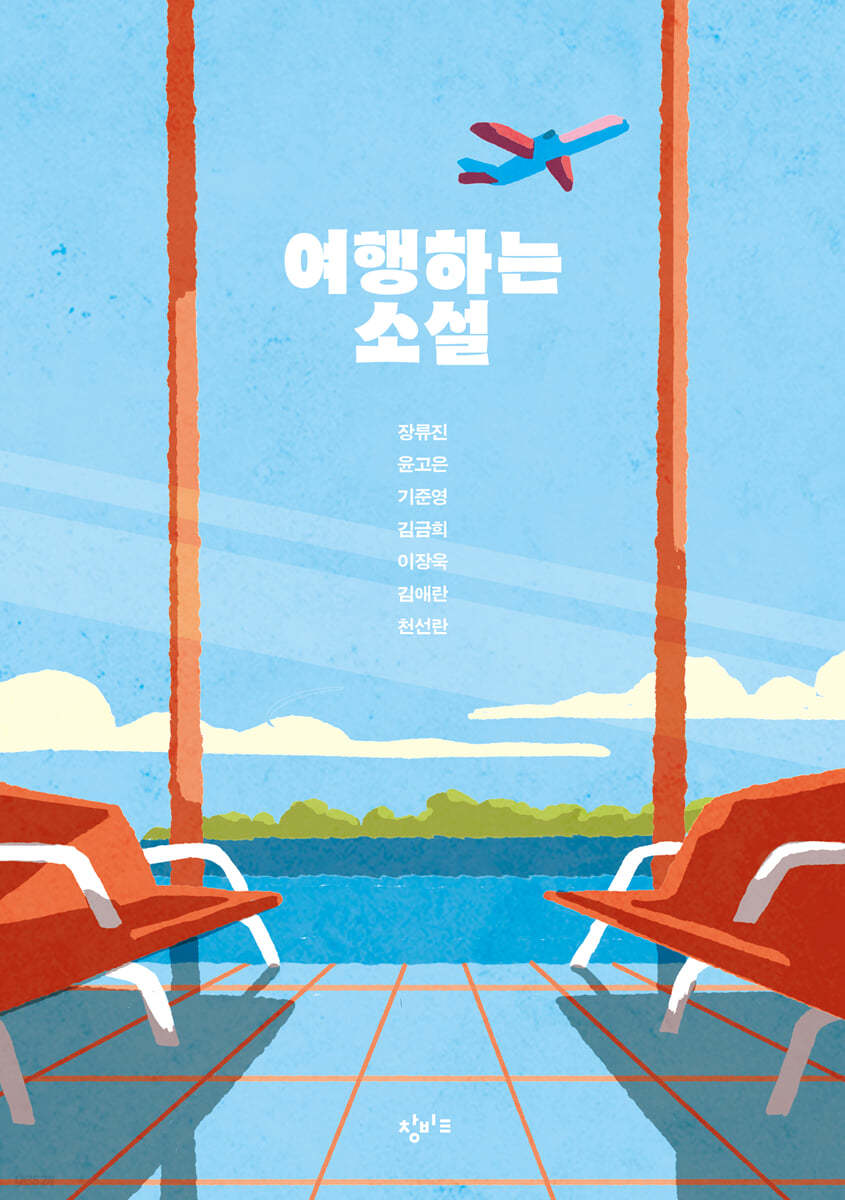
『Traveling Novels』, a collection of seven short stories with travel as their theme, has been published.
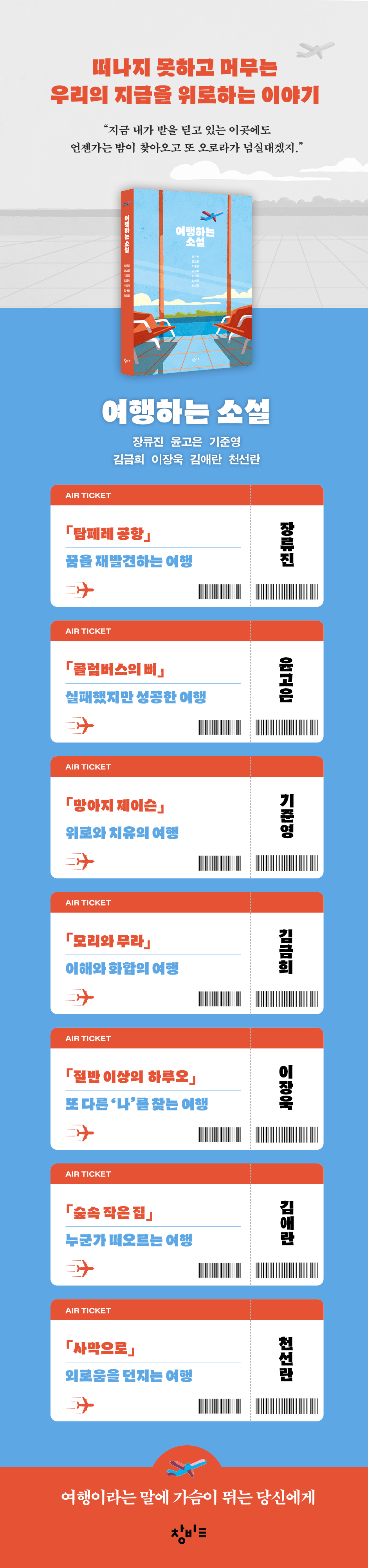
This collection features works by contemporary writers Jang Ryu-jin, Yoon Go-eun, Ki Joon-young, Kim Geum-hee, Lee Jang-wook, Kim Ae-ran, and Cheon Seon-ran, each depicting humanity and the world through travel from their own perspectives.
We are now living in an age where it is difficult to find the word travel.
I'm also worried that I might never be able to travel again.
For us, we need a new way of traveling that suits today.
Embark on a novel journey with the writers of our time, without having to pack your passport or plane ticket.
As we follow their journey, we will once again realize that the world is infinitely open to us as travelers, and that we are beings who can embrace this world.
In this way, this book comforts us in our present, when we cannot leave and must stay.
And this trip will give you a brief break from your repetitive daily routine.
This book is the fifth in a series of themed novels published by Changbi Education, following 『Sweaty Novel』 on the theme of labor, 『Heart-Pounding Novel』 on the theme of love, 『Remembering Novel』 on the theme of disaster, and 『Breathing Novel』 on the theme of ecology.
“Someday night will come and the aurora will shine again.”
A story that comforts us as we remain unable to leave.
『Traveling Novels』, a collection of seven short stories with travel as their theme, has been published.
This collection features works by contemporary writers Jang Ryu-jin, Yoon Go-eun, Ki Joon-young, Kim Geum-hee, Lee Jang-wook, Kim Ae-ran, and Cheon Seon-ran, each depicting humanity and the world through travel from their own perspectives.
We are now living in an age where it is difficult to find the word travel.
I'm also worried that I might never be able to travel again.
For us, we need a new way of traveling that suits today.
Embark on a novel journey with the writers of our time, without having to pack your passport or plane ticket.
As we follow their journey, we will once again realize that the world is infinitely open to us as travelers, and that we are beings who can embrace this world.
In this way, this book comforts us in our present, when we cannot leave and must stay.
And this trip will give you a brief break from your repetitive daily routine.
This book is the fifth in a series of themed novels published by Changbi Education, following 『Sweaty Novel』 on the theme of labor, 『Heart-Pounding Novel』 on the theme of love, 『Remembering Novel』 on the theme of disaster, and 『Breathing Novel』 on the theme of ecology.
- You can preview some of the book's contents.
Preview
index
preface
Jang Ryu-jin · Tampere Airport
Yoon Go-eun · Columbus's Bones
Gi-jun Young · Ja-son the Lamb
Kim Geum-hee and Mori and Mura
Lee Jang-wook · More than half of Haruo
Kim Ae-ran · Little House in the Forest
Cheon Seon-ran · To the desert
Jang Ryu-jin · Tampere Airport
Yoon Go-eun · Columbus's Bones
Gi-jun Young · Ja-son the Lamb
Kim Geum-hee and Mori and Mura
Lee Jang-wook · More than half of Haruo
Kim Ae-ran · Little House in the Forest
Cheon Seon-ran · To the desert
Detailed image
Into the book
I promised to do so, and I remembered the aurora I had once seen in a documentary.
A pillar of light, as if shot from a star far below our feet.
Colorful rays of light that seem to be still but are now swimming away into the distance.
Someday, night will come to this place where I am standing now, and the aurora will shine brightly.
--- From "Tampere Airport"
In Seville, a city where orange trees are common, everything hangs lightly like an orange.
In some alleys, thick ham is as light as an orange.
In this place where even the sun hangs as common as a fruit on a street tree, there is nothing that cannot be lightened.
--- From "The Bones of Columbus"
“It’s hard, and the wind and rain keep blowing.
Then it's similar to a trial.
“Have you ever wondered what the meaning of trials is?”
"yes."
“But to become a little more similar, you have to add one more heart to it.
“If you add the will to not fall, if you add with all your might, then it becomes a little more similar to the meaning of trials.”
--- From "Jason the Pup"
As I sat at the kitchen table with a can of beer in front of me, gloomily cursing those people, my mother, Hae-kyung, told me not to do that.
“Everyone dies in the end.
If you think like that, there is no one in the world you can hate.”
The only thing that saves us is the fact that we all die.
Is that pessimism or a perfect way of life?
--- From "Mori and Mura"
In other words, it would be more correct to say that he wrote about how he lived naturally in the place where he was.
It seemed as if he didn't care whether it was New York's Times Square or a back alley in Chiang Khong.
In Times Square, I lived like a New Yorker, and in Chiang Khong, I lived like a Thai person born and raised in Chiang Khong.
That's right.
Haruo traveled in a way that made it impossible to say he had 'lived'.
If you can call it a 'trip'.
--- From "More than Half of Haruo"
Although I don't have much travel experience, I've always enjoyed looking into airline tickets.
Even if it was a country I would never visit or ever be able to visit in the future, it was the same.
Whenever my soul was clouded by work or I was often disappointed in people, I would search for unfamiliar foreign cities alone.
I was basking in the electromagnetic waves as if I was in the tropical sun, face to face with my tablet PC.
--- From "Little House in the Forest"
From the perspective of the universe, Earth was just one of many planets that happened to exist, and it was a very small planet among them, and it would not matter if it suddenly disappeared one day.
And humans were creatures that came into existence by chance, without even knowing the reason for their existence.
It was humans who created the words love and loneliness.
Every time I remembered that it was solely human activity that made this land so lonely, I thought that the only way to escape that loneliness was to leave this planet.
A pillar of light, as if shot from a star far below our feet.
Colorful rays of light that seem to be still but are now swimming away into the distance.
Someday, night will come to this place where I am standing now, and the aurora will shine brightly.
--- From "Tampere Airport"
In Seville, a city where orange trees are common, everything hangs lightly like an orange.
In some alleys, thick ham is as light as an orange.
In this place where even the sun hangs as common as a fruit on a street tree, there is nothing that cannot be lightened.
--- From "The Bones of Columbus"
“It’s hard, and the wind and rain keep blowing.
Then it's similar to a trial.
“Have you ever wondered what the meaning of trials is?”
"yes."
“But to become a little more similar, you have to add one more heart to it.
“If you add the will to not fall, if you add with all your might, then it becomes a little more similar to the meaning of trials.”
--- From "Jason the Pup"
As I sat at the kitchen table with a can of beer in front of me, gloomily cursing those people, my mother, Hae-kyung, told me not to do that.
“Everyone dies in the end.
If you think like that, there is no one in the world you can hate.”
The only thing that saves us is the fact that we all die.
Is that pessimism or a perfect way of life?
--- From "Mori and Mura"
In other words, it would be more correct to say that he wrote about how he lived naturally in the place where he was.
It seemed as if he didn't care whether it was New York's Times Square or a back alley in Chiang Khong.
In Times Square, I lived like a New Yorker, and in Chiang Khong, I lived like a Thai person born and raised in Chiang Khong.
That's right.
Haruo traveled in a way that made it impossible to say he had 'lived'.
If you can call it a 'trip'.
--- From "More than Half of Haruo"
Although I don't have much travel experience, I've always enjoyed looking into airline tickets.
Even if it was a country I would never visit or ever be able to visit in the future, it was the same.
Whenever my soul was clouded by work or I was often disappointed in people, I would search for unfamiliar foreign cities alone.
I was basking in the electromagnetic waves as if I was in the tropical sun, face to face with my tablet PC.
--- From "Little House in the Forest"
From the perspective of the universe, Earth was just one of many planets that happened to exist, and it was a very small planet among them, and it would not matter if it suddenly disappeared one day.
And humans were creatures that came into existence by chance, without even knowing the reason for their existence.
It was humans who created the words love and loneliness.
Every time I remembered that it was solely human activity that made this land so lonely, I thought that the only way to escape that loneliness was to leave this planet.
--- From "Into the Desert"
Publisher's Review
To you, whose heart races at the thought of travel
To comfort you who are exhausted by the prolonged COVID-19 pandemic, we have collected works by contemporary writers Jang Ryu-jin, Yoon Go-eun, Ki Joon-young, Kim Geum-hee, Lee Jang-wook, Kim Ae-ran, and Cheon Seon-ran, each depicting their journeys from their own perspectives.
When we feel tired of our busy society or feel listless from our repetitive daily lives, we often say out of habit, “Ah, I want to go on a trip.”
In this way, travel not only puts a pause in life, but also gives us the strength to start a new daily life.
But now we live in an age where it is difficult to find the word travel.
I am anxious that I might never be able to travel again, and I miss my travel memories as I reminisce.
We need a new way to travel today.
Just as the modern way of traveling, which has been replaced by viewing frozen photos and videos, is a comfort in itself, let's embark on seven novel journeys with the writers of our time, without having to pack a passport or plane ticket.
As we follow their journey, we come to realize that the world is infinitely open to us as travelers, and that we are beings who can embrace this world.
To us, the writers subtly add that the anxiety, confusion, disharmony, despair, understanding, hope, reflection, and enlightenment we encounter while traveling all add color to our lives.
In this way, this book will comfort us in our present, when we cannot leave and must stay.
The Meaning of Travel as Conveyed by Jang Ryu-jin, Yoon Go-eun, Ki Joon-young, Kim Geum-hee, Lee Jang-wook, Kim Ae-ran, and Cheon Seon-ran
According to the Korean dictionary, travel is defined as 'going to another place or foreign country for work or pleasure.'
However, this book argues that what matters more than the purpose of travel, whether for work or pleasure, is what the experience of leaving means to us.
Jang Ryu-jin's "Tampere Airport" tells the story of a young man's pure dream of travel.
That dream is also a dream that is frustrated amidst the hardships of having to juggle tuition, building up one's resume, making a living, and finding a job.
The rediscovery of the mail that supported my dream with warm and delicate kindness and consideration, that is, the traces of the journey, are the rediscovery of 'my' dream.
In Yoon Go-eun's "The Bones of Columbus," 'I' travels to Seville, Spain to find my roots and identity.
While traveling, he fails to achieve the purpose of his trip, but finds new meaning in life here.
Kijun Young's "Jason the Little Pig" shows comfort and healing through travel.
In this work, travel brings together anxious and difficult lives, allowing them to communicate with kindness toward one another, and in the process, we glimpse the possibility of healing and a new life.
Kim Geum-hee's "Mori and Mura" depicts characters who have lived hard lives but are left with only unbearable conflicts and emotional wounds. Through their journey, they confirm each other's "shame" and "disgrace," while revealing that leaving behind "a minimum of mercy" may be the meaning of "life."
In Lee Jang-wook's "More Than Half of Haruo," travel is about finding a "different" self, a "more than half of myself," and a "different world."
Travel is perhaps the search for the inexplicable source of oneself, the secret of existence, which is another name for life.
Kim Ae-ran's "Little House in the Forest" raises various issues such as money and language, sex and power, class and race through travel.
As we face the complexities of life, someone's face keeps coming to mind, and it may be our own.
Cheon Seon-ran's "To the Desert" tells the story of a journey from Earth in the future to space, conveying the message that travel is about finding what you believe you see, and that life is about holding on to something you desperately need while endlessly throwing loneliness outward.
In this book, the meaning of travel is revealed when we realize that the original purpose of the trip was meaningless, or it is discovered in the process of finding something that we believe we see but does not actually exist.
Ultimately, what I am saying is that if we realize something true, our life is about holding on to that something desperate and moving forward.
That is why there will be no failed journeys in our lives.
In this way, this book will support and encourage you on your continued journey in life.
To comfort you who are exhausted by the prolonged COVID-19 pandemic, we have collected works by contemporary writers Jang Ryu-jin, Yoon Go-eun, Ki Joon-young, Kim Geum-hee, Lee Jang-wook, Kim Ae-ran, and Cheon Seon-ran, each depicting their journeys from their own perspectives.
When we feel tired of our busy society or feel listless from our repetitive daily lives, we often say out of habit, “Ah, I want to go on a trip.”
In this way, travel not only puts a pause in life, but also gives us the strength to start a new daily life.
But now we live in an age where it is difficult to find the word travel.
I am anxious that I might never be able to travel again, and I miss my travel memories as I reminisce.
We need a new way to travel today.
Just as the modern way of traveling, which has been replaced by viewing frozen photos and videos, is a comfort in itself, let's embark on seven novel journeys with the writers of our time, without having to pack a passport or plane ticket.
As we follow their journey, we come to realize that the world is infinitely open to us as travelers, and that we are beings who can embrace this world.
To us, the writers subtly add that the anxiety, confusion, disharmony, despair, understanding, hope, reflection, and enlightenment we encounter while traveling all add color to our lives.
In this way, this book will comfort us in our present, when we cannot leave and must stay.
The Meaning of Travel as Conveyed by Jang Ryu-jin, Yoon Go-eun, Ki Joon-young, Kim Geum-hee, Lee Jang-wook, Kim Ae-ran, and Cheon Seon-ran
According to the Korean dictionary, travel is defined as 'going to another place or foreign country for work or pleasure.'
However, this book argues that what matters more than the purpose of travel, whether for work or pleasure, is what the experience of leaving means to us.
Jang Ryu-jin's "Tampere Airport" tells the story of a young man's pure dream of travel.
That dream is also a dream that is frustrated amidst the hardships of having to juggle tuition, building up one's resume, making a living, and finding a job.
The rediscovery of the mail that supported my dream with warm and delicate kindness and consideration, that is, the traces of the journey, are the rediscovery of 'my' dream.
In Yoon Go-eun's "The Bones of Columbus," 'I' travels to Seville, Spain to find my roots and identity.
While traveling, he fails to achieve the purpose of his trip, but finds new meaning in life here.
Kijun Young's "Jason the Little Pig" shows comfort and healing through travel.
In this work, travel brings together anxious and difficult lives, allowing them to communicate with kindness toward one another, and in the process, we glimpse the possibility of healing and a new life.
Kim Geum-hee's "Mori and Mura" depicts characters who have lived hard lives but are left with only unbearable conflicts and emotional wounds. Through their journey, they confirm each other's "shame" and "disgrace," while revealing that leaving behind "a minimum of mercy" may be the meaning of "life."
In Lee Jang-wook's "More Than Half of Haruo," travel is about finding a "different" self, a "more than half of myself," and a "different world."
Travel is perhaps the search for the inexplicable source of oneself, the secret of existence, which is another name for life.
Kim Ae-ran's "Little House in the Forest" raises various issues such as money and language, sex and power, class and race through travel.
As we face the complexities of life, someone's face keeps coming to mind, and it may be our own.
Cheon Seon-ran's "To the Desert" tells the story of a journey from Earth in the future to space, conveying the message that travel is about finding what you believe you see, and that life is about holding on to something you desperately need while endlessly throwing loneliness outward.
In this book, the meaning of travel is revealed when we realize that the original purpose of the trip was meaningless, or it is discovered in the process of finding something that we believe we see but does not actually exist.
Ultimately, what I am saying is that if we realize something true, our life is about holding on to that something desperate and moving forward.
That is why there will be no failed journeys in our lives.
In this way, this book will support and encourage you on your continued journey in life.
GOODS SPECIFICS
- Publication date: March 25, 2022
- Page count, weight, size: 244 pages | 376g | 148*210*17mm
- ISBN13: 9791165701222
- ISBN10: 1165701227
You may also like
카테고리
korean


korean

![GQ KOREA Mark (Monthly): December [2025]](http://librairie.coreenne.fr/cdn/shop/files/8ef265dbbfbf186523ed75ba7319009d.jpg?v=1765340328&width=3840)


