

150 minutes is enough for basic middle and high school math.
 |
Description
Book Introduction
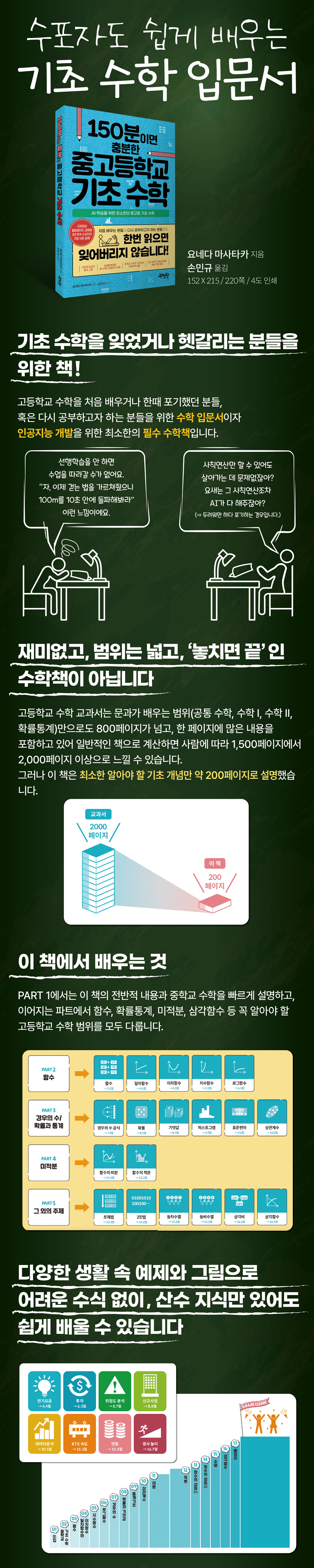
An introductory book on basic mathematics that even beginners can easily learn through a variety of everyday examples and illustrations.
This book is an introductory book for those who are learning high school mathematics for the first time, those who have given up on it, or those who want to study it again.
It covers all the essential math topics you need to know, including functions, probability and statistics, calculus, and trigonometry. Through this book, you can learn not only basic middle and high school math, but also the minimum math knowledge required for AI learning.
This book is an introductory book for those who are learning high school mathematics for the first time, those who have given up on it, or those who want to study it again.
It covers all the essential math topics you need to know, including functions, probability and statistics, calculus, and trigonometry. Through this book, you can learn not only basic middle and high school math, but also the minimum math knowledge required for AI learning.
- You can preview some of the book's contents.
Preview
index
Translator's Preface xiii
Starting with xv
Part 1 To those of you who are learning mathematics from now on
Chapter 01 Features and Structure of This Book 2
1.1 Anyone can learn basic high school math 2
1.2 You can read it all in about 150 minutes 4
1.3 What You'll Learn from This Book 5
Chapter 02 Let's quickly learn basic middle school math first 8
2.1 Numbers less than 0 8
2.2 Addition with minus 9
2.3 Subtraction including minus 10
2.4 Multiplication/Division with Minus 11
2.5 Powers of the same number multiplied multiple times 12
2.6 The square root of 13, which becomes the original number when multiplied twice
2.7 Character expression 14
2.8 Character Writing Rules 15
2.9 Let's start high school math 16
Part 2 Functions
Chapter 03: Functions Even Complete Beginners Can Understand 18
3.1 Function 18
3.2 Function Example (1): Driving a Car 19
3.3 Function Example (2): Change 19
3.4 How to write a function expression 20
3.5 Graphs to Help Understand Functions 21
Chapter 04 Linear and Quadratic Functions 24
4.1 Linear Functions 24
4.2 Graph of Linear Function 26
4.3 Example of a linear function (1): Annual salary 28
4.4 Example of a Linear Function (2): Electricity Rate 29
4.5 Quadratic Functions 30
4.6 Graphs of Quadratic Functions 31
Column Cubic Function 33
Chapter 05 Rapidly Increasing Exponential Functions 34
5.1 Review of Exponents 34
5.2 Exponential Functions 35
5.3 Rapidly Increasing Exponential Functions 36
5.4 Example of an Exponential Function (1): The Spread of Infectious Diseases 37
5.5 Example of an Exponential Function (2): Company Growth 38
5.6 2?1 or 20.5 can also be calculated 39
Chapter 06: How many years will it take to grow tenfold? Logarithmic Function 42
6.1 Logarithms, what power is good to raise? 42
6.2 Logarithmic Function 44
6.3 Example of Logarithmic Function (1): Investment 45
6.4 Example of Logarithmic Function (2): Logarithmic Graph 46
How to calculate column log with calculator 48
Part 3 Cases/Probability and Statistics
Chapter 07 Counting the Number of Patterns 52
7.1 Let's count the number of patterns 52
7.2 Tree diagram 53
7.3 Problems with the Tree Diagram 56
7.4 Formula (1): Multiplication Rule 57
7.5 Before learning the permutation formula 59
7.6 Formula (2): Permutation Formula 61
7.7 Before learning the combination formula 64
7.8 Formula (3): Combination Formula 66
7.9 Let's use the combination formula 67
Column Game and Case 69
Chapter 08 Understanding Probability and Expected Value 70
8.1 Probability 70
8.2 To calculate the probability 71
8.3 Probability Calculation Method (1): Division Formula 71
8.4 Probability Calculation Method (2): The Multiplication Rule 72
8.5 Expected value 74
8.6 How to calculate expected values 74
8.7 Example of Probability and Expected Value (1): Risk Analysis 76
8.8 Example of Probability and Expected Value (2): Profit and Loss Analysis 76
78 Common Misconceptions About Column Probability
Chapter 09 Statistics for Data Analysis 79
9.1 Let's analyze the data 79
9.2 Histograms to understand the overall data 80
9.3 Problems with Histograms 82
9.4 Average of data combined into one 82
9.5 The Importance of Data Variance 83
9.6 Indicator of deviation, standard deviation 84
9.7 What can we learn from standard deviation? 87
89 About Column Deviation Values
Column mean and median 90
Chapter 10: Let's delve deeper into data analysis 91
10.1 To measure the strength of a relationship 91
10.2 Correlation coefficient 93
10.3 How to calculate the correlation coefficient 94
10.4 Notes on Correlation Coefficients 97
101 Puzzles to Boost Your Relaxation and Thinking Skills
Part 4 Calculus
Chapter 11 Differentiation: Seeing the Rate of Change 114
11.1 Differentiation for Rate of Change 114
11.2 Notes on Differentiation 116
11.3 Differentiating Functions (1) 117
11.4 Differentiating Functions (2) 118
11.5 To calculate the differential coefficient accurately 119
11.6 Differentiation Formula 120
Column 122 Differentiation Formula for Cubic Functions
Chapter 12: Integral with Cumulative Values 124
12.1 Integral with cumulative values 124
12.2 Notes on Integration 126
12.3 Let's calculate the integral (1) 127
12.4 Let's calculate the integral (2) 128
12.5 To compute more complex integrals 129
12.6 Integration Formula 130
12.7 Differentiation and integration are opposites 132
Column Advanced: How to Use Integrals 133
Part 5 Other Topics
Chapter 13 Integers (1): Euclidean Algorithm 136
13.1 Greatest Common Divisor Review 136
13.2 How to quickly calculate the greatest common divisor 137
13.3 Euclidean Algorithm 138
13.4 Least Common Multiple Review 139
13.5 How to quickly calculate the least common multiple 140
Chapter 14 Integers (2): Decimal and Binary 142
14.1 What is the decimal system? 142
14.2 Binary 143
14.3 The Relationship Between Decimal and Binary 144
14.4 Binary to Decimal Conversion 145
14.5 Decimal to Binary Conversion 146
Why Column Conversion Works Accurately 148
Column Computers and Binary 149
Chapter 15: Conquering Sequences 150
15.1 A sequence is a list of numbers 150
15.2 Arithmetic and Geometric Sequences 151
15.3 Sequence Sum 152
15.4 Calculate the sum of an arithmetic sequence 153
15.5 Why the formula for the sum of a sequence is accurate 154
Column Formula for the Sum of Geometric Sequences 155
Column Necessary and Sufficient Conditions 156
Chapter 16: Mastering Trigonometric Ratios and Trigonometric Functions 158
16.1 Before learning trigonometry 158
16.2 Trigonometric Ratios (1): sin 159
16.3 Trigonometric Ratios (2): cos 160
16.4 Trigonometric Ratios (3): tan 161
16.5 Trigonometric Theorem 162
16.6 How to Calculate Trigonometric Ratios 163
16.7 Example using trigonometric ratios (1): Slope 164
16.8 Example using trigonometric ratios (2): Airplane 165
16.9 Trigonometric Functions 166
Why Column sin 0° becomes 0 169
Part 6 Let's review the contents of this book.
Chapter 17: High School Math Fundamentals - 172
17.1 What You Learned from This Book 172
17.2 Part 2 Functions 173
17.3 Part 3 Cases/Probability and Statistics 174
17.4 Part 4 Calculus 176
17.5 Part 5 Other Topics 177
The problem ends here 184
Practice Problem Answers 186
Conclusion 200
Acknowledgments 201
Search 202
Starting with xv
Part 1 To those of you who are learning mathematics from now on
Chapter 01 Features and Structure of This Book 2
1.1 Anyone can learn basic high school math 2
1.2 You can read it all in about 150 minutes 4
1.3 What You'll Learn from This Book 5
Chapter 02 Let's quickly learn basic middle school math first 8
2.1 Numbers less than 0 8
2.2 Addition with minus 9
2.3 Subtraction including minus 10
2.4 Multiplication/Division with Minus 11
2.5 Powers of the same number multiplied multiple times 12
2.6 The square root of 13, which becomes the original number when multiplied twice
2.7 Character expression 14
2.8 Character Writing Rules 15
2.9 Let's start high school math 16
Part 2 Functions
Chapter 03: Functions Even Complete Beginners Can Understand 18
3.1 Function 18
3.2 Function Example (1): Driving a Car 19
3.3 Function Example (2): Change 19
3.4 How to write a function expression 20
3.5 Graphs to Help Understand Functions 21
Chapter 04 Linear and Quadratic Functions 24
4.1 Linear Functions 24
4.2 Graph of Linear Function 26
4.3 Example of a linear function (1): Annual salary 28
4.4 Example of a Linear Function (2): Electricity Rate 29
4.5 Quadratic Functions 30
4.6 Graphs of Quadratic Functions 31
Column Cubic Function 33
Chapter 05 Rapidly Increasing Exponential Functions 34
5.1 Review of Exponents 34
5.2 Exponential Functions 35
5.3 Rapidly Increasing Exponential Functions 36
5.4 Example of an Exponential Function (1): The Spread of Infectious Diseases 37
5.5 Example of an Exponential Function (2): Company Growth 38
5.6 2?1 or 20.5 can also be calculated 39
Chapter 06: How many years will it take to grow tenfold? Logarithmic Function 42
6.1 Logarithms, what power is good to raise? 42
6.2 Logarithmic Function 44
6.3 Example of Logarithmic Function (1): Investment 45
6.4 Example of Logarithmic Function (2): Logarithmic Graph 46
How to calculate column log with calculator 48
Part 3 Cases/Probability and Statistics
Chapter 07 Counting the Number of Patterns 52
7.1 Let's count the number of patterns 52
7.2 Tree diagram 53
7.3 Problems with the Tree Diagram 56
7.4 Formula (1): Multiplication Rule 57
7.5 Before learning the permutation formula 59
7.6 Formula (2): Permutation Formula 61
7.7 Before learning the combination formula 64
7.8 Formula (3): Combination Formula 66
7.9 Let's use the combination formula 67
Column Game and Case 69
Chapter 08 Understanding Probability and Expected Value 70
8.1 Probability 70
8.2 To calculate the probability 71
8.3 Probability Calculation Method (1): Division Formula 71
8.4 Probability Calculation Method (2): The Multiplication Rule 72
8.5 Expected value 74
8.6 How to calculate expected values 74
8.7 Example of Probability and Expected Value (1): Risk Analysis 76
8.8 Example of Probability and Expected Value (2): Profit and Loss Analysis 76
78 Common Misconceptions About Column Probability
Chapter 09 Statistics for Data Analysis 79
9.1 Let's analyze the data 79
9.2 Histograms to understand the overall data 80
9.3 Problems with Histograms 82
9.4 Average of data combined into one 82
9.5 The Importance of Data Variance 83
9.6 Indicator of deviation, standard deviation 84
9.7 What can we learn from standard deviation? 87
89 About Column Deviation Values
Column mean and median 90
Chapter 10: Let's delve deeper into data analysis 91
10.1 To measure the strength of a relationship 91
10.2 Correlation coefficient 93
10.3 How to calculate the correlation coefficient 94
10.4 Notes on Correlation Coefficients 97
101 Puzzles to Boost Your Relaxation and Thinking Skills
Part 4 Calculus
Chapter 11 Differentiation: Seeing the Rate of Change 114
11.1 Differentiation for Rate of Change 114
11.2 Notes on Differentiation 116
11.3 Differentiating Functions (1) 117
11.4 Differentiating Functions (2) 118
11.5 To calculate the differential coefficient accurately 119
11.6 Differentiation Formula 120
Column 122 Differentiation Formula for Cubic Functions
Chapter 12: Integral with Cumulative Values 124
12.1 Integral with cumulative values 124
12.2 Notes on Integration 126
12.3 Let's calculate the integral (1) 127
12.4 Let's calculate the integral (2) 128
12.5 To compute more complex integrals 129
12.6 Integration Formula 130
12.7 Differentiation and integration are opposites 132
Column Advanced: How to Use Integrals 133
Part 5 Other Topics
Chapter 13 Integers (1): Euclidean Algorithm 136
13.1 Greatest Common Divisor Review 136
13.2 How to quickly calculate the greatest common divisor 137
13.3 Euclidean Algorithm 138
13.4 Least Common Multiple Review 139
13.5 How to quickly calculate the least common multiple 140
Chapter 14 Integers (2): Decimal and Binary 142
14.1 What is the decimal system? 142
14.2 Binary 143
14.3 The Relationship Between Decimal and Binary 144
14.4 Binary to Decimal Conversion 145
14.5 Decimal to Binary Conversion 146
Why Column Conversion Works Accurately 148
Column Computers and Binary 149
Chapter 15: Conquering Sequences 150
15.1 A sequence is a list of numbers 150
15.2 Arithmetic and Geometric Sequences 151
15.3 Sequence Sum 152
15.4 Calculate the sum of an arithmetic sequence 153
15.5 Why the formula for the sum of a sequence is accurate 154
Column Formula for the Sum of Geometric Sequences 155
Column Necessary and Sufficient Conditions 156
Chapter 16: Mastering Trigonometric Ratios and Trigonometric Functions 158
16.1 Before learning trigonometry 158
16.2 Trigonometric Ratios (1): sin 159
16.3 Trigonometric Ratios (2): cos 160
16.4 Trigonometric Ratios (3): tan 161
16.5 Trigonometric Theorem 162
16.6 How to Calculate Trigonometric Ratios 163
16.7 Example using trigonometric ratios (1): Slope 164
16.8 Example using trigonometric ratios (2): Airplane 165
16.9 Trigonometric Functions 166
Why Column sin 0° becomes 0 169
Part 6 Let's review the contents of this book.
Chapter 17: High School Math Fundamentals - 172
17.1 What You Learned from This Book 172
17.2 Part 2 Functions 173
17.3 Part 3 Cases/Probability and Statistics 174
17.4 Part 4 Calculus 176
17.5 Part 5 Other Topics 177
The problem ends here 184
Practice Problem Answers 186
Conclusion 200
Acknowledgments 201
Search 202
Detailed image
Into the book
If you're not confident in basic mathematics, I think it would be sufficient to read this book first and then study statistics, machine learning, and deep learning.
I am very pleased to be able to introduce this excellent introductory mathematics book.
I hope that through this book, many people will solidify their mathematical foundations and use it as an opportunity to advance to more advanced study.
--- p.xiv
The special thing about this book is that it can be read without any burden.
It is an easy read because it covers only the basics you need to know in about 200 pages.
And the more important feature of this book is that it is structured most effectively with the goal of 'anyone can learn basic middle and high school mathematics.'
--- p.xv
Why is this book accessible even if you lack a background in middle school mathematics? It's because it provides helpful explanations of the necessary middle school math knowledge needed to understand basic high school mathematics.
In fact, although this book primarily covers high school mathematics, a whopping 20% of the book is dedicated to middle school mathematics.
--- p.2
This book covers only the basic concepts you need to know in about 200 pages.
So, it is not suitable as a study guide, but it can be read without burden by students with special talents in physical education or busy office workers.
It's also a great first book for those learning or relearning math for the first time.
--- p.4
In this book of about 200 pages, we learned about the following four major topics.
ㆍVarious functions
ㆍNumber of cases/probability and statistics
ㆍDifferentiation and integration
ㆍOther topics
Then, let's review each topic for about 3 minutes.
I am very pleased to be able to introduce this excellent introductory mathematics book.
I hope that through this book, many people will solidify their mathematical foundations and use it as an opportunity to advance to more advanced study.
--- p.xiv
The special thing about this book is that it can be read without any burden.
It is an easy read because it covers only the basics you need to know in about 200 pages.
And the more important feature of this book is that it is structured most effectively with the goal of 'anyone can learn basic middle and high school mathematics.'
--- p.xv
Why is this book accessible even if you lack a background in middle school mathematics? It's because it provides helpful explanations of the necessary middle school math knowledge needed to understand basic high school mathematics.
In fact, although this book primarily covers high school mathematics, a whopping 20% of the book is dedicated to middle school mathematics.
--- p.2
This book covers only the basic concepts you need to know in about 200 pages.
So, it is not suitable as a study guide, but it can be read without burden by students with special talents in physical education or busy office workers.
It's also a great first book for those learning or relearning math for the first time.
--- p.4
In this book of about 200 pages, we learned about the following four major topics.
ㆍVarious functions
ㆍNumber of cases/probability and statistics
ㆍDifferentiation and integration
ㆍOther topics
Then, let's review each topic for about 3 minutes.
--- p.172
Publisher's Review
You can learn it easily with only arithmetic knowledge, without any difficult formulas.
This is an introductory book on basic mathematics for middle and high school students, for those who have given up on mathematics for various reasons, those who have given up and want to study again, or those who are learning it for the first time.
The author of this book, Masataka Yoneda, has been interested in programming since his first year of middle school and won gold medals for three consecutive years from 2018 to 2020 at the International Olympiad in Informatics (IOI), a world programming competition for middle and high school students. In particular, this book is a bestseller in Japan, selling over 60,000 copies due to its reputation for easy-to-understand explanations.
1.
Explanation from middle school basic math: You can read it even if you only have knowledge of arithmetic.
2.
'Color pictures' rather than formulas: We use very few difficult formulas, and instead use over 250 color pictures to make the mathematical content easier to understand.
3.
Practical examples that show the power of math: We've prepared many practical and concrete examples, including data analysis, investing, and calculating electricity bills.
4.
Solid Understanding with Fill-in-the-Blank Practice Problems: You can naturally review what you've learned with simple practice problems that require you to fill in the blanks in order.
5.
Minimum Essential Mathematics for Artificial Intelligence: Includes the mathematical knowledge essential for developing artificial intelligence.
This is an introductory book on basic mathematics for middle and high school students, for those who have given up on mathematics for various reasons, those who have given up and want to study again, or those who are learning it for the first time.
The author of this book, Masataka Yoneda, has been interested in programming since his first year of middle school and won gold medals for three consecutive years from 2018 to 2020 at the International Olympiad in Informatics (IOI), a world programming competition for middle and high school students. In particular, this book is a bestseller in Japan, selling over 60,000 copies due to its reputation for easy-to-understand explanations.
1.
Explanation from middle school basic math: You can read it even if you only have knowledge of arithmetic.
2.
'Color pictures' rather than formulas: We use very few difficult formulas, and instead use over 250 color pictures to make the mathematical content easier to understand.
3.
Practical examples that show the power of math: We've prepared many practical and concrete examples, including data analysis, investing, and calculating electricity bills.
4.
Solid Understanding with Fill-in-the-Blank Practice Problems: You can naturally review what you've learned with simple practice problems that require you to fill in the blanks in order.
5.
Minimum Essential Mathematics for Artificial Intelligence: Includes the mathematical knowledge essential for developing artificial intelligence.
GOODS SPECIFICS
- Date of issue: January 3, 2025
- Page count, weight, size: 224 pages | 152*215*13mm
- ISBN13: 9791193926765
You may also like
카테고리
korean


korean

![GQ KOREA Mark (Monthly): December [2025]](http://librairie.coreenne.fr/cdn/shop/files/8ef265dbbfbf186523ed75ba7319009d.jpg?v=1765340328&width=3840)


