

AlphaFold: Revolutionizing AI Drug Development
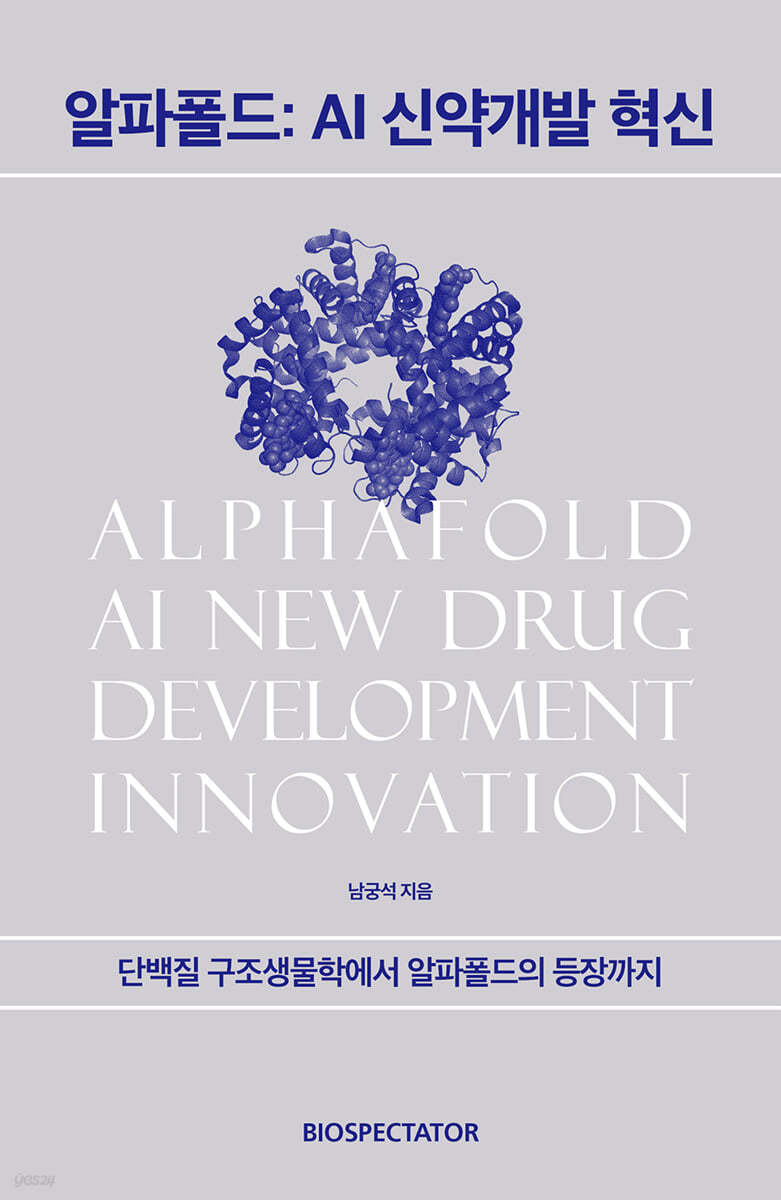 |
Description
Book Introduction
The history of protein research in one volume!
The revolutionary artificial intelligence has changed
The Future of Protein Structure Research and New Drug Development
This is truly the era of artificial intelligence.
Artificial intelligence has transformed human civilization in many ways, particularly in the life sciences.
At the center of it all is Alphafold.
AlphaFold, a protein structure prediction AI announced by Google DeepMind in December 2018, has shown remarkable results since its inception, and in 2020, it further improved prediction accuracy and produced results very similar to experimental structures.
AlphaFold, whose source code is now open, is becoming an essential tool for experimental structural biologists, offering new directions in areas such as drug development and protein design.
AlphaFold: Revolutionizing AI Drug Discovery covers over 100 years of research history, from protein discovery to protein structural biology and the emergence of AlphaFold.
To understand how powerful AlphaFold is, you need to understand the crucial role proteins play in the human body and the arduous process of protein structure prediction.
AlphaFold's direct foundation is data such as protein structure and sequence information accumulated through decades of scientific effort.
This book introduces the achievements of numerous scientists who have uncovered the identity of proteins and examines the changes in structural biology and life science brought about by AlphaFold.
Through this book, let's examine the future of protein structure prediction technology and new drug development through it.
The revolutionary artificial intelligence has changed
The Future of Protein Structure Research and New Drug Development
This is truly the era of artificial intelligence.
Artificial intelligence has transformed human civilization in many ways, particularly in the life sciences.
At the center of it all is Alphafold.
AlphaFold, a protein structure prediction AI announced by Google DeepMind in December 2018, has shown remarkable results since its inception, and in 2020, it further improved prediction accuracy and produced results very similar to experimental structures.
AlphaFold, whose source code is now open, is becoming an essential tool for experimental structural biologists, offering new directions in areas such as drug development and protein design.
AlphaFold: Revolutionizing AI Drug Discovery covers over 100 years of research history, from protein discovery to protein structural biology and the emergence of AlphaFold.
To understand how powerful AlphaFold is, you need to understand the crucial role proteins play in the human body and the arduous process of protein structure prediction.
AlphaFold's direct foundation is data such as protein structure and sequence information accumulated through decades of scientific effort.
This book introduces the achievements of numerous scientists who have uncovered the identity of proteins and examines the changes in structural biology and life science brought about by AlphaFold.
Through this book, let's examine the future of protein structure prediction technology and new drug development through it.
- You can preview some of the book's contents.
Preview
index
To begin with
Part 1: The Dawn of Protein Research
Chapter 1 How did protein research begin?
Chapter 2: Unraveling the Mystery of Amino Acid Sequences
Chapter 3 Are proteins really polymers with fixed structures?
Part 2: Advances in Experimental Structural Biology
Chapter 4 Protein Structure Analysis by X-ray Crystallography
Chapter 5: Advances in Biotechnology and Protein Structure Determination
Chapter 6: Unraveling the Secrets of Disease-Related Proteins
Chapter 7: Drug Development Based on Protein Structure
Chapter 8: Membrane Protein Crystallization and Structural Elucidation
Chapter 9: Cryo-Electron Microscopy and Innovations in Protein Structure Research
Part 3: From Protein Sequence to Structure Prediction
Chapter 10: The Challenge of the Century: Predicting Protein Structure
Chapter 11: Evolutionary Information, Artificial Intelligence, and the AlphaFold Revolution
Chapter 12: The Transformation of Structural Biology and Life Sciences by AlphaFold
Chapter 13: Protein Design by Artificial Intelligence
Chapter 14: How Will Protein Design Change the World?
Image source
Search
References
Part 1: The Dawn of Protein Research
Chapter 1 How did protein research begin?
Chapter 2: Unraveling the Mystery of Amino Acid Sequences
Chapter 3 Are proteins really polymers with fixed structures?
Part 2: Advances in Experimental Structural Biology
Chapter 4 Protein Structure Analysis by X-ray Crystallography
Chapter 5: Advances in Biotechnology and Protein Structure Determination
Chapter 6: Unraveling the Secrets of Disease-Related Proteins
Chapter 7: Drug Development Based on Protein Structure
Chapter 8: Membrane Protein Crystallization and Structural Elucidation
Chapter 9: Cryo-Electron Microscopy and Innovations in Protein Structure Research
Part 3: From Protein Sequence to Structure Prediction
Chapter 10: The Challenge of the Century: Predicting Protein Structure
Chapter 11: Evolutionary Information, Artificial Intelligence, and the AlphaFold Revolution
Chapter 12: The Transformation of Structural Biology and Life Sciences by AlphaFold
Chapter 13: Protein Design by Artificial Intelligence
Chapter 14: How Will Protein Design Change the World?
Image source
Search
References
Into the book
What's the most groundbreaking event that's occurred in the life sciences in recent years? Or, put another way, what's the greatest scientific achievement in artificial intelligence (AI) technology to date?
--- From "Starting"
Hemoglobin accounts for 34% of the total mass of a red blood cell, and excluding water, it accounts for 96% of the dry weight of the red blood cell.
In 1840, German chemist Friedrich Ludwig Hunefeld placed earthworm blood between a slide glass and a cover glass and slowly dried it to obtain red crystals.
This crystal, derived from hemoglobin, is the first crystallization of any protein, not just hemoglobin.
--- p.21
Because protein structures are much better conserved than protein sequences, even if the protein is from a different species than the one you are studying, the structure is conserved if it is a protein of the same type with a similar sequence.
For example, even if crystallization of a human-derived protein fails and the structure cannot be obtained, there are many cases where the structure is preserved for proteins from other animals, insects, yeast, and even bacteria.
--- p.87
Thanks to molecular biology, the functions of HIV's genes and proteins have been thoroughly investigated, and research into the virus's life cycle has revealed its "weaknesses," enabling the development of drugs to attack them.
In particular, advances in structural biology have led to the elucidation of almost all of the protein structures of HIV, which has greatly contributed to the development of drugs that inhibit HIV proteins.
--- p.103
As the structures of drug target proteins, which had not been crystallized and thus had not been able to obtain high-resolution structural information, began to be known through the development of cryo-electron microscopy, new drug development using this began.
In particular, various GPCRs have become priority drug targets in drug development based on cryo-electron microscopy.
About 35% of drugs approved by the FDA to date target GPCRs, and about 128 GPCRs are known as drug targets.
--- p.166
AlphaFold is also a useful tool for anyone trying to solve protein structures that have not yet been experimentally verified.
If the structure predicted by AlphaFold provides sufficient information for the research purpose, subsequent experiments (biochemistry, cell biology, etc.) can be conducted using the AlphaFold model as is.
--- p.227
Protein design technology also has the potential to accelerate the development process for existing antibody drugs.
If we can rapidly design antibodies that bind to target proteins through protein design or improve various properties of antibodies, this will also play an important role in the development of antibody drugs.
--- From "Starting"
Hemoglobin accounts for 34% of the total mass of a red blood cell, and excluding water, it accounts for 96% of the dry weight of the red blood cell.
In 1840, German chemist Friedrich Ludwig Hunefeld placed earthworm blood between a slide glass and a cover glass and slowly dried it to obtain red crystals.
This crystal, derived from hemoglobin, is the first crystallization of any protein, not just hemoglobin.
--- p.21
Because protein structures are much better conserved than protein sequences, even if the protein is from a different species than the one you are studying, the structure is conserved if it is a protein of the same type with a similar sequence.
For example, even if crystallization of a human-derived protein fails and the structure cannot be obtained, there are many cases where the structure is preserved for proteins from other animals, insects, yeast, and even bacteria.
--- p.87
Thanks to molecular biology, the functions of HIV's genes and proteins have been thoroughly investigated, and research into the virus's life cycle has revealed its "weaknesses," enabling the development of drugs to attack them.
In particular, advances in structural biology have led to the elucidation of almost all of the protein structures of HIV, which has greatly contributed to the development of drugs that inhibit HIV proteins.
--- p.103
As the structures of drug target proteins, which had not been crystallized and thus had not been able to obtain high-resolution structural information, began to be known through the development of cryo-electron microscopy, new drug development using this began.
In particular, various GPCRs have become priority drug targets in drug development based on cryo-electron microscopy.
About 35% of drugs approved by the FDA to date target GPCRs, and about 128 GPCRs are known as drug targets.
--- p.166
AlphaFold is also a useful tool for anyone trying to solve protein structures that have not yet been experimentally verified.
If the structure predicted by AlphaFold provides sufficient information for the research purpose, subsequent experiments (biochemistry, cell biology, etc.) can be conducted using the AlphaFold model as is.
--- p.227
Protein design technology also has the potential to accelerate the development process for existing antibody drugs.
If we can rapidly design antibodies that bind to target proteins through protein design or improve various properties of antibodies, this will also play an important role in the development of antibody drugs.
--- p.284
Publisher's Review
From basic knowledge of proteins to structural elucidation
The birth of structural biology, a field steeped in the noble efforts of scientists.
In Part 1, 'The Dawn of Protein Research,' we look into the process of studying the chemical composition of proteins and discovering the 22 amino acids used in proteins, starting with Antoine-François Fourcroix's discovery of albumin.
Deciphering protein structure requires crystallization, which requires first purifying the protein.
In the early days of research, when there was no technology for purifying proteins through chromatography, the main research subjects were proteins that existed in large quantities in nature and could be purified without difficulty.
One of them is hemoglobin.
As the composition and function of hemoglobin were revealed, research on proteins gradually advanced in relation to chemical reactions occurring within cells.
Later, chromatography was developed, which made it possible to identify the types of amino acids that make up proteins, and in 1958, Frederick Sanger was awarded the first Nobel Prize in Chemistry for his achievement in determining the amino acid sequence of proteins for the first time.
Sanger's second Nobel Prize in Chemistry was awarded in 1980 for his development of Sanger sequencing, a method of chemically decomposing DNA to determine its sequence.
By analyzing the amino acid sequence of a protein, which is much more efficient than using various chemicals, it is possible to easily determine the amino acid sequence of a protein and obtain the most important primary data for analyzing the function of the protein.
Crucial Moments in Protein Structure Prediction
How Scientists Uncovered the Secrets of Proteins
The following section, 'Part 2: Advances in Experimental Structural Biology', introduces the achievements scientists have made using X-ray crystallography.
Among them, in 1950, Linus Pauling, along with other scientists, first devised a protein structural model called 'alpha helix' and 'beta sheet' based on the fact that the peptide bonds in proteins have a double bond nature.
Later, Max Ferdinand Perutz proved through experiments that this structure actually existed, and together with John Cowdery Kendrew, he was awarded the 1962 Nobel Prize in Chemistry for first elucidating the structures of hemoglobin and myoglobin using X-ray crystallography.
The study of structural biology began in earnest with the elucidation of the structures of hemoglobin and myoglobin.
Since the late 1960s, active structural determination has been conducted with a focus on enzymes, and in 1971, the Protein Data Bank (PDB) was established to compile information on protein structures that had been identified so far.
Subsequent development of synchrotron-derived X-rays dramatically accelerated the determination of protein structures through higher-resolution diffraction data.
On the one hand, research continued to elucidate the structure of disease-related proteins, such as 'K-Ras', one of the oncogenes, and the HIV (human immunodeficiency virus) gene.
Unraveling the structure of a protein and finding substances that inhibit its function are only the beginning of the drug development process.
However, actively utilizing the drug target protein structure can be of great help in quickly deriving candidate substances, shortening the development period, or optimizing lead substances.
Another important achievement was the successful crystallization of membrane proteins, which had previously been difficult to crystallize due to their presence in biological membranes.
However, membrane protein crystallization still had a high failure rate, and many protein complexes containing multiple proteins failed to crystallize, making structural analysis impossible.
This began to be gradually overcome in the 2010s with the development of cryo-electron microscopy (Cryo-EM).
From the era of 'reading biology' to the era of 'writing biology'
AlphaFold Offers a New Path to Protein Structure Prediction
Finally, Part 3, “From Protein Sequence to Structure Prediction,” highlights the development and limitations of protein structure prediction technology leading up to the emergence of protein structure prediction AI, including AlphaFold.
We also explore the potential of artificial intelligence in drug development and protein design.
We are currently at an inflection point from “read biology,” where we decipher protein structures, to “write biology,” where we specify protein structures using protein design software.
Until then, the number of ways a protein can fold was astronomical, so calculating the 3D structure of a protein required enormous computing resources and the accuracy was not very high.
To overcome this, various attempts such as 'Rosetta' and 'homology modeling' emerged, and an academic conference called CASP was held starting in 1994.
Then, starting in the 2010s, as artificial intelligence, represented by deep learning, made rapid progress, DNA sequencing technology also began to grow significantly.
AlphaFold in 2020 creates multiple sequence alignments (MSAs) and then analyzes them using sophisticated deep learning techniques to extract as much protein structure information as possible.
Using the information obtained in this way, multiple sequence alignment is re-optimized to improve protein structural information with increasing precision.
AlphaFold still has many hurdles to overcome.
For example, the prediction reliability of amorphous proteins that float without a fixed structure is low, as it does not take into account the protein structure that changes depending on activation or inactivation.
This is a limitation shared not only by AlphaFold but also by AI-based structural prediction methodologies.
Therefore, while related fields such as new drug development and protein design using artificial intelligence are rapidly advancing, we are at a point where an unprecedented innovation comparable to AlphaFold, which changed the landscape of structural biology, is needed.
On the one hand, it cannot be assumed that technological development will only flow in a positive direction.
This is also why we need to keep an eye on protein structure prediction technology.
This book will serve as a forum for assessing the future benefits that the innovations brought about by AlphaFold will bring.
The birth of structural biology, a field steeped in the noble efforts of scientists.
In Part 1, 'The Dawn of Protein Research,' we look into the process of studying the chemical composition of proteins and discovering the 22 amino acids used in proteins, starting with Antoine-François Fourcroix's discovery of albumin.
Deciphering protein structure requires crystallization, which requires first purifying the protein.
In the early days of research, when there was no technology for purifying proteins through chromatography, the main research subjects were proteins that existed in large quantities in nature and could be purified without difficulty.
One of them is hemoglobin.
As the composition and function of hemoglobin were revealed, research on proteins gradually advanced in relation to chemical reactions occurring within cells.
Later, chromatography was developed, which made it possible to identify the types of amino acids that make up proteins, and in 1958, Frederick Sanger was awarded the first Nobel Prize in Chemistry for his achievement in determining the amino acid sequence of proteins for the first time.
Sanger's second Nobel Prize in Chemistry was awarded in 1980 for his development of Sanger sequencing, a method of chemically decomposing DNA to determine its sequence.
By analyzing the amino acid sequence of a protein, which is much more efficient than using various chemicals, it is possible to easily determine the amino acid sequence of a protein and obtain the most important primary data for analyzing the function of the protein.
Crucial Moments in Protein Structure Prediction
How Scientists Uncovered the Secrets of Proteins
The following section, 'Part 2: Advances in Experimental Structural Biology', introduces the achievements scientists have made using X-ray crystallography.
Among them, in 1950, Linus Pauling, along with other scientists, first devised a protein structural model called 'alpha helix' and 'beta sheet' based on the fact that the peptide bonds in proteins have a double bond nature.
Later, Max Ferdinand Perutz proved through experiments that this structure actually existed, and together with John Cowdery Kendrew, he was awarded the 1962 Nobel Prize in Chemistry for first elucidating the structures of hemoglobin and myoglobin using X-ray crystallography.
The study of structural biology began in earnest with the elucidation of the structures of hemoglobin and myoglobin.
Since the late 1960s, active structural determination has been conducted with a focus on enzymes, and in 1971, the Protein Data Bank (PDB) was established to compile information on protein structures that had been identified so far.
Subsequent development of synchrotron-derived X-rays dramatically accelerated the determination of protein structures through higher-resolution diffraction data.
On the one hand, research continued to elucidate the structure of disease-related proteins, such as 'K-Ras', one of the oncogenes, and the HIV (human immunodeficiency virus) gene.
Unraveling the structure of a protein and finding substances that inhibit its function are only the beginning of the drug development process.
However, actively utilizing the drug target protein structure can be of great help in quickly deriving candidate substances, shortening the development period, or optimizing lead substances.
Another important achievement was the successful crystallization of membrane proteins, which had previously been difficult to crystallize due to their presence in biological membranes.
However, membrane protein crystallization still had a high failure rate, and many protein complexes containing multiple proteins failed to crystallize, making structural analysis impossible.
This began to be gradually overcome in the 2010s with the development of cryo-electron microscopy (Cryo-EM).
From the era of 'reading biology' to the era of 'writing biology'
AlphaFold Offers a New Path to Protein Structure Prediction
Finally, Part 3, “From Protein Sequence to Structure Prediction,” highlights the development and limitations of protein structure prediction technology leading up to the emergence of protein structure prediction AI, including AlphaFold.
We also explore the potential of artificial intelligence in drug development and protein design.
We are currently at an inflection point from “read biology,” where we decipher protein structures, to “write biology,” where we specify protein structures using protein design software.
Until then, the number of ways a protein can fold was astronomical, so calculating the 3D structure of a protein required enormous computing resources and the accuracy was not very high.
To overcome this, various attempts such as 'Rosetta' and 'homology modeling' emerged, and an academic conference called CASP was held starting in 1994.
Then, starting in the 2010s, as artificial intelligence, represented by deep learning, made rapid progress, DNA sequencing technology also began to grow significantly.
AlphaFold in 2020 creates multiple sequence alignments (MSAs) and then analyzes them using sophisticated deep learning techniques to extract as much protein structure information as possible.
Using the information obtained in this way, multiple sequence alignment is re-optimized to improve protein structural information with increasing precision.
AlphaFold still has many hurdles to overcome.
For example, the prediction reliability of amorphous proteins that float without a fixed structure is low, as it does not take into account the protein structure that changes depending on activation or inactivation.
This is a limitation shared not only by AlphaFold but also by AI-based structural prediction methodologies.
Therefore, while related fields such as new drug development and protein design using artificial intelligence are rapidly advancing, we are at a point where an unprecedented innovation comparable to AlphaFold, which changed the landscape of structural biology, is needed.
On the one hand, it cannot be assumed that technological development will only flow in a positive direction.
This is also why we need to keep an eye on protein structure prediction technology.
This book will serve as a forum for assessing the future benefits that the innovations brought about by AlphaFold will bring.
GOODS SPECIFICS
- Date of issue: March 11, 2024
- Page count, weight, size: 320 pages | 140*215*30mm
- ISBN13: 9791191768084
- ISBN10: 1191768082
You may also like
카테고리
korean


korean

![GQ KOREA Mark (Monthly): December [2025]](http://librairie.coreenne.fr/cdn/shop/files/8ef265dbbfbf186523ed75ba7319009d.jpg?v=1765340328&width=3840)


