

Visible math book
 |
Description
Book Introduction
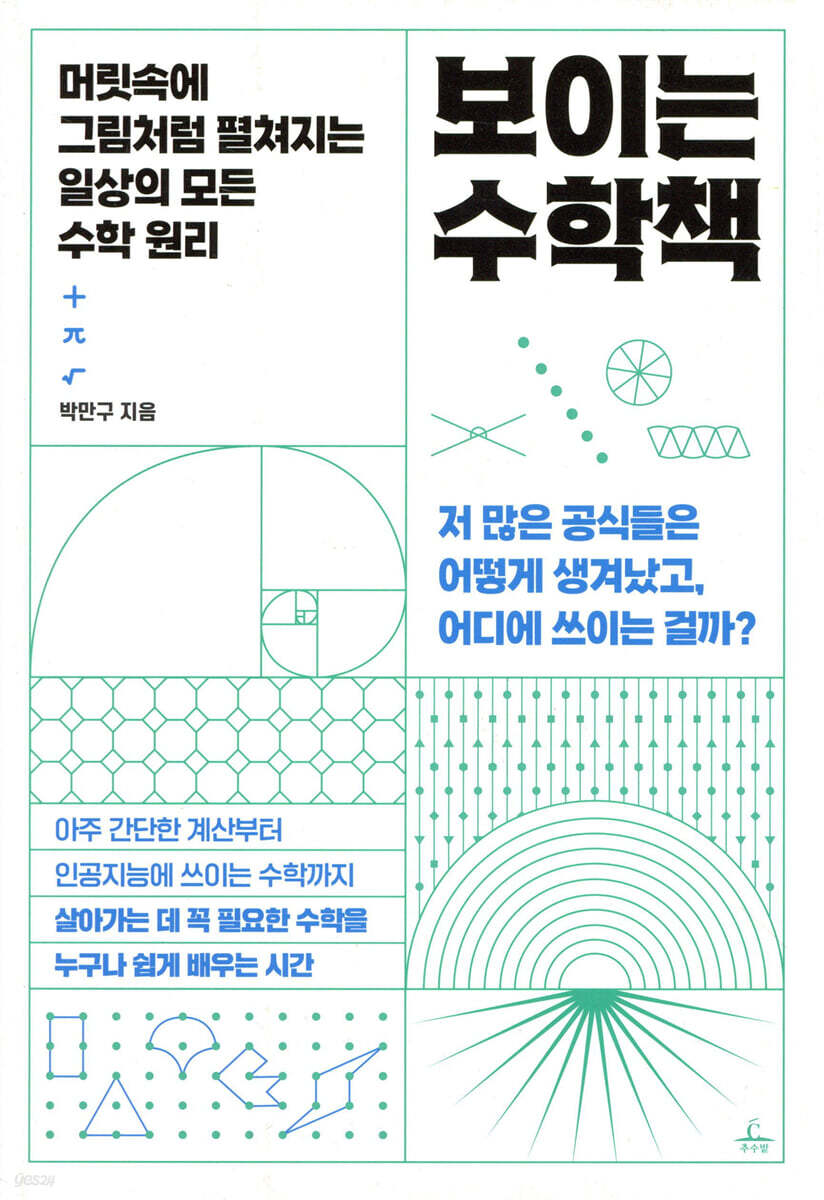
A new textbook that introduces mathematical formulas, concepts, and terms you've likely seen in textbooks, connecting them to our real lives, and explains the logical basis of mathematics using various visual tools.
It literally 'shows' the principles of mathematics applied in various fields, from novel calculation methods never seen before, geometry that teaches spatial sense by cutting and pasting shapes, the secrets of algorithms used in artificial intelligence, and even the formula for achieving the greatest happiness in life.
This book, which delves into the question of "why," which has been overlooked in our study of mathematics, will serve as a guide to mathematical thinking that will help you creatively solve any problem.
It literally 'shows' the principles of mathematics applied in various fields, from novel calculation methods never seen before, geometry that teaches spatial sense by cutting and pasting shapes, the secrets of algorithms used in artificial intelligence, and even the formula for achieving the greatest happiness in life.
This book, which delves into the question of "why," which has been overlooked in our study of mathematics, will serve as a guide to mathematical thinking that will help you creatively solve any problem.
- You can preview some of the book's contents.
Preview
index
Opening Remarks: Why We Study Mathematics
Part 1: Warming Up with Math
Why study math? │ Various solutions for even simple calculations? │ Creative calculation methods that play with numbers │ Multiplication methods that are not taught even in school │ Understanding bases through groups of numbers │ Unconventional thinking for solving area problems │ Develop spatial sense by dissecting shapes │ Become familiar with shapes by cutting and putting them together │ Learning the basics of math with triangles
Part 2: Thinking and Proving with Mathematics
Breaking stereotypes reveals the solution │ Proof can be found just by drawing a picture │ Why does 1+1=2? │ Why can't we divide by zero? │ The principles of fraction calculation that even elementary school students can understand
Understanding Math Formulas Without Memorizing Part 3
How to easily determine the multiple of any number │ How to understand and use the root formula │ The secret of the formula for finding the area of a trapezoid │ The secret of the formula for finding the area of a circle │ How to find the volume of a round solid
Part 4: Discovering Mathematical Principles in Everyday Life
How to become familiar with mathematics through origami │ The secrets of mathematics hidden in the rules of patterns │ The principles of mathematics used in artificial intelligence │ The beautiful meeting of mathematics and humanities
Part 5: Teaching the Math I Learned in a Fun Way
Let's create problems instead of just solving them │ There are multiple answers to one problem, and various solutions to one answer │ Even the same question can be interpreted differently │ The world of shapes and numbers created with a ruler and compass │ The true meaning of commonly used mathematical terms
Conclusion: Learning Mathematics: The Optimal Tool for Problem Solving
annotation
Part 1: Warming Up with Math
Why study math? │ Various solutions for even simple calculations? │ Creative calculation methods that play with numbers │ Multiplication methods that are not taught even in school │ Understanding bases through groups of numbers │ Unconventional thinking for solving area problems │ Develop spatial sense by dissecting shapes │ Become familiar with shapes by cutting and putting them together │ Learning the basics of math with triangles
Part 2: Thinking and Proving with Mathematics
Breaking stereotypes reveals the solution │ Proof can be found just by drawing a picture │ Why does 1+1=2? │ Why can't we divide by zero? │ The principles of fraction calculation that even elementary school students can understand
Understanding Math Formulas Without Memorizing Part 3
How to easily determine the multiple of any number │ How to understand and use the root formula │ The secret of the formula for finding the area of a trapezoid │ The secret of the formula for finding the area of a circle │ How to find the volume of a round solid
Part 4: Discovering Mathematical Principles in Everyday Life
How to become familiar with mathematics through origami │ The secrets of mathematics hidden in the rules of patterns │ The principles of mathematics used in artificial intelligence │ The beautiful meeting of mathematics and humanities
Part 5: Teaching the Math I Learned in a Fun Way
Let's create problems instead of just solving them │ There are multiple answers to one problem, and various solutions to one answer │ Even the same question can be interpreted differently │ The world of shapes and numbers created with a ruler and compass │ The true meaning of commonly used mathematical terms
Conclusion: Learning Mathematics: The Optimal Tool for Problem Solving
annotation
Into the book
Why should we study mathematics?
Being good at math allows you to think logically and understand cause and effect.
In other words, mathematics is the engine of all thought and the discipline that helps us understand causality and reach enlightenment.
Being good at math allows you to distinguish between logical conclusions based on certain assumptions and those that are not, and avoid being deceived by lies that don't make sense.
Even when opposing arguments are made on the same issue, you must be able to think logically to determine what is right and what is wrong.
So, if you are good at math, you will be able to live a happy life without being overwhelmed by anything that happens in life, and ultimately, you will be able to achieve peace of mind.
--- p.17
Multiplication methods that are not taught even in school
Most of the calculation methods used in textbooks at school are standard methods.
It is not easy to cover all computational methods in textbooks due to space constraints or the amount of material to be covered in class.
So it is common to deal with computational methods using very limited computational algorithms.
And Alan H. Schönfeld of the University of California, Berkeley, a leading authority on problem solving research.
As Professor Schoenfeld points out, most students believe that there is only one answer to a math problem and that there are limited ways to solve it.
To solve diverse problems with flexible thinking, we need to help students change their rigid ideas about mathematics.
Letting students try out different methods of calculation will not only enhance their creativity but also help them understand the meaning of calculations more deeply. It will also make them curious about simple calculation methods, making them think, "Oh, there's a way to do this too!"
In addition to the methods presented in textbooks, there are various computational methods, such as multiplication, that can arouse students' curiosity.
--- pp.35~36
Breaking stereotypes reveals solutions
“A traveler went one mile south from where he was, then turned 90 degrees to the left and went one mile east.
Then I turned 90 degrees to the left again and went north for one mile and arrived at the original starting point.
If you met a bear there, what color was it?”
At first glance, this problem doesn't seem like a math problem.
Why did Foyer pose this problem? Perhaps he wanted to emphasize that when solving a problem, we shouldn't be trapped in a fixed, flat way of thinking.
This problem cannot be solved by thinking on a plane.
--- p.99
The principles of fraction calculation that even elementary school students can understand
Learning mathematics should be a process that allows you to understand why results are obtained as they are, rather than simply focusing on training yourself to solve given problems.
Furthermore, it is a good idea to be able to explain what you understand about the results.
Because in order to be able to explain what you know to others in your own words, you need to understand the concept well.
Furthermore, it would be better if you could teach it so that friends who do not fully understand the content can understand it.
In mathematics, explaining well is better than solving well, and teaching well is better than explaining well.
--- pp.150~151
Principles of Mathematics Used in Artificial Intelligence
“AI learns…” means calculating the determinant of a large amount of data in this way and adjusting the components to obtain the optimal value with the minimum error.
This technique is called Supervised Learning.
For example, to teach something like "this is a cat," we train it to recognize cats through tens of millions of cat images, just as humans recognize cats by looking at various cats and seeing their commonalities.
Deep learning, which allows machines to automatically perform even this learning process, utilizes linear algebra and partial differentiation to adjust or change the strength of connections between data.
--- pp.227~228
A beautiful meeting of mathematics and humanities
If we look at all phenomena through the eyes of mathematics, we can understand a deeper meaning.
The power of mathematics lies in the ability to reason logically about not only what is visible but also what is invisible.
Even if something doesn't seem to be true at first glance, you can derive new, invisible facts through logical reasoning.
Therefore, if you continuously practice finding answers that fit given conditions through studying mathematics and develop your reasoning skills, it will become the foundation for understanding the phenomena of the world and further realizing the hidden principles behind those phenomena.
If we do that, we will be able to live a happy life without being impatient or anxious, and we will be able to achieve peace of mind. In other words, mathematics can lead us to a happy life.
Being good at math allows you to think logically and understand cause and effect.
In other words, mathematics is the engine of all thought and the discipline that helps us understand causality and reach enlightenment.
Being good at math allows you to distinguish between logical conclusions based on certain assumptions and those that are not, and avoid being deceived by lies that don't make sense.
Even when opposing arguments are made on the same issue, you must be able to think logically to determine what is right and what is wrong.
So, if you are good at math, you will be able to live a happy life without being overwhelmed by anything that happens in life, and ultimately, you will be able to achieve peace of mind.
--- p.17
Multiplication methods that are not taught even in school
Most of the calculation methods used in textbooks at school are standard methods.
It is not easy to cover all computational methods in textbooks due to space constraints or the amount of material to be covered in class.
So it is common to deal with computational methods using very limited computational algorithms.
And Alan H. Schönfeld of the University of California, Berkeley, a leading authority on problem solving research.
As Professor Schoenfeld points out, most students believe that there is only one answer to a math problem and that there are limited ways to solve it.
To solve diverse problems with flexible thinking, we need to help students change their rigid ideas about mathematics.
Letting students try out different methods of calculation will not only enhance their creativity but also help them understand the meaning of calculations more deeply. It will also make them curious about simple calculation methods, making them think, "Oh, there's a way to do this too!"
In addition to the methods presented in textbooks, there are various computational methods, such as multiplication, that can arouse students' curiosity.
--- pp.35~36
Breaking stereotypes reveals solutions
“A traveler went one mile south from where he was, then turned 90 degrees to the left and went one mile east.
Then I turned 90 degrees to the left again and went north for one mile and arrived at the original starting point.
If you met a bear there, what color was it?”
At first glance, this problem doesn't seem like a math problem.
Why did Foyer pose this problem? Perhaps he wanted to emphasize that when solving a problem, we shouldn't be trapped in a fixed, flat way of thinking.
This problem cannot be solved by thinking on a plane.
--- p.99
The principles of fraction calculation that even elementary school students can understand
Learning mathematics should be a process that allows you to understand why results are obtained as they are, rather than simply focusing on training yourself to solve given problems.
Furthermore, it is a good idea to be able to explain what you understand about the results.
Because in order to be able to explain what you know to others in your own words, you need to understand the concept well.
Furthermore, it would be better if you could teach it so that friends who do not fully understand the content can understand it.
In mathematics, explaining well is better than solving well, and teaching well is better than explaining well.
--- pp.150~151
Principles of Mathematics Used in Artificial Intelligence
“AI learns…” means calculating the determinant of a large amount of data in this way and adjusting the components to obtain the optimal value with the minimum error.
This technique is called Supervised Learning.
For example, to teach something like "this is a cat," we train it to recognize cats through tens of millions of cat images, just as humans recognize cats by looking at various cats and seeing their commonalities.
Deep learning, which allows machines to automatically perform even this learning process, utilizes linear algebra and partial differentiation to adjust or change the strength of connections between data.
--- pp.227~228
A beautiful meeting of mathematics and humanities
If we look at all phenomena through the eyes of mathematics, we can understand a deeper meaning.
The power of mathematics lies in the ability to reason logically about not only what is visible but also what is invisible.
Even if something doesn't seem to be true at first glance, you can derive new, invisible facts through logical reasoning.
Therefore, if you continuously practice finding answers that fit given conditions through studying mathematics and develop your reasoning skills, it will become the foundation for understanding the phenomena of the world and further realizing the hidden principles behind those phenomena.
If we do that, we will be able to live a happy life without being impatient or anxious, and we will be able to achieve peace of mind. In other words, mathematics can lead us to a happy life.
--- p.235
Publisher's Review
“There is no more ‘giving up on math’ in my dictionary!”
Math class where you learn with your eyes and think with your head, without memorizing.
The secret to studying math is unfounded confidence.
Insights from Professor Jun-i Heo, 2022 Fields Medalist
Professor Heo Jun-i, who became the first Korean to win the Fields Medal, often called the Nobel Prize of mathematics, in July 2022, is constantly in the spotlight.
Professor Heo Jun-i's achievement of solving the '11 mathematical problems', which are considered lifelong challenges even for mathematicians, is expected to be utilized in very important research that will take responsibility for our future.
The fact that Professor Heo Jun's research findings are being applied to many modern technologies, including information and communications, semiconductors, statistical physics, and big data, clearly demonstrates that mathematical thinking is becoming an essential virtue in our daily lives, surrounded by increasingly complex networks and rapidly developing artificial intelligence.
However, in a reality where there are still many ‘math dropouts’, Professor Heo Jun-i chose ‘unfounded confidence’ as the secret to being good at math.
How can one promote "unfounded" virtues in mathematics, a field that, more than any other discipline, relies on causality and logical thinking? Professor Heo Jun emphasizes that the secret to excelling in mathematics lies in the "courage" of persistent study, even when you can't immediately obtain the answers required by exam questions, fail to find the right answer, or face an uncertain future due to a lack of established skills.
Memorizing formulas and repeatedly solving hundreds of problems in the 'problem bank' just for the entrance exam will only reduce interest in math.
Professor Heo Jun-i emphasizes that the first step in studying mathematics is to understand the principles of the problem in your own head, even if it means solving just one problem, and to try to discover mathematical principles in everyday life.
“Math that you can understand through principles, without having to memorize.”
The magical study of mathematics where problems are solved as they appear
Beyond simply learning math through rote memorization, how can we understand and apply its principles? Professor Park Man-gu, who has long developed optimal math education methods for those struggling with math, has captured the fundamentals of mathematical thinking for both adults and children in his new book, "Visible Math."
From mathematical formulas and concepts you've likely learned at school to mathematical ideas that connect with our everyday lives, this book uses a variety of visual tools to explain the logical foundations of mathematics, focusing on the question "why" that has often been overlooked in our mathematics studies.
For those of us who have studied by memorizing the solution process using 'problem-solving books' or 'math practice books', this book guides us to understand and apply mathematical principles 'with our heads' in a single breath through the process of simply seeing and learning.
From simple calculations to complex formulas
The unique secret of counting that you never learned in school
Even simple additions and subtractions can be solved in a variety of ways if you know the mathematical principles.
For example, when doing 17-8, adults naturally think of borrowing from the tens digit (borrowing) because they cannot subtract the ones digits, but children think of numbers as groups of beads, so they subtract 8 from a group of 10 beads and add the remaining 2 to a group of 7 beads to get the answer of 9.
This book develops this mathematical thinking by introducing a variety of problems and propositions that cannot be resolved into a single answer and require multiple solutions.
This book takes a fresh look at the principles of calculation that we have taken for granted, such as the Poppos game that uses 4 four times to derive the answer, visually understanding the principles of ternary and quinary numbers beyond the decimal system, why you should not divide a number by 0, why division of fractions is multiplication by reciprocals, and how to prove 1+1=2. This book uncovers the rich secrets of mathematical thinking that cannot be left to calculators alone.
From geometry that develops spatial sense to mathematics used in artificial intelligence.
Principles of mathematical thinking used in various fields of daily life
Geometry is used to understand the various characteristics of shapes and to acquire spatial sense in two- or three-dimensional areas.
A sense of geometric space is essential not only for designers, architects, and surgeons, but also for drivers who need to estimate distances or guess the shape of buildings.
This book guides you through understanding and utilizing mathematics in a single step with 'pictures' by visually showing what shapes appear when you cut and dissect a shape, why the formula for calculating the area of various shapes such as circles and trapezoids was created that way, and how to prove the Pythagorean theorem.
Furthermore, it presents ways to utilize mathematics as an engine of logical thinking, from play to cutting-edge industries, such as by teaching mathematics hidden in specific patterns or rules through origami and tessellation games, and by introducing big data learning methods utilized in artificial intelligence.
“Even in mathematics, there can be more than one answer.”
Finding creative learning methods to solve life's problems
The author recommends going beyond solving problems and creating other math problems as a math learning method that encourages creative thinking (this is a math teaching method that Professor Heo Jun-i also frequently uses with his son).
The author, who has participated in various mathematics gifted education programs, emphasizes that mathematical thinking can be further developed when students go beyond the method of finding a set answer and undergo training to accurately understand the intent and principles of the problem and express them in various ways.
It is impossible to solve difficult math problems by simply applying what you learned in textbooks.
By addressing novel and novel problems that challenge our preconceptions, this book provides a foundation for mathematical thinking that empowers us to think and solve problems on our own.
The author emphasizes that even seemingly complex problems in life can be simplified and made clearer if thought about mathematically.
The power of mathematics lies in the ability to reason logically about not only the visible but also the invisible.
This is possible through the beautiful meeting of mathematics and humanities.
For example, the formula for achieving maximum happiness in life can be expressed through the properties of fractions we have learned.
This is the formula: 'The size of happiness = what I have already achieved / what I desire.'
According to this formula, no matter how much you achieve, if what you desire is greater than what you achieve, you will not be satisfied. However, even if what you achieve is little, if what you desire is less than what you achieve, you will be satisfied.
By basing ourselves on mathematical ideas like these, we can discover the secret to happiness that no philosopher has ever easily defined, and we can have the "unfounded confidence" to ultimately find the optimal solution to any difficult problem.
Math class where you learn with your eyes and think with your head, without memorizing.
The secret to studying math is unfounded confidence.
Insights from Professor Jun-i Heo, 2022 Fields Medalist
Professor Heo Jun-i, who became the first Korean to win the Fields Medal, often called the Nobel Prize of mathematics, in July 2022, is constantly in the spotlight.
Professor Heo Jun-i's achievement of solving the '11 mathematical problems', which are considered lifelong challenges even for mathematicians, is expected to be utilized in very important research that will take responsibility for our future.
The fact that Professor Heo Jun's research findings are being applied to many modern technologies, including information and communications, semiconductors, statistical physics, and big data, clearly demonstrates that mathematical thinking is becoming an essential virtue in our daily lives, surrounded by increasingly complex networks and rapidly developing artificial intelligence.
However, in a reality where there are still many ‘math dropouts’, Professor Heo Jun-i chose ‘unfounded confidence’ as the secret to being good at math.
How can one promote "unfounded" virtues in mathematics, a field that, more than any other discipline, relies on causality and logical thinking? Professor Heo Jun emphasizes that the secret to excelling in mathematics lies in the "courage" of persistent study, even when you can't immediately obtain the answers required by exam questions, fail to find the right answer, or face an uncertain future due to a lack of established skills.
Memorizing formulas and repeatedly solving hundreds of problems in the 'problem bank' just for the entrance exam will only reduce interest in math.
Professor Heo Jun-i emphasizes that the first step in studying mathematics is to understand the principles of the problem in your own head, even if it means solving just one problem, and to try to discover mathematical principles in everyday life.
“Math that you can understand through principles, without having to memorize.”
The magical study of mathematics where problems are solved as they appear
Beyond simply learning math through rote memorization, how can we understand and apply its principles? Professor Park Man-gu, who has long developed optimal math education methods for those struggling with math, has captured the fundamentals of mathematical thinking for both adults and children in his new book, "Visible Math."
From mathematical formulas and concepts you've likely learned at school to mathematical ideas that connect with our everyday lives, this book uses a variety of visual tools to explain the logical foundations of mathematics, focusing on the question "why" that has often been overlooked in our mathematics studies.
For those of us who have studied by memorizing the solution process using 'problem-solving books' or 'math practice books', this book guides us to understand and apply mathematical principles 'with our heads' in a single breath through the process of simply seeing and learning.
From simple calculations to complex formulas
The unique secret of counting that you never learned in school
Even simple additions and subtractions can be solved in a variety of ways if you know the mathematical principles.
For example, when doing 17-8, adults naturally think of borrowing from the tens digit (borrowing) because they cannot subtract the ones digits, but children think of numbers as groups of beads, so they subtract 8 from a group of 10 beads and add the remaining 2 to a group of 7 beads to get the answer of 9.
This book develops this mathematical thinking by introducing a variety of problems and propositions that cannot be resolved into a single answer and require multiple solutions.
This book takes a fresh look at the principles of calculation that we have taken for granted, such as the Poppos game that uses 4 four times to derive the answer, visually understanding the principles of ternary and quinary numbers beyond the decimal system, why you should not divide a number by 0, why division of fractions is multiplication by reciprocals, and how to prove 1+1=2. This book uncovers the rich secrets of mathematical thinking that cannot be left to calculators alone.
From geometry that develops spatial sense to mathematics used in artificial intelligence.
Principles of mathematical thinking used in various fields of daily life
Geometry is used to understand the various characteristics of shapes and to acquire spatial sense in two- or three-dimensional areas.
A sense of geometric space is essential not only for designers, architects, and surgeons, but also for drivers who need to estimate distances or guess the shape of buildings.
This book guides you through understanding and utilizing mathematics in a single step with 'pictures' by visually showing what shapes appear when you cut and dissect a shape, why the formula for calculating the area of various shapes such as circles and trapezoids was created that way, and how to prove the Pythagorean theorem.
Furthermore, it presents ways to utilize mathematics as an engine of logical thinking, from play to cutting-edge industries, such as by teaching mathematics hidden in specific patterns or rules through origami and tessellation games, and by introducing big data learning methods utilized in artificial intelligence.
“Even in mathematics, there can be more than one answer.”
Finding creative learning methods to solve life's problems
The author recommends going beyond solving problems and creating other math problems as a math learning method that encourages creative thinking (this is a math teaching method that Professor Heo Jun-i also frequently uses with his son).
The author, who has participated in various mathematics gifted education programs, emphasizes that mathematical thinking can be further developed when students go beyond the method of finding a set answer and undergo training to accurately understand the intent and principles of the problem and express them in various ways.
It is impossible to solve difficult math problems by simply applying what you learned in textbooks.
By addressing novel and novel problems that challenge our preconceptions, this book provides a foundation for mathematical thinking that empowers us to think and solve problems on our own.
The author emphasizes that even seemingly complex problems in life can be simplified and made clearer if thought about mathematically.
The power of mathematics lies in the ability to reason logically about not only the visible but also the invisible.
This is possible through the beautiful meeting of mathematics and humanities.
For example, the formula for achieving maximum happiness in life can be expressed through the properties of fractions we have learned.
This is the formula: 'The size of happiness = what I have already achieved / what I desire.'
According to this formula, no matter how much you achieve, if what you desire is greater than what you achieve, you will not be satisfied. However, even if what you achieve is little, if what you desire is less than what you achieve, you will be satisfied.
By basing ourselves on mathematical ideas like these, we can discover the secret to happiness that no philosopher has ever easily defined, and we can have the "unfounded confidence" to ultimately find the optimal solution to any difficult problem.
GOODS SPECIFICS
- Publication date: August 24, 2022
- Page count, weight, size: 328 pages | 572g | 148*215*20mm
- ISBN13: 9791155402078
- ISBN10: 1155402073
You may also like
카테고리
korean


korean

![GQ KOREA Mark (Monthly): December [2025]](http://librairie.coreenne.fr/cdn/shop/files/8ef265dbbfbf186523ed75ba7319009d.jpg?v=1765340328&width=3840)


