

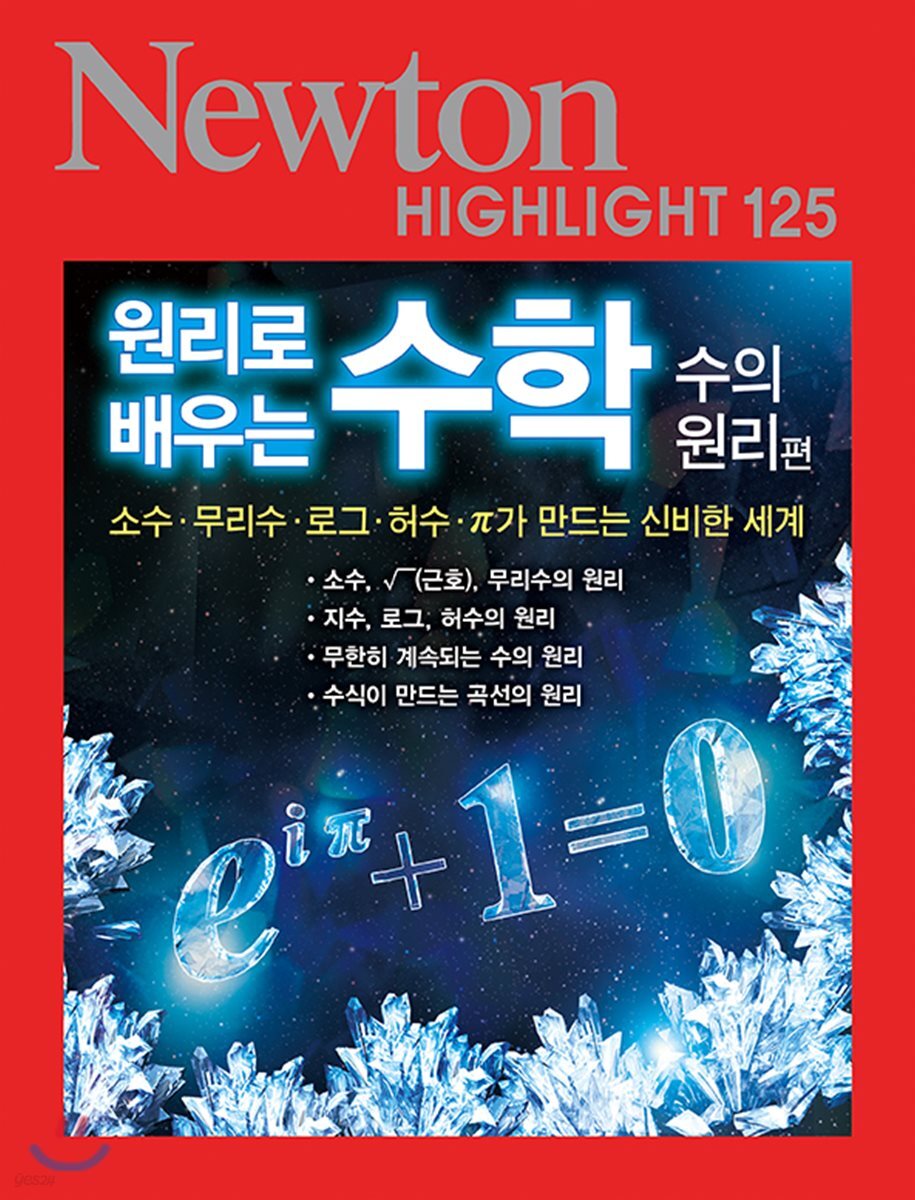
NEWTON HIGHLIGHT: Learning Math with Newton's 125 Principles (Principles of Numbers)
 |
Description
Book Introduction
Learn the basics of mathematics through principles
Mathematics is a subject that is more logic-based than any other subject taught in school.
Therefore, it is most important to thoroughly learn the basic principles.
However, the basis of ‘mathematics’ is ‘numbers’.
Numbers, along with shapes, are a major subject of study in mathematics.
Even numbers that seem to be simply consecutive like 1, 2, 3, 4, … actually have many types.
These include real numbers and imaginary numbers, rational numbers and irrational numbers, integers and decimals.
Not only that.
In addition to what has been mentioned above, special numbers such as prime numbers that are divisible only by 1 and themselves, exponents, logarithms, pi, √ (radians), continued fractions, and various related concepts also occupy an important part of mathematics.
『Mathematics through Principles (Principles of Numbers)』 is a book that explores the world of mathematics, which is made up of numbers, from the basics to applications, based on principles.
The book is divided into seven chapters.
Chapter 1 deals with prime numbers.
We'll explore the definition and discovery of prime numbers, their number, the peculiar properties of prime numbers, and even the crucial role they play as "codes" in modern society.
Chapters 2 through 4 cover √ (radians), irrational numbers, exponents and logarithms, and imaginary numbers.
By explaining in detail the core concepts learned in middle and high school mathematics, such as rational and irrational numbers, pi, and the laws of exponents and logarithms, from a fundamental perspective, it is structured so that you can confidently handle various application situations you will encounter in the future.
In Imaginary Numbers, we introduce not only its definition and application, but also examples of how imaginary numbers, along with quantum mechanics, are supporting an axis of modern civilization.
Chapters 5 through 7 present more in-depth applications of numbers.
We will learn about cases that will help us rediscover the mysterious principles of mathematics, such as infinitely continuing numbers, Euler's equation, which is called "the most beautiful equation in the world," and the relationship between π, the imaginary unit i, and trigonometric functions.
In addition, it presents various curves expressed in formulas and their applications in real life, reaffirming that mathematics is not separate from our lives.
We sincerely hope that this book, which introduces the various characteristics and applications of numbers, will become a friendly friend and faithful guide to readers.
Mathematics is a subject that is more logic-based than any other subject taught in school.
Therefore, it is most important to thoroughly learn the basic principles.
However, the basis of ‘mathematics’ is ‘numbers’.
Numbers, along with shapes, are a major subject of study in mathematics.
Even numbers that seem to be simply consecutive like 1, 2, 3, 4, … actually have many types.
These include real numbers and imaginary numbers, rational numbers and irrational numbers, integers and decimals.
Not only that.
In addition to what has been mentioned above, special numbers such as prime numbers that are divisible only by 1 and themselves, exponents, logarithms, pi, √ (radians), continued fractions, and various related concepts also occupy an important part of mathematics.
『Mathematics through Principles (Principles of Numbers)』 is a book that explores the world of mathematics, which is made up of numbers, from the basics to applications, based on principles.
The book is divided into seven chapters.
Chapter 1 deals with prime numbers.
We'll explore the definition and discovery of prime numbers, their number, the peculiar properties of prime numbers, and even the crucial role they play as "codes" in modern society.
Chapters 2 through 4 cover √ (radians), irrational numbers, exponents and logarithms, and imaginary numbers.
By explaining in detail the core concepts learned in middle and high school mathematics, such as rational and irrational numbers, pi, and the laws of exponents and logarithms, from a fundamental perspective, it is structured so that you can confidently handle various application situations you will encounter in the future.
In Imaginary Numbers, we introduce not only its definition and application, but also examples of how imaginary numbers, along with quantum mechanics, are supporting an axis of modern civilization.
Chapters 5 through 7 present more in-depth applications of numbers.
We will learn about cases that will help us rediscover the mysterious principles of mathematics, such as infinitely continuing numbers, Euler's equation, which is called "the most beautiful equation in the world," and the relationship between π, the imaginary unit i, and trigonometric functions.
In addition, it presents various curves expressed in formulas and their applications in real life, reaffirming that mathematics is not separate from our lives.
We sincerely hope that this book, which introduces the various characteristics and applications of numbers, will become a friendly friend and faithful guide to readers.
- You can preview some of the book's contents.
Preview
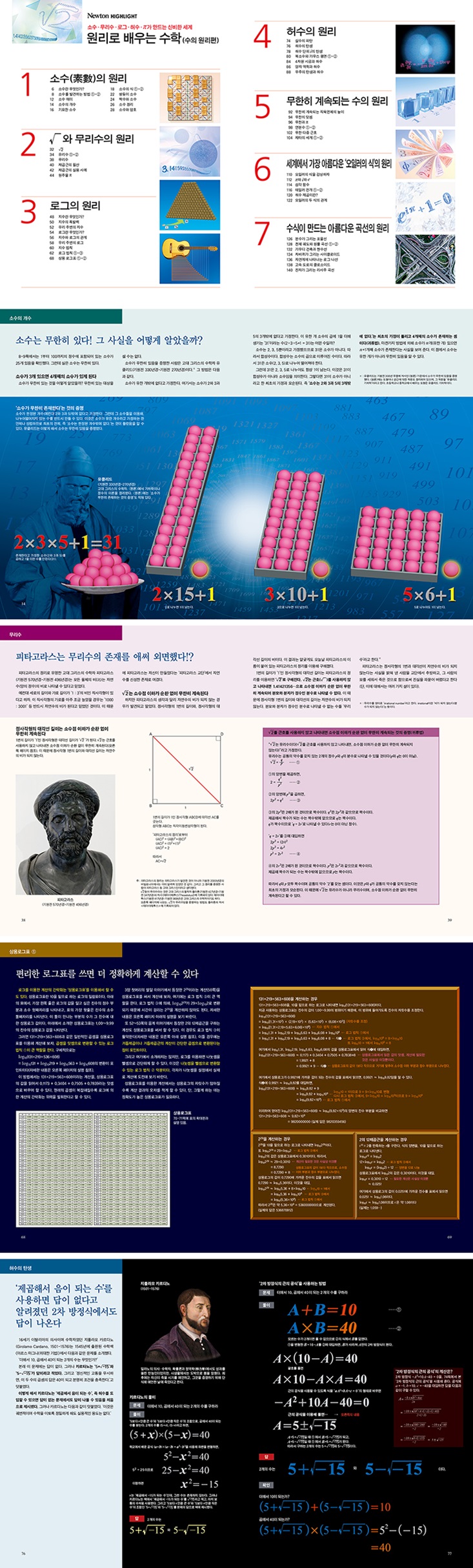
index
Chapter 1: The Principle of Prime Numbers
What is a prime number? / How to find a prime number ①~② / Prime number / The number of prime numbers / Strange prime numbers / Prime number formulas ①~② / Twin prime numbers / Even numbers and prime numbers / Prime number theorem / Prime numbers and codes
Chapter 2: √ and the Principle of Irrational Numbers
√2 / Rational numbers ①~② / Irrational numbers / Calculating square roots / Practical examples of square roots / Pi
Chapter 3: The Principle of Logarithms
What is an exponent? / The explosive power of exponents / Exponents around us / What is a logarithm? / The relationship between exponents and logarithms / Logarithms around us / Laws of exponents / Laws of logarithms ①~③ / Common logarithm tables ①~②
Chapter 4: The Principle of Imaginary Numbers
The collapse of real numbers / The birth of imaginary numbers / The birth of the imaginary unit @i / Complex numbers and the Gaussian plane ①~② / Four-dimensional spacetime and imaginary numbers / Quantum mechanics and imaginary numbers / The birth of the universe and imaginary numbers
Chapter 5: The Principle of Infinitely Continued Numbers
The height of an infinitely continuing rectangular solid / Infinite addition / Infinity and π / Continued fractions ①~② / Infinite multiple roots / The world of zeta ①~②
Chapter 6: The Principle of the World's Most Beautiful 'Euler's Formula'
Let's Appreciate Euler's Formulas / π, i, and e / Trigonometric Functions / Taylor's Expansion ①~② / What is an Imaginary Square? / The Relationship Between Euler's Two Formulas
Chapter 7: The Principle of Beautiful Curves Created by Formulas
Parabolas drawn by fountains / Celestial orbits and conic sections ①~② / Gaudí's architecture and catenary lines / Cycloids drawn by wheels / Logarithmic spirals appearing in nature / Clothoids of highways / Lissajous curves drawn by pendulums
What is a prime number? / How to find a prime number ①~② / Prime number / The number of prime numbers / Strange prime numbers / Prime number formulas ①~② / Twin prime numbers / Even numbers and prime numbers / Prime number theorem / Prime numbers and codes
Chapter 2: √ and the Principle of Irrational Numbers
√2 / Rational numbers ①~② / Irrational numbers / Calculating square roots / Practical examples of square roots / Pi
Chapter 3: The Principle of Logarithms
What is an exponent? / The explosive power of exponents / Exponents around us / What is a logarithm? / The relationship between exponents and logarithms / Logarithms around us / Laws of exponents / Laws of logarithms ①~③ / Common logarithm tables ①~②
Chapter 4: The Principle of Imaginary Numbers
The collapse of real numbers / The birth of imaginary numbers / The birth of the imaginary unit @i / Complex numbers and the Gaussian plane ①~② / Four-dimensional spacetime and imaginary numbers / Quantum mechanics and imaginary numbers / The birth of the universe and imaginary numbers
Chapter 5: The Principle of Infinitely Continued Numbers
The height of an infinitely continuing rectangular solid / Infinite addition / Infinity and π / Continued fractions ①~② / Infinite multiple roots / The world of zeta ①~②
Chapter 6: The Principle of the World's Most Beautiful 'Euler's Formula'
Let's Appreciate Euler's Formulas / π, i, and e / Trigonometric Functions / Taylor's Expansion ①~② / What is an Imaginary Square? / The Relationship Between Euler's Two Formulas
Chapter 7: The Principle of Beautiful Curves Created by Formulas
Parabolas drawn by fountains / Celestial orbits and conic sections ①~② / Gaudí's architecture and catenary lines / Cycloids drawn by wheels / Logarithmic spirals appearing in nature / Clothoids of highways / Lissajous curves drawn by pendulums
Detailed image
Publisher's Review
Methods for finding prime numbers, the number of prime numbers, strange prime numbers, formulas for making prime numbers, twin prime numbers, even numbers and prime numbers, prime number theorem, prime numbers and the principles of modern cryptography
A prime number is an integer greater than or equal to 2, such as 2, 3, 5, or 7, that is divisible only by 1 and itself.
Although they seem like common numbers, not everything about the properties of prime numbers is yet known.
How many prime numbers exist? And what patterns do they exhibit? We explore the principle of prime numbers, which poses various mysteries.
Meanwhile, minority rights are also used as a means of establishing encryption, which is essential in many fields that support modern society, such as the financial system.
It also explains how prime numbers are used as encryption.
√2·Rational and irrational numbers·Calculation of square roots·Practical use of square roots·The principle of pi
Integers such as 1, 2, 3, and numbers that can be expressed as fractions with integers in the numerator and denominator are collectively called 'rational numbers'.
On the other hand, a number that cannot be expressed as an integer or fraction and whose digits after the decimal point do not repeat and continue infinitely is called an 'irrational number'.
Famous irrational numbers include √2, which continues as 1.4142…, and pi, which continues as 3.1415….
Why is 0.33333… equal to 1/3? What is the meaning of irrational numbers like √2? Along with rational numbers, we explore the mysterious world created by the digits that continue after the decimal point of irrational numbers.
Exponents and logarithms, exponents and logarithms in everyday life, exponent laws, logarithm laws, common logarithms, etc.
In our daily lives and industries, we often multiply the same numbers repeatedly, such as calculating interest on deposits.
However, calculating things like 5 to the 12th power or 2 to the 29th power by hand is time-consuming and very cumbersome.
Logarithm, which means 'the number of times to repeat a multiplying number', was developed as a means to make such complex and cumbersome calculations easier.
Logarithms became a cornerstone of the development of natural science in an era before electronic calculators.
Meanwhile, the exponent is in a 'before and after' relationship with the log.
We will examine the principles behind the calculation rules for exponents and logarithms, which transform complex calculations into simple calculations.
The birth of imaginary numbers and the imaginary unit i, complex numbers and the Gaussian plane, four-dimensional spacetime and imaginary numbers, quantum mechanics and imaginary numbers, the birth of the universe and imaginary numbers, etc.
All the numbers we commonly deal with become positive when squared.
However, in the world of mathematics and physics, there are numbers that become negative when squared.
It's a 'scarecrow'.
With the birth of scarecrows, the world of numbers has expanded greatly.
Furthermore, the formula that became the basis of 'quantum theory', which is called the two major theories of physics along with 'theory of relativity', was created, and through this, it became possible to explain the appearance of the universe at the moment of its birth.
Modern computers, mobile phones, and other electronic devices that utilize electrons cannot exist without quantum mechanics, which relies on imaginary numbers.
We examine the peculiar properties of imaginary numbers and the progress they have made in natural science.
Infinity and π, continued fractions, infinite multiple roots, Euler's equation, trigonometric functions, curves created by formulas, etc.
There is a formula in which numbers continue infinitely and regularly.
These are formulas in which fractions with regularity are added infinitely, formulas in which the same fractions are stacked in the denominator, and formulas in which the same √ is placed infinitely within √.
There is also 'Euler's equation', which is a unique equation in mathematics that unifies the 'Napier number e', 'imaginary unit i', and 'circle ratio π' into one form, and when 1 is added to it, it becomes 0.
Meanwhile, mathematics is also the source of beautiful curves.
Learn about the shapes and formulas of parabolas, conic sections, catenary curves, cycloids, logarithmic spirals, clothoids, and Lissajous curves, as well as the principles behind their origin.
A prime number is an integer greater than or equal to 2, such as 2, 3, 5, or 7, that is divisible only by 1 and itself.
Although they seem like common numbers, not everything about the properties of prime numbers is yet known.
How many prime numbers exist? And what patterns do they exhibit? We explore the principle of prime numbers, which poses various mysteries.
Meanwhile, minority rights are also used as a means of establishing encryption, which is essential in many fields that support modern society, such as the financial system.
It also explains how prime numbers are used as encryption.
√2·Rational and irrational numbers·Calculation of square roots·Practical use of square roots·The principle of pi
Integers such as 1, 2, 3, and numbers that can be expressed as fractions with integers in the numerator and denominator are collectively called 'rational numbers'.
On the other hand, a number that cannot be expressed as an integer or fraction and whose digits after the decimal point do not repeat and continue infinitely is called an 'irrational number'.
Famous irrational numbers include √2, which continues as 1.4142…, and pi, which continues as 3.1415….
Why is 0.33333… equal to 1/3? What is the meaning of irrational numbers like √2? Along with rational numbers, we explore the mysterious world created by the digits that continue after the decimal point of irrational numbers.
Exponents and logarithms, exponents and logarithms in everyday life, exponent laws, logarithm laws, common logarithms, etc.
In our daily lives and industries, we often multiply the same numbers repeatedly, such as calculating interest on deposits.
However, calculating things like 5 to the 12th power or 2 to the 29th power by hand is time-consuming and very cumbersome.
Logarithm, which means 'the number of times to repeat a multiplying number', was developed as a means to make such complex and cumbersome calculations easier.
Logarithms became a cornerstone of the development of natural science in an era before electronic calculators.
Meanwhile, the exponent is in a 'before and after' relationship with the log.
We will examine the principles behind the calculation rules for exponents and logarithms, which transform complex calculations into simple calculations.
The birth of imaginary numbers and the imaginary unit i, complex numbers and the Gaussian plane, four-dimensional spacetime and imaginary numbers, quantum mechanics and imaginary numbers, the birth of the universe and imaginary numbers, etc.
All the numbers we commonly deal with become positive when squared.
However, in the world of mathematics and physics, there are numbers that become negative when squared.
It's a 'scarecrow'.
With the birth of scarecrows, the world of numbers has expanded greatly.
Furthermore, the formula that became the basis of 'quantum theory', which is called the two major theories of physics along with 'theory of relativity', was created, and through this, it became possible to explain the appearance of the universe at the moment of its birth.
Modern computers, mobile phones, and other electronic devices that utilize electrons cannot exist without quantum mechanics, which relies on imaginary numbers.
We examine the peculiar properties of imaginary numbers and the progress they have made in natural science.
Infinity and π, continued fractions, infinite multiple roots, Euler's equation, trigonometric functions, curves created by formulas, etc.
There is a formula in which numbers continue infinitely and regularly.
These are formulas in which fractions with regularity are added infinitely, formulas in which the same fractions are stacked in the denominator, and formulas in which the same √ is placed infinitely within √.
There is also 'Euler's equation', which is a unique equation in mathematics that unifies the 'Napier number e', 'imaginary unit i', and 'circle ratio π' into one form, and when 1 is added to it, it becomes 0.
Meanwhile, mathematics is also the source of beautiful curves.
Learn about the shapes and formulas of parabolas, conic sections, catenary curves, cycloids, logarithmic spirals, clothoids, and Lissajous curves, as well as the principles behind their origin.
GOODS SPECIFICS
- Publication date: December 15, 2018
- Pages, weight, size: 144 pages | 274g | 210*275*20mm
- ISBN13: 9791161960456
- ISBN10: 1161960457
You may also like
카테고리
korean


korean

![GQ KOREA Mark (Monthly): December [2025]](http://librairie.coreenne.fr/cdn/shop/files/8ef265dbbfbf186523ed75ba7319009d.jpg?v=1765340328&width=3840)


