

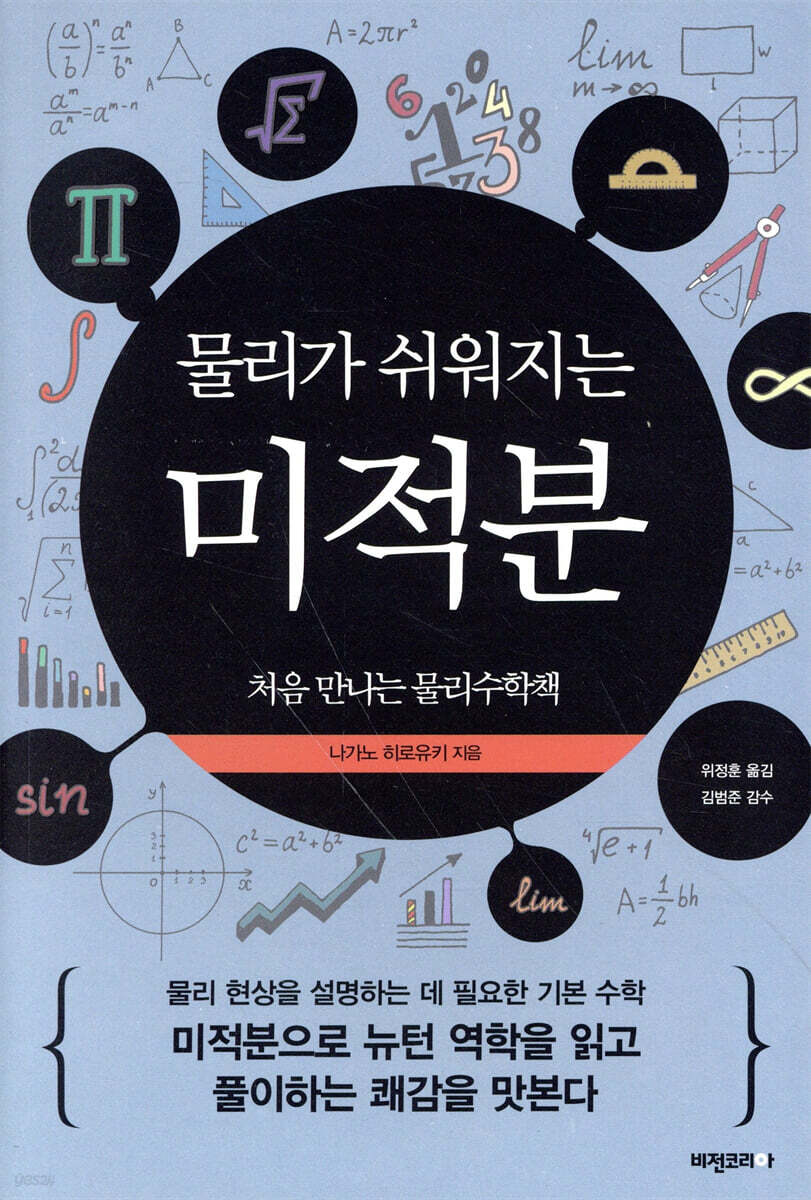
Calculus makes physics easy
 |
Description
Book Introduction
Vectors, of course, functions, limits, and even calculus
A new concept physics and mathematics book that covers both 'physics' and 'mathematics'!
Hiroyuki Nagano, famous for teaching 'useful mathematics' in an easy and fun way through books such as 'Mathematical Power that Makes Statistics Faster' and 'Mathematical Power: 7 Thinking Methods to Awaken Mathematical Instinct', has now published a book on mathematics necessary for physics and science.
This book explains how the mathematical concepts we learned in school without knowing anything about them are applied in physics.
Studying by memorizing math formulas and physics formulas separately only increases the number of people who give up on math and physics.
Physics and mathematics cannot be improved by simply memorizing formulas in the form of 'just know that this is how it works.'
If you understand the content, even complex and difficult problems can be solved easily.
Mathematics, especially calculus, and physics are inseparable.
So, if you can find the link between mathematics and physics, anyone can escape from the water bubble at any time.
Through this book, readers will realize why mathematics is the foundation of physics.
In this book, we will examine how the mathematical concept of calculus explains Newton's laws of motion, and how limits and differential coefficients determine instantaneous velocity.
The author explains physics concepts such as acceleration, centrifugal force, the law of conservation of mechanical energy, the law of conservation of momentum, and simple oscillations, along with mathematics, to enhance the reader's understanding.
In particular, he says, "Physics becomes easier if you know calculus," and guides readers who show resistance at the mere mention of the word calculus into the world of mathematics and physics with a unique learning method that allows them to follow the progress even without any foundation.
While most physics and mathematics books only need to be explained once or twice, this book is unique in that it repeatedly shows important formulas, making you review them on your own.
Even though I learned it in school, I didn't know much about 'physics', but I can easily understand it through 'mathematics'.
Most students who give up on math during their school days also give up on physics, but this book guides them to not miss out on either physics or math.
It provides easy-to-understand explanations of mathematical concepts essential to understanding physics, including vectors, functions, limits, and calculus, making it a ray of light for high school students and college students majoring in science and engineering.
Also, anyone who is acquiring relevant knowledge in preparation for the Fourth Industrial Revolution era should definitely check out this book, which allows them to learn physics and mathematics together.
A new concept physics and mathematics book that covers both 'physics' and 'mathematics'!
Hiroyuki Nagano, famous for teaching 'useful mathematics' in an easy and fun way through books such as 'Mathematical Power that Makes Statistics Faster' and 'Mathematical Power: 7 Thinking Methods to Awaken Mathematical Instinct', has now published a book on mathematics necessary for physics and science.
This book explains how the mathematical concepts we learned in school without knowing anything about them are applied in physics.
Studying by memorizing math formulas and physics formulas separately only increases the number of people who give up on math and physics.
Physics and mathematics cannot be improved by simply memorizing formulas in the form of 'just know that this is how it works.'
If you understand the content, even complex and difficult problems can be solved easily.
Mathematics, especially calculus, and physics are inseparable.
So, if you can find the link between mathematics and physics, anyone can escape from the water bubble at any time.
Through this book, readers will realize why mathematics is the foundation of physics.
In this book, we will examine how the mathematical concept of calculus explains Newton's laws of motion, and how limits and differential coefficients determine instantaneous velocity.
The author explains physics concepts such as acceleration, centrifugal force, the law of conservation of mechanical energy, the law of conservation of momentum, and simple oscillations, along with mathematics, to enhance the reader's understanding.
In particular, he says, "Physics becomes easier if you know calculus," and guides readers who show resistance at the mere mention of the word calculus into the world of mathematics and physics with a unique learning method that allows them to follow the progress even without any foundation.
While most physics and mathematics books only need to be explained once or twice, this book is unique in that it repeatedly shows important formulas, making you review them on your own.
Even though I learned it in school, I didn't know much about 'physics', but I can easily understand it through 'mathematics'.
Most students who give up on math during their school days also give up on physics, but this book guides them to not miss out on either physics or math.
It provides easy-to-understand explanations of mathematical concepts essential to understanding physics, including vectors, functions, limits, and calculus, making it a ray of light for high school students and college students majoring in science and engineering.
Also, anyone who is acquiring relevant knowledge in preparation for the Fourth Industrial Revolution era should definitely check out this book, which allows them to learn physics and mathematics together.
- You can preview some of the book's contents.
Preview
index
To begin with
Chapter 1 Differentiation
01 Differential Coefficient_'Values that get infinitely closer', the beginning of differentiation and integration
Mathematics for Physics_Instantaneous Velocity
Past exam questions
Q&A
02 Derivative_Understanding the 'cause' and the 'cause' of the 'cause'
Mathematics required for physics_Position, velocity, and acceleration
Past exam questions
Q&A
03 Limits of Trigonometric Functions_A New Angle Notation for Certain Limits
Mathematics for Physics_Acceleration of Uniform Circular Motion
Past exam questions
Q&A
04 Differentiation of the product_'small thing' × 'small thing' can be ignored
Mathematics required for physics: equations of motion and angular momentum
Past exam questions
Q&A
05 Differentiation of Trigonometric Functions and Differentiation of Composite Functions: The Identity of the 'Power of Estimation'
Mathematics for Physics: Coriolis Force and Centrifugal Force
Past exam questions
Q&A
Chapter 2 Integration
01 Fundamental Theorem of Calculus_Great Discovery in the History of Science
Mathematics required for physics_uniformly accelerated straight-line motion
Past exam questions
Q&A
02 Substitution Integral Calculus_Leibniz, the King of Symbols
Mathematics Required for Physics: The Laws of Conservation of Energy and Momentum
Past exam questions
Q&A
Chapter 3 Differential Equations
01 Differential Equations and Modeling_Modeling Reality, Predicting the Future
Mathematics for Physics_Simple Vibration
Past exam questions
Q&A
02 First-order differential equations - Separation of variables - Basic form of 'solvable' differential equations
Mathematics for Physics_Motion of falling objects with air resistance
Past exam questions
Q&A
03 Linear Homogeneous Differential Equations of Two Worlds_Obtaining the Root Formula using Euler's Formula
Mathematics for Physics_Damped Oscillations
Expected questions
Q&A
In conclusion
Into the book
--- p.10
I think mathematics and physics are the most suitable subjects for lifelong learning.
With paper, pencil, and a reference book, you can relearn at your own pace, whenever you want, and as much as you want.
I really recommend this book to anyone who gave up on math or completely forgot about it as a student.
I hope you discover the joy of learning math and physics together.
--- p.54~55
Differentiation means 'to divide into smaller parts'.
Differentiating a function can be said to be a calculation that divides the function into smaller pieces and examines the slope of the tangent line at each point on the graph to find out what causes the change in the value of the function.
When we want to know the cause of a change, we differentiate it and find its derivative.
--- p.198
The origins of integration can be traced back to around 1800 BC.
The reason why integration arose so quickly was simply to find area.
For example, if siblings were to equally divide an inherited piece of land, the land boundary line would not necessarily be a straight line, so a technique to accurately calculate the area of land surrounded by a curve would have been necessary.
Such calculations were also necessary to reasonably impose taxes on fields and rice paddies.
So what was created was the integral.
For a long time, integration has been a term used to refer to a method for calculating area.
--- p.256
Discovering, through substitution and integration of the equations of motion (which is taught in high school), that work, kinetic energy, and potential energy due to gravity or spring force are each defined to satisfy the "law of conservation of energy"—I think that's the greatest thrill of learning physics using differentiation and integration.
In differential equations, the function to be solved is called the unknown function.
When the coefficient of the highest differentiation (the number of times it is differentiated) among the derivatives of an unknown function is n, this equation is called an n-th order differential equation (p.
289).
Also, most of the differential equations that appear in physics are first-order and second-order differential equations, so this book only covers these two.
I think mathematics and physics are the most suitable subjects for lifelong learning.
With paper, pencil, and a reference book, you can relearn at your own pace, whenever you want, and as much as you want.
I really recommend this book to anyone who gave up on math or completely forgot about it as a student.
I hope you discover the joy of learning math and physics together.
--- p.54~55
Differentiation means 'to divide into smaller parts'.
Differentiating a function can be said to be a calculation that divides the function into smaller pieces and examines the slope of the tangent line at each point on the graph to find out what causes the change in the value of the function.
When we want to know the cause of a change, we differentiate it and find its derivative.
--- p.198
The origins of integration can be traced back to around 1800 BC.
The reason why integration arose so quickly was simply to find area.
For example, if siblings were to equally divide an inherited piece of land, the land boundary line would not necessarily be a straight line, so a technique to accurately calculate the area of land surrounded by a curve would have been necessary.
Such calculations were also necessary to reasonably impose taxes on fields and rice paddies.
So what was created was the integral.
For a long time, integration has been a term used to refer to a method for calculating area.
--- p.256
Discovering, through substitution and integration of the equations of motion (which is taught in high school), that work, kinetic energy, and potential energy due to gravity or spring force are each defined to satisfy the "law of conservation of energy"—I think that's the greatest thrill of learning physics using differentiation and integration.
In differential equations, the function to be solved is called the unknown function.
When the coefficient of the highest differentiation (the number of times it is differentiated) among the derivatives of an unknown function is n, this equation is called an n-th order differential equation (p.
289).
Also, most of the differential equations that appear in physics are first-order and second-order differential equations, so this book only covers these two.
--- p.323
Publisher's Review
Recently, an article came out saying that about half of the students entering Seoul National University's College of Engineering did not learn Physics II in high school and are therefore unable to keep up with their major classes.
For them, Seoul National University is said to provide lectures on physics and mathematics divided into ‘basic,’ ‘general,’ and ‘advanced.’
The situation at other universities will probably be the same.
There seem to be surprisingly many science and engineering college students who are bad at physics and math.
This book is designed for those who lack basic mathematical knowledge and thus cannot turn to physics.
It was also planned for those who gave up on their dreams because they were held back by math and physics.
The author, who believes that mathematics and physics are essentially effective when learned together, guarantees that if you understand the 'connection' between mathematics and physics, you will be able to understand physics theories that you were previously obsessed with memorizing.
The structure of this book is quite interesting.
After explaining the physics theory by appropriately utilizing calculus, vectors, etc., we check whether the reader has properly understood the content through example problems and past exam questions.
At the end of each chapter, there is a 'Q&A' to further answer readers' questions.
The advantage of this book is that the author explains things step by step.
It explains the origins of mathematical symbols, their notation, and even how to read them.
Moreover, the author has placed devices throughout the book to make it easy to understand even for those who have no knowledge of calculus.
Thanks to the author's friendly and easy-to-understand explanations, readers will feel as if they are receiving one-on-one tutoring.
Introduction
Chapter 1 Differentiation begins by explaining the difference between average velocity and instantaneous velocity.
If the formula we learned in elementary school was to find the average speed, then the differential coefficient and limit are mathematical tools to find the instantaneous speed in accelerated motion.
If you follow the contents of Chapter 1, which goes from differential coefficients to derivatives, differentiation of trigonometric functions, differentiation formulas for products, differentiation of trigonometric functions, and differentiation of composite functions, the concept of differentiation will be easily organized.
In the [Mathematics Required for Physics] corner, you can learn about instantaneous velocity, position, velocity, acceleration, acceleration of uniform circular motion, equations of motion and angular momentum, Coriolis force, and centrifugal force.
Chapter 2 Integration is about finding velocity or position from acceleration, that is, finding the original function from the derivative.
The main contents are the fundamental theorem of calculus and the substitution integration method.
The author explains in detail why the formula discovered by Leibniz is considered a great discovery in the history of science.
It also proves the mean value theorem.
It also shows how diversely calculus is used in physics, emphasizing that integrating the 'equations of motion' can lead to the 'law of conservation of mechanical energy' or the 'law of conservation of momentum'.
In the [Mathematics Required for Physics] section, we cover uniformly accelerated rectilinear motion, the law of conservation of energy, and the law of conservation of momentum.
Chapter 3 Differential equations are closely related to integration.
This chapter is actually a bit difficult, full of complex formulas and difficult terms.
However, as in Chapters 1 and 2, the author uses well-organized formulas, graphs, and examples to help us understand the joys of integration.
In the process of solving Newton's laws of motion using differential equations, readers will be able to understand Galileo's words that "the book of nature is written in the language of mathematics."
In the [Mathematics Required for Physics] corner, simple vibrations, free fall motion, and damped vibrations await you.
For them, Seoul National University is said to provide lectures on physics and mathematics divided into ‘basic,’ ‘general,’ and ‘advanced.’
The situation at other universities will probably be the same.
There seem to be surprisingly many science and engineering college students who are bad at physics and math.
This book is designed for those who lack basic mathematical knowledge and thus cannot turn to physics.
It was also planned for those who gave up on their dreams because they were held back by math and physics.
The author, who believes that mathematics and physics are essentially effective when learned together, guarantees that if you understand the 'connection' between mathematics and physics, you will be able to understand physics theories that you were previously obsessed with memorizing.
The structure of this book is quite interesting.
After explaining the physics theory by appropriately utilizing calculus, vectors, etc., we check whether the reader has properly understood the content through example problems and past exam questions.
At the end of each chapter, there is a 'Q&A' to further answer readers' questions.
The advantage of this book is that the author explains things step by step.
It explains the origins of mathematical symbols, their notation, and even how to read them.
Moreover, the author has placed devices throughout the book to make it easy to understand even for those who have no knowledge of calculus.
Thanks to the author's friendly and easy-to-understand explanations, readers will feel as if they are receiving one-on-one tutoring.
Introduction
Chapter 1 Differentiation begins by explaining the difference between average velocity and instantaneous velocity.
If the formula we learned in elementary school was to find the average speed, then the differential coefficient and limit are mathematical tools to find the instantaneous speed in accelerated motion.
If you follow the contents of Chapter 1, which goes from differential coefficients to derivatives, differentiation of trigonometric functions, differentiation formulas for products, differentiation of trigonometric functions, and differentiation of composite functions, the concept of differentiation will be easily organized.
In the [Mathematics Required for Physics] corner, you can learn about instantaneous velocity, position, velocity, acceleration, acceleration of uniform circular motion, equations of motion and angular momentum, Coriolis force, and centrifugal force.
Chapter 2 Integration is about finding velocity or position from acceleration, that is, finding the original function from the derivative.
The main contents are the fundamental theorem of calculus and the substitution integration method.
The author explains in detail why the formula discovered by Leibniz is considered a great discovery in the history of science.
It also proves the mean value theorem.
It also shows how diversely calculus is used in physics, emphasizing that integrating the 'equations of motion' can lead to the 'law of conservation of mechanical energy' or the 'law of conservation of momentum'.
In the [Mathematics Required for Physics] section, we cover uniformly accelerated rectilinear motion, the law of conservation of energy, and the law of conservation of momentum.
Chapter 3 Differential equations are closely related to integration.
This chapter is actually a bit difficult, full of complex formulas and difficult terms.
However, as in Chapters 1 and 2, the author uses well-organized formulas, graphs, and examples to help us understand the joys of integration.
In the process of solving Newton's laws of motion using differential equations, readers will be able to understand Galileo's words that "the book of nature is written in the language of mathematics."
In the [Mathematics Required for Physics] corner, simple vibrations, free fall motion, and damped vibrations await you.
GOODS SPECIFICS
- Date of publication: June 20, 2018
- Page count, weight, size: 452 pages | 790g | 153*224*30mm
- ISBN13: 9788963221359
- ISBN10: 8963221350
You may also like
카테고리
korean


korean

![GQ KOREA Mark (Monthly): December [2025]](http://librairie.coreenne.fr/cdn/shop/files/8ef265dbbfbf186523ed75ba7319009d.jpg?v=1765340328&width=3840)


