

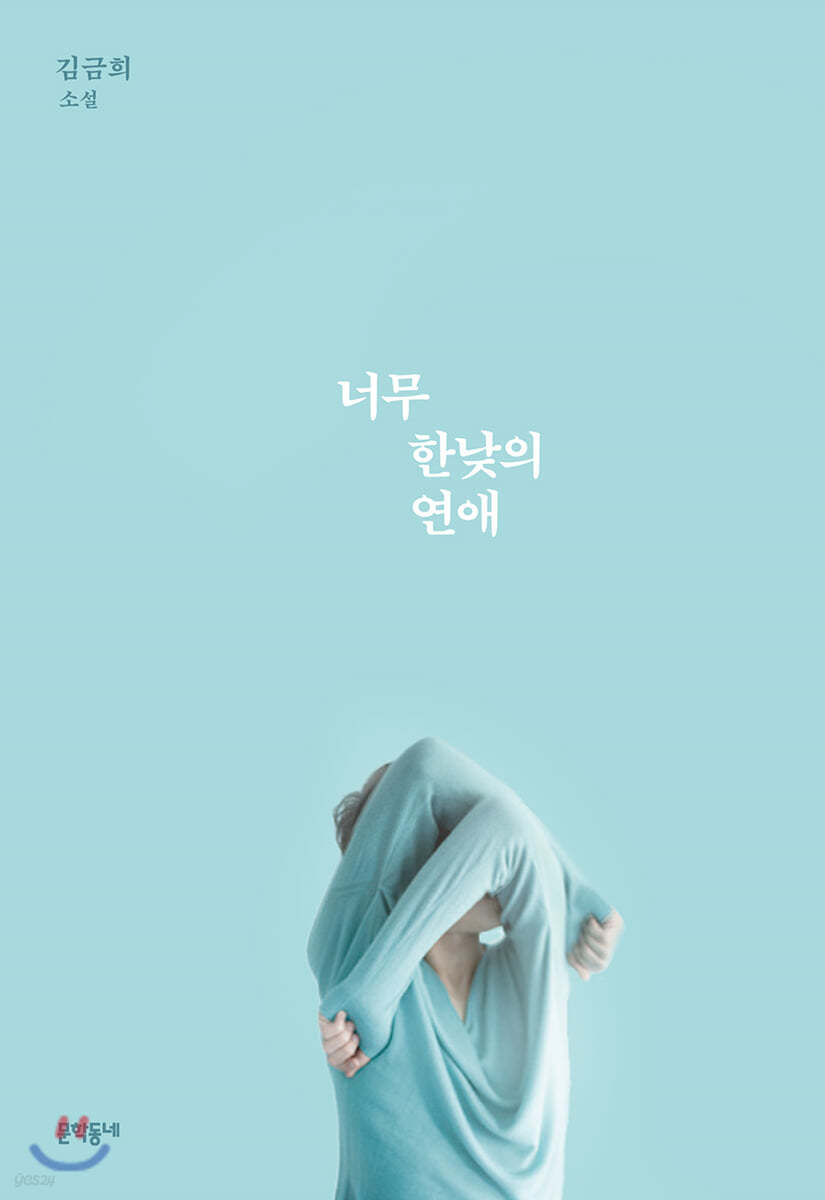
Too much midday romance
 |
Description
Book Introduction
2015 Young Writer Award winner “The World of Jo Jung-gyun”
Includes the 2016 Young Writer's Award Grand Prize winner, "Love in Broad Daylight"
Memories that are locked in a state of 'non-existence' rather than 'absence'
The 'ordinary times' touched by the subtle waves flowing from it
Novelist Kim Geum-hee, who heated up the Korean literary world by winning the grand prize at the 7th Young Writer's Award in 2016 with "Love in Broad Daylight," has published her second collection of short stories, "Love in Broad Daylight."
Kim Geum-hee, who showed her potential as a writer by winning the 33rd Shin Dong-yup Literary Award for her first short story collection, “Sentimentality for a Day or Two” (Changbi, 2014), has now become a true “young writer who is receiving the most attention right now.”
This collection of short stories, published between 2014 and 2015, contains nine works, demonstrating not only the author's passion for literature and her prolific writing, but also the high expectations the Korean literary world has for Kim Geum-hee.
"Love in Broad Daylight" is Kim Geum-hee's shy but confident response to that expectation.
Literary critic Jeong Hong-su begins his Young Writer's Award review of "Love in Broad Daylight" with the story of the detection of "gravitational waves," which was an issue at the time.
What surprised him was that the gravitational waves were created 13 billion light-years ago and are visible to us now.
Furthermore, Jeong Hong-su says, “It is quite conceivable that our daily lives also generate some kind of waves that subtly vibrate and distort space-time through the conflicts and deviations of relationships (and so on).”
And when the “micro-accumulation of that wave exceeds the critical point, it tilts our bodies and subtly shifts the coordinates of our lives.”
It was as if the memory of 'Pil-yong' sitting across from 'Yang-hee' at a McDonald's in Jongro sixteen years ago had been buried beneath his consciousness, and something had brought it to him, making him shed tears.
In this way, Kim Geum-hee devotes herself to retrieving ‘locked memories of the past’ in this collection of short stories.
Whether we think of them as trivial, want to forget them, or for some other reason, Kim Geum-hee brings those waves that have become subtle to the present and makes them resonate with us.
Includes the 2016 Young Writer's Award Grand Prize winner, "Love in Broad Daylight"
Memories that are locked in a state of 'non-existence' rather than 'absence'
The 'ordinary times' touched by the subtle waves flowing from it
Novelist Kim Geum-hee, who heated up the Korean literary world by winning the grand prize at the 7th Young Writer's Award in 2016 with "Love in Broad Daylight," has published her second collection of short stories, "Love in Broad Daylight."
Kim Geum-hee, who showed her potential as a writer by winning the 33rd Shin Dong-yup Literary Award for her first short story collection, “Sentimentality for a Day or Two” (Changbi, 2014), has now become a true “young writer who is receiving the most attention right now.”
This collection of short stories, published between 2014 and 2015, contains nine works, demonstrating not only the author's passion for literature and her prolific writing, but also the high expectations the Korean literary world has for Kim Geum-hee.
"Love in Broad Daylight" is Kim Geum-hee's shy but confident response to that expectation.
Literary critic Jeong Hong-su begins his Young Writer's Award review of "Love in Broad Daylight" with the story of the detection of "gravitational waves," which was an issue at the time.
What surprised him was that the gravitational waves were created 13 billion light-years ago and are visible to us now.
Furthermore, Jeong Hong-su says, “It is quite conceivable that our daily lives also generate some kind of waves that subtly vibrate and distort space-time through the conflicts and deviations of relationships (and so on).”
And when the “micro-accumulation of that wave exceeds the critical point, it tilts our bodies and subtly shifts the coordinates of our lives.”
It was as if the memory of 'Pil-yong' sitting across from 'Yang-hee' at a McDonald's in Jongro sixteen years ago had been buried beneath his consciousness, and something had brought it to him, making him shed tears.
In this way, Kim Geum-hee devotes herself to retrieving ‘locked memories of the past’ in this collection of short stories.
Whether we think of them as trivial, want to forget them, or for some other reason, Kim Geum-hee brings those waves that have become subtle to the present and makes them resonate with us.
- You can preview some of the book's contents.
Preview
index
Love in Broad Daylight _007
Jo Jung-gyun's World _043
Cecilia _073
Half Moon _103
Meat _129
Waiting for the Dog _153
Which star are we from _179
Ordinary Times _205
How Cats Are Trained _231
Commentary | Kang Ji-hee (literary critic)
The Pathos of Residualism _261
Author's Note _285
Jo Jung-gyun's World _043
Cecilia _073
Half Moon _103
Meat _129
Waiting for the Dog _153
Which star are we from _179
Ordinary Times _205
How Cats Are Trained _231
Commentary | Kang Ji-hee (literary critic)
The Pathos of Residualism _261
Author's Note _285
Into the book
What happens when you reunite with someone you had a romantic relationship with sixteen years ago, if not a romantic relationship, and you recognize each other?
What are we going to do in the future? I don't have any major complaints about my wife, but my son is precious.
So it didn't work.
Even though Pil-yong could see Yang-hee, Yang-hee was not allowed to see Pil-yong.
The gaze should be one-sided and not exchanged.
When something is exchanged, something remains, something is created in the remaining space, something grows, what exists has weight and becomes real.
---From "Love in Broad Daylight"
"sorry.
“I said something harsh,” Pil-yong apologized.
“Senior, don’t do things like apologizing. Just look at a tree like this.” Yanghee turned around and pointed to a tree at the entrance to the village.
It was a huge zelkova tree.
It was a zelkova tree whose bark peeled and peeled endlessly, yet it was surprising that there was still more bark to peel off.
“No matter when you look at a tree, you won’t be embarrassed, and no one will laugh at you, so just look at the tree.”
---From "Love in Broad Daylight"
Poor Cecilia, I'm an expert at that.
Night comes, sleep goes, there is only silence beside me, my head is noisy, and yet I can't think clearly, so I feel like I am just empty like a tin can, rolling around noisily in the breeze.
---From "Cecilia"
The dream seemed to have a rhythm like a song.
It creates a cycle by stopping and continuing.
My eldest brother is our enemy, but he is also our father, and our father is the last of the human species, but now he is a pitiful loner standing before death and God, and a former salaryman who seeks revenge.
If you stop dreaming like that and keep dreaming and dreaming, all those things will become vague and just become ordinary things.
Salarymen are ordinary, and devils are ordinary.
The human race, the enemy, and the pitiful loner are all ordinary things, just ordinary, insignificant, things that can be forgotten, things that are just there.
---From "Ordinary Times"
In a way, it wasn't like I came back to life.
It was almost like stepping back from being a subject that could die to being an object that was interfered with.
But the cat was the only living thing in this bizarre single-family home that moved, ate, lay down, pooped, cried, and scratched, so focusing on the cat meant focusing on life.
That very fact saved him from death.
---From "How Cats Are Trained"
I often find myself quietly enduring my daily life, but at some point, I reach a point where I can no longer bear it any longer, and I want to go up to someone around me—even a stranger like you—and ask them a question. The question is, "Why did this happen?"
The question, "Are you okay?"
Why did it turn out like this, are you okay?
When you ask me that, I will stand beside people like the hazy breath of a cold window, like someone's 96,000 won, like the zelkova tree in Munsan, like a lost, affectionate dog.
What are we going to do in the future? I don't have any major complaints about my wife, but my son is precious.
So it didn't work.
Even though Pil-yong could see Yang-hee, Yang-hee was not allowed to see Pil-yong.
The gaze should be one-sided and not exchanged.
When something is exchanged, something remains, something is created in the remaining space, something grows, what exists has weight and becomes real.
---From "Love in Broad Daylight"
"sorry.
“I said something harsh,” Pil-yong apologized.
“Senior, don’t do things like apologizing. Just look at a tree like this.” Yanghee turned around and pointed to a tree at the entrance to the village.
It was a huge zelkova tree.
It was a zelkova tree whose bark peeled and peeled endlessly, yet it was surprising that there was still more bark to peel off.
“No matter when you look at a tree, you won’t be embarrassed, and no one will laugh at you, so just look at the tree.”
---From "Love in Broad Daylight"
Poor Cecilia, I'm an expert at that.
Night comes, sleep goes, there is only silence beside me, my head is noisy, and yet I can't think clearly, so I feel like I am just empty like a tin can, rolling around noisily in the breeze.
---From "Cecilia"
The dream seemed to have a rhythm like a song.
It creates a cycle by stopping and continuing.
My eldest brother is our enemy, but he is also our father, and our father is the last of the human species, but now he is a pitiful loner standing before death and God, and a former salaryman who seeks revenge.
If you stop dreaming like that and keep dreaming and dreaming, all those things will become vague and just become ordinary things.
Salarymen are ordinary, and devils are ordinary.
The human race, the enemy, and the pitiful loner are all ordinary things, just ordinary, insignificant, things that can be forgotten, things that are just there.
---From "Ordinary Times"
In a way, it wasn't like I came back to life.
It was almost like stepping back from being a subject that could die to being an object that was interfered with.
But the cat was the only living thing in this bizarre single-family home that moved, ate, lay down, pooped, cried, and scratched, so focusing on the cat meant focusing on life.
That very fact saved him from death.
---From "How Cats Are Trained"
I often find myself quietly enduring my daily life, but at some point, I reach a point where I can no longer bear it any longer, and I want to go up to someone around me—even a stranger like you—and ask them a question. The question is, "Why did this happen?"
The question, "Are you okay?"
Why did it turn out like this, are you okay?
When you ask me that, I will stand beside people like the hazy breath of a cold window, like someone's 96,000 won, like the zelkova tree in Munsan, like a lost, affectionate dog.
---From the author's note
Publisher's Review
2015 Young Writer Award winner “The World of Jo Jung-gyun”
Includes the 2016 Young Writer's Award Grand Prize winner, "Love in Broad Daylight"
Memories that are locked in a state of 'non-existence' rather than 'absence'
The 'ordinary times' touched by the subtle waves flowing from it
Novelist Kim Geum-hee, who heated up the Korean literary world by winning the grand prize at the 7th Young Writer's Award in 2016 with "Love in Broad Daylight," has published her second collection of short stories, "Love in Broad Daylight."
Kim Geum-hee, who showed her potential as a writer by winning the 33rd Shin Dong-yup Literary Award for her first short story collection, “Sentimentality for a Day or Two” (Changbi, 2014), has now become a true “young writer who is receiving the most attention right now.”
This collection of short stories, published between 2014 and 2015, contains nine works, demonstrating not only the author's passion for literature and her prolific writing, but also the high expectations the Korean literary world has for Kim Geum-hee.
"Love in Broad Daylight" is Kim Geum-hee's shy but confident response to that expectation.
Literary critic Jeong Hong-su begins his Young Writer's Award review of "Love in Broad Daylight" with the story of the detection of "gravitational waves," which was an issue at the time.
What surprised him was that the gravitational waves were created 13 billion light-years ago and are visible to us now.
Furthermore, Jeong Hong-su says, “It is quite conceivable that our daily lives also generate some kind of waves that subtly vibrate and distort space-time through the conflicts and deviations of relationships (and so on).”
And when the “micro-accumulation of that wave exceeds the critical point, it tilts our bodies and subtly shifts the coordinates of our lives.”
It was as if the memory of 'Pil-yong' sitting across from 'Yang-hee' at a McDonald's in Jongro sixteen years ago had been buried beneath his consciousness, and something had brought it to him, making him shed tears.
In this way, Kim Geum-hee devotes herself to retrieving ‘locked memories of the past’ in this collection of short stories.
Whether we think of them as trivial, want to forget them, or for some other reason, Kim Geum-hee brings those waves that have become subtle to the present and makes them resonate with us.
The 2014 works, located in the innermost corners of the collection, seem to project Kim Geum-hee's gaze toward the past in refined language.
"Half Moon," which depicts a high school student's summer vacation by overlaying a girlish imagination onto a tragic daily life, evokes nostalgia for childhood in itself, while "From Which Star Are We" exquisitely captures the moment when memories of being "loved" by others in childhood are understood differently as we grow older.
"Meat" and "Waiting for a Dog" also add suspense to the experience of the past trauma not being resolved and drifting in a state of "non-existence" until it suddenly stabs us, drawing the reader in.
As we move on to the later published works surrounding the collection of short stories, such as “Love in Broad Daylight,” “The World of Jo Jung-gyun,” “Cecilia,” “Ordinary Times,” and “How Cats Are Trained,” we can see that Kim Geum-hee’s narrative has become even more vibrant and her sparkling wit is displayed at the right time and place.
The central characters of the novel also grew older and more cunning to some extent.
Did novelist Jeong Yeong-su call this “writing of liberation” in his interview with Kim Geum-hee?
In particular, onomatopoeias that have become Kim Geum-hee's specialty, such as "hair-eok," "eogugugugugugu," and "saposapposapposapposappo," enhance the enjoyment of reading by delivering the sounds in the novel as if they were directly inserted into your ears.
However, the sharpness of the fangs that Kim Geum-hee's novel reveals in unexpected places remains the same.
As we read his novels, we cannot help but feel a chill at least once, bitten by the 'truth' that he had tried so hard to hide and pretend not to know.
Maybe that's why.
At the end of “the long exploration they have gone through,” we are left with “a feeling that is too cold to laugh and too warm to cry” (literary critic Kang Ji-hee, commentary on “The Pathos of Residual”).
In an interview, Kim Geum-hee said she wanted to write a novel that “doesn’t cruelly show ugliness, but rather saves people so that they can take at least one step forward despite their ugliness.”
While depicting a group of people who have become worn and hated over time, Kim Geum-hee never loses sight of the lovability that these characters possess.
As we read Kim Geum-hee's work, we gain a bit of strength in our hearts as we see the world and write novels through her warm and detailed gaze.
Even if she is momentarily stopped in her tracks by waves reaching from the distant past, her novel will continue to be written with slow steps toward progress.
Includes the 2016 Young Writer's Award Grand Prize winner, "Love in Broad Daylight"
Memories that are locked in a state of 'non-existence' rather than 'absence'
The 'ordinary times' touched by the subtle waves flowing from it
Novelist Kim Geum-hee, who heated up the Korean literary world by winning the grand prize at the 7th Young Writer's Award in 2016 with "Love in Broad Daylight," has published her second collection of short stories, "Love in Broad Daylight."
Kim Geum-hee, who showed her potential as a writer by winning the 33rd Shin Dong-yup Literary Award for her first short story collection, “Sentimentality for a Day or Two” (Changbi, 2014), has now become a true “young writer who is receiving the most attention right now.”
This collection of short stories, published between 2014 and 2015, contains nine works, demonstrating not only the author's passion for literature and her prolific writing, but also the high expectations the Korean literary world has for Kim Geum-hee.
"Love in Broad Daylight" is Kim Geum-hee's shy but confident response to that expectation.
Literary critic Jeong Hong-su begins his Young Writer's Award review of "Love in Broad Daylight" with the story of the detection of "gravitational waves," which was an issue at the time.
What surprised him was that the gravitational waves were created 13 billion light-years ago and are visible to us now.
Furthermore, Jeong Hong-su says, “It is quite conceivable that our daily lives also generate some kind of waves that subtly vibrate and distort space-time through the conflicts and deviations of relationships (and so on).”
And when the “micro-accumulation of that wave exceeds the critical point, it tilts our bodies and subtly shifts the coordinates of our lives.”
It was as if the memory of 'Pil-yong' sitting across from 'Yang-hee' at a McDonald's in Jongro sixteen years ago had been buried beneath his consciousness, and something had brought it to him, making him shed tears.
In this way, Kim Geum-hee devotes herself to retrieving ‘locked memories of the past’ in this collection of short stories.
Whether we think of them as trivial, want to forget them, or for some other reason, Kim Geum-hee brings those waves that have become subtle to the present and makes them resonate with us.
The 2014 works, located in the innermost corners of the collection, seem to project Kim Geum-hee's gaze toward the past in refined language.
"Half Moon," which depicts a high school student's summer vacation by overlaying a girlish imagination onto a tragic daily life, evokes nostalgia for childhood in itself, while "From Which Star Are We" exquisitely captures the moment when memories of being "loved" by others in childhood are understood differently as we grow older.
"Meat" and "Waiting for a Dog" also add suspense to the experience of the past trauma not being resolved and drifting in a state of "non-existence" until it suddenly stabs us, drawing the reader in.
As we move on to the later published works surrounding the collection of short stories, such as “Love in Broad Daylight,” “The World of Jo Jung-gyun,” “Cecilia,” “Ordinary Times,” and “How Cats Are Trained,” we can see that Kim Geum-hee’s narrative has become even more vibrant and her sparkling wit is displayed at the right time and place.
The central characters of the novel also grew older and more cunning to some extent.
Did novelist Jeong Yeong-su call this “writing of liberation” in his interview with Kim Geum-hee?
In particular, onomatopoeias that have become Kim Geum-hee's specialty, such as "hair-eok," "eogugugugugugu," and "saposapposapposapposappo," enhance the enjoyment of reading by delivering the sounds in the novel as if they were directly inserted into your ears.
However, the sharpness of the fangs that Kim Geum-hee's novel reveals in unexpected places remains the same.
As we read his novels, we cannot help but feel a chill at least once, bitten by the 'truth' that he had tried so hard to hide and pretend not to know.
Maybe that's why.
At the end of “the long exploration they have gone through,” we are left with “a feeling that is too cold to laugh and too warm to cry” (literary critic Kang Ji-hee, commentary on “The Pathos of Residual”).
In an interview, Kim Geum-hee said she wanted to write a novel that “doesn’t cruelly show ugliness, but rather saves people so that they can take at least one step forward despite their ugliness.”
While depicting a group of people who have become worn and hated over time, Kim Geum-hee never loses sight of the lovability that these characters possess.
As we read Kim Geum-hee's work, we gain a bit of strength in our hearts as we see the world and write novels through her warm and detailed gaze.
Even if she is momentarily stopped in her tracks by waves reaching from the distant past, her novel will continue to be written with slow steps toward progress.
GOODS SPECIFICS
- Date of issue: May 31, 2016
- Page count, weight, size: 288 pages | 390g | 145*210mm
- ISBN13: 9788954640756
- ISBN10: 8954640753
You may also like
카테고리
korean


korean

![GQ KOREA Mark (Monthly): December [2025]](http://librairie.coreenne.fr/cdn/shop/files/8ef265dbbfbf186523ed75ba7319009d.jpg?v=1765340328&width=3840)


