

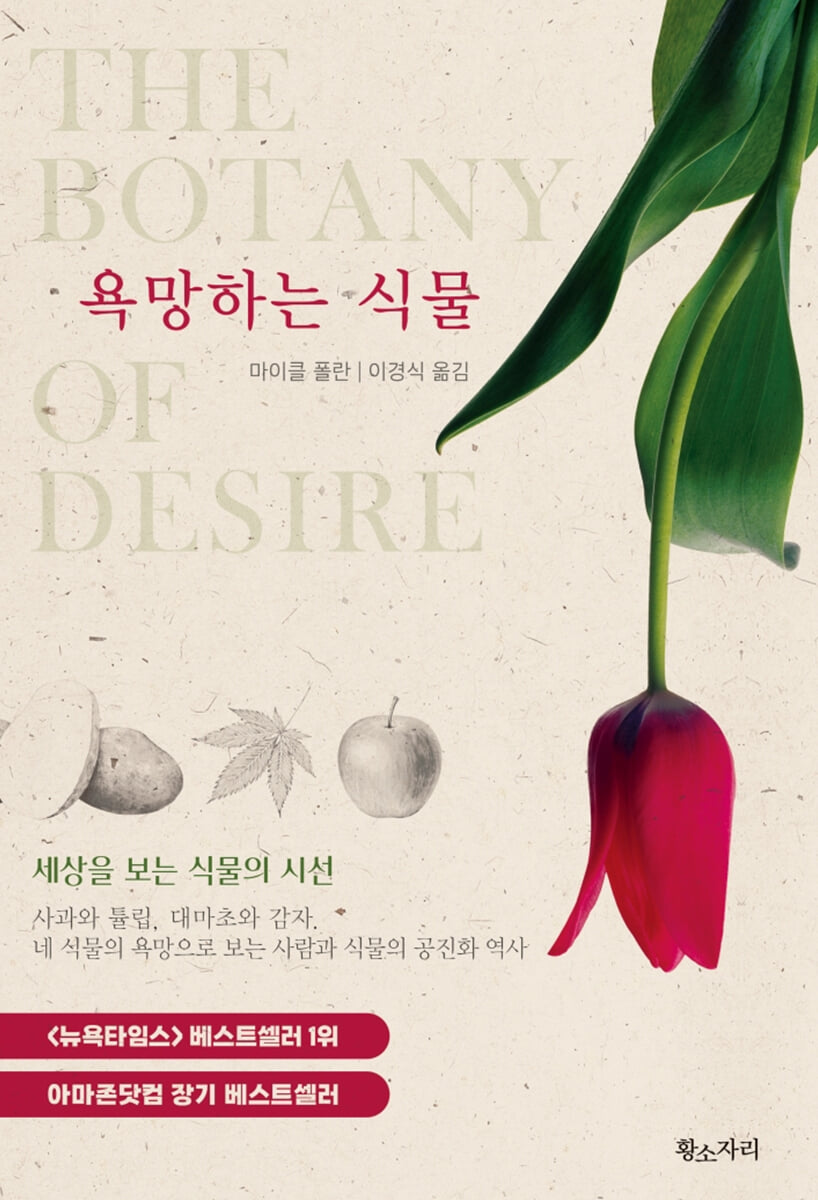
Desiring Plant
 |
Description
Book Introduction
Amazon.com and New York Times bestseller!
A 21st century neoclassic that breaks down the boundaries between humanities and natural sciences!!
★ Pollan's genius, imbued with curiosity and consideration, stimulates and inspires me.
_Richard Ford (novelist.
1996 Pulitzer Prize winner)
★ No one writes about the human environment like Michael Pollan.
It is fortunate that the wittiest writers on nature are also the wisest.
William Cronan (environmental historian and professor at the University of Wisconsin)
★ It is a rare pleasure to come across a book so elegant, witty, and thought-provoking.
It makes readers smile while simultaneously making them think deeply about the many problems we face.
_Mark Kurlansky (bestselling author.
Author of 《The Basque History of the World》)
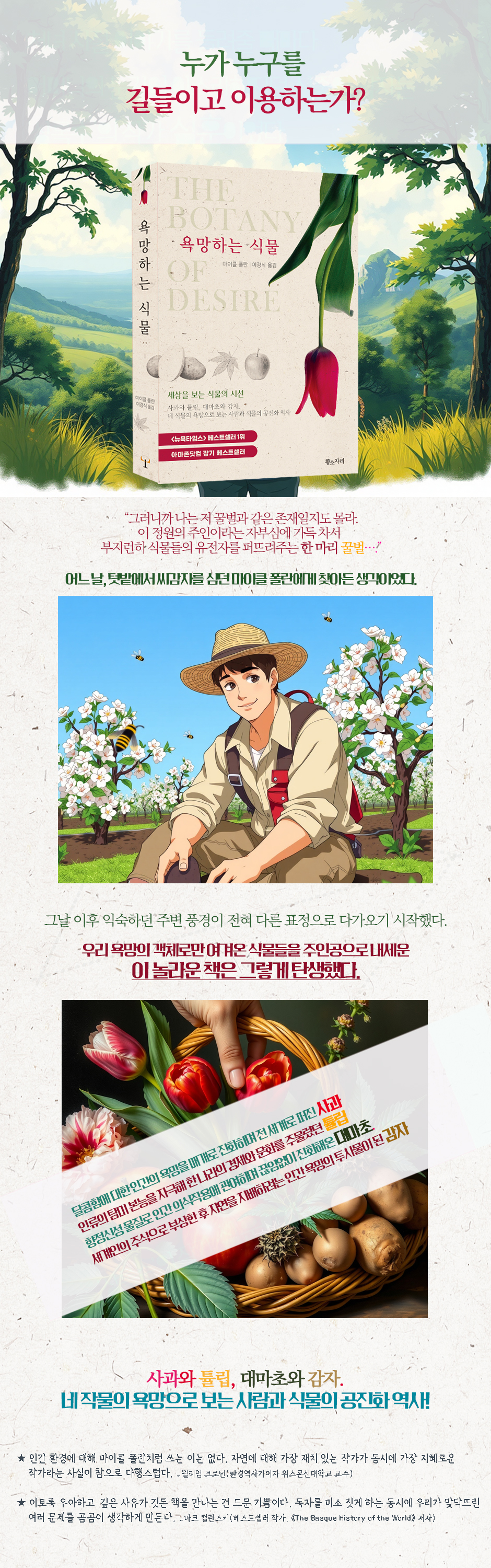
Who is taming and exploiting whom?
One day in May, while planting seed potatoes next to an apple tree buzzing with bees, Pollan had this thought.
What's the difference between those bees, diligently flitting between apple blossoms, spreading their genes, and me, burying seed potatoes in the ground, brimming with pride as the owner of my garden? Aren't I in the same boat as the bees, who spread the genes of specific plants in exchange for food?
As my thoughts wandered there, the familiar surrounding scenery suddenly appeared new.
The realization has arrived that plants, which had been considered objects of desire, may be creatures as intelligent as, or perhaps even more intelligent than, humans.
In this book, Pollan traces the long history of co-evolution between plants and humans through apples, tulips, cannabis, and potatoes.
Although they are representative crops that humans have 'tamed', the truth is that they are beings that have actively used humans more than any other plant species.
What they gained in return for their transformations to suit the changing whims of humanity over time was survival, prosperity, and their own golden age.
What a clever and clever strategy.
Apples evolved through human desire for sweetness and spread throughout the world.
Tulips, which stimulated humanity's aesthetic instincts and became the main character that influenced a country's economy and culture.
Marijuana, a psychoactive substance that affects human consciousness, continues to produce hybrids despite all kinds of persecution.
And the potato, which emerged as a major food source for the world's people, became a projection of human desire to dominate nature.
Pollan's writing, which moves busily from his own garden to the mountains of Kazakhstan, the Andes and Ireland, the Netherlands and the American Midwest, is full of dazzling humor and insight.
This story, which tells the long history of plants and humanity, crossing over botany and anthropology, philosophy and literature, geography and biotechnology, has helped countless readers readjust their perspectives on civilization and nature, desire and ethics, and the past and future, and broaden their horizons.
A 21st century neoclassic that breaks down the boundaries between humanities and natural sciences!!
★ Pollan's genius, imbued with curiosity and consideration, stimulates and inspires me.
_Richard Ford (novelist.
1996 Pulitzer Prize winner)
★ No one writes about the human environment like Michael Pollan.
It is fortunate that the wittiest writers on nature are also the wisest.
William Cronan (environmental historian and professor at the University of Wisconsin)
★ It is a rare pleasure to come across a book so elegant, witty, and thought-provoking.
It makes readers smile while simultaneously making them think deeply about the many problems we face.
_Mark Kurlansky (bestselling author.
Author of 《The Basque History of the World》)
Who is taming and exploiting whom?
One day in May, while planting seed potatoes next to an apple tree buzzing with bees, Pollan had this thought.
What's the difference between those bees, diligently flitting between apple blossoms, spreading their genes, and me, burying seed potatoes in the ground, brimming with pride as the owner of my garden? Aren't I in the same boat as the bees, who spread the genes of specific plants in exchange for food?
As my thoughts wandered there, the familiar surrounding scenery suddenly appeared new.
The realization has arrived that plants, which had been considered objects of desire, may be creatures as intelligent as, or perhaps even more intelligent than, humans.
In this book, Pollan traces the long history of co-evolution between plants and humans through apples, tulips, cannabis, and potatoes.
Although they are representative crops that humans have 'tamed', the truth is that they are beings that have actively used humans more than any other plant species.
What they gained in return for their transformations to suit the changing whims of humanity over time was survival, prosperity, and their own golden age.
What a clever and clever strategy.
Apples evolved through human desire for sweetness and spread throughout the world.
Tulips, which stimulated humanity's aesthetic instincts and became the main character that influenced a country's economy and culture.
Marijuana, a psychoactive substance that affects human consciousness, continues to produce hybrids despite all kinds of persecution.
And the potato, which emerged as a major food source for the world's people, became a projection of human desire to dominate nature.
Pollan's writing, which moves busily from his own garden to the mountains of Kazakhstan, the Andes and Ireland, the Netherlands and the American Midwest, is full of dazzling humor and insight.
This story, which tells the long history of plants and humanity, crossing over botany and anthropology, philosophy and literature, geography and biotechnology, has helped countless readers readjust their perspectives on civilization and nature, desire and ethics, and the past and future, and broaden their horizons.
- You can preview some of the book's contents.
Preview
index
Editor's Note 8
Prologue _ Human Bee 15
Chapter 1 _ Desire for Sweetness * Apple 35
Chapter 2: The Desire for Beauty * Tulip 117
Chapter 3: The Desire for Intoxication * Marijuana 185
Chapter 4: The Desire for Domination * Potato 273
Epilogue 351
References 361
Search 375
Prologue _ Human Bee 15
Chapter 1 _ Desire for Sweetness * Apple 35
Chapter 2: The Desire for Beauty * Tulip 117
Chapter 3: The Desire for Intoxication * Marijuana 185
Chapter 4: The Desire for Domination * Potato 273
Epilogue 351
References 361
Search 375
Detailed image
Into the book
Through trial and error, plants have discovered that the most effective way to spread their species is to attract and use animals.
Whether the target is a bee or a human, it makes no difference to the plants.
It is of no concern to the plant whether the other animal is aware of its desires or not.
All you have to do is effectively stimulate the desires of the target animal and spread your species widely.
In conclusion, apples and potatoes were wise.
They have thrived to this day by effectively spreading their genes while producing more of the sweet flowers that bees desire and more desirable tubers that humans eat.
--- p.19, from the main text, “Introduction: Human Bees”
Humans are creatures who grossly overestimate their role in nature.
Many of the activities that humans mistakenly believe are solely for their own benefit (such as developing agricultural techniques, planting or prohibiting certain plant species, or writing books praising certain plant species) are, in the eyes of nature, trivial and accidental.
What is a crisis for one species can be a golden opportunity for another.
The desires we humans possess are tiny streams that flow into the great river of evolution.
--- p.28, from the main text, “Introduction: Human Bees”
The human and apple seeds, each perched on one of the two logs that make up Chapman's ship, symbolize the happy union of two creatures.
Perhaps no one has seen the world from a plant perspective as thoroughly as Chapman.
He understood perfectly well that he was doing something for the apple as much as the apple was doing something for him.
That's why he often compared himself to a bee, and designed his log boat to travel alongside it instead of hanging a chest of apple seeds behind it.
--- p.39, from the text “Chapter 1: The Desire for Sweetness * Apple”
But the plant took a few more steps to protect its seeds from the greed of its companion.
For example, plants prevent their fruits from becoming sweet and colorful until the seeds are fully developed.
Unripe fruit is too tasteless to be eaten, and the berries remain green to be inconspicuous.
Going a step further, they coat the seeds with small amounts of a special substance (like apples, for example) so that fruit-eating animals spit out the seeds without chewing them, or if they do swallow them, they pass them safely out of the body without being digested.
It is a measure taken by plants to protect their seeds.
--- p.60, from the text “Chapter 1: The Desire for Sweetness * Apple”
But there is one thing to keep in mind.
This craze, which blew wildly in the Netherlands and then died out just as wildly, also originated from a desire for beauty.
At that time, the Netherlands had very little to offer that could be called beautiful compared to other neighboring countries.
Also, Dutch people, regardless of class, wore clothes of one color.
In the gray, gloomy land of Calvinism, tulips with their bright, primary-colored flowers caught people's attention.
Needless to say.
The Dutch had probably never before seen the rich, bright, and intense colours of tulips.
Whether the target is a bee or a human, it makes no difference to the plants.
It is of no concern to the plant whether the other animal is aware of its desires or not.
All you have to do is effectively stimulate the desires of the target animal and spread your species widely.
In conclusion, apples and potatoes were wise.
They have thrived to this day by effectively spreading their genes while producing more of the sweet flowers that bees desire and more desirable tubers that humans eat.
--- p.19, from the main text, “Introduction: Human Bees”
Humans are creatures who grossly overestimate their role in nature.
Many of the activities that humans mistakenly believe are solely for their own benefit (such as developing agricultural techniques, planting or prohibiting certain plant species, or writing books praising certain plant species) are, in the eyes of nature, trivial and accidental.
What is a crisis for one species can be a golden opportunity for another.
The desires we humans possess are tiny streams that flow into the great river of evolution.
--- p.28, from the main text, “Introduction: Human Bees”
The human and apple seeds, each perched on one of the two logs that make up Chapman's ship, symbolize the happy union of two creatures.
Perhaps no one has seen the world from a plant perspective as thoroughly as Chapman.
He understood perfectly well that he was doing something for the apple as much as the apple was doing something for him.
That's why he often compared himself to a bee, and designed his log boat to travel alongside it instead of hanging a chest of apple seeds behind it.
--- p.39, from the text “Chapter 1: The Desire for Sweetness * Apple”
But the plant took a few more steps to protect its seeds from the greed of its companion.
For example, plants prevent their fruits from becoming sweet and colorful until the seeds are fully developed.
Unripe fruit is too tasteless to be eaten, and the berries remain green to be inconspicuous.
Going a step further, they coat the seeds with small amounts of a special substance (like apples, for example) so that fruit-eating animals spit out the seeds without chewing them, or if they do swallow them, they pass them safely out of the body without being digested.
It is a measure taken by plants to protect their seeds.
--- p.60, from the text “Chapter 1: The Desire for Sweetness * Apple”
But there is one thing to keep in mind.
This craze, which blew wildly in the Netherlands and then died out just as wildly, also originated from a desire for beauty.
At that time, the Netherlands had very little to offer that could be called beautiful compared to other neighboring countries.
Also, Dutch people, regardless of class, wore clothes of one color.
In the gray, gloomy land of Calvinism, tulips with their bright, primary-colored flowers caught people's attention.
Needless to say.
The Dutch had probably never before seen the rich, bright, and intense colours of tulips.
--- p.163, from the text “Chapter 2: The Desire for Beauty * Tulips”
Publisher's Review
Who is taming and exploiting whom?
One day in May, while planting seed potatoes next to an apple tree buzzing with bees, Pollan had this thought.
What's the difference between those bees, diligently flitting between apple blossoms, spreading their genes, and me, burying seed potatoes in the ground, brimming with pride as the owner of my garden? Aren't I in the same boat as the bees, who spread the genes of specific plants in exchange for food?
As my thoughts wandered there, the familiar surrounding scenery suddenly appeared new.
The realization has arrived that plants, which had been considered objects of desire, may be creatures as intelligent as, or perhaps even more intelligent than, humans.
This is how the book “Plant Desire,” which tells the story of their evolution from the perspective of plants, was born.
Apples and tulips, cannabis and potatoes.
The history of co-evolution between people and plants, as seen through the desires of your crops!
In this book, Pollan traces the long history of co-evolution between plants and humans through apples, tulips, cannabis, and potatoes.
Although they are representative crops that humans have 'tamed', the truth is that they are beings that have actively used humans more than any other plant species.
What they gained in return for their transformations to suit the changing whims of humanity over time was survival, prosperity, and their own golden age.
What a clever and clever strategy.
Apples evolved through human desire for sweetness and spread throughout the world.
Tulips, which stimulated humanity's aesthetic instincts and became the main character that influenced a country's economy and culture.
Marijuana, a psychoactive substance that affects human consciousness, continues to produce hybrids despite all kinds of persecution.
And the potato, which emerged as a major food source for the world's people, became a projection of human desire to dominate nature.
Beginning in his own garden and moving busily between the mountains of Kazakhstan, the Andes and Ireland, the Netherlands and the American Midwest, Pollan's writing is dazzlingly captivating and full of insight.
The thrilling experience of secretly growing two marijuana plants and being caught by the police chief who came to deliver firewood, the real dangers of biotechnology realized for the first time while growing genetically modified potatoes with pesticides in the garden, and the exquisite beauty of all things in the world brought about by the balance and restraint of Apollo's reason and Dionysus's emotion...
This story, which tells the long history of plants and humans, crossing over botany and anthropology, philosophy and literature, evolution and biotechnology, has helped countless readers readjust their perspectives on civilization and nature, desire and ethics, and the past and future, and broaden their horizons.
This book is a revised edition of The Botany of Desire, published by Taurus in 2007.
When the first edition of this book was published in the United States in 2001, almost all media outlets, including the New York Times and the Wall Street Journal, rushed to praise the birth of a new author.
This controversial work, which illuminates human society through the eyes of plants, has remained at the top of the bestseller lists compiled by major American bookstores for an unusually long period of time for a natural science book.
Furthermore, Michael Pollan, whose free-spirited and intelligent writing deftly transcends the barriers between human history and natural history, natural science and biotechnology, has quickly become one of the most beloved authors of the 21st century worldwide.
One day in May, while planting seed potatoes next to an apple tree buzzing with bees, Pollan had this thought.
What's the difference between those bees, diligently flitting between apple blossoms, spreading their genes, and me, burying seed potatoes in the ground, brimming with pride as the owner of my garden? Aren't I in the same boat as the bees, who spread the genes of specific plants in exchange for food?
As my thoughts wandered there, the familiar surrounding scenery suddenly appeared new.
The realization has arrived that plants, which had been considered objects of desire, may be creatures as intelligent as, or perhaps even more intelligent than, humans.
This is how the book “Plant Desire,” which tells the story of their evolution from the perspective of plants, was born.
Apples and tulips, cannabis and potatoes.
The history of co-evolution between people and plants, as seen through the desires of your crops!
In this book, Pollan traces the long history of co-evolution between plants and humans through apples, tulips, cannabis, and potatoes.
Although they are representative crops that humans have 'tamed', the truth is that they are beings that have actively used humans more than any other plant species.
What they gained in return for their transformations to suit the changing whims of humanity over time was survival, prosperity, and their own golden age.
What a clever and clever strategy.
Apples evolved through human desire for sweetness and spread throughout the world.
Tulips, which stimulated humanity's aesthetic instincts and became the main character that influenced a country's economy and culture.
Marijuana, a psychoactive substance that affects human consciousness, continues to produce hybrids despite all kinds of persecution.
And the potato, which emerged as a major food source for the world's people, became a projection of human desire to dominate nature.
Beginning in his own garden and moving busily between the mountains of Kazakhstan, the Andes and Ireland, the Netherlands and the American Midwest, Pollan's writing is dazzlingly captivating and full of insight.
The thrilling experience of secretly growing two marijuana plants and being caught by the police chief who came to deliver firewood, the real dangers of biotechnology realized for the first time while growing genetically modified potatoes with pesticides in the garden, and the exquisite beauty of all things in the world brought about by the balance and restraint of Apollo's reason and Dionysus's emotion...
This story, which tells the long history of plants and humans, crossing over botany and anthropology, philosophy and literature, evolution and biotechnology, has helped countless readers readjust their perspectives on civilization and nature, desire and ethics, and the past and future, and broaden their horizons.
This book is a revised edition of The Botany of Desire, published by Taurus in 2007.
When the first edition of this book was published in the United States in 2001, almost all media outlets, including the New York Times and the Wall Street Journal, rushed to praise the birth of a new author.
This controversial work, which illuminates human society through the eyes of plants, has remained at the top of the bestseller lists compiled by major American bookstores for an unusually long period of time for a natural science book.
Furthermore, Michael Pollan, whose free-spirited and intelligent writing deftly transcends the barriers between human history and natural history, natural science and biotechnology, has quickly become one of the most beloved authors of the 21st century worldwide.
Recommendation
Michael Pollan reveals surprising facts that fundamentally shake conventional wisdom.
Pollan's writing seems infinitely loose, yet at the same time sparkles with sharp intelligence and vitality.
He has an amazing knack for pulling out perfect examples from places no one would have thought of.
_ The New York Times
This is an environmental and historical book that provides valuable information about humanity and nature through unique writing that seems somewhat quirky.
_ The New Yorker
Apples, tulips, cannabis, potatoes… .
This witty book tells the stories of four plants from their own perspectives.
_ 《People》
Before reading this book, I had never looked into the soul of a plant.
Written from the perspective of plants by Pollan, a master gardener and writer, this book shatters common notions about gardening, such as the idea that I control and dominate my lilies.
(…) Pollan rebuked and awakened me to my ignorance of having lived only in a human-centered way.
_ The Wall Street Journal
Once you pick up this book, which unravels the social, political, economic, and historical factors that led humanity to cultivate four plants, you will find it impossible to put it down.
(…) Michael Pollan has a genius for finding the lines between the seemingly disparate dots and organizing their connections in the garden of all its complexities, whether political, literary, historical, socioeconomic, or even sexual.
_ Chicago Tribune
This book is full of fascinating and insightful information.
(…) takes the reader on a beautiful and informative journey that threads science and history through four species of plants.
_ 《Hartford Crant》
This is a must-read book.
It's a thought-provoking, yet peculiar book that defies pinpointing.
(…) Even for a gardening scholar, it is almost impossible to write a book like this.
_ The New York Observer
In brilliant and entertaining prose, Michael Pollan vividly shows how these plants evolved to satisfy our most basic human desires, thereby becoming indispensable to human life.
_ 《Vogue》
It reveals, in a surprising and sometimes shocking way, how the basic human desires and the desires of four different plants have evolved together.
_ 《Organic Garden》
He is a person who writes attractively enough to make people jealous.
At the same time, he is a perceptive historian, social scientist, and brilliant environmentalist.
_ High Times
Pollan's clear and elegant writing style has the power to breathe life and dignity into plants, animals, and even natural materials.
It seems that his tremendous study and humble attitude were the driving forces that led him to the realization that humans and nature are one great community with a shared destiny.
_ Publisher's Weekly
Tracing the connections between four plants that have thrived under human affection and love, Pollan exquisitely blends history, personal anecdotes, and new facts that people had never known before.
(…) Pollan's dynamic, intelligent and bold expressions, which weave a wondrous dialogue between humans and plants, offer a new perspective on plant desire.
_ 《Booklist》
It brilliantly explores humanity's unpredictable relationship with nature and our constant attempts to overturn it.
_ Recommendation from the LA Times
Michael Pollan reveals surprising facts that fundamentally shake conventional wisdom.
Pollan's writing seems infinitely loose, yet at the same time sparkles with sharp intelligence and vitality.
He has an amazing knack for pulling out perfect examples from places no one would have thought of.
_ The New York Times
This is an environmental and historical book that provides valuable information about humanity and nature through unique writing that seems somewhat quirky.
_ The New Yorker
Apples, tulips, cannabis, potatoes… .
This witty book tells the stories of four plants from their own perspectives.
_ 《People》
Before reading this book, I had never looked into the soul of a plant.
Written from the perspective of plants by Pollan, a master gardener and writer, this book shatters common notions about gardening, such as the idea that I control and dominate my lilies.
(…) Pollan rebuked and awakened me to my ignorance of having lived only in a human-centered way.
_ The Wall Street Journal
Once you pick up this book, which unravels the social, political, economic, and historical factors that led humanity to cultivate four plants, you will find it impossible to put it down.
(…) Michael Pollan has a genius for finding the lines between the seemingly disparate dots and organizing their connections in the garden of all its complexities, whether political, literary, historical, socioeconomic, or even sexual.
_ Chicago Tribune
This book is full of fascinating and insightful information.
(…) takes the reader on a beautiful and informative journey that threads science and history through four species of plants.
_ 《Hartford Crant》
This is a must-read book.
It's a thought-provoking, yet peculiar book that defies pinpointing.
(…) Even for a gardening scholar, it is almost impossible to write a book like this.
_ The New York Observer
In brilliant and entertaining prose, Michael Pollan vividly shows how these plants evolved to satisfy our most basic human desires, thereby becoming indispensable to human life.
_ 《Vogue》
It reveals, in a surprising and sometimes shocking way, how the basic human desires and the desires of four different plants have evolved together.
_ 《Organic Garden》
He is a person who writes attractively enough to make people jealous.
At the same time, he is a perceptive historian, social scientist, and brilliant environmentalist.
_ High Times
Pollan's clear and elegant writing style has the power to breathe life and dignity into plants, animals, and even natural materials.
It seems that his tremendous study and humble attitude were the driving forces that led him to the realization that humans and nature are one great community with a shared destiny.
_ Publisher's Weekly
Tracing the connections between four plants that have thrived under human affection and love, Pollan exquisitely blends history, personal anecdotes, and new facts that people had never known before.
(…) Pollan's dynamic, intelligent and bold expressions, which weave a wondrous dialogue between humans and plants, offer a new perspective on plant desire.
_ 《Booklist》
It brilliantly explores humanity's unpredictable relationship with nature and our constant attempts to overturn it.
_ The Los Angeles Times
Michael Pollan reveals surprising facts that fundamentally shake conventional wisdom.
Pollan's writing seems infinitely loose, yet at the same time sparkles with sharp intelligence and vitality.
He has an amazing knack for pulling out perfect examples from places no one would have thought of.
_ The New York Times
This is an environmental and historical book that provides valuable information about humanity and nature through unique writing that seems somewhat quirky.
_ The New Yorker
Apples, tulips, cannabis, potatoes… .
This witty book tells the stories of four plants from their own perspectives.
_ 《People》
Before reading this book, I had never looked into the soul of a plant.
Written from the perspective of plants by Pollan, a master gardener and writer, this book shatters common notions about gardening, such as the idea that I control and dominate my lilies.
(…) Pollan rebuked and awakened me to my ignorance of having lived only in a human-centered way.
_ The Wall Street Journal
Once you pick up this book, which unravels the social, political, economic, and historical factors that led humanity to cultivate four plants, you will find it impossible to put it down.
(…) Michael Pollan has a genius for finding the lines between the seemingly disparate dots and organizing their connections in the garden of all its complexities, whether political, literary, historical, socioeconomic, or even sexual.
_ Chicago Tribune
This book is full of fascinating and insightful information.
(…) takes the reader on a beautiful and informative journey that threads science and history through four species of plants.
_ 《Hartford Crant》
This is a must-read book.
It's a thought-provoking, yet peculiar book that defies pinpointing.
(…) Even for a gardening scholar, it is almost impossible to write a book like this.
_ The New York Observer
In brilliant and entertaining prose, Michael Pollan vividly shows how these plants evolved to satisfy our most basic human desires, thereby becoming indispensable to human life.
_ 《Vogue》
It reveals, in a surprising and sometimes shocking way, how the basic human desires and the desires of four different plants have evolved together.
_ 《Organic Garden》
He is a person who writes attractively enough to make people jealous.
At the same time, he is a perceptive historian, social scientist, and brilliant environmentalist.
_ High Times
Pollan's clear and elegant writing style has the power to breathe life and dignity into plants, animals, and even natural materials.
It seems that his tremendous study and humble attitude were the driving forces that led him to the realization that humans and nature are one great community with a shared destiny.
_ Publisher's Weekly
Tracing the connections between four plants that have thrived under human affection and love, Pollan exquisitely blends history, personal anecdotes, and new facts that people had never known before.
(…) Pollan's dynamic, intelligent and bold expressions, which weave a wondrous dialogue between humans and plants, offer a new perspective on plant desire.
_ 《Booklist》
It brilliantly explores humanity's unpredictable relationship with nature and our constant attempts to overturn it.
_ Recommendation from the LA Times
Michael Pollan reveals surprising facts that fundamentally shake conventional wisdom.
Pollan's writing seems infinitely loose, yet at the same time sparkles with sharp intelligence and vitality.
He has an amazing knack for pulling out perfect examples from places no one would have thought of.
_ The New York Times
This is an environmental and historical book that provides valuable information about humanity and nature through unique writing that seems somewhat quirky.
_ The New Yorker
Apples, tulips, cannabis, potatoes… .
This witty book tells the stories of four plants from their own perspectives.
_ 《People》
Before reading this book, I had never looked into the soul of a plant.
Written from the perspective of plants by Pollan, a master gardener and writer, this book shatters common notions about gardening, such as the idea that I control and dominate my lilies.
(…) Pollan rebuked and awakened me to my ignorance of having lived only in a human-centered way.
_ The Wall Street Journal
Once you pick up this book, which unravels the social, political, economic, and historical factors that led humanity to cultivate four plants, you will find it impossible to put it down.
(…) Michael Pollan has a genius for finding the lines between the seemingly disparate dots and organizing their connections in the garden of all its complexities, whether political, literary, historical, socioeconomic, or even sexual.
_ Chicago Tribune
This book is full of fascinating and insightful information.
(…) takes the reader on a beautiful and informative journey that threads science and history through four species of plants.
_ 《Hartford Crant》
This is a must-read book.
It's a thought-provoking, yet peculiar book that defies pinpointing.
(…) Even for a gardening scholar, it is almost impossible to write a book like this.
_ The New York Observer
In brilliant and entertaining prose, Michael Pollan vividly shows how these plants evolved to satisfy our most basic human desires, thereby becoming indispensable to human life.
_ 《Vogue》
It reveals, in a surprising and sometimes shocking way, how the basic human desires and the desires of four different plants have evolved together.
_ 《Organic Garden》
He is a person who writes attractively enough to make people jealous.
At the same time, he is a perceptive historian, social scientist, and brilliant environmentalist.
_ High Times
Pollan's clear and elegant writing style has the power to breathe life and dignity into plants, animals, and even natural materials.
It seems that his tremendous study and humble attitude were the driving forces that led him to the realization that humans and nature are one great community with a shared destiny.
_ Publisher's Weekly
Tracing the connections between four plants that have thrived under human affection and love, Pollan exquisitely blends history, personal anecdotes, and new facts that people had never known before.
(…) Pollan's dynamic, intelligent and bold expressions, which weave a wondrous dialogue between humans and plants, offer a new perspective on plant desire.
_ 《Booklist》
It brilliantly explores humanity's unpredictable relationship with nature and our constant attempts to overturn it.
_ The Los Angeles Times
GOODS SPECIFICS
- Date of issue: November 20, 2025
- Page count, weight, size: 384 pages | 538g | 150*225*22mm
- ISBN13: 9791191290479
- ISBN10: 1191290476
You may also like
카테고리
korean


korean

![GQ KOREA Mark (Monthly): December [2025]](http://librairie.coreenne.fr/cdn/shop/files/8ef265dbbfbf186523ed75ba7319009d.jpg?v=1765340328&width=3840)


