

The 100-Year-Old Man Who Climbed Out the Window and Disappeared
 |
Description
Book Introduction
A super bestseller with over 5 million copies sold worldwide
For 100 years, I have traveled the world and unintentionally found myself in the middle of history.
The old man who got stuck in the middle of a stomachache goes on an adventure for 101 years!
2010 Swedish Bestseller Award
2012 Best Writer by Germany's Buchmarkt
Amazon UK's Top 10 Books of 2012
2011 German M-Pioneer Award
2011 Danish Audiobook Award
2012 French Escapade Award
A work of immense imagination that will have you laughing nonstop - The Telegraph
A comedy with explosive power like dynamite - Le Figaro
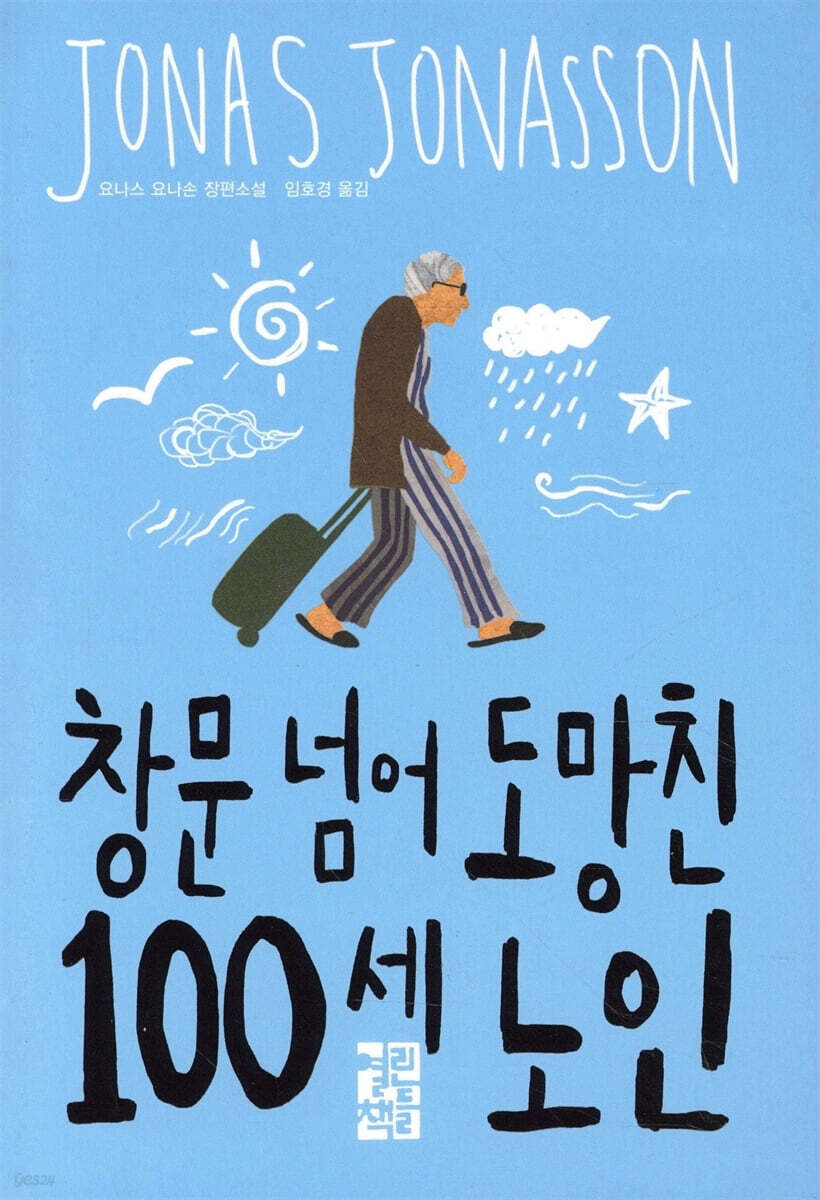
The 100-Year-Old Man Who Climbed Out the Window and Disappeared, a novel by Swedish author Jonas Jonasson.
This novel, a late debut work by an author who has worked as a reporter and producer for many years, sold over 1 million copies in Sweden, a country with a population of 9 million, and over 5 million copies worldwide, creating the [Century Old Man Phenomenon].
Even now, translated versions are being published one after another in countries around the world, and it has even been made into a movie, so this centenarian craze is expected to continue.
"The Hundred-Year-Old Man Who Climbed Out the Window and Disappeared" is a comical and delightful work that depicts the life of a protagonist born in a rural Swedish village in 1905 over the past hundred years.
The protagonist's actions, which unintentionally intervene in key scenes of rapidly changing modern history and change the course of history, draw readers into the vivid scenes of history.
The constant coincidences and exaggerated settings may at times feel absurd, but amidst the endless bursts of laughter, it is a light read but leaves a deep impression, making you ponder what ideology is, what religion is, and what our lives are.
For 100 years, I have traveled the world and unintentionally found myself in the middle of history.
The old man who got stuck in the middle of a stomachache goes on an adventure for 101 years!
2010 Swedish Bestseller Award
2012 Best Writer by Germany's Buchmarkt
Amazon UK's Top 10 Books of 2012
2011 German M-Pioneer Award
2011 Danish Audiobook Award
2012 French Escapade Award
A work of immense imagination that will have you laughing nonstop - The Telegraph
A comedy with explosive power like dynamite - Le Figaro
The 100-Year-Old Man Who Climbed Out the Window and Disappeared, a novel by Swedish author Jonas Jonasson.
This novel, a late debut work by an author who has worked as a reporter and producer for many years, sold over 1 million copies in Sweden, a country with a population of 9 million, and over 5 million copies worldwide, creating the [Century Old Man Phenomenon].
Even now, translated versions are being published one after another in countries around the world, and it has even been made into a movie, so this centenarian craze is expected to continue.
"The Hundred-Year-Old Man Who Climbed Out the Window and Disappeared" is a comical and delightful work that depicts the life of a protagonist born in a rural Swedish village in 1905 over the past hundred years.
The protagonist's actions, which unintentionally intervene in key scenes of rapidly changing modern history and change the course of history, draw readers into the vivid scenes of history.
The constant coincidences and exaggerated settings may at times feel absurd, but amidst the endless bursts of laughter, it is a light read but leaves a deep impression, making you ponder what ideology is, what religion is, and what our lives are.
- You can preview some of the book's contents.
Preview
Into the book
The old man asked himself why he had thought of stealing the trunk.
Was it simply because the opportunity presented itself? Or because the owner was a thug? Or because he was hoping the trunk might contain a pair of shoes, or even a hat? Or because he had nothing to lose? Seriously, he couldn't tell which of these was the right answer.
Well, when life enters overtime, it's okay to be fickle sometimes...
That was the conclusion he reached as he settled comfortably into his seat.
--- pp.15~16
Then Julius placed the trunk on the kitchen table and examined the lock.
He licked the fork he had used to eat the moose steak with his potatoes and then poked it into the lock hole, but the lock didn't hold for more than a few seconds.
He advised Alan to open it himself, saying that he was the one who stole it.
“Where is yours and mine between us?” Alan retorted.
“We will split what we get exactly in half.
But if there's a pair of shoes in here that fits me, I'll take them.
Alan lifted the trunk lid.
“Oh my god!” Alan shouted.
“Oh my god!” Julius also gaped.
--- pp.35~36
"President Truman would like to know the correct spelling of your name.
"Would you like to speak to him directly?" Alan said to Berikvist.
After spelling his name out to the President of the United States in a near-trance, Third Secretary Barekvist hung up the phone and remained silent for at least eight minutes.
Those eight minutes were the time it took Prime Minister Tae Erlander to call Bergqvist, the third secretary at the Swedish embassy in Tehran, to issue two directives.
First, issue a diplomatic passport to Alan Karlsson immediately.
Second, we will take steps to ensure Mr. Karlsson's prompt return to his home country.
“But this person doesn’t even have a resident registration number,” Third Secretary Berikvist cried.
“Let the third secretary take care of that matter.
"Unless you want to be the Fourth Secretary or the Fifth Secretary," Prime Minister Elander snapped.
“But there is no such thing as a fourth secretary.
There is no fifth secretary either… … .」
"So what's the conclusion?" --- p.234
Could China be the answer? If Alan and Herbert were wearing black-and-white striped jumpsuits, the answer would be no, but things are different now.
Since Alan's transformation into the Marshal of the Soviet Union, Korea's powerful neighbor has changed from a [threat] to a [promise].
It would be the icing on the cake if Kim Il-sung wrote a nice letter of introduction.
(……) Alan thought that this plan was sufficient.
First, we will present 300 tanks to Kim Il-sung.
No, 400 would be fine too.
There is absolutely no reason to be petty.
Then I will respectfully ask Comrade Chairman.
I have business with Comrade Mao Zedong, so please arrange transportation and a visa to get to China.
Alan was satisfied with his flawless plan.
Was it simply because the opportunity presented itself? Or because the owner was a thug? Or because he was hoping the trunk might contain a pair of shoes, or even a hat? Or because he had nothing to lose? Seriously, he couldn't tell which of these was the right answer.
Well, when life enters overtime, it's okay to be fickle sometimes...
That was the conclusion he reached as he settled comfortably into his seat.
--- pp.15~16
Then Julius placed the trunk on the kitchen table and examined the lock.
He licked the fork he had used to eat the moose steak with his potatoes and then poked it into the lock hole, but the lock didn't hold for more than a few seconds.
He advised Alan to open it himself, saying that he was the one who stole it.
“Where is yours and mine between us?” Alan retorted.
“We will split what we get exactly in half.
But if there's a pair of shoes in here that fits me, I'll take them.
Alan lifted the trunk lid.
“Oh my god!” Alan shouted.
“Oh my god!” Julius also gaped.
--- pp.35~36
"President Truman would like to know the correct spelling of your name.
"Would you like to speak to him directly?" Alan said to Berikvist.
After spelling his name out to the President of the United States in a near-trance, Third Secretary Barekvist hung up the phone and remained silent for at least eight minutes.
Those eight minutes were the time it took Prime Minister Tae Erlander to call Bergqvist, the third secretary at the Swedish embassy in Tehran, to issue two directives.
First, issue a diplomatic passport to Alan Karlsson immediately.
Second, we will take steps to ensure Mr. Karlsson's prompt return to his home country.
“But this person doesn’t even have a resident registration number,” Third Secretary Berikvist cried.
“Let the third secretary take care of that matter.
"Unless you want to be the Fourth Secretary or the Fifth Secretary," Prime Minister Elander snapped.
“But there is no such thing as a fourth secretary.
There is no fifth secretary either… … .」
"So what's the conclusion?" --- p.234
Could China be the answer? If Alan and Herbert were wearing black-and-white striped jumpsuits, the answer would be no, but things are different now.
Since Alan's transformation into the Marshal of the Soviet Union, Korea's powerful neighbor has changed from a [threat] to a [promise].
It would be the icing on the cake if Kim Il-sung wrote a nice letter of introduction.
(……) Alan thought that this plan was sufficient.
First, we will present 300 tanks to Kim Il-sung.
No, 400 would be fine too.
There is absolutely no reason to be petty.
Then I will respectfully ask Comrade Chairman.
I have business with Comrade Mao Zedong, so please arrange transportation and a visa to get to China.
Alan was satisfied with his flawless plan.
--- p.341
Publisher's Review
A super bestseller with over 5 million copies sold worldwide
For 100 years, I have traveled the world and unintentionally found myself in the middle of history.
The old man who got stuck in the middle of a stomachache goes on an adventure for 101 years!
2010 Swedish Bestseller Award
2011 German M-Pioneer Award
2012 Best Writer by Germany's Buchmarkt
2011 Danish Audiobook Award
2012 French Escapade Award
A work of immense imagination that will have you laughing nonstop _ The Telegraph
A comedy with explosive power like dynamite _ Le Figaro
Swedish author Jonas Jonasson's novel, The Hundred-Year-Old Man Who Climbed Out the Window and Disappeared, has been published by Open Books.
This novel, a late debut work by an author who has worked as a reporter and producer for many years, sold over 1 million copies in Sweden, a country with a population of 9 million, and over 5 million copies worldwide, creating the [Century Old Man Phenomenon].
Even now, translated versions are being published one after another in countries around the world, and it is even being made into a movie, so this centenarian craze is expected to continue.
"The Hundred-Year-Old Man Who Climbed Out the Window and Disappeared" is a comical and delightful work that depicts the life of a protagonist born in a rural Swedish village in 1905 over the past hundred years.
The protagonist's actions, which unintentionally intervene in key scenes of rapidly changing modern history and change the course of history, draw readers into the vivid scenes of history.
The constant coincidences and exaggerated settings may at times feel absurd, but amidst the endless bursts of laughter, it is a light read but leaves a deep impression, making you ponder what ideology is, what religion is, and what our lives are.
A story where the present and past intersect lively
The story unfolds in two parts: one begins in the present, when Alan, an old man who has just turned 100, runs away from his 100th birthday party, and the other tells the story of his life over the past 100 years.
Watching the story of a man who sets out on a new life on his 100th birthday and the intersecting events of a century of world history, it feels like watching a comic mystery road movie and a digest of world history at the same time.
The story begins with Alan escaping from a nursing home on May 2, 2005, his 100th birthday.
Instead of repeating to myself, “I should just die now,” I decided to enjoy life as it entered [extra time].
The first place he went after leaving the nursing home was the bus terminal.
There, he accidentally gets his hands on a bag of money belonging to a certain gang, and starts running away to escape the group chasing him.
Along the way, a motley crew joins him on his journey, including Julius, who has been a petty conman his entire life, Benny, who [almost] earned dozens of degrees, and Gunilla, the [pretty older sister] who raises elephants.
Meanwhile, a small Swedish town is thrown into chaos by the disappearance of an old man, and a detective is dispatched to find him.
A group of centenarians, a gang chasing them, and the police following their trail again.
Unlike the usual chase, this game of tag, where the runner has a lot of free time, is refreshingly fun.
Another axis of the novel, paired with the old man's adventures during his escape, is the story of the hundred years he has lived.
After losing his parents at a young age and getting a job at an explosives company, Alan, thanks to the skills required by the harsh times, ends up living a life that a Swedish country bumpkin could never have imagined.
He left his hometown just to see [the Negro] once, and he saved General Franco's life in the Spanish Civil War, gave American scientists a crucial clue to making the atomic bomb, saved Mao Zedong's wife from danger, fell into disfavor with Stalin and was sent to Vladivostok for hard labor, and escaped to North Korea, where he met Kim Il-sung and a young Kim Jong-il.
Alan's optimistic and relaxed attitude, even amidst a series of tremendous events and hardships, makes readers think about what happiness is and whether anything can suppress the free will to live a happy life.
Political neutrality that mocks the traps of ideology
Alan's philosophy in the work is simple and clear.
He wants nothing more in this world than plenty of food and drink, and he hates talk of politics and religion more than anything else.
In an era where everything was driven by ideology, his appearance of not having any political views and moving according to his heart's desire at the time felt rather unrealistic.
The character, who meets world-famous celebrities by chance and gets caught up in a major historical event, but has no real political views, is reminiscent of the movie "Forrest Gump" directed by Robert Zemeckis.
Forrest Gump, who is portrayed as a retarded person with low intelligence, or Alan, who is not stupid but refuses to make political judgments, can be seen as the most effective device to criticize many politicians who approach everything from a political perspective and exclude the most important [human] people.
Readers can deeply agree with Alan's philosophy and adventures, as if he had lived a hundred years without much thought, because they instinctively understand that the most important thing in this world is each person's life and happiness, and that it is unacceptable for this life and happiness to be suppressed or imprisoned in the name of anything.
The fun of encountering key scenes from modern history
The greatest virtue of this work is, without a doubt, its ability to provide a glimpse into the major events of modern world history in a single novel.
As you follow Alan's life with bated breath, the major events of modern history will soon take root in your mind.
The heated nuclear weapons development race during World War II is an interesting example.
The United States, which developed the world's first nuclear bomb, actually found the key to nuclear explosion with Alan's help, and then Russia succeeded in developing nuclear weapons when Alan leaked information while drunk.
Also, through his adventures, we can get a glimpse into the public sentiment at the time, how the Kuomintang, which initially had an overwhelming advantage, ended up losing to the Communists in the Chinese Civil War.
The part that Korean readers will be most interested in is the part where Alan meets Kim Il-sung and Kim Jong-il.
In this scene, Alan's lies to the young Kim Jong-il are exposed, which becomes a decisive turning point for Kim Jong-il to not be able to trust anyone later on.
After all, if Alan had not existed, the world, and even the history of the Korean Peninsula, might have been completely different.
For 100 years, I have traveled the world and unintentionally found myself in the middle of history.
The old man who got stuck in the middle of a stomachache goes on an adventure for 101 years!
2010 Swedish Bestseller Award
2011 German M-Pioneer Award
2012 Best Writer by Germany's Buchmarkt
2011 Danish Audiobook Award
2012 French Escapade Award
A work of immense imagination that will have you laughing nonstop _ The Telegraph
A comedy with explosive power like dynamite _ Le Figaro
Swedish author Jonas Jonasson's novel, The Hundred-Year-Old Man Who Climbed Out the Window and Disappeared, has been published by Open Books.
This novel, a late debut work by an author who has worked as a reporter and producer for many years, sold over 1 million copies in Sweden, a country with a population of 9 million, and over 5 million copies worldwide, creating the [Century Old Man Phenomenon].
Even now, translated versions are being published one after another in countries around the world, and it is even being made into a movie, so this centenarian craze is expected to continue.
"The Hundred-Year-Old Man Who Climbed Out the Window and Disappeared" is a comical and delightful work that depicts the life of a protagonist born in a rural Swedish village in 1905 over the past hundred years.
The protagonist's actions, which unintentionally intervene in key scenes of rapidly changing modern history and change the course of history, draw readers into the vivid scenes of history.
The constant coincidences and exaggerated settings may at times feel absurd, but amidst the endless bursts of laughter, it is a light read but leaves a deep impression, making you ponder what ideology is, what religion is, and what our lives are.
A story where the present and past intersect lively
The story unfolds in two parts: one begins in the present, when Alan, an old man who has just turned 100, runs away from his 100th birthday party, and the other tells the story of his life over the past 100 years.
Watching the story of a man who sets out on a new life on his 100th birthday and the intersecting events of a century of world history, it feels like watching a comic mystery road movie and a digest of world history at the same time.
The story begins with Alan escaping from a nursing home on May 2, 2005, his 100th birthday.
Instead of repeating to myself, “I should just die now,” I decided to enjoy life as it entered [extra time].
The first place he went after leaving the nursing home was the bus terminal.
There, he accidentally gets his hands on a bag of money belonging to a certain gang, and starts running away to escape the group chasing him.
Along the way, a motley crew joins him on his journey, including Julius, who has been a petty conman his entire life, Benny, who [almost] earned dozens of degrees, and Gunilla, the [pretty older sister] who raises elephants.
Meanwhile, a small Swedish town is thrown into chaos by the disappearance of an old man, and a detective is dispatched to find him.
A group of centenarians, a gang chasing them, and the police following their trail again.
Unlike the usual chase, this game of tag, where the runner has a lot of free time, is refreshingly fun.
Another axis of the novel, paired with the old man's adventures during his escape, is the story of the hundred years he has lived.
After losing his parents at a young age and getting a job at an explosives company, Alan, thanks to the skills required by the harsh times, ends up living a life that a Swedish country bumpkin could never have imagined.
He left his hometown just to see [the Negro] once, and he saved General Franco's life in the Spanish Civil War, gave American scientists a crucial clue to making the atomic bomb, saved Mao Zedong's wife from danger, fell into disfavor with Stalin and was sent to Vladivostok for hard labor, and escaped to North Korea, where he met Kim Il-sung and a young Kim Jong-il.
Alan's optimistic and relaxed attitude, even amidst a series of tremendous events and hardships, makes readers think about what happiness is and whether anything can suppress the free will to live a happy life.
Political neutrality that mocks the traps of ideology
Alan's philosophy in the work is simple and clear.
He wants nothing more in this world than plenty of food and drink, and he hates talk of politics and religion more than anything else.
In an era where everything was driven by ideology, his appearance of not having any political views and moving according to his heart's desire at the time felt rather unrealistic.
The character, who meets world-famous celebrities by chance and gets caught up in a major historical event, but has no real political views, is reminiscent of the movie "Forrest Gump" directed by Robert Zemeckis.
Forrest Gump, who is portrayed as a retarded person with low intelligence, or Alan, who is not stupid but refuses to make political judgments, can be seen as the most effective device to criticize many politicians who approach everything from a political perspective and exclude the most important [human] people.
Readers can deeply agree with Alan's philosophy and adventures, as if he had lived a hundred years without much thought, because they instinctively understand that the most important thing in this world is each person's life and happiness, and that it is unacceptable for this life and happiness to be suppressed or imprisoned in the name of anything.
The fun of encountering key scenes from modern history
The greatest virtue of this work is, without a doubt, its ability to provide a glimpse into the major events of modern world history in a single novel.
As you follow Alan's life with bated breath, the major events of modern history will soon take root in your mind.
The heated nuclear weapons development race during World War II is an interesting example.
The United States, which developed the world's first nuclear bomb, actually found the key to nuclear explosion with Alan's help, and then Russia succeeded in developing nuclear weapons when Alan leaked information while drunk.
Also, through his adventures, we can get a glimpse into the public sentiment at the time, how the Kuomintang, which initially had an overwhelming advantage, ended up losing to the Communists in the Chinese Civil War.
The part that Korean readers will be most interested in is the part where Alan meets Kim Il-sung and Kim Jong-il.
In this scene, Alan's lies to the young Kim Jong-il are exposed, which becomes a decisive turning point for Kim Jong-il to not be able to trust anyone later on.
After all, if Alan had not existed, the world, and even the history of the Korean Peninsula, might have been completely different.
GOODS SPECIFICS
- Date of publication: July 25, 2013
- Page count, weight, size: 512 pages | 700g | 128*188*35mm
- ISBN13: 9788932916194
- ISBN10: 8932916195
You may also like
카테고리
korean


korean

![GQ KOREA Mark (Monthly): December [2025]](http://librairie.coreenne.fr/cdn/shop/files/8ef265dbbfbf186523ed75ba7319009d.jpg?v=1765340328&width=3840)


