

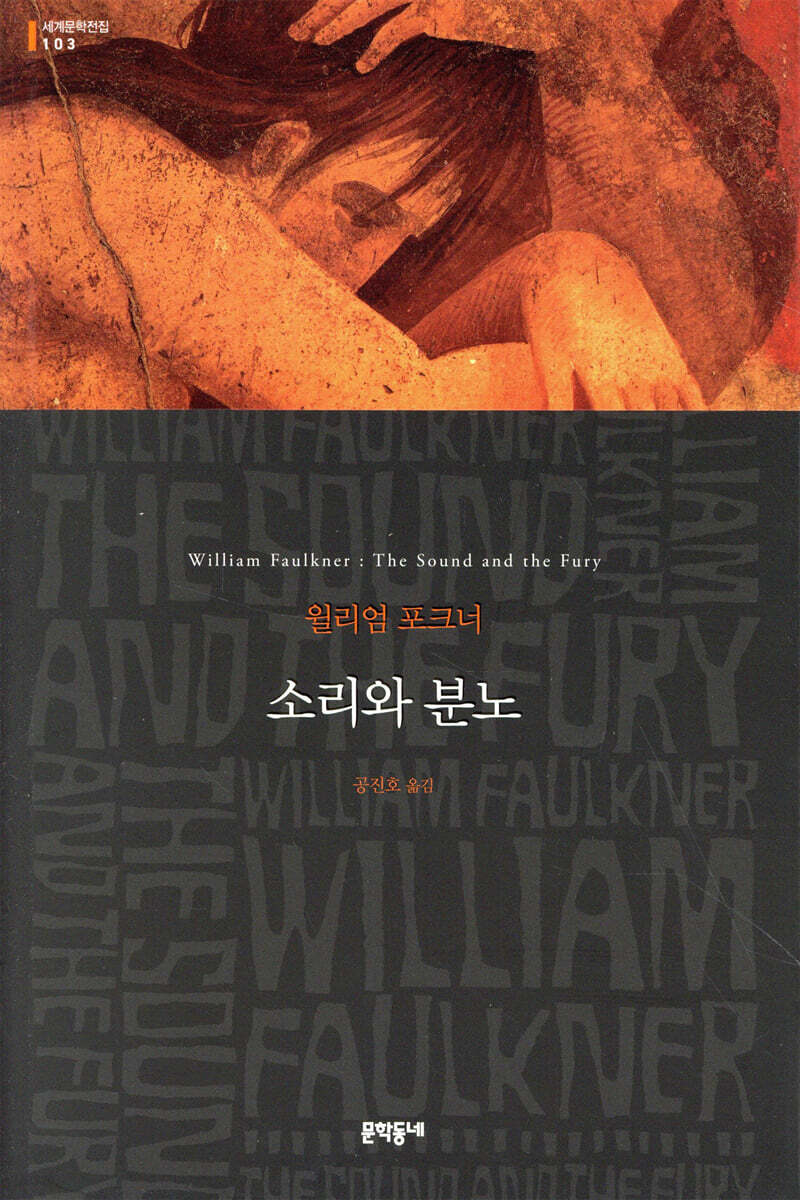
Sound and Fury
 |
Description
Book Introduction
Experimental narrative techniques, intense visual language
The landscape of 20th century modern literature changed
William Faulkner's greatest masterpiece
Faulkner's greatest novel, depicting the gradual disintegration of Southern society after the Civil War through the spiritual and class decline of the Compson family, a prominent Southern family, over a period of 20 years.
This work is considered the pinnacle of modernist novels, which declared a break with tradition in the early 20th century when doubts were being raised about the moral foundations and sustainability of Western civilization and attempted to impose order on the “vast panorama of nihilism and disorder” by using “stream of consciousness, fragmented narrative, multiple narrative perspectives, and conflicting notions of time and the past.”
The story reconstructs the memories of major events that occurred between 1910 and 1928, with three of the four Compson siblings and their black maid, Dilsey, each serving as a narrator.
The title, "The Sound and the Fury," comes from Macbeth's famous soliloquy in Act 5, Scene 5 of Shakespeare's play "Macbeth," when he hears that his wife has committed suicide: "...it is a fool's / babble, full of sound and fury, / And without any meaning."
The landscape of 20th century modern literature changed
William Faulkner's greatest masterpiece
Faulkner's greatest novel, depicting the gradual disintegration of Southern society after the Civil War through the spiritual and class decline of the Compson family, a prominent Southern family, over a period of 20 years.
This work is considered the pinnacle of modernist novels, which declared a break with tradition in the early 20th century when doubts were being raised about the moral foundations and sustainability of Western civilization and attempted to impose order on the “vast panorama of nihilism and disorder” by using “stream of consciousness, fragmented narrative, multiple narrative perspectives, and conflicting notions of time and the past.”
The story reconstructs the memories of major events that occurred between 1910 and 1928, with three of the four Compson siblings and their black maid, Dilsey, each serving as a narrator.
The title, "The Sound and the Fury," comes from Macbeth's famous soliloquy in Act 5, Scene 5 of Shakespeare's play "Macbeth," when he hears that his wife has committed suicide: "...it is a fool's / babble, full of sound and fury, / And without any meaning."
- You can preview some of the book's contents.
Preview
index
time
April 7, 1928
June 2, 1910
April 6, 1928
April 8, 1928
Commentary | A masterpiece of "dizzying modernism"
William Faulkner Chronology
April 7, 1928
June 2, 1910
April 6, 1928
April 8, 1928
Commentary | A masterpiece of "dizzying modernism"
William Faulkner Chronology
Publisher's Review
Experimental narrative techniques, intense visual language
The landscape of 20th century modern literature changed
William Faulkner's greatest masterpiece
“William Faulkner’s contribution to modern American fiction is not only immense but artistically unparalleled.” Reason for selecting him for the Nobel Prize in Literature
★ 1949 Nobel Prize in Literature
★ Time's 100 Best English Novels
★ Le Monde's 100 Best Books of the 20th Century
★ Modern Library's 100 Greatest English Novels of the 20th Century
A masterpiece of "dizzying modernism" that changed the landscape of 20th-century modern literature.
William Faulkner, along with Ernest Hemingway, Scott Fitzgerald, and John Dospass, represents the 'Lost Generation' and is one of the greatest writers of the 20th century who led Western modernist literature along with James Joyce, Virginia Woolf, and Marcel Proust.
Modernism, which emerged in the late 19th century and reached its peak in the 1920s, became skeptical of the “moral foundations and permanence of Western civilization” after witnessing World War I, and writers introduced experimental techniques that “dismantled the continuity of narrative, deviated from the norms of character portrayal, and ignored the syntax and unity of traditional narrative” as a means of expressing the changed world and values.
Faulkner also attempted a new literary form never seen before by combining 'unconventional narrative style' and 'stream of consciousness' and continuing various linguistic experiments, and by publishing 'The Sound and the Fury' in 1929, which is considered the pinnacle of modernist novels, he shook up the landscape of 20th-century modern literature.
"The Sound and the Fury" is Faulkner's greatest masterpiece, which vividly depicts the economic and spiritual disintegration and corruption of Southern society after its defeat in the Civil War through the Compson family, a large landowning family in the fictional land of Jefferson. The technique of "stream of consciousness, fragmented narrative, multiple narrative perspectives, and the construction of time and the past through conflicting ideas" is realized in Faulkner's characteristically strong visual language.
It is structured as a “four-movement symphony,” and is divided into four chapters: one narrated in the first person by the eldest of the four Compson siblings, Quentin, the third, Jason, and the youngest, Benji, and the last chapter written from the omniscient author’s perspective. The events that play a major role in the Compson family’s downfall are repeated, narrated, and reconstructed by different narrators.
A metaphysics of time that challenges the vast panorama of nothingness and disorder
Chapter 1 is called 'The Benji Section' after the narrator, Benji.
Benji is thirty-three years old but has a developmental disability with the mental age of a three-year-old. The world he portrays through his eyes is abnormal and ungrammatical, but it is a world with “the unexpected kind of poetry you find in a child without preconceptions.”
And it is a “simply conceptual world governed by sight.”
Therefore, readers who are accustomed to the language and thinking of normal people are bewildered and confused by Benji's language and vocabulary that go beyond the understanding of the average person from the very first sentence.
I could see them striking through the crevices of the fence and the winding flower beds. (Page 9)
(…) We ran through the bright, rustling leaves.
We ran up the stairs, out of the bright cold and into the dark cold. (Page 14)
In Benji's world, there is no cause and effect or purpose.
There is only sensation and observation.
Benji doesn't use language.
One must think that Faulkner is looking into Benji's mind at the moment he experiences the world and capturing the 'images' that are swirling around inside him.
So, “Benji’s narrative is almost entirely visual, image-based.” (…) “The novel does not describe the real world so much as create a plausible story and persuade the reader to ‘believe’ it.” To do so, Faulkner creates and narrates in an unusual ‘idiot’s language.’
And the reader believes that it is Benji's language. (Commentary, p. 426)
Moreover, the events described and conveyed through Benji's perspective do not have a consistent flow of time.
Chapter 2 Benji's section, along with the Quentin section, frequently uses unusual grammar, sentence structure, and punctuation, and there are frequent time jumps, making it difficult for readers to find the hidden meaning behind what is written in words.
The boundary between present and past is ambiguous, the past is refracted and distorted by the protagonists' present, and the present cannot escape the memories and experiences of the past.
In this novel, which depicts a total of 14 time zones, readers are suddenly transported to incomprehensible times and spaces as if riding a time machine. In the process, Faulkner throws the readers into further confusion through changes in font color, insertion of margins in the middle of sentences, and omission of punctuation marks without providing any clues.
Meanwhile, in Chapter 2, the narrator Quentin sinks deep into his inner self and falls into chaos, “losing his self and completely losing control of the narrative,” and the disintegration of sentences and meanings on a different level from the Benji section takes place, and the difficulty of Faulkner’s novel reaches its peak.
He sells his younger brother Benji's land and enters Harvard with the expectation that he will revive the Compson family, but Quentin, a "romantic idealist," cannot endure reality.
He is unable to escape the memories of his past, which are summarized as 'his younger sister's caddy', and walks the path of self-division.
He is obsessed with time, constantly running away from it and trying to forget it.
I can see the shadow of the window frame on the curtains, so it must be between seven and eight o'clock, and as I hear the clock chime, I am once again in time.
The watch was my grandfather's, and my father gave it to me, saying, (…) I am not giving it to you so that you will remember time, but so that you will sometimes forget time for a moment, and not spend your whole life trying to conquer time.
That's because no one wins the battle against time.
The fight doesn't even start.
The battlefield only reveals human folly and despair, and victory is the delusion of philosophers and fools. (Main text, pp. 101-102)
Let me be for a little while so that others don't define your happiness. Father, the past tense of existence is the saddest word. There is no sadder word in the world. Despair can only exist as time passes. Even time is not time if its existence does not become the past. (Main text, p. 237)
Meanwhile, Jason, the narrator of Chapter 3, is “chasing time and trying to keep up with it,” in contrast to Quentin.
Jason, who had to become the head of the household and lead it after his family fell into ruin, is a rather realistic and cynical character.
He is self-centered, cunning and narrow-minded, calculating everything.
His world is not a world of ideals and concepts, but a world of material things and profit and loss.
He calculates everything.
(…) He calculates and calculates again, racing against time, but (…) his predictable world crumbles in the process of chasing his nephew Quentin. (Page 237)
In this abnormal life of the Compson family, the only one who knows the importance of love and honor and supports the Compson family is Dilsey, a black woman who raised the four Compson children and is in charge of household affairs.
Dilji, who appears as a central character only in Chapter 4, which is narrated from the omniscient author's point of view, "overturns the reader's expectations.
She is not the stereotypical black nanny or housekeeper, fit and obedient.
“She is both patient and resistant.” And only after Dilji’s story is over, after the four narrators, each of whom is like a short story, each narrating the same major events from different perspectives, have finished their statements, do the readers complete the puzzle of what happened in the Compson household over the course of twenty years as it slowly fell into decline.
Faulkner was born into a prominent Mississippi family in decline at the end of the 19th century.
He grew up listening to stories of his great-grandfather, a Confederate hero, businessman, politician, and writer who was assassinated by his political enemies during the Civil War, and developed a keen interest in his family and Southern history. His black nanny, who raised him, opened his eyes to the politics of race and gender.
Since then, he has devoted his life to reconstructing the history and values of the South and reconstructing the reality of the South, and by adding imagination to his own history, he created a microcosm of Southern society called Yoknapatawpha County.
And now, at the beginning of 2013, we encounter a new world of beauty and despair, destruction and creation, embodied in this microcosm called The Sound and the Fury.
This is more than just a magnificent work of literature, featuring a remarkable narrative technique that changed the landscape of 20th-century modern literature and a powerful visual and musical language; it is a condensed history of an era imbued with universal human life and humanism.
● Overseas book reviews
It's a masterpiece that I can't rewrite.
William Faulkner
The Sound and the Fury is the work that has had the greatest influence on me.
Orhan Pamuk
The Sound and the Fury alone is enough to prove the genius of Faulkner, one of the most important novelists of the 20th century.
André Blecastin (Faulkner researcher)
The greatest writer America has ever produced.
He is a writer who occupies a unique position in 20th-century literature and one of the rare creators in the history of Western literature.
Albert Camus
To the youth of France, Faulkner is a god.
Jean-Paul Sartre
He is the Balzac born in America.
Frederick R.
Karl (literary critic)
No one poured his heart and soul into the written word as much as William Faulkner.
His heart and soul still live on in the novels he wrote.
Eudora Welty (author, 1973 Pulitzer Prize winner)
Faulkner uses language better than anyone who has ever put pen to paper.
Marilynne Robinson (author, 2005 Pulitzer Prize winner)
William Faulkner completely changed the landscape of American literature.
The New York Times
He is a writer who explores human nature.
The greatness of the classics lies in their consistent pursuit of such moral goals.
So we have to go back to Faulkner.
Ralph Ellison (novelist)
A clear masterpiece of the 'art of fiction'... ...a novelist's novel... ...a textbook on novel writing.
Conrad Aitken (novelist, poet)
The landscape of 20th century modern literature changed
William Faulkner's greatest masterpiece
“William Faulkner’s contribution to modern American fiction is not only immense but artistically unparalleled.” Reason for selecting him for the Nobel Prize in Literature
★ 1949 Nobel Prize in Literature
★ Time's 100 Best English Novels
★ Le Monde's 100 Best Books of the 20th Century
★ Modern Library's 100 Greatest English Novels of the 20th Century
A masterpiece of "dizzying modernism" that changed the landscape of 20th-century modern literature.
William Faulkner, along with Ernest Hemingway, Scott Fitzgerald, and John Dospass, represents the 'Lost Generation' and is one of the greatest writers of the 20th century who led Western modernist literature along with James Joyce, Virginia Woolf, and Marcel Proust.
Modernism, which emerged in the late 19th century and reached its peak in the 1920s, became skeptical of the “moral foundations and permanence of Western civilization” after witnessing World War I, and writers introduced experimental techniques that “dismantled the continuity of narrative, deviated from the norms of character portrayal, and ignored the syntax and unity of traditional narrative” as a means of expressing the changed world and values.
Faulkner also attempted a new literary form never seen before by combining 'unconventional narrative style' and 'stream of consciousness' and continuing various linguistic experiments, and by publishing 'The Sound and the Fury' in 1929, which is considered the pinnacle of modernist novels, he shook up the landscape of 20th-century modern literature.
"The Sound and the Fury" is Faulkner's greatest masterpiece, which vividly depicts the economic and spiritual disintegration and corruption of Southern society after its defeat in the Civil War through the Compson family, a large landowning family in the fictional land of Jefferson. The technique of "stream of consciousness, fragmented narrative, multiple narrative perspectives, and the construction of time and the past through conflicting ideas" is realized in Faulkner's characteristically strong visual language.
It is structured as a “four-movement symphony,” and is divided into four chapters: one narrated in the first person by the eldest of the four Compson siblings, Quentin, the third, Jason, and the youngest, Benji, and the last chapter written from the omniscient author’s perspective. The events that play a major role in the Compson family’s downfall are repeated, narrated, and reconstructed by different narrators.
A metaphysics of time that challenges the vast panorama of nothingness and disorder
Chapter 1 is called 'The Benji Section' after the narrator, Benji.
Benji is thirty-three years old but has a developmental disability with the mental age of a three-year-old. The world he portrays through his eyes is abnormal and ungrammatical, but it is a world with “the unexpected kind of poetry you find in a child without preconceptions.”
And it is a “simply conceptual world governed by sight.”
Therefore, readers who are accustomed to the language and thinking of normal people are bewildered and confused by Benji's language and vocabulary that go beyond the understanding of the average person from the very first sentence.
I could see them striking through the crevices of the fence and the winding flower beds. (Page 9)
(…) We ran through the bright, rustling leaves.
We ran up the stairs, out of the bright cold and into the dark cold. (Page 14)
In Benji's world, there is no cause and effect or purpose.
There is only sensation and observation.
Benji doesn't use language.
One must think that Faulkner is looking into Benji's mind at the moment he experiences the world and capturing the 'images' that are swirling around inside him.
So, “Benji’s narrative is almost entirely visual, image-based.” (…) “The novel does not describe the real world so much as create a plausible story and persuade the reader to ‘believe’ it.” To do so, Faulkner creates and narrates in an unusual ‘idiot’s language.’
And the reader believes that it is Benji's language. (Commentary, p. 426)
Moreover, the events described and conveyed through Benji's perspective do not have a consistent flow of time.
Chapter 2 Benji's section, along with the Quentin section, frequently uses unusual grammar, sentence structure, and punctuation, and there are frequent time jumps, making it difficult for readers to find the hidden meaning behind what is written in words.
The boundary between present and past is ambiguous, the past is refracted and distorted by the protagonists' present, and the present cannot escape the memories and experiences of the past.
In this novel, which depicts a total of 14 time zones, readers are suddenly transported to incomprehensible times and spaces as if riding a time machine. In the process, Faulkner throws the readers into further confusion through changes in font color, insertion of margins in the middle of sentences, and omission of punctuation marks without providing any clues.
Meanwhile, in Chapter 2, the narrator Quentin sinks deep into his inner self and falls into chaos, “losing his self and completely losing control of the narrative,” and the disintegration of sentences and meanings on a different level from the Benji section takes place, and the difficulty of Faulkner’s novel reaches its peak.
He sells his younger brother Benji's land and enters Harvard with the expectation that he will revive the Compson family, but Quentin, a "romantic idealist," cannot endure reality.
He is unable to escape the memories of his past, which are summarized as 'his younger sister's caddy', and walks the path of self-division.
He is obsessed with time, constantly running away from it and trying to forget it.
I can see the shadow of the window frame on the curtains, so it must be between seven and eight o'clock, and as I hear the clock chime, I am once again in time.
The watch was my grandfather's, and my father gave it to me, saying, (…) I am not giving it to you so that you will remember time, but so that you will sometimes forget time for a moment, and not spend your whole life trying to conquer time.
That's because no one wins the battle against time.
The fight doesn't even start.
The battlefield only reveals human folly and despair, and victory is the delusion of philosophers and fools. (Main text, pp. 101-102)
Let me be for a little while so that others don't define your happiness. Father, the past tense of existence is the saddest word. There is no sadder word in the world. Despair can only exist as time passes. Even time is not time if its existence does not become the past. (Main text, p. 237)
Meanwhile, Jason, the narrator of Chapter 3, is “chasing time and trying to keep up with it,” in contrast to Quentin.
Jason, who had to become the head of the household and lead it after his family fell into ruin, is a rather realistic and cynical character.
He is self-centered, cunning and narrow-minded, calculating everything.
His world is not a world of ideals and concepts, but a world of material things and profit and loss.
He calculates everything.
(…) He calculates and calculates again, racing against time, but (…) his predictable world crumbles in the process of chasing his nephew Quentin. (Page 237)
In this abnormal life of the Compson family, the only one who knows the importance of love and honor and supports the Compson family is Dilsey, a black woman who raised the four Compson children and is in charge of household affairs.
Dilji, who appears as a central character only in Chapter 4, which is narrated from the omniscient author's point of view, "overturns the reader's expectations.
She is not the stereotypical black nanny or housekeeper, fit and obedient.
“She is both patient and resistant.” And only after Dilji’s story is over, after the four narrators, each of whom is like a short story, each narrating the same major events from different perspectives, have finished their statements, do the readers complete the puzzle of what happened in the Compson household over the course of twenty years as it slowly fell into decline.
Faulkner was born into a prominent Mississippi family in decline at the end of the 19th century.
He grew up listening to stories of his great-grandfather, a Confederate hero, businessman, politician, and writer who was assassinated by his political enemies during the Civil War, and developed a keen interest in his family and Southern history. His black nanny, who raised him, opened his eyes to the politics of race and gender.
Since then, he has devoted his life to reconstructing the history and values of the South and reconstructing the reality of the South, and by adding imagination to his own history, he created a microcosm of Southern society called Yoknapatawpha County.
And now, at the beginning of 2013, we encounter a new world of beauty and despair, destruction and creation, embodied in this microcosm called The Sound and the Fury.
This is more than just a magnificent work of literature, featuring a remarkable narrative technique that changed the landscape of 20th-century modern literature and a powerful visual and musical language; it is a condensed history of an era imbued with universal human life and humanism.
● Overseas book reviews
It's a masterpiece that I can't rewrite.
William Faulkner
The Sound and the Fury is the work that has had the greatest influence on me.
Orhan Pamuk
The Sound and the Fury alone is enough to prove the genius of Faulkner, one of the most important novelists of the 20th century.
André Blecastin (Faulkner researcher)
The greatest writer America has ever produced.
He is a writer who occupies a unique position in 20th-century literature and one of the rare creators in the history of Western literature.
Albert Camus
To the youth of France, Faulkner is a god.
Jean-Paul Sartre
He is the Balzac born in America.
Frederick R.
Karl (literary critic)
No one poured his heart and soul into the written word as much as William Faulkner.
His heart and soul still live on in the novels he wrote.
Eudora Welty (author, 1973 Pulitzer Prize winner)
Faulkner uses language better than anyone who has ever put pen to paper.
Marilynne Robinson (author, 2005 Pulitzer Prize winner)
William Faulkner completely changed the landscape of American literature.
The New York Times
He is a writer who explores human nature.
The greatness of the classics lies in their consistent pursuit of such moral goals.
So we have to go back to Faulkner.
Ralph Ellison (novelist)
A clear masterpiece of the 'art of fiction'... ...a novelist's novel... ...a textbook on novel writing.
Conrad Aitken (novelist, poet)
GOODS SPECIFICS
- Date of issue: January 8, 2013
- Page count, weight, size: 464 pages | 602g | 150*210*30mm
- ISBN13: 9788954620253
- ISBN10: 8954620256
You may also like
카테고리
korean


korean

![GQ KOREA Mark (Monthly): December [2025]](http://librairie.coreenne.fr/cdn/shop/files/8ef265dbbfbf186523ed75ba7319009d.jpg?v=1765340328&width=3840)


