

MIT robotics class with genius roboticist Daniela Russ
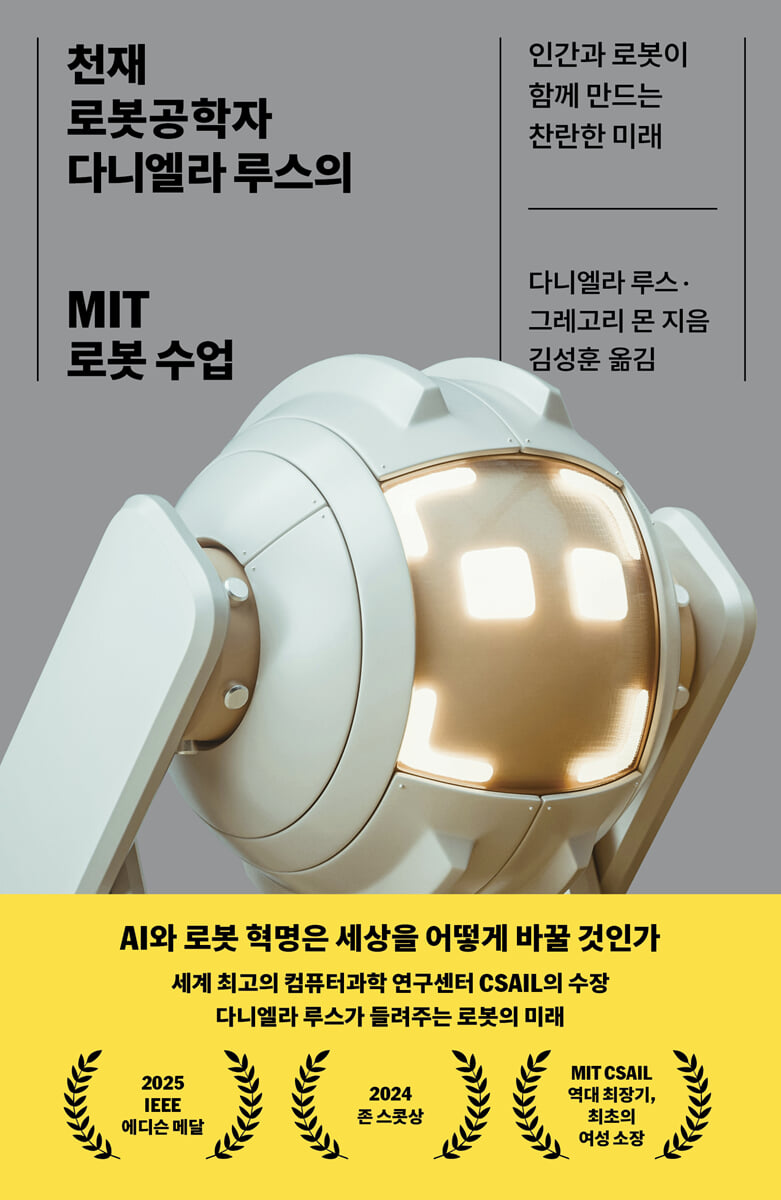 |
Description
Book Introduction
How the AI and robotics revolution will change the world
Director of CSAIL, the world's leading computer science research center
The Future of Robots with Daniela Russ
The world is already filled with technologies that are indistinguishable from magic.
It's not uncommon to see machines flying across Mars, self-driving cars navigating complex cities, and robots making coffee in cafes or baking bread in kitchens.
This magical technology is the result of a combination of human-designed mathematical models, algorithms, and new materials. As the AI revolution shakes the world, what kind of robots are MIT engineers building? "MIT Robotics: Daniela Rus's Robotics Class" is the first popular book written by Daniela Rus, director of MIT's Computer Science and Artificial Intelligence Laboratory (CSAIL) and a leading researcher who can simultaneously survey the present and future of robotics.
It provides accessible explanations of the interconnected fields of robotics, artificial intelligence, and machine learning, and guides readers through the world of ingenious and fascinating robots, including jet suits that fly, electronic insects that climb the Eiffel Tower, photosynthetic robots that move along building facades, and vibration navigation systems for the visually impaired.
When we think of robots, we often think of clunky machines with metal bodies, but Ruth's lab researches less "robotic" robots with agile and flexible bodies made of lightweight materials like fiber and plastic.
Her research team's robots, including a miniature origami robot that folds like paper (which, when swallowed in a capsule, can be used to treat organs), Sophie, a robot with soft skin that swims like real fish, M-Block, which reconfigures itself, and a self-driving boat that traverses the canals of Amsterdam, have garnered significant media attention whenever they were revealed.
In this book, Ruth shares insights from her expertise and diverse experiences as a robotics engineer in a way that appeals to the general public, offering hope for the changes robotics technology will bring to readers who feel anxious amid the dizzying waves of the AI revolution.
Countering pessimistic predictions that the rise of robots will lead to machine domination or the replacement of human jobs, she asserts that robots will lead us to more capable, productive, and accurate beings, leading to a more humane life.
In this book, which consists of three parts, readers can hear directly from the voices of world-renowned robotics engineers about what robots are being created around the world and where robotics technology is at today (Part 1), how robots are designed and how they operate (Part 2), and what responsibilities robotics engineers have to society (Part 3).
Director of CSAIL, the world's leading computer science research center
The Future of Robots with Daniela Russ
The world is already filled with technologies that are indistinguishable from magic.
It's not uncommon to see machines flying across Mars, self-driving cars navigating complex cities, and robots making coffee in cafes or baking bread in kitchens.
This magical technology is the result of a combination of human-designed mathematical models, algorithms, and new materials. As the AI revolution shakes the world, what kind of robots are MIT engineers building? "MIT Robotics: Daniela Rus's Robotics Class" is the first popular book written by Daniela Rus, director of MIT's Computer Science and Artificial Intelligence Laboratory (CSAIL) and a leading researcher who can simultaneously survey the present and future of robotics.
It provides accessible explanations of the interconnected fields of robotics, artificial intelligence, and machine learning, and guides readers through the world of ingenious and fascinating robots, including jet suits that fly, electronic insects that climb the Eiffel Tower, photosynthetic robots that move along building facades, and vibration navigation systems for the visually impaired.
When we think of robots, we often think of clunky machines with metal bodies, but Ruth's lab researches less "robotic" robots with agile and flexible bodies made of lightweight materials like fiber and plastic.
Her research team's robots, including a miniature origami robot that folds like paper (which, when swallowed in a capsule, can be used to treat organs), Sophie, a robot with soft skin that swims like real fish, M-Block, which reconfigures itself, and a self-driving boat that traverses the canals of Amsterdam, have garnered significant media attention whenever they were revealed.
In this book, Ruth shares insights from her expertise and diverse experiences as a robotics engineer in a way that appeals to the general public, offering hope for the changes robotics technology will bring to readers who feel anxious amid the dizzying waves of the AI revolution.
Countering pessimistic predictions that the rise of robots will lead to machine domination or the replacement of human jobs, she asserts that robots will lead us to more capable, productive, and accurate beings, leading to a more humane life.
In this book, which consists of three parts, readers can hear directly from the voices of world-renowned robotics engineers about what robots are being created around the world and where robotics technology is at today (Part 1), how robots are designed and how they operate (Part 2), and what responsibilities robotics engineers have to society (Part 3).
- You can preview some of the book's contents.
Preview
index
Introduction - Starting the Robotics Class
Part 1: Dreams - Robots, Nothing is Impossible
1st class strength
2nd class reach
Lecture 3 time
Advance to the semifinals
5th class magic
6th quarter visual
Lesson 7 Precision
Part 2: Reality - How Are Robots Made?
How to make a robot in the quarterfinals
Lesson 9: The Moving Brain
Lesson 10: The Brain That Feels Tactile
Lesson 11: How Robots Learn
Take a break - Helpful technical information
12 Technician's To-Do List
Part 3: Responsibility - How to Prepare for the Future
Lesson 13: Possible Futures
Lesson 14: What Can Go Wrong?
Lesson 15: Future Work
16th Computing Education
Lesson 17: A Big Challenge
Review - Robot's Dream
Words of gratitude
main
Source of the illustration
Search
Part 1: Dreams - Robots, Nothing is Impossible
1st class strength
2nd class reach
Lecture 3 time
Advance to the semifinals
5th class magic
6th quarter visual
Lesson 7 Precision
Part 2: Reality - How Are Robots Made?
How to make a robot in the quarterfinals
Lesson 9: The Moving Brain
Lesson 10: The Brain That Feels Tactile
Lesson 11: How Robots Learn
Take a break - Helpful technical information
12 Technician's To-Do List
Part 3: Responsibility - How to Prepare for the Future
Lesson 13: Possible Futures
Lesson 14: What Can Go Wrong?
Lesson 15: Future Work
16th Computing Education
Lesson 17: A Big Challenge
Review - Robot's Dream
Words of gratitude
main
Source of the illustration
Search
Detailed image

Into the book
Will robots take our jobs? I don't think so.
Rather, robots will make us more capable, productive, and precise.
If this revolution is led correctly and wisely, these clever machines have the potential to dramatically improve the quality of human life, just as the plow revolutionized agriculture in the past.
--- p.10 Robots are tools.
It is neither good nor evil in itself.
In that respect, it's just like a hammer.
Think of this new generation of amazing machines as highly advanced hammers.
--- p.15 A robot is a programmable mechanical device that receives input from its surroundings, processes that information, and then takes physical action in response to that input.
--- p.28 When air is injected into the covering, the accordion-like muscle fibers and the skeleton inside expand, and when the air is removed, the covering and skeleton contract, reducing the length to less than 10 percent of its original length.
Overall, this artificial muscle has a strength-to-weight ratio of a whopping 1000 times.
--- p.42 Thanks to its visual system and artificial intelligence, this snake robot snakebot can choose its own path.
The robot's head can be equipped with a camera to inspect places that are inaccessible to humans, or it can be equipped with a drill to drill holes for wiring.
In some ways, this robot could be considered a future version of a typical construction tool.
--- p.52 Imagine these mobile robots deployed throughout the city, like shared electric scooters or shared bicycles.
On a cloudy day at my house in Boston, I could put on a headset, rent one of these robots, and remotely control it to roam any Parisian neighborhood I wanted.
--- p.54 Our robot SoFi moves by wagging its tail back and forth like a shark.
The dorsal fin and two lateral fins allow Sophie to glide smoothly through the water, and we have already demonstrated that she can navigate among other aquatic creatures without disturbing them.
--- p.62 My friend Bruce Donald and I explored ways to turn a desk itself into a robot by adding tiny cilia to its surface.
The desk robot we envisioned can move objects in a desired direction by wiggling cilia and turning the desk surface into a kind of conveyor belt.
Would it be a little creepy? --- p.73 Imagine what it would be like to leave your car in the garage, put on a special robot suit, and fly over the surrounding cars and buildings.
To me, this is just a dream.
But Richard Browning invented a jetpack that actually worked.
He was the Tony Stark of the real world.
--- p.91 Robots have the potential to make magic a reality.
First, you have to get rid of or ignore the filter of thought that insists that something is impossible.
By combining human creativity with technological knowledge, we can see the world from a new perspective, explore applications that seem magical at first glance, and figure out how to make them a reality.
--- p.104 When we think of robots, we often think of systems that imitate human form (such as humanoid robots or robotic arms) or boxes with wheels, but this is a very stereotypical idea.
In other words, any form that exists in natural or artificial environments can be made into a robot.
--- p.106 All living things in nature are made up of cells, and complex and diverse living things like snakes and ants, as well as organs like the lungs and heart, are all made of these cells.
So I wondered what it would be like if there were robotic cells that could create a variety of robotic life forms.
--- p.113~114 The software of the robot brain is a spider web-like structure of various individual programs, from high-level artificial intelligence engines to low-level controllers that instruct each motor what to do and when.
One widely used planning and reasoning system is the Stanford Research Institute Problem Solver, known by the acronym STRIPS.
--- p.172 Ken points out that having four fingers gives you an interesting ability.
While three fingers hold the object steady, the fourth finger can be used to manipulate the object by walking over its surface.
This process allows you to explore angles and detect differences in texture and firmness.
--- p.210 The researchers did not teach the robot how to run.
We simply gave the robot a goal, such as "run fast," placed it in a virtual world, and let the program figure out how to achieve its goal.
After 4,000 clumsy, awkward attempts and countless failures, the system learned to coordinate its movements, maintain balance, and move forward.
A virtual cheetah has learned to run on its own.
--- p.219 Let's imagine a world where machines adapt to people, rather than people adapting to machines.
When people struggle to handle large parts, factory robots come to help.
And when an elderly person is doing housework and is struggling, a home robot comes to help.
--- p.255 Our field requires testing, evaluation, and certification procedures, as well as regulatory bodies like the FDA to assess the safety and efficacy of intelligent machines and approve them for specific uses before they are released commercially.
--- p.284 I imagined that a fleet of drones could create a massive video screen in the air in the middle of a major Russian city square, showing the realities of war.
I'm talking about actual war footage, not government-approved video clips.
--- p.301 We see the mind and the chip as opposing forces, not as complementary forces.
It is a mistake to view robots as competitors rather than as tools and collaborators that can enhance human productivity and capabilities.
Rather, robots will make us more capable, productive, and precise.
If this revolution is led correctly and wisely, these clever machines have the potential to dramatically improve the quality of human life, just as the plow revolutionized agriculture in the past.
--- p.10 Robots are tools.
It is neither good nor evil in itself.
In that respect, it's just like a hammer.
Think of this new generation of amazing machines as highly advanced hammers.
--- p.15 A robot is a programmable mechanical device that receives input from its surroundings, processes that information, and then takes physical action in response to that input.
--- p.28 When air is injected into the covering, the accordion-like muscle fibers and the skeleton inside expand, and when the air is removed, the covering and skeleton contract, reducing the length to less than 10 percent of its original length.
Overall, this artificial muscle has a strength-to-weight ratio of a whopping 1000 times.
--- p.42 Thanks to its visual system and artificial intelligence, this snake robot snakebot can choose its own path.
The robot's head can be equipped with a camera to inspect places that are inaccessible to humans, or it can be equipped with a drill to drill holes for wiring.
In some ways, this robot could be considered a future version of a typical construction tool.
--- p.52 Imagine these mobile robots deployed throughout the city, like shared electric scooters or shared bicycles.
On a cloudy day at my house in Boston, I could put on a headset, rent one of these robots, and remotely control it to roam any Parisian neighborhood I wanted.
--- p.54 Our robot SoFi moves by wagging its tail back and forth like a shark.
The dorsal fin and two lateral fins allow Sophie to glide smoothly through the water, and we have already demonstrated that she can navigate among other aquatic creatures without disturbing them.
--- p.62 My friend Bruce Donald and I explored ways to turn a desk itself into a robot by adding tiny cilia to its surface.
The desk robot we envisioned can move objects in a desired direction by wiggling cilia and turning the desk surface into a kind of conveyor belt.
Would it be a little creepy? --- p.73 Imagine what it would be like to leave your car in the garage, put on a special robot suit, and fly over the surrounding cars and buildings.
To me, this is just a dream.
But Richard Browning invented a jetpack that actually worked.
He was the Tony Stark of the real world.
--- p.91 Robots have the potential to make magic a reality.
First, you have to get rid of or ignore the filter of thought that insists that something is impossible.
By combining human creativity with technological knowledge, we can see the world from a new perspective, explore applications that seem magical at first glance, and figure out how to make them a reality.
--- p.104 When we think of robots, we often think of systems that imitate human form (such as humanoid robots or robotic arms) or boxes with wheels, but this is a very stereotypical idea.
In other words, any form that exists in natural or artificial environments can be made into a robot.
--- p.106 All living things in nature are made up of cells, and complex and diverse living things like snakes and ants, as well as organs like the lungs and heart, are all made of these cells.
So I wondered what it would be like if there were robotic cells that could create a variety of robotic life forms.
--- p.113~114 The software of the robot brain is a spider web-like structure of various individual programs, from high-level artificial intelligence engines to low-level controllers that instruct each motor what to do and when.
One widely used planning and reasoning system is the Stanford Research Institute Problem Solver, known by the acronym STRIPS.
--- p.172 Ken points out that having four fingers gives you an interesting ability.
While three fingers hold the object steady, the fourth finger can be used to manipulate the object by walking over its surface.
This process allows you to explore angles and detect differences in texture and firmness.
--- p.210 The researchers did not teach the robot how to run.
We simply gave the robot a goal, such as "run fast," placed it in a virtual world, and let the program figure out how to achieve its goal.
After 4,000 clumsy, awkward attempts and countless failures, the system learned to coordinate its movements, maintain balance, and move forward.
A virtual cheetah has learned to run on its own.
--- p.219 Let's imagine a world where machines adapt to people, rather than people adapting to machines.
When people struggle to handle large parts, factory robots come to help.
And when an elderly person is doing housework and is struggling, a home robot comes to help.
--- p.255 Our field requires testing, evaluation, and certification procedures, as well as regulatory bodies like the FDA to assess the safety and efficacy of intelligent machines and approve them for specific uses before they are released commercially.
--- p.284 I imagined that a fleet of drones could create a massive video screen in the air in the middle of a major Russian city square, showing the realities of war.
I'm talking about actual war footage, not government-approved video clips.
--- p.301 We see the mind and the chip as opposing forces, not as complementary forces.
It is a mistake to view robots as competitors rather than as tools and collaborators that can enhance human productivity and capabilities.
--- p.307
Publisher's Review
How the AI and robotics revolution will change the world
Director of CSAIL, the world's leading computer science research center
The Future of Robots with Daniela Russ
MIT CSAIL's longest-serving and first female director
2025 IEEE Edison Medal, 2024 John Scott Award Winner
The quirky and fascinating world of robots
The world is already filled with technologies that are indistinguishable from magic.
It's not uncommon to see machines flying across Mars, self-driving cars navigating complex cities, and robots making coffee in cafes or baking bread in kitchens.
This magical technology is the result of a combination of human-designed mathematical models, algorithms, and novel materials. As the AI revolution shakes the world, what kind of robots are MIT engineers building?
MIT Robotics is the first popular book written by Daniela Russ, director of MIT's Computer Science and Artificial Intelligence Laboratory (CSAIL) and a leading researcher who can simultaneously view the present and future of robotics.
It provides accessible explanations of the interconnected fields of robotics, artificial intelligence, and machine learning, and guides readers through the world of ingenious and fascinating robots, including jet suits that fly, electronic insects that climb the Eiffel Tower, photosynthetic robots that move along building facades, and vibration navigation systems for the visually impaired.
When we think of robots, we often think of clunky machines with metal bodies, but Ruth's lab researches less "robotic" robots with agile and flexible bodies made of lightweight materials like fiber and plastic.
Her research team's robots, including a miniature origami robot that folds like paper (which, when swallowed in a capsule, can be used to treat organs), Sophie, a robot with soft skin that swims like real fish, M-Block, which reconfigures itself, and a self-driving boat that traverses the canals of Amsterdam, have garnered significant media attention whenever they were revealed.
In this book, Ruth conveys insights from her expertise and diverse experiences as a robotics engineer in a way that is accessible to the general public, offering hope for the changes that robotics technology will bring to readers who feel anxious amid the dizzying waves of the AI revolution.
Countering pessimistic predictions that the rise of robots will lead to machine domination or the replacement of human jobs, she asserts that robots will lead us to more capable, productive, and accurate beings, leading to a more humane life.
In this book, which consists of three parts, readers can hear directly from the voices of world-renowned robotics engineers about what robots are being created around the world and where robotics technology is at today (Part 1), how robots are designed and how they operate (Part 2), and what responsibilities robotics engineers have to society (Part 3).
A robotics engineer ahead of his time
Those familiar with robotics likely don't need a lengthy explanation, but some readers may be unfamiliar with CSAIL or Daniela Russ. CSAIL is arguably the world's leading computer science research center, and is one of MIT's leading research institutes in terms of scale and activity.
With 115 senior researchers and hundreds of scientists and students, the institute is conducting over 800 research projects.
Joint research with overseas research institutes is also active, and it is known that several projects are being carried out with the Gwangju Institute of Science and Technology (GIST) in Korea.
Ruth took over as director of CSAIL in 2012, making her the longest-serving director since its founding.
Her background is unique.
Born in Romania, he immigrated to the United States with his parents in 1982 (during the Ceausescu communist dictatorship) around the time he graduated from high school.
His father was a pioneering computer scientist in Romania, and his mother was a physicist.
The book includes some episodes from Ruth's school days, especially the interesting one about working in a factory making train parts under the direction of the Romanian government.
Although it was a difficult task for a high school student, she recalls that her experience handling equipment like a lathe helped her later choose a career as a robotics engineer.
After graduating from college, Ruth began building her career as a robotics researcher.
Since then, he has gained a world-renowned reputation in the fields of modular/reconfigurable robots, multi-robot systems (systems in which multiple robots cooperate to perform specific tasks), and control algorithms, and has won a series of top awards in engineering (including the 2025 IEEE Edison Medal and the 2024 John Scott Award), earning praise as a robotics engineer “ahead of his time.”
Even now, she collaborates with research institutions around the world to create “all kinds of intelligent machines that can crawl, walk, run, drive, heal, transform, and fly.”
Robots, nothing is impossible
So, what exactly is a robot? How does it differ from the common mechanical devices we see around us? Ruth defines a robot as, in a nutshell, "a programmable mechanical device that receives input from its environment, processes that information, and then takes physical action in response to that input."
Robots are also called 'intelligent machines'.
Let's take 'paper presser (questionnaire)' as an example.
A paper pusher applies force downward to the paper stack using its own weight (action), but that does not make it a robot.
What if we added a camera, a processing unit, and mechanical legs to this paper presser? Now, when the wind blows and the paper flutters, the newly modified paper presser's mechanical legs, which were previously folded inside the device, will unfold and walk toward the paper.
And then sit on it and hold the paper in place.
So, now the paper presser has become a "deskbot"! So, a robot is a mechanical device capable of executing the "sensing-thinking-acting" cycle.
If any one of these three conditions is not met, it cannot be a robot (similarly, an alarm clock is not a robot in itself, but if you modify it to sense the time on its own and jump towards the bed of its sleeping owner, it becomes an 'alarm clock robot').
In this book, Ruth introduces various robots that augment human strength and extend physical reach and senses.
For example, clothes can also be made by intelligent machines.
It uses soft artificial muscles as a covering and attaches sensors to monitor the user's physical condition in real time and carry out commands such as body temperature control and muscle strength enhancement.
The suit Ruth envisions would provide independent mobility to older adults with weakened muscles, precise posture correction to athletes, and increased strength and endurance for manual laborers to help them perform tasks safely and sustainably.
Meanwhile, robots that expand the range of vision are also possible.
We are currently developing a drone that can be launched from autonomous vehicles to see around corners.
The drone flies ahead of the car, turns corners, scans the interior of a complex underground parking garage, and then transmits the video to the car's navigation system.
It's another 'eye' attached to the car.
Let's push our imagination further.
Ruth's vision of 'overseas travel of the future' is very special.
She imagines deploying public mobile robots in famous tourist destinations like Paris, allowing people to remotely access these robots from overseas and visit famous Parisian bakeries to savor the flavors and aromas of their food.
Of course, it remains to be seen whether bakers will allow robots to sell their food, but theoretically it is possible.
Challenges for Young Robotics Engineers
While it's fun to hear about robots like this, there are still many technological hurdles to overcome.
A robot is typically composed of 1) a skeleton, 2) electromechanical components (sensors, actuators, cables, power supplies), 3) computing hardware (processors and storage devices), 4) a communication board, and 5) a brain (which manages perception, planning, learning, reasoning, coordination, and control).
Sensors detect information from the external environment and transmit the collected information to the control device.
The control unit (the robot's brain) analyzes data received from sensors and issues appropriate commands, and sophisticated robots can make complex decisions through machine learning.
The skeleton and actuators (the robot's arms, legs, hands, wheels, etc.) move the robot according to control commands, and a balance of precision and power is important.
The key here is that an excellent robot can only be created when the overall performance of each component that makes up the robot improves.
Even if you create a hand with high precision, if the brain that controls it is not up to standard, you cannot create an excellent robot.
Therefore, we need 1) smarter and more sensitive hands, 2) softer and safer robots, 3) less “robotic” robots that move more agilely, 4) more efficient methods of making robots, 5) more flexible and stronger artificial muscles, 6) more powerful batteries, 7) better sensors, 8) faster brains, and 9) natural language processing technology that allows us to communicate with robots more easily (pp. 249-265).
This list is comprised of nine challenges Ruth proposes for young inventors and engineers in this book, encompassing the key technical challenges needed to improve current robots.
Problems that others find difficult to solve tend to inspire passion, so perhaps among the readers of this book, there will be future engineers who will discover their own goals on this list and ignite their technical passion.
Responsibilities of a Roboticist
This book also addresses the issue of responsibility for robotics engineers.
For Ruth, the biggest crisis facing robotics today isn't the Hollywood staple of "human-destroying robots" (she makes it clear that we're still a long way from the emergence of "general artificial intelligence" that surpasses humans).
Rather, he points out that the problem is “the situation where we are left with a huge and complex system that we have become dependent on without even properly understanding, and are stuck in a mountain of abandoned technology and electronic waste.”
Currently, many robots are being released into the world without resolving their own technical and ethical problems.
Robotics engineers are bound to be held to greater ethical responsibility.
Therefore, Ruth argues that “when we deploy intelligent machines into the world and utilize them, we must establish safeguards and ethical principles to ensure that their use serves the public interest.”
In particular, she presents 11 design principles for robots and AI (stability, security, fairness, explainability, sustainability, certification system, etc.) (pp. 276-287), and her point that “for intelligent machines, there is a regulatory body like the FDA that evaluates safety and efficacy and approves them for specific uses before they are commercially released” is noteworthy.
Meanwhile, we cannot ignore concerns about the most difficult problems facing humanity (climate crisis, health, food security, energy and electricity, etc.).
Ruth emphasizes that various robotics research projects are underway around the world to solve humanity's challenges, and suggests that many robotics engineers join in these efforts.
Ruth also argues that we need to spread the benefits of AI across society through computational thinking and production education for children and adults, and build the capacity to prepare for the new jobs of the future.
In this regard, a groundbreaking idea is also being proposed in the industrial and distribution sectors: to establish manufacturing centers that operate 24 hours a day by deploying cutting-edge equipment such as 3D printers throughout the region.
The idea is to sell customized products (toys, furniture, etc.) that consumers want through this center, and she claims that because the products are produced and sold locally, carbon emissions and waste can also be reduced.
The original title of this book is 'The heart and the chip'.
The 'chip (machine)' is a powerful tool, but it is the 'heart (human)' that gives meaning to the means.
Robots are simply 'tools for building a better world.'
“The true superpowers of creativity, innovation and vision remain human beings.”
Now Ruth is thinking about how to free the robots from the protective cages of industrial sites and laboratories.
“Imagine a world where machines adapt to people, rather than people adapting to machines.
“When a person struggles to handle a large part, a factory robot will come and help, and when an elderly person struggles to do housework, a home robot will come and help.” She envisions a future where robots become human collaborators and accompany people in their daily lives.
Now is the time to contemplate and actively discuss how we can guide and leverage these intelligent machines to support human prosperity.
Director of CSAIL, the world's leading computer science research center
The Future of Robots with Daniela Russ
MIT CSAIL's longest-serving and first female director
2025 IEEE Edison Medal, 2024 John Scott Award Winner
The quirky and fascinating world of robots
The world is already filled with technologies that are indistinguishable from magic.
It's not uncommon to see machines flying across Mars, self-driving cars navigating complex cities, and robots making coffee in cafes or baking bread in kitchens.
This magical technology is the result of a combination of human-designed mathematical models, algorithms, and novel materials. As the AI revolution shakes the world, what kind of robots are MIT engineers building?
MIT Robotics is the first popular book written by Daniela Russ, director of MIT's Computer Science and Artificial Intelligence Laboratory (CSAIL) and a leading researcher who can simultaneously view the present and future of robotics.
It provides accessible explanations of the interconnected fields of robotics, artificial intelligence, and machine learning, and guides readers through the world of ingenious and fascinating robots, including jet suits that fly, electronic insects that climb the Eiffel Tower, photosynthetic robots that move along building facades, and vibration navigation systems for the visually impaired.
When we think of robots, we often think of clunky machines with metal bodies, but Ruth's lab researches less "robotic" robots with agile and flexible bodies made of lightweight materials like fiber and plastic.
Her research team's robots, including a miniature origami robot that folds like paper (which, when swallowed in a capsule, can be used to treat organs), Sophie, a robot with soft skin that swims like real fish, M-Block, which reconfigures itself, and a self-driving boat that traverses the canals of Amsterdam, have garnered significant media attention whenever they were revealed.
In this book, Ruth conveys insights from her expertise and diverse experiences as a robotics engineer in a way that is accessible to the general public, offering hope for the changes that robotics technology will bring to readers who feel anxious amid the dizzying waves of the AI revolution.
Countering pessimistic predictions that the rise of robots will lead to machine domination or the replacement of human jobs, she asserts that robots will lead us to more capable, productive, and accurate beings, leading to a more humane life.
In this book, which consists of three parts, readers can hear directly from the voices of world-renowned robotics engineers about what robots are being created around the world and where robotics technology is at today (Part 1), how robots are designed and how they operate (Part 2), and what responsibilities robotics engineers have to society (Part 3).
A robotics engineer ahead of his time
Those familiar with robotics likely don't need a lengthy explanation, but some readers may be unfamiliar with CSAIL or Daniela Russ. CSAIL is arguably the world's leading computer science research center, and is one of MIT's leading research institutes in terms of scale and activity.
With 115 senior researchers and hundreds of scientists and students, the institute is conducting over 800 research projects.
Joint research with overseas research institutes is also active, and it is known that several projects are being carried out with the Gwangju Institute of Science and Technology (GIST) in Korea.
Ruth took over as director of CSAIL in 2012, making her the longest-serving director since its founding.
Her background is unique.
Born in Romania, he immigrated to the United States with his parents in 1982 (during the Ceausescu communist dictatorship) around the time he graduated from high school.
His father was a pioneering computer scientist in Romania, and his mother was a physicist.
The book includes some episodes from Ruth's school days, especially the interesting one about working in a factory making train parts under the direction of the Romanian government.
Although it was a difficult task for a high school student, she recalls that her experience handling equipment like a lathe helped her later choose a career as a robotics engineer.
After graduating from college, Ruth began building her career as a robotics researcher.
Since then, he has gained a world-renowned reputation in the fields of modular/reconfigurable robots, multi-robot systems (systems in which multiple robots cooperate to perform specific tasks), and control algorithms, and has won a series of top awards in engineering (including the 2025 IEEE Edison Medal and the 2024 John Scott Award), earning praise as a robotics engineer “ahead of his time.”
Even now, she collaborates with research institutions around the world to create “all kinds of intelligent machines that can crawl, walk, run, drive, heal, transform, and fly.”
Robots, nothing is impossible
So, what exactly is a robot? How does it differ from the common mechanical devices we see around us? Ruth defines a robot as, in a nutshell, "a programmable mechanical device that receives input from its environment, processes that information, and then takes physical action in response to that input."
Robots are also called 'intelligent machines'.
Let's take 'paper presser (questionnaire)' as an example.
A paper pusher applies force downward to the paper stack using its own weight (action), but that does not make it a robot.
What if we added a camera, a processing unit, and mechanical legs to this paper presser? Now, when the wind blows and the paper flutters, the newly modified paper presser's mechanical legs, which were previously folded inside the device, will unfold and walk toward the paper.
And then sit on it and hold the paper in place.
So, now the paper presser has become a "deskbot"! So, a robot is a mechanical device capable of executing the "sensing-thinking-acting" cycle.
If any one of these three conditions is not met, it cannot be a robot (similarly, an alarm clock is not a robot in itself, but if you modify it to sense the time on its own and jump towards the bed of its sleeping owner, it becomes an 'alarm clock robot').
In this book, Ruth introduces various robots that augment human strength and extend physical reach and senses.
For example, clothes can also be made by intelligent machines.
It uses soft artificial muscles as a covering and attaches sensors to monitor the user's physical condition in real time and carry out commands such as body temperature control and muscle strength enhancement.
The suit Ruth envisions would provide independent mobility to older adults with weakened muscles, precise posture correction to athletes, and increased strength and endurance for manual laborers to help them perform tasks safely and sustainably.
Meanwhile, robots that expand the range of vision are also possible.
We are currently developing a drone that can be launched from autonomous vehicles to see around corners.
The drone flies ahead of the car, turns corners, scans the interior of a complex underground parking garage, and then transmits the video to the car's navigation system.
It's another 'eye' attached to the car.
Let's push our imagination further.
Ruth's vision of 'overseas travel of the future' is very special.
She imagines deploying public mobile robots in famous tourist destinations like Paris, allowing people to remotely access these robots from overseas and visit famous Parisian bakeries to savor the flavors and aromas of their food.
Of course, it remains to be seen whether bakers will allow robots to sell their food, but theoretically it is possible.
Challenges for Young Robotics Engineers
While it's fun to hear about robots like this, there are still many technological hurdles to overcome.
A robot is typically composed of 1) a skeleton, 2) electromechanical components (sensors, actuators, cables, power supplies), 3) computing hardware (processors and storage devices), 4) a communication board, and 5) a brain (which manages perception, planning, learning, reasoning, coordination, and control).
Sensors detect information from the external environment and transmit the collected information to the control device.
The control unit (the robot's brain) analyzes data received from sensors and issues appropriate commands, and sophisticated robots can make complex decisions through machine learning.
The skeleton and actuators (the robot's arms, legs, hands, wheels, etc.) move the robot according to control commands, and a balance of precision and power is important.
The key here is that an excellent robot can only be created when the overall performance of each component that makes up the robot improves.
Even if you create a hand with high precision, if the brain that controls it is not up to standard, you cannot create an excellent robot.
Therefore, we need 1) smarter and more sensitive hands, 2) softer and safer robots, 3) less “robotic” robots that move more agilely, 4) more efficient methods of making robots, 5) more flexible and stronger artificial muscles, 6) more powerful batteries, 7) better sensors, 8) faster brains, and 9) natural language processing technology that allows us to communicate with robots more easily (pp. 249-265).
This list is comprised of nine challenges Ruth proposes for young inventors and engineers in this book, encompassing the key technical challenges needed to improve current robots.
Problems that others find difficult to solve tend to inspire passion, so perhaps among the readers of this book, there will be future engineers who will discover their own goals on this list and ignite their technical passion.
Responsibilities of a Roboticist
This book also addresses the issue of responsibility for robotics engineers.
For Ruth, the biggest crisis facing robotics today isn't the Hollywood staple of "human-destroying robots" (she makes it clear that we're still a long way from the emergence of "general artificial intelligence" that surpasses humans).
Rather, he points out that the problem is “the situation where we are left with a huge and complex system that we have become dependent on without even properly understanding, and are stuck in a mountain of abandoned technology and electronic waste.”
Currently, many robots are being released into the world without resolving their own technical and ethical problems.
Robotics engineers are bound to be held to greater ethical responsibility.
Therefore, Ruth argues that “when we deploy intelligent machines into the world and utilize them, we must establish safeguards and ethical principles to ensure that their use serves the public interest.”
In particular, she presents 11 design principles for robots and AI (stability, security, fairness, explainability, sustainability, certification system, etc.) (pp. 276-287), and her point that “for intelligent machines, there is a regulatory body like the FDA that evaluates safety and efficacy and approves them for specific uses before they are commercially released” is noteworthy.
Meanwhile, we cannot ignore concerns about the most difficult problems facing humanity (climate crisis, health, food security, energy and electricity, etc.).
Ruth emphasizes that various robotics research projects are underway around the world to solve humanity's challenges, and suggests that many robotics engineers join in these efforts.
Ruth also argues that we need to spread the benefits of AI across society through computational thinking and production education for children and adults, and build the capacity to prepare for the new jobs of the future.
In this regard, a groundbreaking idea is also being proposed in the industrial and distribution sectors: to establish manufacturing centers that operate 24 hours a day by deploying cutting-edge equipment such as 3D printers throughout the region.
The idea is to sell customized products (toys, furniture, etc.) that consumers want through this center, and she claims that because the products are produced and sold locally, carbon emissions and waste can also be reduced.
The original title of this book is 'The heart and the chip'.
The 'chip (machine)' is a powerful tool, but it is the 'heart (human)' that gives meaning to the means.
Robots are simply 'tools for building a better world.'
“The true superpowers of creativity, innovation and vision remain human beings.”
Now Ruth is thinking about how to free the robots from the protective cages of industrial sites and laboratories.
“Imagine a world where machines adapt to people, rather than people adapting to machines.
“When a person struggles to handle a large part, a factory robot will come and help, and when an elderly person struggles to do housework, a home robot will come and help.” She envisions a future where robots become human collaborators and accompany people in their daily lives.
Now is the time to contemplate and actively discuss how we can guide and leverage these intelligent machines to support human prosperity.
GOODS SPECIFICS
- Date of issue: June 18, 2025
- Page count, weight, size: 400 pages | 140*215*30mm
- ISBN13: 9791173321832
You may also like
카테고리
korean


korean

![GQ KOREA Mark (Monthly): December [2025]](http://librairie.coreenne.fr/cdn/shop/files/8ef265dbbfbf186523ed75ba7319009d.jpg?v=1765340328&width=3840)


