

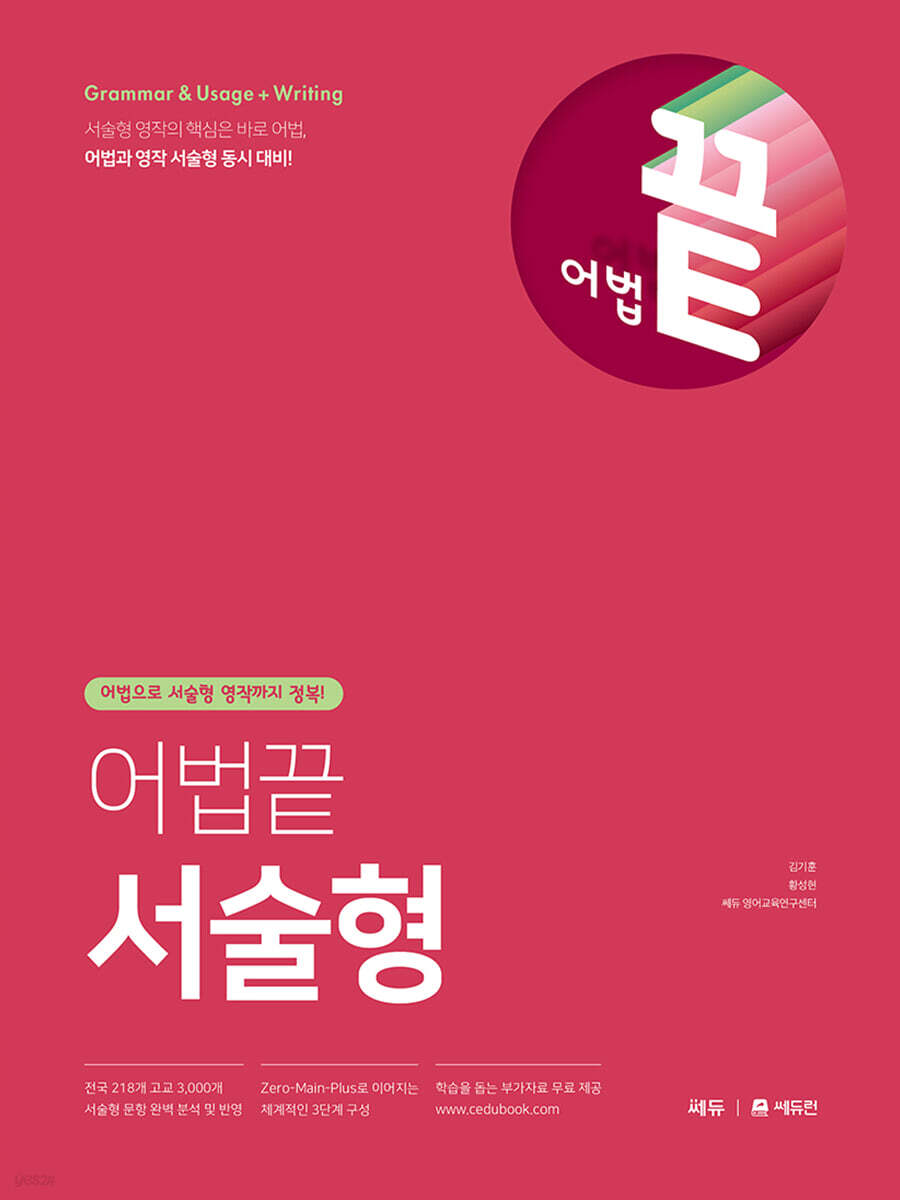
Grammar end descriptive form
 |
Description
Book Introduction
Optimized for descriptive exam preparation based on analysis of descriptive questions from 218 high schools nationwide and co-authored by current teachers. 'Zero Stage' helps warm up descriptive learning with concise concept summaries and light examples. 'Main Stage' of 'Grammar, Writing, and Sentence Transition' type for full-fledged descriptive training 'Plus Stage' predicts the conditions, types, and probabilities of questions from the perspective of the examiner. 'UNIT EXERCISE' develops practical skills through various problem types. Provides practical application strategies for internal exams, including preparation periods and tips for writing answers. Answers and explanations are thoroughly included to enable self-study, including deduction factors, question pitfalls, background explanations, and structural analysis. "Grammar End Descriptive" provides the basics and training for the descriptive section of the high school English exam. Compared to middle school, it is difficult to get a satisfactory score on high school exams through memorization alone due to the scope of the exam, the possibility of text changes, and external texts. Additionally, because it is necessary to assign grades from 1 to 9 based on relative evaluation, very conservative standards are set for grading and awarding partial points for descriptive questions. Therefore, most students are likely to experience significant deductions in scores due to mistakes or poor skills in descriptive questions, and this is difficult to resolve in a short period of time. 『Grammar End Descriptive Type』 was developed to provide a thorough understanding of the difficult descriptive type of high school internal exams and practical countermeasures. In particular, we invited a current high school teacher as a co-author to incorporate the perspectives of those who actually create and grade exams in schools. An analysis of descriptive questions from 218 high schools across the country revealed that approximately 60% of descriptive questions were grammar and composition questions, and composition questions often included important grammatical elements. In other words, grammar is writing and writing is grammar, so we can conclude that these two areas of study are not separate areas. Therefore, 『Grammar End Descriptive』 is designed to help you complete your English writing by focusing on descriptive grammar problems. |
- You can preview some of the book's contents.
Preview
index
Introduction I
Introduction II
UNIT 01 Number Matching and Tae
Point 01 Subject-Verb Agreement I
Zero Stage
Main Stage 1 Grammar Descriptive
Main Stage 2 Descriptive Writing
Plus Stage
Point 02 Subject-Verb Agreement II
Zero Stage
Main Stage 1 Grammar Descriptive
Main Stage 2 Descriptive Writing
Plus Stage
Point 03 Verb Tense I
Zero Stage
Main Stage 1 Grammar Descriptive I
Main Stage 2 Grammar Descriptive II
Main Stage 3 Descriptive Writing
Plus Stage
Point 04 Verb Tense II
Zero Stage
Main Stage 1 Grammar Descriptive
Main Stage 2 Descriptive Writing
Main Stage 3 Sentence Transition Descriptive
Plus Stage
UNIT EXERCISE
UNIT 02 Tense, Auxiliary Verbs, and Sentence Patterns
Point 05 Tense
Zero Stage
Main Stage 1 Grammar Descriptive
Main Stage 2 Descriptive Writing
Plus Stage
Point 06 Auxiliary Verbs
Zero Stage
Main Stage 1 Grammar Descriptive
Main Stage 2 Descriptive Writing
Plus Stage
Point 07 SVO sentence pattern
Zero Stage
Main Stage 1 Grammar Descriptive
Main Stage 2 Descriptive Writing I
Main Stage 3 Descriptive Writing II
Plus Stage
Point 08 SVOC sentence pattern
Zero Stage
Main Stage 1 Grammar Descriptive
Main Stage 2 Descriptive Writing
Plus Stage
UNIT EXERCISE
UNIT 03 Verbs and Quasi-Verbs
Point 09 to-infinitive
Zero Stage
Main Stage 1 Grammar Descriptive
Main Stage 2 Descriptive Writing I
Main Stage 3 Descriptive Writing II
Plus Stage
Point 10 injection
Zero Stage
Main Stage 1 Grammar Descriptive
Main Stage 2 Descriptive Writing
Plus Stage
Point 11 Participle Phrase
Zero Stage
Main Stage 1 Grammar Descriptive
Main Stage 2 Sentence Transition Descriptive
Main Stage 3 Descriptive Writing
Plus Stage
Point 12 Verb position vs.
Verb position
Zero Stage
Main Stage 1 Grammar Descriptive
Main Stage 2 Descriptive Writing
Plus Stage
UNIT EXERCISE
UNIT 04 Conjunctions and Conditionals
Point 13: Coordinating conjunctions and parallel relationships
Zero Stage
Main Stage 1 Grammar Descriptive
Main Stage 2 Descriptive Writing I
Main Stage 3 Descriptive Writing II
Plus Stage
Point 14 Noun clause conjunctions
Zero Stage
Main Stage 1 Grammar Descriptive
Main Stage 2 Descriptive Writing
Plus Stage
Point 15 Adverbial Conjunctions
Zero Stage
Main Stage 1 Grammar Descriptive
Main Stage 2 Descriptive Writing I
Main Stage 3 Descriptive Writing II
Plus Stage
Point 16: Subjunctive
Zero Stage
Main Stage 1 Sentence Transition Descriptive
Main Stage 2 Descriptive Grammar
Main Stage 3 Descriptive Writing
Plus Stage
UNIT EXERCISE
UNIT 05 Relative Pronouns and Relative Adverbs
Point 17 Relative Pronouns
Zero Stage
Main Stage 1 Grammar Descriptive
Main Stage 2 Descriptive Writing
Plus Stage
Point 18: Comma (,) + relative pronoun
Zero Stage
Main Stage 1 Grammar Descriptive
Main Stage 2 Descriptive Writing
Plus Stage
Point 19 〈Preposition + Relative Pronoun〉 · Relative Adverb
Zero Stage
Main Stage 1 Sentence Transition Descriptive
Main Stage 2 Grammar Descriptive
Main Stage 3 Descriptive Writing
Plus Stage
Point 20 What / Which / That
Zero Stage
Main Stage 1 Grammar Descriptive
Main Stage 2 Descriptive Writing
Plus Stage
UNIT EXERCISE
UNIT 06 Key Phrases
Point 21 Comparative Phrases I
Zero Stage
Main Stage 1 Grammar Descriptive
Main Stage 2 Descriptive Writing
Plus Stage
Point 22 Comparative Phrases II
Zero Stage
Main Stage 1 Grammar Descriptive
Main Stage 2 Descriptive Writing I
Main Stage 3 Descriptive Writing II
Plus Stage
Point 23: Inverted sentence
Zero Stage
Main Stage 1 Sentence Transition Descriptive
Main Stage 2 Descriptive Grammar
Main Stage 3 Descriptive Writing
Plus Stage
Point 24 Phrases using It
Zero Stage
Main Stage 1 Grammar Descriptive
Main Stage 2 Sentence Transition Descriptive
Main Stage 3 Descriptive Writing
Plus Stage
UNIT EXERCISE
[Book within a Book] Answers and Explanations
Introduction II
UNIT 01 Number Matching and Tae
Point 01 Subject-Verb Agreement I
Zero Stage
Main Stage 1 Grammar Descriptive
Main Stage 2 Descriptive Writing
Plus Stage
Point 02 Subject-Verb Agreement II
Zero Stage
Main Stage 1 Grammar Descriptive
Main Stage 2 Descriptive Writing
Plus Stage
Point 03 Verb Tense I
Zero Stage
Main Stage 1 Grammar Descriptive I
Main Stage 2 Grammar Descriptive II
Main Stage 3 Descriptive Writing
Plus Stage
Point 04 Verb Tense II
Zero Stage
Main Stage 1 Grammar Descriptive
Main Stage 2 Descriptive Writing
Main Stage 3 Sentence Transition Descriptive
Plus Stage
UNIT EXERCISE
UNIT 02 Tense, Auxiliary Verbs, and Sentence Patterns
Point 05 Tense
Zero Stage
Main Stage 1 Grammar Descriptive
Main Stage 2 Descriptive Writing
Plus Stage
Point 06 Auxiliary Verbs
Zero Stage
Main Stage 1 Grammar Descriptive
Main Stage 2 Descriptive Writing
Plus Stage
Point 07 SVO sentence pattern
Zero Stage
Main Stage 1 Grammar Descriptive
Main Stage 2 Descriptive Writing I
Main Stage 3 Descriptive Writing II
Plus Stage
Point 08 SVOC sentence pattern
Zero Stage
Main Stage 1 Grammar Descriptive
Main Stage 2 Descriptive Writing
Plus Stage
UNIT EXERCISE
UNIT 03 Verbs and Quasi-Verbs
Point 09 to-infinitive
Zero Stage
Main Stage 1 Grammar Descriptive
Main Stage 2 Descriptive Writing I
Main Stage 3 Descriptive Writing II
Plus Stage
Point 10 injection
Zero Stage
Main Stage 1 Grammar Descriptive
Main Stage 2 Descriptive Writing
Plus Stage
Point 11 Participle Phrase
Zero Stage
Main Stage 1 Grammar Descriptive
Main Stage 2 Sentence Transition Descriptive
Main Stage 3 Descriptive Writing
Plus Stage
Point 12 Verb position vs.
Verb position
Zero Stage
Main Stage 1 Grammar Descriptive
Main Stage 2 Descriptive Writing
Plus Stage
UNIT EXERCISE
UNIT 04 Conjunctions and Conditionals
Point 13: Coordinating conjunctions and parallel relationships
Zero Stage
Main Stage 1 Grammar Descriptive
Main Stage 2 Descriptive Writing I
Main Stage 3 Descriptive Writing II
Plus Stage
Point 14 Noun clause conjunctions
Zero Stage
Main Stage 1 Grammar Descriptive
Main Stage 2 Descriptive Writing
Plus Stage
Point 15 Adverbial Conjunctions
Zero Stage
Main Stage 1 Grammar Descriptive
Main Stage 2 Descriptive Writing I
Main Stage 3 Descriptive Writing II
Plus Stage
Point 16: Subjunctive
Zero Stage
Main Stage 1 Sentence Transition Descriptive
Main Stage 2 Descriptive Grammar
Main Stage 3 Descriptive Writing
Plus Stage
UNIT EXERCISE
UNIT 05 Relative Pronouns and Relative Adverbs
Point 17 Relative Pronouns
Zero Stage
Main Stage 1 Grammar Descriptive
Main Stage 2 Descriptive Writing
Plus Stage
Point 18: Comma (,) + relative pronoun
Zero Stage
Main Stage 1 Grammar Descriptive
Main Stage 2 Descriptive Writing
Plus Stage
Point 19 〈Preposition + Relative Pronoun〉 · Relative Adverb
Zero Stage
Main Stage 1 Sentence Transition Descriptive
Main Stage 2 Grammar Descriptive
Main Stage 3 Descriptive Writing
Plus Stage
Point 20 What / Which / That
Zero Stage
Main Stage 1 Grammar Descriptive
Main Stage 2 Descriptive Writing
Plus Stage
UNIT EXERCISE
UNIT 06 Key Phrases
Point 21 Comparative Phrases I
Zero Stage
Main Stage 1 Grammar Descriptive
Main Stage 2 Descriptive Writing
Plus Stage
Point 22 Comparative Phrases II
Zero Stage
Main Stage 1 Grammar Descriptive
Main Stage 2 Descriptive Writing I
Main Stage 3 Descriptive Writing II
Plus Stage
Point 23: Inverted sentence
Zero Stage
Main Stage 1 Sentence Transition Descriptive
Main Stage 2 Descriptive Grammar
Main Stage 3 Descriptive Writing
Plus Stage
Point 24 Phrases using It
Zero Stage
Main Stage 1 Grammar Descriptive
Main Stage 2 Sentence Transition Descriptive
Main Stage 3 Descriptive Writing
Plus Stage
UNIT EXERCISE
[Book within a Book] Answers and Explanations
Detailed image

Publisher's Review
● 3-step learning: concept → descriptive training → expected question training
Analysis of descriptive questions from 218 high schools nationwide and co-authored by current teachers
● Providing practical application strategies that take into account various variables of actual exams.
● Answers and explanations that include not only explanations but also traps and deduction factors within the questions
Learning is largely divided into three stages. The first stage, 'Zero Stage', is a stage that contains basic information, examples of each item, and light application problems that will be helpful for later learning before full-scale descriptive learning.
It concisely covers the essential concepts that form the basis of narrative learning, and helps you warm up your grammar for narrative learning by applying the concepts learned to easy problems and examples.
Stage 2 is the 'Main Stage', which focuses on training descriptive questions.
We mainly study 'Grammar Descriptive' and 'Composition Descriptive', which focus on solving each point of the test, such as 'Find and correct grammatical errors' and 'Write the reason for errors', and we also study 'Sentence Transition Descriptive' depending on the needs of each concept.
In particular, before solving the writing problem, the step-by-step solution process is introduced along with representative questions, thereby reducing the burden and confusion of descriptive questions.
Additionally, you can experience a variety of questions that you might encounter on the internal exam, from simple sentence arrangements to combined reading comprehension passages.
The third stage is the 'Plus Stage', a learning stage where previously learned concepts are reexamined from the perspective of the examiner.
Plus Stage contains concept explanations and problems that will most directly help solve descriptive problems according to the characteristics of each point. It consists of various activities such as predicting the conditions for the corresponding learning point to appear as a test question, frequently appearing types, the probability of each sentence appearing, and selecting sentences expected to appear in the text.
This is the highlight section of this book, where you can deepen your understanding by looking at the concepts from the perspective of the examiner.
After the 3rd stage of learning, the 'UNIT EXERCISE' stage is a summary learning stage where all the main points of the unit are gathered and solved in various problem types to develop the ability to prepare for real-life situations.
The appendix and commentary for 『Grammar End Descriptive』 were also produced to be highly useful for learning.
The appendix contains detailed strategies for preparing for the descriptive portion of the internal exam.
We aim to help you with your study strategies and prevent factors that negatively impact your score outside of studying, such as focusing on studying before and after the internal exam preparation period, allocating exam time, and things to keep in mind when writing descriptive answers.
Additionally, the commentary includes detailed interpretation, commentary, and structural analysis, and points out factors that can be deducted during actual grading and pitfalls that can easily be avoided during solution.
Published in this way, "Grammar Ends Descriptive Type," which includes concepts, training, and practical application tips, will help you properly understand and prepare for descriptive types, and even gain insight into what types of questions will appear on the exam.
Through the study of 『Grammar End Descriptive』, I hope that the descriptive questions, which account for 40% of high school English exams, will be viewed as a stepping stone for learners rather than an object of fear.
Analysis of descriptive questions from 218 high schools nationwide and co-authored by current teachers
● Providing practical application strategies that take into account various variables of actual exams.
● Answers and explanations that include not only explanations but also traps and deduction factors within the questions
Learning is largely divided into three stages. The first stage, 'Zero Stage', is a stage that contains basic information, examples of each item, and light application problems that will be helpful for later learning before full-scale descriptive learning.
It concisely covers the essential concepts that form the basis of narrative learning, and helps you warm up your grammar for narrative learning by applying the concepts learned to easy problems and examples.
Stage 2 is the 'Main Stage', which focuses on training descriptive questions.
We mainly study 'Grammar Descriptive' and 'Composition Descriptive', which focus on solving each point of the test, such as 'Find and correct grammatical errors' and 'Write the reason for errors', and we also study 'Sentence Transition Descriptive' depending on the needs of each concept.
In particular, before solving the writing problem, the step-by-step solution process is introduced along with representative questions, thereby reducing the burden and confusion of descriptive questions.
Additionally, you can experience a variety of questions that you might encounter on the internal exam, from simple sentence arrangements to combined reading comprehension passages.
The third stage is the 'Plus Stage', a learning stage where previously learned concepts are reexamined from the perspective of the examiner.
Plus Stage contains concept explanations and problems that will most directly help solve descriptive problems according to the characteristics of each point. It consists of various activities such as predicting the conditions for the corresponding learning point to appear as a test question, frequently appearing types, the probability of each sentence appearing, and selecting sentences expected to appear in the text.
This is the highlight section of this book, where you can deepen your understanding by looking at the concepts from the perspective of the examiner.
After the 3rd stage of learning, the 'UNIT EXERCISE' stage is a summary learning stage where all the main points of the unit are gathered and solved in various problem types to develop the ability to prepare for real-life situations.
The appendix and commentary for 『Grammar End Descriptive』 were also produced to be highly useful for learning.
The appendix contains detailed strategies for preparing for the descriptive portion of the internal exam.
We aim to help you with your study strategies and prevent factors that negatively impact your score outside of studying, such as focusing on studying before and after the internal exam preparation period, allocating exam time, and things to keep in mind when writing descriptive answers.
Additionally, the commentary includes detailed interpretation, commentary, and structural analysis, and points out factors that can be deducted during actual grading and pitfalls that can easily be avoided during solution.
Published in this way, "Grammar Ends Descriptive Type," which includes concepts, training, and practical application tips, will help you properly understand and prepare for descriptive types, and even gain insight into what types of questions will appear on the exam.
Through the study of 『Grammar End Descriptive』, I hope that the descriptive questions, which account for 40% of high school English exams, will be viewed as a stepping stone for learners rather than an object of fear.
GOODS SPECIFICS
- Date of issue: August 21, 2023
- Page count, weight, size: 308 pages | 210*280*30mm
- ISBN13: 9788968062827
- ISBN10: 896806282X
You may also like
카테고리
korean


korean

![ELLE 엘르 스페셜 에디션 A형 : 12월 [2025]](http://librairie.coreenne.fr/cdn/shop/files/b8e27a3de6c9538896439686c6b0e8fb.jpg?v=1766436872&width=3840)


