

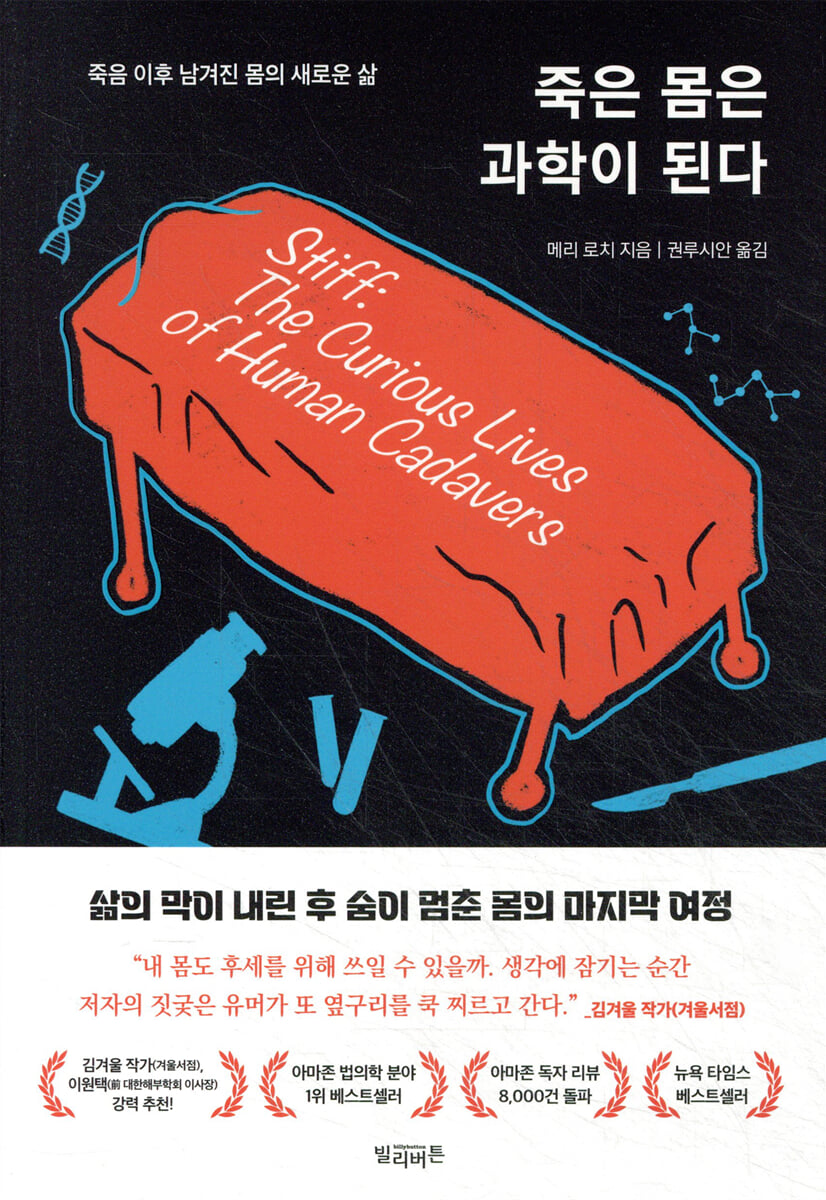
The dead body becomes science
 |
Description
Book Introduction
How are dead human bodies utilized?
From dissection labs to car crash tests and human composting.
The True Nature of Death as the Body's "Second Life"
Highly recommended by author Kim Gyul-wool of 'Winter Bookstore'
Strongly recommended by Won-taek Lee, former Professor Emeritus of the Department of Anatomy at Yonsei University and Chairman of the Korean Society of Anatomy
#1 Bestseller in Amazon's Forensic Science Category
New York Times bestseller
We think of death as the end of everything, but there are countless paths our bodies can take after we die.
I'm not just talking about the more well-known options, like becoming a medical student's intern or donating an organ.
The bodies of dead people can be used in experiments to test the safety of automobiles and can even assist in scientific investigations.
It can even be used as a medicinal herb or compost material to feed and sustain living beings.
In this way, the roles that a dead body can take on in this world are endless.
"The Dead Body Becomes Science" is the result of Mary Roach, America's leading science journalist, personally exploring this new aspect of death.
The author demonstrates his unique ability to explain difficult topics in an accessible manner, skillfully weaving together vast historical data, scientific knowledge, and firsthand field reports to present a detailed account of the various uses of the dead body.
Beginning with an intellectual exploration of the uses of the dead body and culminating in a series of journeys that question human dignity, this book will allow us to encounter a world of life and death that has previously been beyond our view.
From dissection labs to car crash tests and human composting.
The True Nature of Death as the Body's "Second Life"
Highly recommended by author Kim Gyul-wool of 'Winter Bookstore'
Strongly recommended by Won-taek Lee, former Professor Emeritus of the Department of Anatomy at Yonsei University and Chairman of the Korean Society of Anatomy
#1 Bestseller in Amazon's Forensic Science Category
New York Times bestseller
We think of death as the end of everything, but there are countless paths our bodies can take after we die.
I'm not just talking about the more well-known options, like becoming a medical student's intern or donating an organ.
The bodies of dead people can be used in experiments to test the safety of automobiles and can even assist in scientific investigations.
It can even be used as a medicinal herb or compost material to feed and sustain living beings.
In this way, the roles that a dead body can take on in this world are endless.
"The Dead Body Becomes Science" is the result of Mary Roach, America's leading science journalist, personally exploring this new aspect of death.
The author demonstrates his unique ability to explain difficult topics in an accessible manner, skillfully weaving together vast historical data, scientific knowledge, and firsthand field reports to present a detailed account of the various uses of the dead body.
Beginning with an intellectual exploration of the uses of the dead body and culminating in a series of journeys that question human dignity, this book will allow us to encounter a world of life and death that has previously been beyond our view.
index
Recommendation: The Science of Death That Fascinated the Human Intellect
preface
1 You can't waste your brain
Practice surgery on the dead
2 Anatomy and Crime
Body Thieves
3 What happens after death
Bodily Decay and How to Deal with It
4 Dead people can't drive
The dead who give life to the living
5 What happened on that plane?
When the body must tell the truth
6 About shooting a dead person
The tricky ethics of bullets and bombs
7 Holy Sacrifice
Cross experiment
8 Live or die
How to distinguish between life and death
9 Just one head is enough
Decapitation, Reanimation, and Human Head Transplantation
10 Eat me
Several stories about cannibalism
11 Out of the fire, into the compost bin
Discussion on new funeral methods
12 My remains
What is Mary Roach thinking?
Acknowledgements
References
preface
1 You can't waste your brain
Practice surgery on the dead
2 Anatomy and Crime
Body Thieves
3 What happens after death
Bodily Decay and How to Deal with It
4 Dead people can't drive
The dead who give life to the living
5 What happened on that plane?
When the body must tell the truth
6 About shooting a dead person
The tricky ethics of bullets and bombs
7 Holy Sacrifice
Cross experiment
8 Live or die
How to distinguish between life and death
9 Just one head is enough
Decapitation, Reanimation, and Human Head Transplantation
10 Eat me
Several stories about cannibalism
11 Out of the fire, into the compost bin
Discussion on new funeral methods
12 My remains
What is Mary Roach thinking?
Acknowledgements
References
Detailed image

Into the book
Surgeons weren't the only ones who were at the forefront of developing every surgical procedure, from heart transplants to sex-reassignment surgery.
The corpse has always been quietly creating medical history in its own way, piece by piece.
For 2,000 years, cadavers have been willingly or unknowingly participating in one of the boldest steps in the history of science.
--- p.10
In the heyday of the British School of Anatomy, such rational and painful emotions were rare.
The most common method used was to sneak into graveyards and dig up and study other people's relatives.
People called this behavior "corpse-raiding," and it was a new crime, different from grave robbing, which involved stealing valuables and treasures buried in the tombs or ossuaries of the rich.
However, at that time, if you were caught with a corpse's cufflinks, you were considered a criminal, but if you were caught with the corpse itself, you were not punished in any way.
Before the advent of anatomy schools, there were no laws against stealing a recently deceased human being.
--- p.54
Let's turn our attention to the corruption process.
The fluid flowing out of the cells destroyed by the enzyme now flows through the body.
Soon, this liquid encounters bacteria within the body, the foot soldiers that promote the process of putrefaction.
These bacteria are those that exist inside living bodies.
These are mainly those that live in places that come into contact with the outside world, such as the intestines, lungs, and skin.
Life looks rosy for these single-celled friends now.
They were already benefiting greatly from the human immune system's inactivity, and as the cells lining the internal organs were destroyed, they were buried in the porridge-like food that flowed out.
Food is pouring down like rain.
As is always the case in times of abundance, their numbers swell.
--- p.84
But let's think about it rationally.
Why is it acceptable to cut off my grandfather's thigh with a chainsaw, package the severed leg, send it to the lab, hang it on a hook, and hit it with a mock car bumper, but not acceptable to send his entire body to the lab for use? Why would cutting off his leg first be less offensive and less sacrilegious? --- p.141
He finds it easier to deal with severed hands, legs, and pieces of flesh that most of us find difficult to handle or even imagine seeing.
“A corpse in that state is just tissue.
“I handle my work with that kind of mindset.”
It's miserable, but not sad.
You get used to the misery.
But I can't get used to a ruined life.
Shanahan uses the methods of pathologists.
“They focus on the part, not the person.
During the autopsy, they describe the condition of the eyes and then the mouth.
You don't stand back and say, 'This is the body of a father of four.'
“That’s the only way to survive emotionally.”
However, an intact body is the most useful clue in determining whether a bomb has exploded.
--- p.154
H doesn't look like a dead person, nor does he smell like a dead person.
If you lean over the wheat and look closely, you can see her pulse beating in her artery.
When I touch his arm, it feels warm and elastic, just like my own.
Perhaps this is why the doctors and nurses call H "patient" and push him into the operating room with a brisk pace, as if they were carrying a living person.
In the United States, brain death is defined as legal death, so Person H is recognized as dead.
However, organs and tissues H are very active and alive.
These two seemingly contradictory facts give her an opportunity most corpses don't have.
In other words, it's a chance to extend the lives of a couple of dying strangers.
--- p.222
She thinks similarly about corpses.
“Death is the possibility of new life.
The body changes into something different.
“I want to make that other thing as positive as possible.”
People have accused her of reducing the dead to the level of garden waste.
She sees it from a slightly different perspective.
“What I mean is, let’s raise the value of garden waste to the same level as human bodies.”
What she means is that anything organic should not be treated as trash.
Everything must be recycled.
--- p.349
The body inside the barrel looked peaceful.
Just as a guinea pig the size of a police dog feels unnecessarily scary, the idea of a corpse being processed into synthetic resin seems scarier than it actually is.
We just lie there in the barrel, absorbing the polymer and being preserved.
After the polymer treatment, someone takes us out and poses us like a Yuto doll.
Then, when you rub the catalyst into your skin, the catalyst begins to penetrate into the tissue and the hardening process begins.
This way, the dead body is preserved permanently.
The corpse has always been quietly creating medical history in its own way, piece by piece.
For 2,000 years, cadavers have been willingly or unknowingly participating in one of the boldest steps in the history of science.
--- p.10
In the heyday of the British School of Anatomy, such rational and painful emotions were rare.
The most common method used was to sneak into graveyards and dig up and study other people's relatives.
People called this behavior "corpse-raiding," and it was a new crime, different from grave robbing, which involved stealing valuables and treasures buried in the tombs or ossuaries of the rich.
However, at that time, if you were caught with a corpse's cufflinks, you were considered a criminal, but if you were caught with the corpse itself, you were not punished in any way.
Before the advent of anatomy schools, there were no laws against stealing a recently deceased human being.
--- p.54
Let's turn our attention to the corruption process.
The fluid flowing out of the cells destroyed by the enzyme now flows through the body.
Soon, this liquid encounters bacteria within the body, the foot soldiers that promote the process of putrefaction.
These bacteria are those that exist inside living bodies.
These are mainly those that live in places that come into contact with the outside world, such as the intestines, lungs, and skin.
Life looks rosy for these single-celled friends now.
They were already benefiting greatly from the human immune system's inactivity, and as the cells lining the internal organs were destroyed, they were buried in the porridge-like food that flowed out.
Food is pouring down like rain.
As is always the case in times of abundance, their numbers swell.
--- p.84
But let's think about it rationally.
Why is it acceptable to cut off my grandfather's thigh with a chainsaw, package the severed leg, send it to the lab, hang it on a hook, and hit it with a mock car bumper, but not acceptable to send his entire body to the lab for use? Why would cutting off his leg first be less offensive and less sacrilegious? --- p.141
He finds it easier to deal with severed hands, legs, and pieces of flesh that most of us find difficult to handle or even imagine seeing.
“A corpse in that state is just tissue.
“I handle my work with that kind of mindset.”
It's miserable, but not sad.
You get used to the misery.
But I can't get used to a ruined life.
Shanahan uses the methods of pathologists.
“They focus on the part, not the person.
During the autopsy, they describe the condition of the eyes and then the mouth.
You don't stand back and say, 'This is the body of a father of four.'
“That’s the only way to survive emotionally.”
However, an intact body is the most useful clue in determining whether a bomb has exploded.
--- p.154
H doesn't look like a dead person, nor does he smell like a dead person.
If you lean over the wheat and look closely, you can see her pulse beating in her artery.
When I touch his arm, it feels warm and elastic, just like my own.
Perhaps this is why the doctors and nurses call H "patient" and push him into the operating room with a brisk pace, as if they were carrying a living person.
In the United States, brain death is defined as legal death, so Person H is recognized as dead.
However, organs and tissues H are very active and alive.
These two seemingly contradictory facts give her an opportunity most corpses don't have.
In other words, it's a chance to extend the lives of a couple of dying strangers.
--- p.222
She thinks similarly about corpses.
“Death is the possibility of new life.
The body changes into something different.
“I want to make that other thing as positive as possible.”
People have accused her of reducing the dead to the level of garden waste.
She sees it from a slightly different perspective.
“What I mean is, let’s raise the value of garden waste to the same level as human bodies.”
What she means is that anything organic should not be treated as trash.
Everything must be recycled.
--- p.349
The body inside the barrel looked peaceful.
Just as a guinea pig the size of a police dog feels unnecessarily scary, the idea of a corpse being processed into synthetic resin seems scarier than it actually is.
We just lie there in the barrel, absorbing the polymer and being preserved.
After the polymer treatment, someone takes us out and poses us like a Yuto doll.
Then, when you rub the catalyst into your skin, the catalyst begins to penetrate into the tissue and the hardening process begins.
This way, the dead body is preserved permanently.
--- p.385
Publisher's Review
***Highly recommended by author Gyul-wool Kim of 'Winter Bookstore'****
*** Strongly recommended by Won-taek Lee, former professor of anatomy at Yonsei University and president of the Korean Society of Anatomy***
***Amazon's #1 Bestseller in Forensics***
***New York Times Bestseller***
About the other side of death that we have never seen before
The most scientific and intellectual journey
For humans, death is either a fearful thing that brings loss and pain, or a majestic and solemn moment that marks the end of a person's life.
In either case, death was a difficult subject to bring up.
However, 『The Dead Body Becomes Science』 realistically illuminates the practical aspects of death without any embellishment or exaggeration.
The author speaks candidly about the dead body and its journey, using a unique style that makes even uncomfortable topics accessible.
As you watch the dead bodies following her take on the dangerous and important tasks that the living cannot do, and do the work of a single person, you will be surprised at how different they are from traditional death.
Some bodies climb into the driver's seat to participate in experiments to verify the safety of automobiles, while others are used as fertilizer.
You can trace back the history of anatomy and medicine to see how our ancestors utilized the bodies of the dead.
But what makes this book special is not simply that it deals with the rare subject of death.
The true value of this book lies in its in-depth study of the history of human death and anatomy, yet written in an accessible way for anyone.
This book, written by the author while traveling across the United States, China, Sweden, and other parts of the world, contains vivid knowledge about the whereabouts of dead bodies that cannot be easily accessed by watching just a few books or watching a few videos.
This is a must-read for any intelligent reader with a curiosity for the great unknown that is death.
Why do you have to use a dead body?
Exploring the History and Future of Human Utilization
Until now, mankind has relied on dead bodies to develop science and the world, but even so, the use of human bodies has been close to a taboo that cannot be discussed openly.
Because it feels like they are treating a 'person' who should be receiving condolences and respect from the bereaved family without any interference as if they were an object.
However, faced with problems such as a lack of land to bury the dead and environmental pollution caused by existing funeral methods, the scope of use of 'dead bodies' is expanding.
So this book doesn't ponder whether it's desirable or not to utilize dead bodies.
Instead, we consider how best to utilize the dead body.
Medical students who name corpses for practice, and scientists who understand the unreasonable demands of bereaved families to "test the performance of bulletproof vests using corpses without allowing bullets to penetrate the corpse's skin," are also people who, while standing at the center of human utilization, deeply contemplate human dignity.
And readers can also take the time to find their own answers about how to utilize the human body by looking at these images.
Until now, most stories about human utilization have been close to ghost stories or superstitions, but this book will help you break free from existing, flat stereotypes and deepen your understanding of human utilization.
Breaking free from the dichotomy of life and death
How to see life from a broader perspective
This book shows us the lives of those who have faced the end of their lives before us and chosen the fate of their bodies, providing an opportunity to look at death, which will one day come, and the body we will leave behind, in a slightly different way.
When we see the dead, who are as colorful as the living, we naturally begin to imagine our own end.
Would it be better to just lie in a coffin and rot? Should I donate my organs, like I donated a statue to my alma mater? Or is there a more elegant way to leave my body in this world forever?
As you read the book with these kinds of imaginations, some facts gradually become clearer.
The death depicted in this book is neither a noble sacrifice nor a terrible disaster.
Rather, it is closer to an inevitable ending and natural change that will come to us all.
As Haruki Murakami said, “Death is not the opposite of life, but a part of life.” This book shows us death as another beginning that comes at the end of life.
The moment you realize that death is not simply the end, your perspective on life will broaden and deepen.
*** Strongly recommended by Won-taek Lee, former professor of anatomy at Yonsei University and president of the Korean Society of Anatomy***
***Amazon's #1 Bestseller in Forensics***
***New York Times Bestseller***
About the other side of death that we have never seen before
The most scientific and intellectual journey
For humans, death is either a fearful thing that brings loss and pain, or a majestic and solemn moment that marks the end of a person's life.
In either case, death was a difficult subject to bring up.
However, 『The Dead Body Becomes Science』 realistically illuminates the practical aspects of death without any embellishment or exaggeration.
The author speaks candidly about the dead body and its journey, using a unique style that makes even uncomfortable topics accessible.
As you watch the dead bodies following her take on the dangerous and important tasks that the living cannot do, and do the work of a single person, you will be surprised at how different they are from traditional death.
Some bodies climb into the driver's seat to participate in experiments to verify the safety of automobiles, while others are used as fertilizer.
You can trace back the history of anatomy and medicine to see how our ancestors utilized the bodies of the dead.
But what makes this book special is not simply that it deals with the rare subject of death.
The true value of this book lies in its in-depth study of the history of human death and anatomy, yet written in an accessible way for anyone.
This book, written by the author while traveling across the United States, China, Sweden, and other parts of the world, contains vivid knowledge about the whereabouts of dead bodies that cannot be easily accessed by watching just a few books or watching a few videos.
This is a must-read for any intelligent reader with a curiosity for the great unknown that is death.
Why do you have to use a dead body?
Exploring the History and Future of Human Utilization
Until now, mankind has relied on dead bodies to develop science and the world, but even so, the use of human bodies has been close to a taboo that cannot be discussed openly.
Because it feels like they are treating a 'person' who should be receiving condolences and respect from the bereaved family without any interference as if they were an object.
However, faced with problems such as a lack of land to bury the dead and environmental pollution caused by existing funeral methods, the scope of use of 'dead bodies' is expanding.
So this book doesn't ponder whether it's desirable or not to utilize dead bodies.
Instead, we consider how best to utilize the dead body.
Medical students who name corpses for practice, and scientists who understand the unreasonable demands of bereaved families to "test the performance of bulletproof vests using corpses without allowing bullets to penetrate the corpse's skin," are also people who, while standing at the center of human utilization, deeply contemplate human dignity.
And readers can also take the time to find their own answers about how to utilize the human body by looking at these images.
Until now, most stories about human utilization have been close to ghost stories or superstitions, but this book will help you break free from existing, flat stereotypes and deepen your understanding of human utilization.
Breaking free from the dichotomy of life and death
How to see life from a broader perspective
This book shows us the lives of those who have faced the end of their lives before us and chosen the fate of their bodies, providing an opportunity to look at death, which will one day come, and the body we will leave behind, in a slightly different way.
When we see the dead, who are as colorful as the living, we naturally begin to imagine our own end.
Would it be better to just lie in a coffin and rot? Should I donate my organs, like I donated a statue to my alma mater? Or is there a more elegant way to leave my body in this world forever?
As you read the book with these kinds of imaginations, some facts gradually become clearer.
The death depicted in this book is neither a noble sacrifice nor a terrible disaster.
Rather, it is closer to an inevitable ending and natural change that will come to us all.
As Haruki Murakami said, “Death is not the opposite of life, but a part of life.” This book shows us death as another beginning that comes at the end of life.
The moment you realize that death is not simply the end, your perspective on life will broaden and deepen.
GOODS SPECIFICS
- Date of issue: September 17, 2025
- Page count, weight, size: 404 pages | 145*210*30mm
- ISBN13: 9791192999890
- ISBN10: 1192999894
You may also like
카테고리
korean


korean

![GQ KOREA Mark (Monthly): December [2025]](http://librairie.coreenne.fr/cdn/shop/files/8ef265dbbfbf186523ed75ba7319009d.jpg?v=1765340328&width=3840)


