

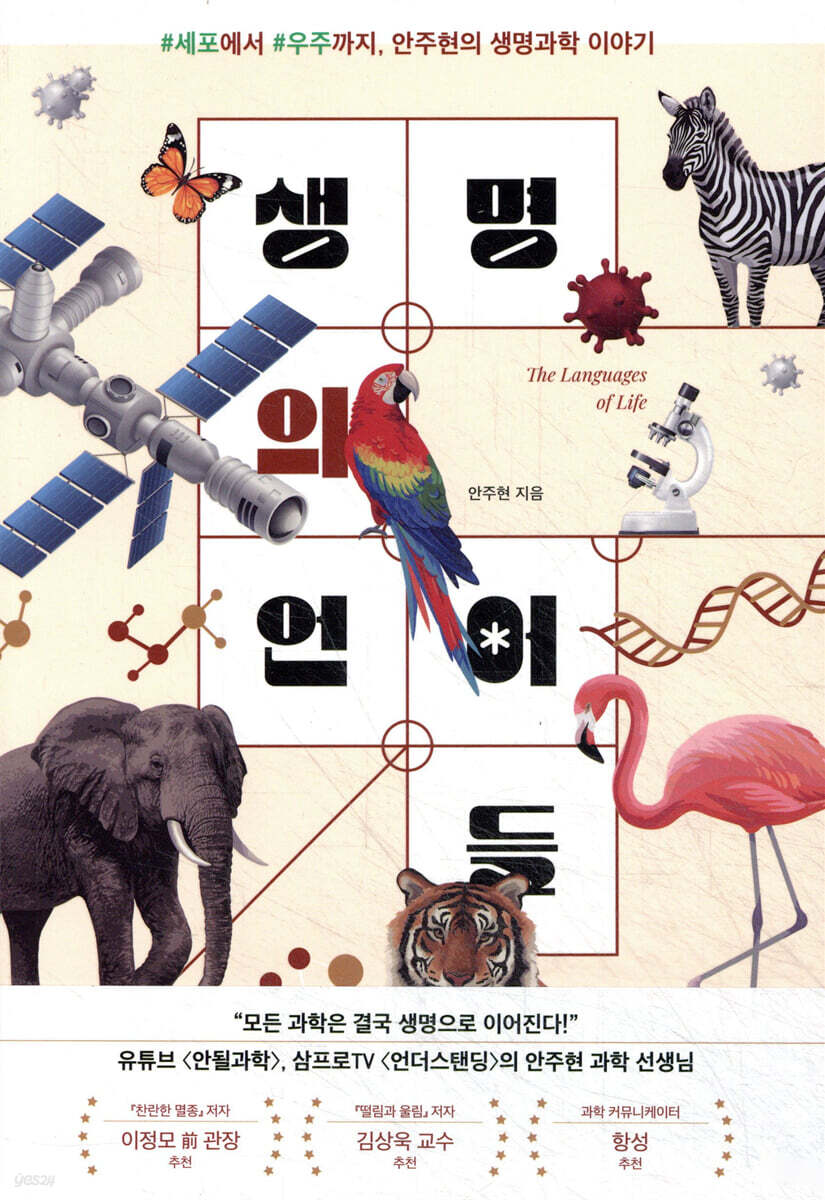
Languages of Life
 |
Description
Book Introduction
Strongly recommended by Lee Jeong-mo, Kim Sang-wook, and Hang Seong!
“All science ultimately leads to life!”
Science teacher from YouTube's [Science That Won't Work] and Sampro TV's [Understanding]
"The Languages of Life" is a science textbook that weaves together previously divided subjects like physics, chemistry, and earth science into a single stream called "life."
Ahn Joo-hyun, a life scientist who studied the development of the fruit fly nervous system and a current high school teacher, has developed a series of 40 stories with practical commentary that she has refined from her desk and on YouTube.
A wide range of topics, including ultraviolet mutations, dinosaurs and asteroids, painless injections, and seed bolts, are marked with hashtags, allowing readers to immediately find and read topics of interest.
The narrative, which derives circulatory science from blood pressure monitors, high-performance materials from spider silk, and safety and ethics from the blue blood of horseshoe crabs, naturally conveys the message, “Protect what you know, and act what you understand.”
Former Director of the National Science Museum in Gwacheon, Lee Jeong-mo, commented that the book “penetrates all life through the language of science,” and that it allows people to acquire the “language of life” beyond knowledge.
In fact, stories always begin in everyday life.
Taking the static of noise-canceling headphones, the pink of strawberry milk, and the elasticity of a spider's web as clues, they advance to deeper principles such as destructive interference, microbial metabolic engineering, and biomimetic polymer fiber design, respectively.
As Professor Kim Sang-wook put it, the writing style is “short but deep, easy but not light,” making it an easy read for everyone from middle and high school students to adults.
The concise structure makes it ideal for reading groups or classroom materials.
Even if you read different chapters, you can quickly continue the conversation, providing solid guidance to young people exploring career paths across science, medicine, the environment, and engineering.
The perspective that draws ecological disruption from pollen allergies, climate change from reindeer eating habits, and bioethics from gene editing overlaps scientific facts with real-world issues.
Science communicator Haengseong marveled, "Can science be this warm?" When you close the book, even ordinary street scenes come back to you with a new question: "Why is that?"
“All science ultimately leads to life!”
Science teacher from YouTube's [Science That Won't Work] and Sampro TV's [Understanding]
"The Languages of Life" is a science textbook that weaves together previously divided subjects like physics, chemistry, and earth science into a single stream called "life."
Ahn Joo-hyun, a life scientist who studied the development of the fruit fly nervous system and a current high school teacher, has developed a series of 40 stories with practical commentary that she has refined from her desk and on YouTube.
A wide range of topics, including ultraviolet mutations, dinosaurs and asteroids, painless injections, and seed bolts, are marked with hashtags, allowing readers to immediately find and read topics of interest.
The narrative, which derives circulatory science from blood pressure monitors, high-performance materials from spider silk, and safety and ethics from the blue blood of horseshoe crabs, naturally conveys the message, “Protect what you know, and act what you understand.”
Former Director of the National Science Museum in Gwacheon, Lee Jeong-mo, commented that the book “penetrates all life through the language of science,” and that it allows people to acquire the “language of life” beyond knowledge.
In fact, stories always begin in everyday life.
Taking the static of noise-canceling headphones, the pink of strawberry milk, and the elasticity of a spider's web as clues, they advance to deeper principles such as destructive interference, microbial metabolic engineering, and biomimetic polymer fiber design, respectively.
As Professor Kim Sang-wook put it, the writing style is “short but deep, easy but not light,” making it an easy read for everyone from middle and high school students to adults.
The concise structure makes it ideal for reading groups or classroom materials.
Even if you read different chapters, you can quickly continue the conversation, providing solid guidance to young people exploring career paths across science, medicine, the environment, and engineering.
The perspective that draws ecological disruption from pollen allergies, climate change from reindeer eating habits, and bioethics from gene editing overlaps scientific facts with real-world issues.
Science communicator Haengseong marveled, "Can science be this warm?" When you close the book, even ordinary street scenes come back to you with a new question: "Why is that?"
- You can preview some of the book's contents.
Preview
index
Recommendation 004
Prologue: In Search of the Invisible Language 008
Part 1: Beyond the Boundaries: A Dialogue Between Life and Science
Chapter 1: The Language of Life as Told by Engineering
Strawberry Milk #The Secret to Color: Natural Pigment 020
From Chemistry to E. coli, the #TextileRevolution: Nylon 026
Underwater robot 032 that mimics the movements of a school of fish
#StructuralDesignTougherThanSteel, Spiders and Their Webs 038
Chapter 2: The Formula of Life as Told by Physics
Blood pressure monitor 048 that reads your body's circulation
#Pain-Reducing, Pain-Free Injection Discovered Through Pressure 054
#EraseSoundWithSound, Noise Cancelling 063
#Tigers and Desert Foxes Regulate Their Heat: Temperature and Size 069
Chapter 3: Traces of Life from Earth and the Universe
#Collision Opportunity: Dinosaurs and Asteroids 078
#The Secret of the Giant Dragonfly Revealed by Breathing, Oxygen 085
#Going to Space to Save Lives, Mice and Medical Research 091
Seed Vault 098: A Vault for Earth's #Doomsday
Part 2: The Human Body and Medicine - The Story of Life Inside My Body
Chapter 1: Signals Transmitted by the Senses
#Wisdom to block UV rays, melanin pigment 110
Why spicy #stimuli are hot and painful: Skin sensation 117
Frogs and I Are Different #Design, Cell Death 125
Chapter 2: A Dialogue on Immunity and Disease
Pollen that causes a runny nose #Allergy, Ragweed 132
Research that challenges the irreversible: Lung Cancer 139
Measles 145, a virus that destroys immunity and memory
#Blue blood that blocks germs, horseshoe crab 152
Mosquitoes: The #DiseaseVector That Changed Our Lives Due to Climate Change 158
Chapter 3: The Future of Medicine - Rewriting Life
Beyond DNA Structure, Into the Era of #Editing: Gene Scissors 166
#TheFutureofArtificialOrgans:OrganoidsandAssemblyoids 173
#The Secret to Creating Universal Blood: Blood Types and Transfusions 182
Virus 189 that protects us by attacking germs
Part 3: The Diversity of Life - A Time Journey with Life
Chapter 1: The Origin of Life and the History of Humanity
Secret passage to life's birth: Hydrothermal vents 202
Bacteria 208, the #ancestors of life everywhere
#Information from Fossilized Poop: Gut Microbes 214
#The Breath of Ancient Human Art: Cave Paintings 220
Chapter 2: Evolution and the Footsteps of History
Korean Mesozoic Reptile #Fossil, Primitive Crocodile 230
#Changes in Nature Divided Creatures, Geographic Isolation 236
#Evolution and Breeding Brought About by Civilization 244
#The Infinite Transformation of Cabbage Through Breeding: Woo Jang-chun's Triangle 253
Chapter 3: Stories from Plants and Animals
#Rudolph, the reindeer with a stomachache due to climate change 260
Autumn's #Signal of Tree Protection: Maple Leaves 266
#Beauty Born from Genes, Flower Colors 273
#The Sound of Summer, Cicadas 280
Chapter 4: Emotions and Ecology of Living Things
#How to Express Emotions, Animal Communication 288
#Messages through Dance, Bee 295
Ecosystem #Disruption: A Warning: King Snail 301
#The Answer for Coexistence: I-Cow Project 310
Epilogue: The Unfinished Treasure Hunt 316
Prologue: In Search of the Invisible Language 008
Part 1: Beyond the Boundaries: A Dialogue Between Life and Science
Chapter 1: The Language of Life as Told by Engineering
Strawberry Milk #The Secret to Color: Natural Pigment 020
From Chemistry to E. coli, the #TextileRevolution: Nylon 026
Underwater robot 032 that mimics the movements of a school of fish
#StructuralDesignTougherThanSteel, Spiders and Their Webs 038
Chapter 2: The Formula of Life as Told by Physics
Blood pressure monitor 048 that reads your body's circulation
#Pain-Reducing, Pain-Free Injection Discovered Through Pressure 054
#EraseSoundWithSound, Noise Cancelling 063
#Tigers and Desert Foxes Regulate Their Heat: Temperature and Size 069
Chapter 3: Traces of Life from Earth and the Universe
#Collision Opportunity: Dinosaurs and Asteroids 078
#The Secret of the Giant Dragonfly Revealed by Breathing, Oxygen 085
#Going to Space to Save Lives, Mice and Medical Research 091
Seed Vault 098: A Vault for Earth's #Doomsday
Part 2: The Human Body and Medicine - The Story of Life Inside My Body
Chapter 1: Signals Transmitted by the Senses
#Wisdom to block UV rays, melanin pigment 110
Why spicy #stimuli are hot and painful: Skin sensation 117
Frogs and I Are Different #Design, Cell Death 125
Chapter 2: A Dialogue on Immunity and Disease
Pollen that causes a runny nose #Allergy, Ragweed 132
Research that challenges the irreversible: Lung Cancer 139
Measles 145, a virus that destroys immunity and memory
#Blue blood that blocks germs, horseshoe crab 152
Mosquitoes: The #DiseaseVector That Changed Our Lives Due to Climate Change 158
Chapter 3: The Future of Medicine - Rewriting Life
Beyond DNA Structure, Into the Era of #Editing: Gene Scissors 166
#TheFutureofArtificialOrgans:OrganoidsandAssemblyoids 173
#The Secret to Creating Universal Blood: Blood Types and Transfusions 182
Virus 189 that protects us by attacking germs
Part 3: The Diversity of Life - A Time Journey with Life
Chapter 1: The Origin of Life and the History of Humanity
Secret passage to life's birth: Hydrothermal vents 202
Bacteria 208, the #ancestors of life everywhere
#Information from Fossilized Poop: Gut Microbes 214
#The Breath of Ancient Human Art: Cave Paintings 220
Chapter 2: Evolution and the Footsteps of History
Korean Mesozoic Reptile #Fossil, Primitive Crocodile 230
#Changes in Nature Divided Creatures, Geographic Isolation 236
#Evolution and Breeding Brought About by Civilization 244
#The Infinite Transformation of Cabbage Through Breeding: Woo Jang-chun's Triangle 253
Chapter 3: Stories from Plants and Animals
#Rudolph, the reindeer with a stomachache due to climate change 260
Autumn's #Signal of Tree Protection: Maple Leaves 266
#Beauty Born from Genes, Flower Colors 273
#The Sound of Summer, Cicadas 280
Chapter 4: Emotions and Ecology of Living Things
#How to Express Emotions, Animal Communication 288
#Messages through Dance, Bee 295
Ecosystem #Disruption: A Warning: King Snail 301
#The Answer for Coexistence: I-Cow Project 310
Epilogue: The Unfinished Treasure Hunt 316
Detailed image

Into the book
What we call life is not simply the phenomenon of cells dividing and metabolizing energy and substances.
The continuous communication and interaction that takes place in nature, the continuous change and adaptation that has continued for a long time, and the colorful diversity that has been created as a result, are recorded from cells to the universe, and are still being created today.
In all these moments the language of life exists.
So, efforts to understand the language of life are being made in various fields beyond biology, such as physics, chemistry, earth and space science, and engineering.
--- p.10 From "Prologue: In Search of the Invisible Language"
We began researching ways to find a natural pigment that would address the shortcomings of cochineal through scientific and engineering methods while still producing a vibrant and effective red.
If we could obtain carmine from a source other than cochineal insects, wouldn't we be able to solve the problems caused by cochineal insects? Research results successfully producing carmine without using cochineal insects will be published in 2021.
Previously, the only organisms known to be capable of producing carmine were cochineal bugs and some fungi, but a research team at the Korea Advanced Institute of Science and Technology (KAIST) developed a method to produce carmine in E. coli using glucose as a raw material.
--- p.23~24 From "Strawberry Milk #The Secret of Color, Natural Pigment"
Spider silk is made of a protein called fibroin, which is known to be in a liquid state within the silk, but as it passes through the silk tube, the molecular structure of the protein changes and it turns into a solid spider silk that does not dissolve in water and comes out.
The strength and elasticity of spider silk are determined by its protein structure and moisture content.
Spider silk without moisture is rigid and will break if stretched more than 30% of its original length, but spider silk with moisture is highly viscous and elastic and can stretch more than 300% of its original length.
Spiders take advantage of this property to make the basic skeleton of their webs out of dry, hard spider silk, and the line they use to catch prey out of elastic spider silk that contains moisture.
--- p.42 From "Structural Design Tougher Than Steel, Spiders and Spiderwebs"
Since their initial development in 1998, microneedles have been actively studied in various fields, including medicine, biology, chemical engineering, materials engineering, mechanical engineering, and electronic engineering.
Many researchers are working to develop painless injections that eliminate needle fear, so I hope that one day the fear of needles will disappear and people will no longer be hesitant to get vaccinated.
--- p.62 From “#Reducing pain through pressure, painless injections”
But some recent studies suggest that asteroids may not have only caused extinction.
According to a study by a Japanese research team published in Scientific Reports in 2020, the impact of an asteroid hitting Earth about 4 billion years ago may have created amino acids essential for the emergence of life.
The research team simulated the chemical reactions that would have occurred if an asteroid had struck the ancient Earth's oceans, and discovered that amino acids like glycine and alanine, which serve as catalysts for biological reactions, were created.
This means that both the emergence and extinction of life could be related to asteroids.
--- p.84 From “#The Opportunity Brought by Collisions, Dinosaurs and Asteroids”
The Golden Goose Award was proposed in 2012 by then-U.S. Representative Jim Cooper, and is awarded by the American Association for the Advancement of Science (AAAS) and the U.S. Congress to recognize research that may not have produced remarkable results or benefits at the time of research, but ultimately contributes greatly to humanity and society over time.
It started as a protest against the Congress' decision to cut funding for some research projects, arguing that even basic scientific research that might seem absurd or even a waste of money could later lead to results that could save lives or have a major impact on the advancement of humanity.
--- p.153 From “#Blue blood that blocks germs, horseshoe crab”
The discovery of a deep-sea ecosystem around hydrothermal vents has brought to light the possibility that the first life arose at hydrothermal vents.
Additionally, as research on hydrothermal vents progresses, research on the possibility of extraterrestrial life naturally becomes more active.
If Miller's previous experiments were to be followed, it was assumed that life could only exist on planets as large as Earth or Mars. However, if life can emerge even in conditions such as hydrothermal vents, where sunlight does not reach, and where high temperatures and pressures are present and where life is surrounded by toxic chemicals, then more celestial bodies could have the possibility of supporting life.
--- p.206~207 From "Life #Secret passage to birth, hydrothermal vents"
For plants to grow well and for us to harvest a large harvest, suitable environmental conditions must be maintained.
However, if there are major changes in environmental conditions due to global warming, such as rising temperatures, changes in rainfall patterns, and increases in carbon dioxide concentration in the atmosphere, it will affect plant growth worldwide.
As a result, this could lead to food problems for animals and humans who live using the plant as an energy source.
To address these challenges, we need to make various efforts to curb climate change, while also conducting research to develop crops that can survive changing environmental conditions.
--- p.245~246 From “#Evolution and Breeding Caused by Civilization”
To find out why reindeer move to the coast, we collected reindeer droppings from coastal and inland areas and analyzed the ratios of isotopes of carbon, nitrogen, sulfur, and other elements in the droppings.
As a result, we found that the reindeer started eating seaweed, which they had not eaten before.
Comparing with climate data from the area, we also found that as the cold weather intensifies, they go down to the coast more often to eat seaweed.
Reindeer have also been observed washing seaweed and kelp in seawater before eating them.
Unlike terrestrial plants or lichens, seaweed has a high salt content, so eating too much of it can cause side effects such as diarrhea, so they cannot eat only seaweed, but it was an inevitable choice to adapt to an environment where food was scarce.
--- p.264~265 From “Rudolph, the reindeer with a stomachache due to climate change”
In fact, the treasure hunt for the language of life never ends.
We still don't know how many unknown languages and signals lie hidden within nature, the universe, and ourselves.
Science discovers new clues every day, engineering translates those clues into real-world technologies, and we all play our part in this grand treasure hunt.
The continuous communication and interaction that takes place in nature, the continuous change and adaptation that has continued for a long time, and the colorful diversity that has been created as a result, are recorded from cells to the universe, and are still being created today.
In all these moments the language of life exists.
So, efforts to understand the language of life are being made in various fields beyond biology, such as physics, chemistry, earth and space science, and engineering.
--- p.10 From "Prologue: In Search of the Invisible Language"
We began researching ways to find a natural pigment that would address the shortcomings of cochineal through scientific and engineering methods while still producing a vibrant and effective red.
If we could obtain carmine from a source other than cochineal insects, wouldn't we be able to solve the problems caused by cochineal insects? Research results successfully producing carmine without using cochineal insects will be published in 2021.
Previously, the only organisms known to be capable of producing carmine were cochineal bugs and some fungi, but a research team at the Korea Advanced Institute of Science and Technology (KAIST) developed a method to produce carmine in E. coli using glucose as a raw material.
--- p.23~24 From "Strawberry Milk #The Secret of Color, Natural Pigment"
Spider silk is made of a protein called fibroin, which is known to be in a liquid state within the silk, but as it passes through the silk tube, the molecular structure of the protein changes and it turns into a solid spider silk that does not dissolve in water and comes out.
The strength and elasticity of spider silk are determined by its protein structure and moisture content.
Spider silk without moisture is rigid and will break if stretched more than 30% of its original length, but spider silk with moisture is highly viscous and elastic and can stretch more than 300% of its original length.
Spiders take advantage of this property to make the basic skeleton of their webs out of dry, hard spider silk, and the line they use to catch prey out of elastic spider silk that contains moisture.
--- p.42 From "Structural Design Tougher Than Steel, Spiders and Spiderwebs"
Since their initial development in 1998, microneedles have been actively studied in various fields, including medicine, biology, chemical engineering, materials engineering, mechanical engineering, and electronic engineering.
Many researchers are working to develop painless injections that eliminate needle fear, so I hope that one day the fear of needles will disappear and people will no longer be hesitant to get vaccinated.
--- p.62 From “#Reducing pain through pressure, painless injections”
But some recent studies suggest that asteroids may not have only caused extinction.
According to a study by a Japanese research team published in Scientific Reports in 2020, the impact of an asteroid hitting Earth about 4 billion years ago may have created amino acids essential for the emergence of life.
The research team simulated the chemical reactions that would have occurred if an asteroid had struck the ancient Earth's oceans, and discovered that amino acids like glycine and alanine, which serve as catalysts for biological reactions, were created.
This means that both the emergence and extinction of life could be related to asteroids.
--- p.84 From “#The Opportunity Brought by Collisions, Dinosaurs and Asteroids”
The Golden Goose Award was proposed in 2012 by then-U.S. Representative Jim Cooper, and is awarded by the American Association for the Advancement of Science (AAAS) and the U.S. Congress to recognize research that may not have produced remarkable results or benefits at the time of research, but ultimately contributes greatly to humanity and society over time.
It started as a protest against the Congress' decision to cut funding for some research projects, arguing that even basic scientific research that might seem absurd or even a waste of money could later lead to results that could save lives or have a major impact on the advancement of humanity.
--- p.153 From “#Blue blood that blocks germs, horseshoe crab”
The discovery of a deep-sea ecosystem around hydrothermal vents has brought to light the possibility that the first life arose at hydrothermal vents.
Additionally, as research on hydrothermal vents progresses, research on the possibility of extraterrestrial life naturally becomes more active.
If Miller's previous experiments were to be followed, it was assumed that life could only exist on planets as large as Earth or Mars. However, if life can emerge even in conditions such as hydrothermal vents, where sunlight does not reach, and where high temperatures and pressures are present and where life is surrounded by toxic chemicals, then more celestial bodies could have the possibility of supporting life.
--- p.206~207 From "Life #Secret passage to birth, hydrothermal vents"
For plants to grow well and for us to harvest a large harvest, suitable environmental conditions must be maintained.
However, if there are major changes in environmental conditions due to global warming, such as rising temperatures, changes in rainfall patterns, and increases in carbon dioxide concentration in the atmosphere, it will affect plant growth worldwide.
As a result, this could lead to food problems for animals and humans who live using the plant as an energy source.
To address these challenges, we need to make various efforts to curb climate change, while also conducting research to develop crops that can survive changing environmental conditions.
--- p.245~246 From “#Evolution and Breeding Caused by Civilization”
To find out why reindeer move to the coast, we collected reindeer droppings from coastal and inland areas and analyzed the ratios of isotopes of carbon, nitrogen, sulfur, and other elements in the droppings.
As a result, we found that the reindeer started eating seaweed, which they had not eaten before.
Comparing with climate data from the area, we also found that as the cold weather intensifies, they go down to the coast more often to eat seaweed.
Reindeer have also been observed washing seaweed and kelp in seawater before eating them.
Unlike terrestrial plants or lichens, seaweed has a high salt content, so eating too much of it can cause side effects such as diarrhea, so they cannot eat only seaweed, but it was an inevitable choice to adapt to an environment where food was scarce.
--- p.264~265 From “Rudolph, the reindeer with a stomachache due to climate change”
In fact, the treasure hunt for the language of life never ends.
We still don't know how many unknown languages and signals lie hidden within nature, the universe, and ourselves.
Science discovers new clues every day, engineering translates those clues into real-world technologies, and we all play our part in this grand treasure hunt.
--- p.318 From "Epilogue: The Never-Ended Treasure Hunt"
Publisher's Review
“Reading the World Through the Eyes of Life”
All roads in science lead to life.
As the title suggests, “Languages of Life” is a book that allows us to look into the universe, the Earth, and our bodies simultaneously through the lens of “life.”
When we learn science, we often remember physics, chemistry, earth science, and life science as subjects in different fruit baskets, like apples, pears, persimmons, and grapes.
However, current teacher Ahn Joo-hyun breaks down this barrier with one sentence: “All science ultimately leads to life.”
It's like weaving together a physics lesson with a story about ultraviolet rays causing mutations, an earth science lesson with a scene of a mass extinction caused by an asteroid impact, an engineering lesson with a microbial process that uses E. coli to synthesize pigments, and finally tying a large ribbon with the title "Sustainability of Life."
What stands out in particular is the narrative style that naturally encompasses scientific facts and 'living issues'.
The scene where the blue blood of a horseshoe crab is used to screen out bacterial toxins in medicine raises the ethical question, “Could science that saves people also accelerate the extinction of other species?”
It also explains the changing eating habits of reindeer, showing the reality of the climate crisis, and as you follow pollen allergies, urban air pollution and indigenous ecology meet in the same paragraph.
The moment biological knowledge is naturally translated into social sensibility, the reader embodies 'responsibility' beyond 'knowledge'.
The book's core message is surprisingly simple.
“Keep what you know, and act what you understand.” The author emphasizes that science is not simply a technical term in a laboratory, but the language of every moment we breathe, walk, eat, and love.
So, after reading this book to the end, you will feel as if the world, which was once divided like “environmental issues in chemistry class, infectious diseases in life science class, and space exploration in physics class,” has come together into a single river of life.
Thanks to its easy and warm writing style, middle and high school students can follow along without feeling burdened, as if they were reading a coming-of-age novel, but it is also suitable as a discussion material for teachers, parents, and the scientific community.
They don't brag about cutting-edge research published in Nature or Science.
Instead, we draw stories from everyday life, such as water droplets, spider webs, and nail dyeing, that we encounter just by looking up.
As we gradually unravel the hidden metabolism, evolution, and ecological interactions behind our daily lives, the joy of learning comes first, followed by the surprise.
This narrative style demonstrates that scientific rigor and emotional resonance are not incompatible.
This is where the author's background as a life science major is fully revealed in his "perspective of integrating all sciences into one biosphere."
In short, 『Languages of Life』 is a book that reflects the concepts that were scattered in textbooks into a single mirror called “the grand narrative of life.”
Thanks to this, readers gain a new way of reading science, hearing it in the "language of warm empathy" and thinking about their own daily lives and the health of the entire planet.
That is the way this book proposes to read the world through the eyes of life.
40 Breaths, One Life Force
"The Languages of Life" remains deeply etched even after reading it in sections.
When you open 『Languages of Life』, the first thing you feel is ‘breathing.’
This is because the 40 articles are spread out like a walking path, rather than the pressure of a thick science textbook.
Where to begin and where to end is entirely up to the reader.
If you are curious about the sound of insects gently tickling your ears on a sunset-drenched evening, read “The Sound of Summer, the Sound of Cicadas.” If you are dazzled by the sunlight pouring through the window, read “The Wisdom of Blocking Ultraviolet Rays, Melanin Pigment.”
Even with just one page, the argument is complete, and the lingering feeling naturally leads you to the next page.
Thanks to this, there is no room for the guilt of procrastinating or worrying about forgetting the beginning.
The author uses the spark of curiosity that arises in everyday life as a starting point to breathe rhythm into the story.
Familiar scenes provide clues, such as the principle of external noise suddenly disappearing when wearing noise-canceling earphones, the reason why maple leaves turn red in the fall, and the identity of the natural pigment hidden in a cup of strawberry milk.
After capturing the reader's attention, the pace slows down to examine the historical and industrial context, and finally expands to a larger picture encompassing the ecosystem and human society.
Although the book is short to read, the depth of analysis deepens with each chapter, and the aspects that Professor Kim Sang-wook described as “short but deep, easy but not light” become clear.
Because it starts from our five senses, not laboratory numbers, scientific details are provided only 'as much as necessary and as accurately as possible.'
The true value of this book lies in its structure, which allows for immersion without breaking even when reading it briefly in the midst of a busy daily life.
You can finish a story in a jiffy, whether you're on the go or just about to go to sleep.
It is also highly useful as a reading group or class material based on an independent faucet.
The topics are rich enough that even if each person reads a different topic, they can naturally connect the stories, so it is certain that the barrier to conversation among meeting participants will be lowered.
A brief reading immediately leads to discussion and reflection, and the book becomes more than a repository of knowledge, but a platform for community conversation.
The amount of information condensed into a short text is thanks to a two-layer design.
First, the author neither compresses the content nor provides detailed information like an academic paper.
Second, place the origin and the future side by side.
As we follow the process of horseshoe crab blood being used in vaccine production, the history of medical development and the dilemma of animal ethics overlap at a glance, and readers naturally experience “a perspective that sees through all life through the language of science” as said by former director of the National Science Museum in Gwacheon, Lee Jeong-mo.
A brisk rhythm means excellent stride control.
When explaining pollen allergies, invasive species, air pollution, and personal health management are all linked together.
This is why a stellar science communicator exclaimed, “Can science be this warm?”
The power to transform the everyday scenes we pass by without a second thought into scientific issues and to turn those issues into community tasks rather than individual ones.
"Languages of Life" contains these two forces divided into 40 rhythms.
Even after closing the book, the reader's daily life is still in the state of 'reading'.
The bubbles in the coffee cup, the smartphone flash illuminating the veins in the palm, the layer of clouds flowing outside the window—all whisper as another title.
In the end, the 40 chapters in the book were nothing more than a guide, and the real textbook is the reality of today that the reader will unfold again.
For this reason, "The Languages of Life" is a rare practical science humanities book that restores the continuity of scientific thought through short, independent pieces.
From the podium to the camera, connecting science
A vivid guide from current teacher and popular science star An Ju-hyun.
An Ju-hyeon received her doctorate from Seoul National University for her research on the development of the nervous system in fruit flies. After lecturing at Seoul Science High School, Ajou University, and Sungshin Women's University, she currently teaches at Jungdong High School.
An Joo-hyun is a person who has been unraveling science through papers in the lab, through research activities in the classroom, and through stories on stage and in front of the camera.
The fact that his childhood award, which included the Minister of Science Award for Outstanding Children in Science, led to the Outstanding Science Teacher Award 20 years later, speaks volumes about his consistency.
These days, he is busy gathering subscribers with his witty remarks on YouTube channels such as “An Joo-hyun’s Knowledge Cells,” “Science That Won’t Work,” and Sampro TV’s “Understanding” and “Sitting Down with Science,” and is also busy as a popular science star who gives public lectures every weekend.
The book that condenses these multi-layered activities into one volume is 『Languages of Life』.
An Ju-hyeon's explanation method puts the 'scene' first.
Don't put definitions or formulas first.
〈Erasing Sound with Sound, Noise Cancelling〉 brings to mind the momentary silence that comes when you turn on your headphones in the subway, and 〈Structural Design Tougher than Steel, Spiders and Spiderwebs〉 reflects the dew that forms on a spider's web during a morning walk.
It piques curiosity with familiar scenes and then drills down into key concepts like sound interference and protein structure.
This flow of 'capturing the moment to explaining the principle' is based on teaching know-how accumulated in the classroom.
Each tab reveals a topic with a hashtag (#pressure, #color, #heat, etc.) and consists of a short, independent piece.
Thanks to this, readers can start reading from the part that catches their attention.
For example, if you frequently check your blood pressure with a wearable device, you can read “A Blood Pressure Monitor That Reads Your Body’s Circulation,” and if you are curious about food security news, you can read “Seed Vault: A Safe for the End of the World.”
The educational advantage of books lies in their lack of a formal structure like 'classroom materials'.
Instead of tables or difficulty levels, rhythmic narratives and rich metaphors become the seeds of inquiry classes.
In “Pain Reduction Discovered Through Pressure, Painless Injections,” various technological attempts toward needle-free injections are introduced, naturally leading to the topic of discussion: “How much can medical technology reduce pain?”
Teachers can easily expand the group activity by searching for experimental videos or additional papers, and students can design their own presentation materials using just one keyword, such as "needle-free injection."
An Ju-hyun's speech reflects both her lab training and broadcasting experience.
In “Rudolph and the Reindeer with Stomach Aches Due to Climate Change,” he describes the reindeer’s diet shaken by climate change, and paints an image of “the Arctic where it rains instead of snow, and reindeer chewing kelp.”
In "Messages Delivered through Dance, Bees," the trajectory of the figure-eight dance is compared to car navigation, revealing how much information honeybees compress and convey.
Such comparisons leave a "moving picture" in the reader's mind, making scientific facts stick in their memory for a long time.
Although this book is not intended as a career exploration guide, its broad range of topics suggests a variety of paths for readers.
"The Future of Artificial Organs: Organoids and Assembloids" connects stem cell research with medical engineering, and "Viruses That Protect Us by Attacking Bacteria" depicts how phage therapy will overcome the problem of antibiotic resistance.
Readers considering science policy can examine models of ecosystem disruption and conservation through "Wang Urongi" and "I Cow Project."
Throughout the book, An Ju-hyeon reminds us of the question, "Why do we learn?"
Moreover, the message that 'science is a sense of discovering problems before solving them' provides breathing room between complex explanations.
Thanks to this, readers see their surroundings in a new light even after closing the page.
From why automatic door sensors emit infrared light, to the materials science behind elevator maximum load signs, to satellite orbits shining beneath the stars at night, everyday scenes become the starting point of your next curiosity.
"The Languages of Life" is not simply a book that conveys interesting scientific knowledge.
The explanatory power cultivated at the podium, the accuracy guaranteed by the lab, and the sense of metaphor refined on the online stage intertwine to form a conduit that connects science to life.
If you are a teacher, you can find lesson ideas, if you are a student, you can find career clues, and if you are a working person, you can find problem-solving perspectives.
The moment you turn the page, science transcends fragmentary knowledge and becomes a language for reading the world, interpreting our society and daily lives.
All roads in science lead to life.
As the title suggests, “Languages of Life” is a book that allows us to look into the universe, the Earth, and our bodies simultaneously through the lens of “life.”
When we learn science, we often remember physics, chemistry, earth science, and life science as subjects in different fruit baskets, like apples, pears, persimmons, and grapes.
However, current teacher Ahn Joo-hyun breaks down this barrier with one sentence: “All science ultimately leads to life.”
It's like weaving together a physics lesson with a story about ultraviolet rays causing mutations, an earth science lesson with a scene of a mass extinction caused by an asteroid impact, an engineering lesson with a microbial process that uses E. coli to synthesize pigments, and finally tying a large ribbon with the title "Sustainability of Life."
What stands out in particular is the narrative style that naturally encompasses scientific facts and 'living issues'.
The scene where the blue blood of a horseshoe crab is used to screen out bacterial toxins in medicine raises the ethical question, “Could science that saves people also accelerate the extinction of other species?”
It also explains the changing eating habits of reindeer, showing the reality of the climate crisis, and as you follow pollen allergies, urban air pollution and indigenous ecology meet in the same paragraph.
The moment biological knowledge is naturally translated into social sensibility, the reader embodies 'responsibility' beyond 'knowledge'.
The book's core message is surprisingly simple.
“Keep what you know, and act what you understand.” The author emphasizes that science is not simply a technical term in a laboratory, but the language of every moment we breathe, walk, eat, and love.
So, after reading this book to the end, you will feel as if the world, which was once divided like “environmental issues in chemistry class, infectious diseases in life science class, and space exploration in physics class,” has come together into a single river of life.
Thanks to its easy and warm writing style, middle and high school students can follow along without feeling burdened, as if they were reading a coming-of-age novel, but it is also suitable as a discussion material for teachers, parents, and the scientific community.
They don't brag about cutting-edge research published in Nature or Science.
Instead, we draw stories from everyday life, such as water droplets, spider webs, and nail dyeing, that we encounter just by looking up.
As we gradually unravel the hidden metabolism, evolution, and ecological interactions behind our daily lives, the joy of learning comes first, followed by the surprise.
This narrative style demonstrates that scientific rigor and emotional resonance are not incompatible.
This is where the author's background as a life science major is fully revealed in his "perspective of integrating all sciences into one biosphere."
In short, 『Languages of Life』 is a book that reflects the concepts that were scattered in textbooks into a single mirror called “the grand narrative of life.”
Thanks to this, readers gain a new way of reading science, hearing it in the "language of warm empathy" and thinking about their own daily lives and the health of the entire planet.
That is the way this book proposes to read the world through the eyes of life.
40 Breaths, One Life Force
"The Languages of Life" remains deeply etched even after reading it in sections.
When you open 『Languages of Life』, the first thing you feel is ‘breathing.’
This is because the 40 articles are spread out like a walking path, rather than the pressure of a thick science textbook.
Where to begin and where to end is entirely up to the reader.
If you are curious about the sound of insects gently tickling your ears on a sunset-drenched evening, read “The Sound of Summer, the Sound of Cicadas.” If you are dazzled by the sunlight pouring through the window, read “The Wisdom of Blocking Ultraviolet Rays, Melanin Pigment.”
Even with just one page, the argument is complete, and the lingering feeling naturally leads you to the next page.
Thanks to this, there is no room for the guilt of procrastinating or worrying about forgetting the beginning.
The author uses the spark of curiosity that arises in everyday life as a starting point to breathe rhythm into the story.
Familiar scenes provide clues, such as the principle of external noise suddenly disappearing when wearing noise-canceling earphones, the reason why maple leaves turn red in the fall, and the identity of the natural pigment hidden in a cup of strawberry milk.
After capturing the reader's attention, the pace slows down to examine the historical and industrial context, and finally expands to a larger picture encompassing the ecosystem and human society.
Although the book is short to read, the depth of analysis deepens with each chapter, and the aspects that Professor Kim Sang-wook described as “short but deep, easy but not light” become clear.
Because it starts from our five senses, not laboratory numbers, scientific details are provided only 'as much as necessary and as accurately as possible.'
The true value of this book lies in its structure, which allows for immersion without breaking even when reading it briefly in the midst of a busy daily life.
You can finish a story in a jiffy, whether you're on the go or just about to go to sleep.
It is also highly useful as a reading group or class material based on an independent faucet.
The topics are rich enough that even if each person reads a different topic, they can naturally connect the stories, so it is certain that the barrier to conversation among meeting participants will be lowered.
A brief reading immediately leads to discussion and reflection, and the book becomes more than a repository of knowledge, but a platform for community conversation.
The amount of information condensed into a short text is thanks to a two-layer design.
First, the author neither compresses the content nor provides detailed information like an academic paper.
Second, place the origin and the future side by side.
As we follow the process of horseshoe crab blood being used in vaccine production, the history of medical development and the dilemma of animal ethics overlap at a glance, and readers naturally experience “a perspective that sees through all life through the language of science” as said by former director of the National Science Museum in Gwacheon, Lee Jeong-mo.
A brisk rhythm means excellent stride control.
When explaining pollen allergies, invasive species, air pollution, and personal health management are all linked together.
This is why a stellar science communicator exclaimed, “Can science be this warm?”
The power to transform the everyday scenes we pass by without a second thought into scientific issues and to turn those issues into community tasks rather than individual ones.
"Languages of Life" contains these two forces divided into 40 rhythms.
Even after closing the book, the reader's daily life is still in the state of 'reading'.
The bubbles in the coffee cup, the smartphone flash illuminating the veins in the palm, the layer of clouds flowing outside the window—all whisper as another title.
In the end, the 40 chapters in the book were nothing more than a guide, and the real textbook is the reality of today that the reader will unfold again.
For this reason, "The Languages of Life" is a rare practical science humanities book that restores the continuity of scientific thought through short, independent pieces.
From the podium to the camera, connecting science
A vivid guide from current teacher and popular science star An Ju-hyun.
An Ju-hyeon received her doctorate from Seoul National University for her research on the development of the nervous system in fruit flies. After lecturing at Seoul Science High School, Ajou University, and Sungshin Women's University, she currently teaches at Jungdong High School.
An Joo-hyun is a person who has been unraveling science through papers in the lab, through research activities in the classroom, and through stories on stage and in front of the camera.
The fact that his childhood award, which included the Minister of Science Award for Outstanding Children in Science, led to the Outstanding Science Teacher Award 20 years later, speaks volumes about his consistency.
These days, he is busy gathering subscribers with his witty remarks on YouTube channels such as “An Joo-hyun’s Knowledge Cells,” “Science That Won’t Work,” and Sampro TV’s “Understanding” and “Sitting Down with Science,” and is also busy as a popular science star who gives public lectures every weekend.
The book that condenses these multi-layered activities into one volume is 『Languages of Life』.
An Ju-hyeon's explanation method puts the 'scene' first.
Don't put definitions or formulas first.
〈Erasing Sound with Sound, Noise Cancelling〉 brings to mind the momentary silence that comes when you turn on your headphones in the subway, and 〈Structural Design Tougher than Steel, Spiders and Spiderwebs〉 reflects the dew that forms on a spider's web during a morning walk.
It piques curiosity with familiar scenes and then drills down into key concepts like sound interference and protein structure.
This flow of 'capturing the moment to explaining the principle' is based on teaching know-how accumulated in the classroom.
Each tab reveals a topic with a hashtag (#pressure, #color, #heat, etc.) and consists of a short, independent piece.
Thanks to this, readers can start reading from the part that catches their attention.
For example, if you frequently check your blood pressure with a wearable device, you can read “A Blood Pressure Monitor That Reads Your Body’s Circulation,” and if you are curious about food security news, you can read “Seed Vault: A Safe for the End of the World.”
The educational advantage of books lies in their lack of a formal structure like 'classroom materials'.
Instead of tables or difficulty levels, rhythmic narratives and rich metaphors become the seeds of inquiry classes.
In “Pain Reduction Discovered Through Pressure, Painless Injections,” various technological attempts toward needle-free injections are introduced, naturally leading to the topic of discussion: “How much can medical technology reduce pain?”
Teachers can easily expand the group activity by searching for experimental videos or additional papers, and students can design their own presentation materials using just one keyword, such as "needle-free injection."
An Ju-hyun's speech reflects both her lab training and broadcasting experience.
In “Rudolph and the Reindeer with Stomach Aches Due to Climate Change,” he describes the reindeer’s diet shaken by climate change, and paints an image of “the Arctic where it rains instead of snow, and reindeer chewing kelp.”
In "Messages Delivered through Dance, Bees," the trajectory of the figure-eight dance is compared to car navigation, revealing how much information honeybees compress and convey.
Such comparisons leave a "moving picture" in the reader's mind, making scientific facts stick in their memory for a long time.
Although this book is not intended as a career exploration guide, its broad range of topics suggests a variety of paths for readers.
"The Future of Artificial Organs: Organoids and Assembloids" connects stem cell research with medical engineering, and "Viruses That Protect Us by Attacking Bacteria" depicts how phage therapy will overcome the problem of antibiotic resistance.
Readers considering science policy can examine models of ecosystem disruption and conservation through "Wang Urongi" and "I Cow Project."
Throughout the book, An Ju-hyeon reminds us of the question, "Why do we learn?"
Moreover, the message that 'science is a sense of discovering problems before solving them' provides breathing room between complex explanations.
Thanks to this, readers see their surroundings in a new light even after closing the page.
From why automatic door sensors emit infrared light, to the materials science behind elevator maximum load signs, to satellite orbits shining beneath the stars at night, everyday scenes become the starting point of your next curiosity.
"The Languages of Life" is not simply a book that conveys interesting scientific knowledge.
The explanatory power cultivated at the podium, the accuracy guaranteed by the lab, and the sense of metaphor refined on the online stage intertwine to form a conduit that connects science to life.
If you are a teacher, you can find lesson ideas, if you are a student, you can find career clues, and if you are a working person, you can find problem-solving perspectives.
The moment you turn the page, science transcends fragmentary knowledge and becomes a language for reading the world, interpreting our society and daily lives.
GOODS SPECIFICS
- Date of issue: June 26, 2025
- Page count, weight, size: 320 pages | 430g | 145*210*17mm
- ISBN13: 9788962626629
- ISBN10: 8962626624
You may also like
카테고리
korean


korean

![GQ KOREA Mark (Monthly): December [2025]](http://librairie.coreenne.fr/cdn/shop/files/8ef265dbbfbf186523ed75ba7319009d.jpg?v=1765340328&width=3840)


