

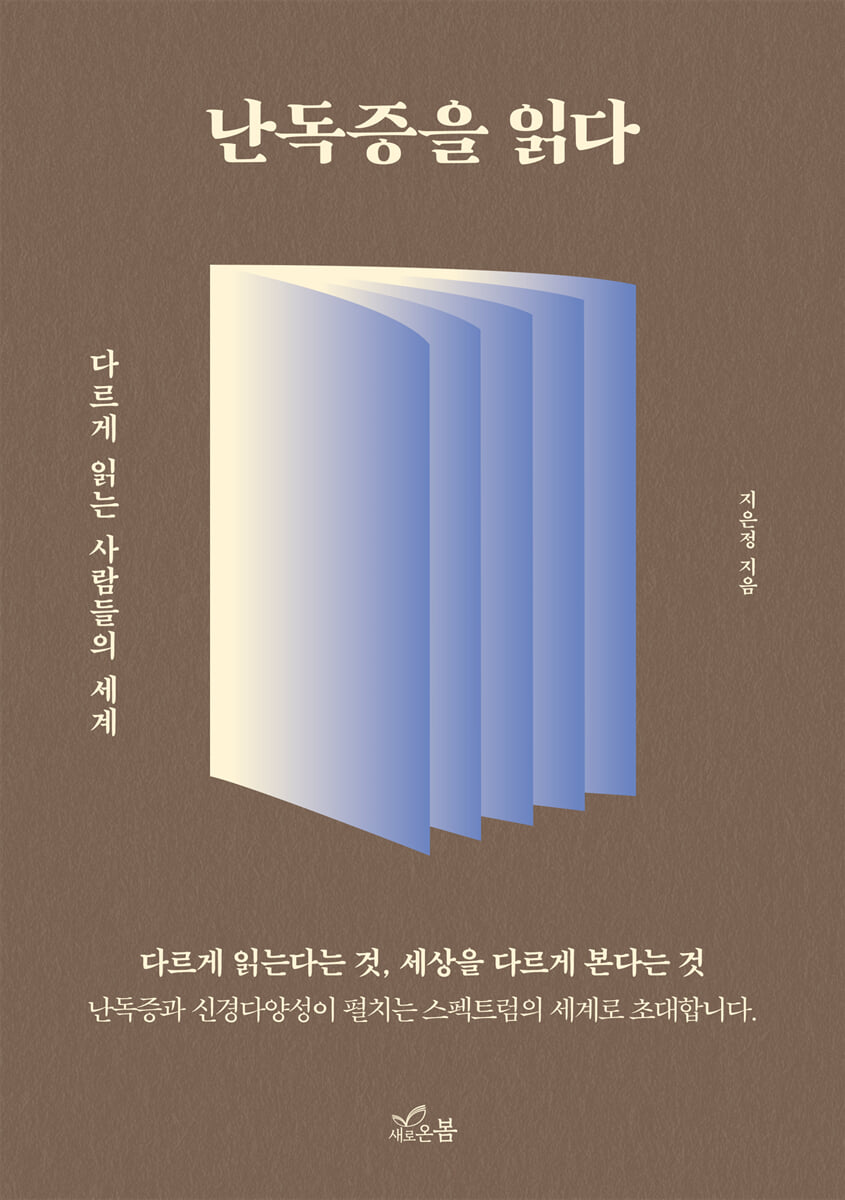
Reading Dyslexia
 |
Description
Book Introduction
Dyslexia is another way of reading.
A book that reinterprets dyslexia from a neurodiversity perspective
We often think of dyslexia as a learning disability that makes it difficult to read, but dyslexia is not simply a problem with reading.
This means that the brain processes information differently, which is linked not only to reading difficulties but also to differences in thinking styles.
According to recent neuroscience research, dyslexia is characterized by a greater use of imagery, spatial, and pattern-based thinking than text-based thinking, and these characteristics may also be linked to creative problem-solving. However, in Korean society, dyslexia is directly linked to academic difficulties, college entrance exams, and literacy, and is often mistaken for learning difficulties or low intelligence.
Students with dyslexia often have greater difficulty reading English than Korean, and in an environment where college entrance exams are highly competitive, they are at a disadvantage.
Furthermore, dyslexia often coexists with ADHD, autism spectrum disorder, and dysgraphia (difficulty writing), rather than appearing alone, necessitating a more complex approach. "Reading Dyslexia" offers a new interpretation of dyslexia from the perspective of neurodiversity.
Beyond simply 'reading difficulties,' it illuminates the characteristics and strengths of dyslexia, as well as ways to understand and support it.
It also illuminates the lives of people with dyslexia through a variety of real-life examples, showing how their thinking and problem-solving methods differ from conventional methods.
"Reading Dyslexia" is a book for anyone concerned about more inclusive education and social approaches.
Understanding dyslexia from a neurodiversity perspective can help individuals with dyslexia, their families, educators, and parents understand that dyslexia is a “different way of thinking” and can help them discover their strengths and possibilities.
So, it leads to finding a direction for practical educational support.
And, through the neurodiversity perspective that everyone's brain works differently, it awakens us all to the true meaning of diversity.
A book that reinterprets dyslexia from a neurodiversity perspective
We often think of dyslexia as a learning disability that makes it difficult to read, but dyslexia is not simply a problem with reading.
This means that the brain processes information differently, which is linked not only to reading difficulties but also to differences in thinking styles.
According to recent neuroscience research, dyslexia is characterized by a greater use of imagery, spatial, and pattern-based thinking than text-based thinking, and these characteristics may also be linked to creative problem-solving. However, in Korean society, dyslexia is directly linked to academic difficulties, college entrance exams, and literacy, and is often mistaken for learning difficulties or low intelligence.
Students with dyslexia often have greater difficulty reading English than Korean, and in an environment where college entrance exams are highly competitive, they are at a disadvantage.
Furthermore, dyslexia often coexists with ADHD, autism spectrum disorder, and dysgraphia (difficulty writing), rather than appearing alone, necessitating a more complex approach. "Reading Dyslexia" offers a new interpretation of dyslexia from the perspective of neurodiversity.
Beyond simply 'reading difficulties,' it illuminates the characteristics and strengths of dyslexia, as well as ways to understand and support it.
It also illuminates the lives of people with dyslexia through a variety of real-life examples, showing how their thinking and problem-solving methods differ from conventional methods.
"Reading Dyslexia" is a book for anyone concerned about more inclusive education and social approaches.
Understanding dyslexia from a neurodiversity perspective can help individuals with dyslexia, their families, educators, and parents understand that dyslexia is a “different way of thinking” and can help them discover their strengths and possibilities.
So, it leads to finding a direction for practical educational support.
And, through the neurodiversity perspective that everyone's brain works differently, it awakens us all to the true meaning of diversity.
- You can preview some of the book's contents.
Preview
index
Recommendation
Introduction: Is it possible to be smart but not good at studying?
Part 1: Dyslexia Within Us
- Do we really understand dyslexia? - A first encounter with dyslexia - Do smart people in Korea not have dyslexia? - Dyslexia of celebrities - Dyslexia of royalty - Dyslexia in movies - Clues to dyslexia are hidden everywhere Chang-woo, a 6th grader who becomes a leader in any group / Subin, a smart person who couldn't read words throughout elementary school / Seo-yoon, a 1st grader who can see invisible moves in Baduk / Chae-yeon, a 40-year-old who wanted to learn English for her children / My friend James, who only has random drawings and no random thoughts in his head / Hee-yeon, who wants to go to Japan to major in animation / Sang-jin, a 40-year-old who works at an advertising company / Jun-young, a 20-year-old who seems to be focused but isn't / Jared, a 40-year-old who dreams of becoming a best-selling author / Yoon, an oriental medicine doctor who found math and science easy in school, but English was too difficult / Jin-woo, a 5th grader who can't remember things after saying them once / Seung-woo, a middle school student who left Korean education / Ha-jun's mother who came out as having dyslexia / Top student in middle school, dropped out of high school, graduated from college People who say their dyslexia has disappeared / Seon-gyeong, whose friend says she has fake dyslexia / Eun-ju, a woman in her 40s with extremely sensitive senses / Princess Pyeonggang and Ondal
Part 2: The World of Dyslexia
- We don't really know what dyslexia is. What on earth is dyslexia? / (Specific) learning disability, learning difficulties, learning differences, SPELD / Characteristics of dyslexia by age / Confusion of literacy and dyslexia / Common questions about dyslexia - Strengths of dyslexia Visual, pattern thinking / Seeing the big picture / Good at telling stories / Persistence, excellent creativity, excellent memory / Reading books quickly and processing information quickly / Very good at forming and maintaining relationships with people - Weaknesses of dyslexia Struggling with texts with a lot of text, reading slowly / Poor sense of direction and movement Having difficulty with sequential tasks / May have difficulty hearing and processing information aloud / Getting confused between letters and numbers without context
Part 3: The Age of Patchwork and Quilts
- Dyslexia's Coordinates: Individually Advancing with Multiliteracy / Innocent Stigma / I Did Nothing Because I Didn't Know / Dyslexia, Again, in Easy Words - Education and the Future of Dyslexia: Reading Paper Books? / Is Dyslexia the Only Thing to Worry About? / EduTech
Coming out: Can dyslexia be divided into dichotomies?
Introduction: Is it possible to be smart but not good at studying?
Part 1: Dyslexia Within Us
- Do we really understand dyslexia? - A first encounter with dyslexia - Do smart people in Korea not have dyslexia? - Dyslexia of celebrities - Dyslexia of royalty - Dyslexia in movies - Clues to dyslexia are hidden everywhere Chang-woo, a 6th grader who becomes a leader in any group / Subin, a smart person who couldn't read words throughout elementary school / Seo-yoon, a 1st grader who can see invisible moves in Baduk / Chae-yeon, a 40-year-old who wanted to learn English for her children / My friend James, who only has random drawings and no random thoughts in his head / Hee-yeon, who wants to go to Japan to major in animation / Sang-jin, a 40-year-old who works at an advertising company / Jun-young, a 20-year-old who seems to be focused but isn't / Jared, a 40-year-old who dreams of becoming a best-selling author / Yoon, an oriental medicine doctor who found math and science easy in school, but English was too difficult / Jin-woo, a 5th grader who can't remember things after saying them once / Seung-woo, a middle school student who left Korean education / Ha-jun's mother who came out as having dyslexia / Top student in middle school, dropped out of high school, graduated from college People who say their dyslexia has disappeared / Seon-gyeong, whose friend says she has fake dyslexia / Eun-ju, a woman in her 40s with extremely sensitive senses / Princess Pyeonggang and Ondal
Part 2: The World of Dyslexia
- We don't really know what dyslexia is. What on earth is dyslexia? / (Specific) learning disability, learning difficulties, learning differences, SPELD / Characteristics of dyslexia by age / Confusion of literacy and dyslexia / Common questions about dyslexia - Strengths of dyslexia Visual, pattern thinking / Seeing the big picture / Good at telling stories / Persistence, excellent creativity, excellent memory / Reading books quickly and processing information quickly / Very good at forming and maintaining relationships with people - Weaknesses of dyslexia Struggling with texts with a lot of text, reading slowly / Poor sense of direction and movement Having difficulty with sequential tasks / May have difficulty hearing and processing information aloud / Getting confused between letters and numbers without context
Part 3: The Age of Patchwork and Quilts
- Dyslexia's Coordinates: Individually Advancing with Multiliteracy / Innocent Stigma / I Did Nothing Because I Didn't Know / Dyslexia, Again, in Easy Words - Education and the Future of Dyslexia: Reading Paper Books? / Is Dyslexia the Only Thing to Worry About? / EduTech
Coming out: Can dyslexia be divided into dichotomies?
Into the book
Inability to read is not the only major characteristic of dyslexia.
However, it is only the most visible feature and the one that causes the greatest difficulty in learning.
Dyslexia exists on a wider spectrum than you might think.
--- p.12
The term 'dyslexia' might be easier to understand if we think of it as a 'brain that thinks three-dimensionally', as opposed to 'flat' or 'two-dimensional' thinking.
--- p.13
It is crucial for teachers and parents to understand people (children) from a neurodiversity perspective.
This is because only then can we find clues on how to recognize people with different thinking styles and educate or support them accordingly.
If we can first recognize that each person's thinking style can be different and that each person's strengths (rather than their weaknesses (deficiencies, insufficiencies)) are important, it will be of great help in overcoming many difficulties encountered in education and learning.
--- p.14
It is estimated that only 1 to 2 percent of adolescents and adults with dyslexia still cannot read.
So, does that mean that 99% of people with dyslexia are 'cured(?)'?
--- p.29
Many people in the West report feeling a sense of "true liberation" only after they truly understood what dyslexia was and recognized that they themselves had dyslexia (whether mildly or severely).
--- p.33
Dyslexia manifests itself in many different ways in our lives, sometimes very clearly, sometimes vaguely, and the number of possible shapes and degrees is innumerable.
So, it is said that 'almost no two people with dyslexia have the same characteristics.'
Dyslexia often does not exist alone, but rather goes hand in hand with two or more other conditions such as ADHD, autism spectrum disorder (Asperger's), motor coordination difficulties, dyscalculia (difficulty with math, difficulty with numbers), and dysgraphia (difficulty with writing).
--- p.51
Depending on what adults label a child's various brain traits, he or she may become a criminal or lead a painful life, or he or she may become a genius, a successful businessman, or a leader.
What names should we give to those who enrich our lives, and to the groups they belong to?
--- p.75
The dyslexic brain tends to be much more creative because it is visual, three-dimensional, and pattern-oriented than a brain accustomed to letters.
--- p.113
Many students with dyslexia say they would rather be called a "problem child" or "not a good student" than be told they "can't" read because they have dyslexia.
--- p.130
Because dyslexia cannot be cured or completely eliminated, they may have lived with it their entire lives.
And at every stage of their lives, dyslexia would have presented them with difficulties.
If dyslexia isn't curable or disappears, how do people with dyslexia live? They simply have to find a way to live that works for them.
--- p.179
‘Dyslexia’ and ‘literacy’ are sometimes proportional and sometimes not.
This is because people with dyslexia can have very low literacy skills, but conversely, they can also have very high literacy skills.
Additionally, some people with dyslexia have poor reading literacy but excellent digital literacy.
--- p.234
The challenges of dyslexia can be overcome with sufficient understanding and support, allowing them to reach their full potential.
That's why it's important to understand that dyslexia isn't a weakness, but rather a starting point for another way of learning and thinking.
However, it is only the most visible feature and the one that causes the greatest difficulty in learning.
Dyslexia exists on a wider spectrum than you might think.
--- p.12
The term 'dyslexia' might be easier to understand if we think of it as a 'brain that thinks three-dimensionally', as opposed to 'flat' or 'two-dimensional' thinking.
--- p.13
It is crucial for teachers and parents to understand people (children) from a neurodiversity perspective.
This is because only then can we find clues on how to recognize people with different thinking styles and educate or support them accordingly.
If we can first recognize that each person's thinking style can be different and that each person's strengths (rather than their weaknesses (deficiencies, insufficiencies)) are important, it will be of great help in overcoming many difficulties encountered in education and learning.
--- p.14
It is estimated that only 1 to 2 percent of adolescents and adults with dyslexia still cannot read.
So, does that mean that 99% of people with dyslexia are 'cured(?)'?
--- p.29
Many people in the West report feeling a sense of "true liberation" only after they truly understood what dyslexia was and recognized that they themselves had dyslexia (whether mildly or severely).
--- p.33
Dyslexia manifests itself in many different ways in our lives, sometimes very clearly, sometimes vaguely, and the number of possible shapes and degrees is innumerable.
So, it is said that 'almost no two people with dyslexia have the same characteristics.'
Dyslexia often does not exist alone, but rather goes hand in hand with two or more other conditions such as ADHD, autism spectrum disorder (Asperger's), motor coordination difficulties, dyscalculia (difficulty with math, difficulty with numbers), and dysgraphia (difficulty with writing).
--- p.51
Depending on what adults label a child's various brain traits, he or she may become a criminal or lead a painful life, or he or she may become a genius, a successful businessman, or a leader.
What names should we give to those who enrich our lives, and to the groups they belong to?
--- p.75
The dyslexic brain tends to be much more creative because it is visual, three-dimensional, and pattern-oriented than a brain accustomed to letters.
--- p.113
Many students with dyslexia say they would rather be called a "problem child" or "not a good student" than be told they "can't" read because they have dyslexia.
--- p.130
Because dyslexia cannot be cured or completely eliminated, they may have lived with it their entire lives.
And at every stage of their lives, dyslexia would have presented them with difficulties.
If dyslexia isn't curable or disappears, how do people with dyslexia live? They simply have to find a way to live that works for them.
--- p.179
‘Dyslexia’ and ‘literacy’ are sometimes proportional and sometimes not.
This is because people with dyslexia can have very low literacy skills, but conversely, they can also have very high literacy skills.
Additionally, some people with dyslexia have poor reading literacy but excellent digital literacy.
--- p.234
The challenges of dyslexia can be overcome with sufficient understanding and support, allowing them to reach their full potential.
That's why it's important to understand that dyslexia isn't a weakness, but rather a starting point for another way of learning and thinking.
--- p.261
Publisher's Review
Reading is not just a skill.
Reading is how we understand the world and is a key means of acquiring knowledge.
But not everyone reads the same way.
For some people, the process of processing text works differently than for others.
Dyslexia is not simply a 'disability to read letters'.
People with dyslexia process information differently than typical text-centric thinkers.
They tend to use images, patterns, and spatial thinking more than text, and these characteristics can also be linked to creative thinking.
However, in Korean society, dyslexia is closely linked to college entrance exams, learning, and literacy issues, and is easily misunderstood as a learning disability or low intelligence.
In particular, many people have great difficulty reading English even after learning Korean.
In Korea, where college entrance exam competition is fierce, students with dyslexia are bound to be at a disadvantage in the English passages, essays, and descriptive assessments of the CSAT.
However, dyslexia has nothing to do with intelligence; it is simply a different way of processing information.
This book helps dispel misconceptions about dyslexia and explore educational approaches through specific examples.
As the digital age dawns, the concept of literacy is also changing.
In addition to the ability to read and interpret text, digital literacy and multiliteracy using images, videos, and audio are becoming increasingly important.
People with dyslexia need a more diverse learning approach than traditional text-centered instruction.
This book provides guidance not only for those with dyslexia, but also for teachers and parents to consider new educational methods.
Our society doesn't know much about dyslexia, but there are surprisingly many people who actually have dyslexia.
National surveys suggest that dyslexia affects between 5 and 20 percent of the population, meaning that roughly one in five people may fall into the dyslexia category.
So this book helps us understand dyslexia correctly and helps people with dyslexia see themselves in a new light.
Dyslexia is not a problem of learning disability or low intelligence.
The way of thinking is different, and within that difference lies special possibilities and strengths.
If not only the person with dyslexia but also their children and those around them become aware of this fact, it will provide an opportunity to understand their learning and life more deeply.
Reading is how we understand the world and is a key means of acquiring knowledge.
But not everyone reads the same way.
For some people, the process of processing text works differently than for others.
Dyslexia is not simply a 'disability to read letters'.
People with dyslexia process information differently than typical text-centric thinkers.
They tend to use images, patterns, and spatial thinking more than text, and these characteristics can also be linked to creative thinking.
However, in Korean society, dyslexia is closely linked to college entrance exams, learning, and literacy issues, and is easily misunderstood as a learning disability or low intelligence.
In particular, many people have great difficulty reading English even after learning Korean.
In Korea, where college entrance exam competition is fierce, students with dyslexia are bound to be at a disadvantage in the English passages, essays, and descriptive assessments of the CSAT.
However, dyslexia has nothing to do with intelligence; it is simply a different way of processing information.
This book helps dispel misconceptions about dyslexia and explore educational approaches through specific examples.
As the digital age dawns, the concept of literacy is also changing.
In addition to the ability to read and interpret text, digital literacy and multiliteracy using images, videos, and audio are becoming increasingly important.
People with dyslexia need a more diverse learning approach than traditional text-centered instruction.
This book provides guidance not only for those with dyslexia, but also for teachers and parents to consider new educational methods.
Our society doesn't know much about dyslexia, but there are surprisingly many people who actually have dyslexia.
National surveys suggest that dyslexia affects between 5 and 20 percent of the population, meaning that roughly one in five people may fall into the dyslexia category.
So this book helps us understand dyslexia correctly and helps people with dyslexia see themselves in a new light.
Dyslexia is not a problem of learning disability or low intelligence.
The way of thinking is different, and within that difference lies special possibilities and strengths.
If not only the person with dyslexia but also their children and those around them become aware of this fact, it will provide an opportunity to understand their learning and life more deeply.
GOODS SPECIFICS
- Date of issue: April 5, 2025
- Page count, weight, size: 312 pages | 430g | 148*210*17mm
- ISBN13: 9791198741349
You may also like
카테고리
korean


korean

![ELLE 엘르 스페셜 에디션 A형 : 12월 [2025]](http://librairie.coreenne.fr/cdn/shop/files/b8e27a3de6c9538896439686c6b0e8fb.jpg?v=1766436872&width=3840)


