

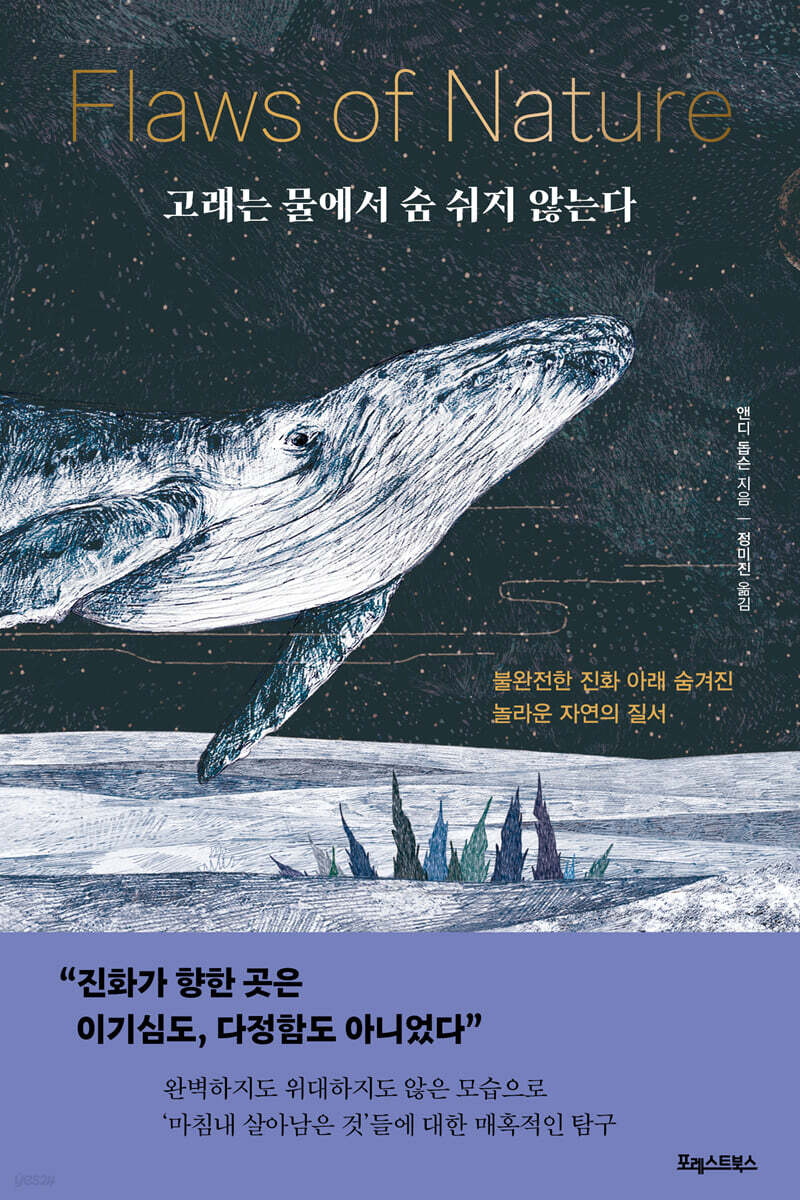
Whales don't breathe underwater.
 |
Description
Book Introduction
★Nominated for the Zoological Society of London Clarivate Award★
A new perspective on evolution from a next-generation British biologist. "Evolution was headed toward neither selfishness nor affection." In a way that is neither perfect nor great A fascinating exploration of those who 'finally survived' Evolution proceeds through 'natural selection', in which genetic mutations that are useful to each generation are favored in the competition for survival and reproduction. In the process, birds, bats, and dragonflies learned to fly, snakes gave up their limbs, electric eels created powerful electricity, and ants became farmers who grew fungi and aphids. The diversity and ingenuity of life through evolution, and the spectacle it has created, are truly amazing and magnificent. But that's not all there is to evolution. There are countless things in nature that live in extremely irrational and uneconomical ways. A whale that lives in the water but is always in danger of drowning, a tit that doesn't recognize a cuckoo's child and raises it instead, an elephant that starves to death when its sixth tooth wears down because its teeth don't grow in, a male swordtail that lives with a long tail that threatens its life to seduce a female, a worker ant that bites its own daughters to make them infertile, and a ground squirrel that screams when it spots a predator even though it knows it will be the first to die. Countless creatures exist in an imperfect form, let alone perfection. All of this is evolution. But it is not a great success. So why have they survived until now? Andy Dobson, a rising British biologist, has written his first book, Flaws of Nature, a delightful and engaging exploration of the strange evolutionary flaws that have occurred in nature, crossing over from ecology and paleontology to sexual selection and genetics. From predators and prey, cuckoos laying eggs and the birds being laid, parasites and their hosts, to the brutal compromises between parents and offspring, to games of chance between males and females, the conflicts that block the perfect evolution of living things and the surprising events that result from them, one after another, plunge us into a great intellectual shock. And at the end of this long story, we will be left with a big question about what it truly means to 'survive' and 'win'. |
- You can preview some of the book's contents.
Preview
index
Entering
Chapter 1.
Dead or hungry
Chapter 2.
One Flew Over the Cuckoo's Nest
Chapter 3.
Free riders
Chapter 4.
Beautiful and Cursed
Chapter 5.
The whereabouts of the seventh tooth
Chapter 6.
extreme altruism
Chapter 7.
cruel compromise
Chapter 8.
Evolution in a trap
Chapter 9.
A pretty good weakness
Chapter 10.
Where humans are headed
Acknowledgements
References
Chapter 1.
Dead or hungry
Chapter 2.
One Flew Over the Cuckoo's Nest
Chapter 3.
Free riders
Chapter 4.
Beautiful and Cursed
Chapter 5.
The whereabouts of the seventh tooth
Chapter 6.
extreme altruism
Chapter 7.
cruel compromise
Chapter 8.
Evolution in a trap
Chapter 9.
A pretty good weakness
Chapter 10.
Where humans are headed
Acknowledgements
References
Detailed image

Into the book
This is a story about evolution's traps, its huge barriers, its blind spots, its compromises, its compromises, its failures.
Through this, we will learn why animals always lag behind slightly, why they generally become less efficient over time, why predators often lose, and why parasites often win.
It's an evolution, but it's not a great success.
---From "Entering"
Lawrenson estimated that the cheetah cubs had a 4.8% chance of surviving to 17 months (roughly the number of months they are independent).
Now, let's compare these figures to the people of the Central African Republic, the country with the lowest life expectancy today.
Here, 91% of children survive their first birthday, and 88% survive their fifth birthday.
Therefore, the life of a young cheetah is far more precarious than that of a child living in the most impoverished country on Earth.
So, is the cheetah the perfect predator? Quite the opposite.
Most cheetahs cannot kill anything.
---From "Chapter 1 Dead or Hungry"
Just as a lawyer might advise a divorcing couple to settle out of court rather than spend thousands of dollars each to arrive at the same conclusion of property division, a benevolent authority would have provided each side with only what was necessary to maintain the status quo, rather than wasting countless hours of effort on longer bones, stronger tendons, denser muscles, and larger hearts.
But without this strategic oversight or purpose, that never happened, and the cost of survival for everyone steadily increased.
---From "Chapter 1 Dead or Hungry"
But what if the nest had been over-prepared from the start? The cuckoo chick would have hatched before the other eggs and, like other European cuckoo chicks, would have knocked the other eggs out of the nest one by one.
The only chick that hatches accordingly will be a cuckoo, and the parent birds will imprint on the cuckoo.
After this, all attempts at breeding will fail, whether or not they are swarmed.
Because the bird will happily raise another cuckoo or reject its own chicks.
In this case, it is actually better for the host to occasionally pay the price of accidentally raising a cuckoo than to evolve a chick imprinting response that would prevent it from reproducing for the rest of its life.
It may not seem obvious right away, but the answer to the question, "Why don't cuckoo hosts reject the big monsters in their nests?" is, "Because in the long run, it's not beneficial to reject them."
---From "Chapter 2: One Flew Over the Cuckoo's Nest"
The appeal of parasitism as a way of life is beyond question.
This is especially true for internal parasites, as the host provides not only food but also the entire environment.
The only problem that matters to them is contagion (since the inevitable death of the host will also lead to the disappearance of the habitat).
Therefore, internal parasites must find a way to jump from one host to another, and to do this, as we have seen, they have evolved many methods, some of which have become extremely sophisticated, such as making the host commit suicide or finding an intermediate organism (vector) to act as a transmitter.
But what is even stranger is why the host tolerates such methods.
---From "Chapter 3 Free Riders"
The most attractive males die earliest and are least likely to produce male offspring that survive to maturity.
But this obvious handicap doesn't matter at all.
Because the most ornately decorated males leave behind the most offspring.
---From "Chapter 4: The Beautiful and Cursed"
The males with the widest eyes a million years ago were just as attractive to females in their generation as the males with the widest eyes are today, but they would have fared better throughout their lives because they didn't waste as much energy growing and maintaining eye stalks or compensating for air resistance during flight.
This is a comparison of the fittest males a million years ago and the fittest males today.
In short, this species has become more messed up over time.
It is an evolutionary product of natural selection.
---From "Chapter 4: The Beautiful and Cursed"
Organisms are usefully conceptualized as mere vehicles for the continued proliferation of existing genes.
So we should remember this when we wonder why animals didn't evolve to live forever.
In short, genes don't care where they are, as long as they exist somewhere.
---From "Chapter 5: The Whereabouts of the Seventh Tooth"
The selfish behavior of a gene can easily be converted into altruistic behavior within the organism in which the gene resides.
---From "Chapter 6: Extreme Altruism"
In conclusion, neither malice nor altruism is purely praiseworthy or detestable.
You shouldn't expect that to happen.
Like other evolutionary forces, kin selection operates blindly, without goals or purpose.
The cooperative social relationships of species such as lions and elephants are shaped by the same pressures that cause premature death and the suffering of aging.
Likewise, as seen in honeybee colonies, the "unified thinking" of the superorganisms of the membranous order can present us with the plausible appearance of cooperation, diligence, and miracles of organization, but it can also lead to suicidal aggression and enslavement.
It also suggests that in the cozy yet cruel world of social species, there are always tricksters willing to manipulate the altruistic actions of others for their own ends.
---From "Chapter 6: Extreme Altruism"
Egg throwing, miscarriage, and countless other acts of filicide observed in the natural world can be thought of as trade-offs between present and future investments.
As with any compromise, the optimal balance point is often determined by external circumstances.
---From "Chapter 7: A Cruel Compromise"
The way for males to maximize their fitness is to have as many offspring as possible.
These different limits to fitness mean that while females play a game of chance, males play a numbers game.
These two games don't really go together.
From this basic dynamic arises much deception, cruelty, and suffering.
---From "Chapter 7: A Cruel Compromise"
Steller's sea cow, Dreadnoughtus shurani, and Tucson's Cooper's hawk were faced with a situation for which evolutionary history had not prepared them.
The two animals above showed that lack of preparation was fatal, and they paid the price of extinction.
In the case of the eagle, the bullet may have missed, but the threat of a mismatch between what was expected and what was encountered remains, and in other times and places it may be eliminated.
But it is extremely harsh to be punished like this for insufficient adaptation.
All species, even those that appear to be thriving on the outside, have flaws.
They are just 'okay enough' and have one or more of several potential flaws: evolutionary quirks, laziness, clumsiness, etc.
---From "Chapter 8: Evolution in Trap"
The same goes for animals.
Animals enjoy the benefits of evolution accumulated over billions of years, but along with those benefits, their range of choices for the future is narrowing.
The lungs of a gray whale stranded in the Beaufort Sea are a decidedly unhelpful legacy of hundreds of millions of years of terrestrial evolution.
Whales have distant ancestors from fish, but they evolved relatively recently from four-legged creatures living on land.
And when the whales returned to the water, they were less acclimated to it than when they last left it.
Because they lost their gills a long time ago.
Here we can ask the rather obvious question (though of course we should not be satisfied with this): 'Why don't whales re-evolve gills?'
In any case, it is clear that although fish ancestors started out with gills, some of their descendants evolved lungs at some point.
So, conversely, wouldn't it have been possible to evolve gills at some point?
---From "Chapter 9: A Pretty Good Weakness"
Evolution is purposeless, passive, and amoral.
This is one reason why it is impossible to draw a connection between what natural selection favors and what we, as civilized humans, should aspire to.
Another reason is that the most direct agents of evolutionary change are genes, not individuals.
So even if we can find 'purpose' in this arduous river of survival, reproduction, and death, we can be sure that we are not its beneficiaries.
---From "Chapter 10 Where Humans Are Heading"
The natural world is full of events and actions that cannot be considered morally instructive.
So far, we've looked at elephants that starve unnecessarily, ants that create slaves, spiders that mutilate female genitalia, pathogens that drive their hosts to suicide, evolved malice, deceptive partners, and various forms of survival killing, filicide, and fratricide.
In addition, we could add cases of otter rape of a baby spotted seal (or seal rape of a king penguin), a pair of deer fighting and dying with their horns entangled, a babirusa (wild boar) tusk growing curved toward its skull, and many other predators continuing to eat their prey while it is clearly still alive.
If any human behavior doesn't fall into this miserable and absurd lineup that unfolds under the label of "natural," can it be defined as immoral? I hope the answer needs no further explanation.
Through this, we will learn why animals always lag behind slightly, why they generally become less efficient over time, why predators often lose, and why parasites often win.
It's an evolution, but it's not a great success.
---From "Entering"
Lawrenson estimated that the cheetah cubs had a 4.8% chance of surviving to 17 months (roughly the number of months they are independent).
Now, let's compare these figures to the people of the Central African Republic, the country with the lowest life expectancy today.
Here, 91% of children survive their first birthday, and 88% survive their fifth birthday.
Therefore, the life of a young cheetah is far more precarious than that of a child living in the most impoverished country on Earth.
So, is the cheetah the perfect predator? Quite the opposite.
Most cheetahs cannot kill anything.
---From "Chapter 1 Dead or Hungry"
Just as a lawyer might advise a divorcing couple to settle out of court rather than spend thousands of dollars each to arrive at the same conclusion of property division, a benevolent authority would have provided each side with only what was necessary to maintain the status quo, rather than wasting countless hours of effort on longer bones, stronger tendons, denser muscles, and larger hearts.
But without this strategic oversight or purpose, that never happened, and the cost of survival for everyone steadily increased.
---From "Chapter 1 Dead or Hungry"
But what if the nest had been over-prepared from the start? The cuckoo chick would have hatched before the other eggs and, like other European cuckoo chicks, would have knocked the other eggs out of the nest one by one.
The only chick that hatches accordingly will be a cuckoo, and the parent birds will imprint on the cuckoo.
After this, all attempts at breeding will fail, whether or not they are swarmed.
Because the bird will happily raise another cuckoo or reject its own chicks.
In this case, it is actually better for the host to occasionally pay the price of accidentally raising a cuckoo than to evolve a chick imprinting response that would prevent it from reproducing for the rest of its life.
It may not seem obvious right away, but the answer to the question, "Why don't cuckoo hosts reject the big monsters in their nests?" is, "Because in the long run, it's not beneficial to reject them."
---From "Chapter 2: One Flew Over the Cuckoo's Nest"
The appeal of parasitism as a way of life is beyond question.
This is especially true for internal parasites, as the host provides not only food but also the entire environment.
The only problem that matters to them is contagion (since the inevitable death of the host will also lead to the disappearance of the habitat).
Therefore, internal parasites must find a way to jump from one host to another, and to do this, as we have seen, they have evolved many methods, some of which have become extremely sophisticated, such as making the host commit suicide or finding an intermediate organism (vector) to act as a transmitter.
But what is even stranger is why the host tolerates such methods.
---From "Chapter 3 Free Riders"
The most attractive males die earliest and are least likely to produce male offspring that survive to maturity.
But this obvious handicap doesn't matter at all.
Because the most ornately decorated males leave behind the most offspring.
---From "Chapter 4: The Beautiful and Cursed"
The males with the widest eyes a million years ago were just as attractive to females in their generation as the males with the widest eyes are today, but they would have fared better throughout their lives because they didn't waste as much energy growing and maintaining eye stalks or compensating for air resistance during flight.
This is a comparison of the fittest males a million years ago and the fittest males today.
In short, this species has become more messed up over time.
It is an evolutionary product of natural selection.
---From "Chapter 4: The Beautiful and Cursed"
Organisms are usefully conceptualized as mere vehicles for the continued proliferation of existing genes.
So we should remember this when we wonder why animals didn't evolve to live forever.
In short, genes don't care where they are, as long as they exist somewhere.
---From "Chapter 5: The Whereabouts of the Seventh Tooth"
The selfish behavior of a gene can easily be converted into altruistic behavior within the organism in which the gene resides.
---From "Chapter 6: Extreme Altruism"
In conclusion, neither malice nor altruism is purely praiseworthy or detestable.
You shouldn't expect that to happen.
Like other evolutionary forces, kin selection operates blindly, without goals or purpose.
The cooperative social relationships of species such as lions and elephants are shaped by the same pressures that cause premature death and the suffering of aging.
Likewise, as seen in honeybee colonies, the "unified thinking" of the superorganisms of the membranous order can present us with the plausible appearance of cooperation, diligence, and miracles of organization, but it can also lead to suicidal aggression and enslavement.
It also suggests that in the cozy yet cruel world of social species, there are always tricksters willing to manipulate the altruistic actions of others for their own ends.
---From "Chapter 6: Extreme Altruism"
Egg throwing, miscarriage, and countless other acts of filicide observed in the natural world can be thought of as trade-offs between present and future investments.
As with any compromise, the optimal balance point is often determined by external circumstances.
---From "Chapter 7: A Cruel Compromise"
The way for males to maximize their fitness is to have as many offspring as possible.
These different limits to fitness mean that while females play a game of chance, males play a numbers game.
These two games don't really go together.
From this basic dynamic arises much deception, cruelty, and suffering.
---From "Chapter 7: A Cruel Compromise"
Steller's sea cow, Dreadnoughtus shurani, and Tucson's Cooper's hawk were faced with a situation for which evolutionary history had not prepared them.
The two animals above showed that lack of preparation was fatal, and they paid the price of extinction.
In the case of the eagle, the bullet may have missed, but the threat of a mismatch between what was expected and what was encountered remains, and in other times and places it may be eliminated.
But it is extremely harsh to be punished like this for insufficient adaptation.
All species, even those that appear to be thriving on the outside, have flaws.
They are just 'okay enough' and have one or more of several potential flaws: evolutionary quirks, laziness, clumsiness, etc.
---From "Chapter 8: Evolution in Trap"
The same goes for animals.
Animals enjoy the benefits of evolution accumulated over billions of years, but along with those benefits, their range of choices for the future is narrowing.
The lungs of a gray whale stranded in the Beaufort Sea are a decidedly unhelpful legacy of hundreds of millions of years of terrestrial evolution.
Whales have distant ancestors from fish, but they evolved relatively recently from four-legged creatures living on land.
And when the whales returned to the water, they were less acclimated to it than when they last left it.
Because they lost their gills a long time ago.
Here we can ask the rather obvious question (though of course we should not be satisfied with this): 'Why don't whales re-evolve gills?'
In any case, it is clear that although fish ancestors started out with gills, some of their descendants evolved lungs at some point.
So, conversely, wouldn't it have been possible to evolve gills at some point?
---From "Chapter 9: A Pretty Good Weakness"
Evolution is purposeless, passive, and amoral.
This is one reason why it is impossible to draw a connection between what natural selection favors and what we, as civilized humans, should aspire to.
Another reason is that the most direct agents of evolutionary change are genes, not individuals.
So even if we can find 'purpose' in this arduous river of survival, reproduction, and death, we can be sure that we are not its beneficiaries.
---From "Chapter 10 Where Humans Are Heading"
The natural world is full of events and actions that cannot be considered morally instructive.
So far, we've looked at elephants that starve unnecessarily, ants that create slaves, spiders that mutilate female genitalia, pathogens that drive their hosts to suicide, evolved malice, deceptive partners, and various forms of survival killing, filicide, and fratricide.
In addition, we could add cases of otter rape of a baby spotted seal (or seal rape of a king penguin), a pair of deer fighting and dying with their horns entangled, a babirusa (wild boar) tusk growing curved toward its skull, and many other predators continuing to eat their prey while it is clearly still alive.
If any human behavior doesn't fall into this miserable and absurd lineup that unfolds under the label of "natural," can it be defined as immoral? I hope the answer needs no further explanation.
---From "Chapter 10 Where Humans Are Heading"
Publisher's Review
“Why can’t whales still breathe underwater?”
In 1988, in the depths of the Arctic winter, a hunter living in the ice-covered Beaufort Sea was searching for bowhead whales.
But what he found were three gray whales trapped under thick ice.
The whales were holding on, taking turns breathing through small holes.
Unlike bowhead whales, gray whales do not have heads strong enough to penetrate thick ice, so they must stay hundreds of miles south during the winter.
But because he left late, he was in danger of drowning in the water.
The whale hunter tried to widen the hole with a chainsaw, but it was not enough.
The nearest ice-free sea was 8 km away.
But as the news spread around the world, an incredible collaboration began between scientists, environmentalists, and navies across national borders.
They put in all kinds of effort, including operating a de-icing device to prevent the water from freezing and dropping balls from helicopters.
But a more fundamental solution was needed.
Then, help arrived from an unexpected place.
At the time, the United States and the Soviet Union, which were in the midst of the Cold War, agreed to send two icebreakers.
Finally the ice broke and the whales were free.
A 21-day rescue operation in temperatures below -20 degrees Celsius, a total rescue cost of approximately $1 million, and even a temporary thaw in the Cold War.
There are several interesting points in this story.
But there is something else that is most surprising about this touching story.
The fact is that 'the whale is in danger of drowning in the sea.'
What's so special about that? But think about it for a moment.
It was millions of years ago that whales evolved into aquatic creatures.
During that time, evolution gave whales a thick layer of fat that gave them a sleek body shape that allowed them to swim efficiently through the water.
And that's not all? Powerful tail fins for propulsion, as well as deeply resonant calls that can carry hundreds of kilometers, are also the result of evolution.
But why hasn't evolution given whales gills yet?
A whale without gills, an elephant starving to death because its seventh tooth has not grown,
A bee committing suicide, a mouse aborting itself, a bird killing its offspring…
“Why did evolution get to such a strange place?”
We believe that organisms evolve over time to become optimized for their environment.
In theory, evolution is an infinite mechanism for eliminating the unfit, but in the process, evolution is trapped by changes in the environment created by humans, creates life-threatening weaknesses, and pursues beauty in a mutually destructive way.
『Whales Don't Breathe Underwater (Original Title: Flaws of Nature)』 is a book that talks about the flaws of nature that led to such imperfect evolution, as its original title suggests.
Andy Dobson, a next-generation British biologist whose impressive and outstanding research has been cited over 1,000 times in the academic literature, delves into the order of this world by addressing the various types of conflicts that hinder the perfect adaptation of organisms.
The book unfolds five representative conflicts in a fluid manner, drawing on abundant case studies and scientific evidence.
The first conflicts we address are interspecies and interindividual conflicts.
The main concept that appears here is 'selection pressure'.
For example, in a race between a cheetah and a gazelle, the reason the gazelle wins is because in this fight, the cheetah put its 'food' at stake, but the gazelle put its 'life' at stake, so the 'selection pressure toward better evolution' given to the gazelle was stronger.
As a result, predators are generally doomed to fail in their hunts and always fall behind.
This logic also applies to the conflicts between cuckoos and their hosts, and between parasites and their hosts that follow (Chapter 1: Dead or Hungry, Chapter 2: One Flew Over the Cuckoo's Nest, Chapter 3: Free Riders).
The second type of conflict we address is that which arises between sexual partners.
Some species evolve dangerous ornamentation that threatens their life and health to attract mates.
The most attractive males are the ones who die the earliest, but also leave behind the most offspring.
It examines the ironic downfall of species that live in a precarious balance between living unattractively and dying attractively (Chapter 4: The Beautiful and the Damned), and also sharply explores the conflict between females playing the game of chance and males playing the game of numbers (Chapter 7: The Cruel Compromise).
The brutal conflict, far from romantic, offers an interesting perspective on human society.
The third conflict is that between families and groups.
We will mainly examine the cases of ants and wasps, which are known as representative eusocial species, and approach the ‘unified thinking’ they exhibit from two perspectives.
One view is that it is a strategic tactic used to advance one's own interests, and the other is that it is an extremely developed form of altruism (Chapter 6: Extreme Altruism).
And this is closely related to the final conflict: the conflict between individuals and genes.
The logic is that it is genes that ultimately survive across generations, and individuals are merely vessels to take them there.
This provides interesting insight into why organisms have not evolved toward immortality and why aging is unavoidable (Chapter 5, The Whereabouts of the Seventh Tooth).
“A delightful exploration of the diversity of life and the downsides of evolution.”
The most complete introduction before reading Darwin and Richard Dawkins.
This book delves deeply into the diversity of life and the shortcomings of evolution, yet it also explains difficult concepts like sexual selection and indirect fitness through creative and playful metaphors by young scientist Andy Dobson, making it accessible even to readers unfamiliar with evolution.
Readers who found Darwin and Richard Dawkins difficult may find this book a good introduction to the world of evolution.
This book, which simultaneously captures the expertise of a science book and the popularity of a general education book, “has considerable scientific weight, but also has humor and a sense of speed.
It received rave reviews such as “It feels like reading a novel!” and “A fascinating microscope that lets you see life beyond what you see,” and was nominated for the Clarivate Prize from the Zoological Society of London.
The questions “Why did they evolve that way?” and “Why did they survive?” are the first questions to understand the world around us.
As we follow the endless and wasteful events unfolding based on rigorous scientific research, we come to realize that evolution, which appears imperfect to human eyes, is not a mistake or failure of nature, but rather a form of survival that was perfect for them.
And when we reach the final chapter, we stop looking at the world of living things like a bystander and discover the spotlight given to humans.
So where are humans going against nature?
So where are humans headed now?
You won't be able to escape from another question that you face at the end.
★★★★★ A perfect book, what more could you want?
★★★★★ A fascinating microscope that lets you see life beyond what you see.
★★★★★ I was captivated from beginning to end.
Although biology and evolution are not my specialty, I explain complex concepts in an easy-to-understand way so that even beginners can approach them.
★★★★★ It has a lot of scientific weight, but it's also humorous and fast-paced.
It feels like reading a novel!
★★★★★ A must-read for anyone interested in the world we share with our fellow creatures.
Andy Dobson's style is clever, insightful, and funny.
There's a lot of fun to be had discovering the blind spots of evolution, the path to catastrophic extinction, and the cunning ways in which creatures cheat in the game of life.
- From Amazon reader reviews (www.amazon.de)
In 1988, in the depths of the Arctic winter, a hunter living in the ice-covered Beaufort Sea was searching for bowhead whales.
But what he found were three gray whales trapped under thick ice.
The whales were holding on, taking turns breathing through small holes.
Unlike bowhead whales, gray whales do not have heads strong enough to penetrate thick ice, so they must stay hundreds of miles south during the winter.
But because he left late, he was in danger of drowning in the water.
The whale hunter tried to widen the hole with a chainsaw, but it was not enough.
The nearest ice-free sea was 8 km away.
But as the news spread around the world, an incredible collaboration began between scientists, environmentalists, and navies across national borders.
They put in all kinds of effort, including operating a de-icing device to prevent the water from freezing and dropping balls from helicopters.
But a more fundamental solution was needed.
Then, help arrived from an unexpected place.
At the time, the United States and the Soviet Union, which were in the midst of the Cold War, agreed to send two icebreakers.
Finally the ice broke and the whales were free.
A 21-day rescue operation in temperatures below -20 degrees Celsius, a total rescue cost of approximately $1 million, and even a temporary thaw in the Cold War.
There are several interesting points in this story.
But there is something else that is most surprising about this touching story.
The fact is that 'the whale is in danger of drowning in the sea.'
What's so special about that? But think about it for a moment.
It was millions of years ago that whales evolved into aquatic creatures.
During that time, evolution gave whales a thick layer of fat that gave them a sleek body shape that allowed them to swim efficiently through the water.
And that's not all? Powerful tail fins for propulsion, as well as deeply resonant calls that can carry hundreds of kilometers, are also the result of evolution.
But why hasn't evolution given whales gills yet?
A whale without gills, an elephant starving to death because its seventh tooth has not grown,
A bee committing suicide, a mouse aborting itself, a bird killing its offspring…
“Why did evolution get to such a strange place?”
We believe that organisms evolve over time to become optimized for their environment.
In theory, evolution is an infinite mechanism for eliminating the unfit, but in the process, evolution is trapped by changes in the environment created by humans, creates life-threatening weaknesses, and pursues beauty in a mutually destructive way.
『Whales Don't Breathe Underwater (Original Title: Flaws of Nature)』 is a book that talks about the flaws of nature that led to such imperfect evolution, as its original title suggests.
Andy Dobson, a next-generation British biologist whose impressive and outstanding research has been cited over 1,000 times in the academic literature, delves into the order of this world by addressing the various types of conflicts that hinder the perfect adaptation of organisms.
The book unfolds five representative conflicts in a fluid manner, drawing on abundant case studies and scientific evidence.
The first conflicts we address are interspecies and interindividual conflicts.
The main concept that appears here is 'selection pressure'.
For example, in a race between a cheetah and a gazelle, the reason the gazelle wins is because in this fight, the cheetah put its 'food' at stake, but the gazelle put its 'life' at stake, so the 'selection pressure toward better evolution' given to the gazelle was stronger.
As a result, predators are generally doomed to fail in their hunts and always fall behind.
This logic also applies to the conflicts between cuckoos and their hosts, and between parasites and their hosts that follow (Chapter 1: Dead or Hungry, Chapter 2: One Flew Over the Cuckoo's Nest, Chapter 3: Free Riders).
The second type of conflict we address is that which arises between sexual partners.
Some species evolve dangerous ornamentation that threatens their life and health to attract mates.
The most attractive males are the ones who die the earliest, but also leave behind the most offspring.
It examines the ironic downfall of species that live in a precarious balance between living unattractively and dying attractively (Chapter 4: The Beautiful and the Damned), and also sharply explores the conflict between females playing the game of chance and males playing the game of numbers (Chapter 7: The Cruel Compromise).
The brutal conflict, far from romantic, offers an interesting perspective on human society.
The third conflict is that between families and groups.
We will mainly examine the cases of ants and wasps, which are known as representative eusocial species, and approach the ‘unified thinking’ they exhibit from two perspectives.
One view is that it is a strategic tactic used to advance one's own interests, and the other is that it is an extremely developed form of altruism (Chapter 6: Extreme Altruism).
And this is closely related to the final conflict: the conflict between individuals and genes.
The logic is that it is genes that ultimately survive across generations, and individuals are merely vessels to take them there.
This provides interesting insight into why organisms have not evolved toward immortality and why aging is unavoidable (Chapter 5, The Whereabouts of the Seventh Tooth).
“A delightful exploration of the diversity of life and the downsides of evolution.”
The most complete introduction before reading Darwin and Richard Dawkins.
This book delves deeply into the diversity of life and the shortcomings of evolution, yet it also explains difficult concepts like sexual selection and indirect fitness through creative and playful metaphors by young scientist Andy Dobson, making it accessible even to readers unfamiliar with evolution.
Readers who found Darwin and Richard Dawkins difficult may find this book a good introduction to the world of evolution.
This book, which simultaneously captures the expertise of a science book and the popularity of a general education book, “has considerable scientific weight, but also has humor and a sense of speed.
It received rave reviews such as “It feels like reading a novel!” and “A fascinating microscope that lets you see life beyond what you see,” and was nominated for the Clarivate Prize from the Zoological Society of London.
The questions “Why did they evolve that way?” and “Why did they survive?” are the first questions to understand the world around us.
As we follow the endless and wasteful events unfolding based on rigorous scientific research, we come to realize that evolution, which appears imperfect to human eyes, is not a mistake or failure of nature, but rather a form of survival that was perfect for them.
And when we reach the final chapter, we stop looking at the world of living things like a bystander and discover the spotlight given to humans.
So where are humans going against nature?
So where are humans headed now?
You won't be able to escape from another question that you face at the end.
★★★★★ A perfect book, what more could you want?
★★★★★ A fascinating microscope that lets you see life beyond what you see.
★★★★★ I was captivated from beginning to end.
Although biology and evolution are not my specialty, I explain complex concepts in an easy-to-understand way so that even beginners can approach them.
★★★★★ It has a lot of scientific weight, but it's also humorous and fast-paced.
It feels like reading a novel!
★★★★★ A must-read for anyone interested in the world we share with our fellow creatures.
Andy Dobson's style is clever, insightful, and funny.
There's a lot of fun to be had discovering the blind spots of evolution, the path to catastrophic extinction, and the cunning ways in which creatures cheat in the game of life.
- From Amazon reader reviews (www.amazon.de)
GOODS SPECIFICS
- Date of issue: May 16, 2024
- Page count, weight, size: 392 pages | 584g | 140*210*22mm
- ISBN13: 9791193506530
- ISBN10: 1193506530
You may also like
카테고리
korean


korean

![GQ KOREA Mark (Monthly): December [2025]](http://librairie.coreenne.fr/cdn/shop/files/8ef265dbbfbf186523ed75ba7319009d.jpg?v=1765340328&width=3840)


