

The mathematician's way of thinking
 |
Description
Book Introduction
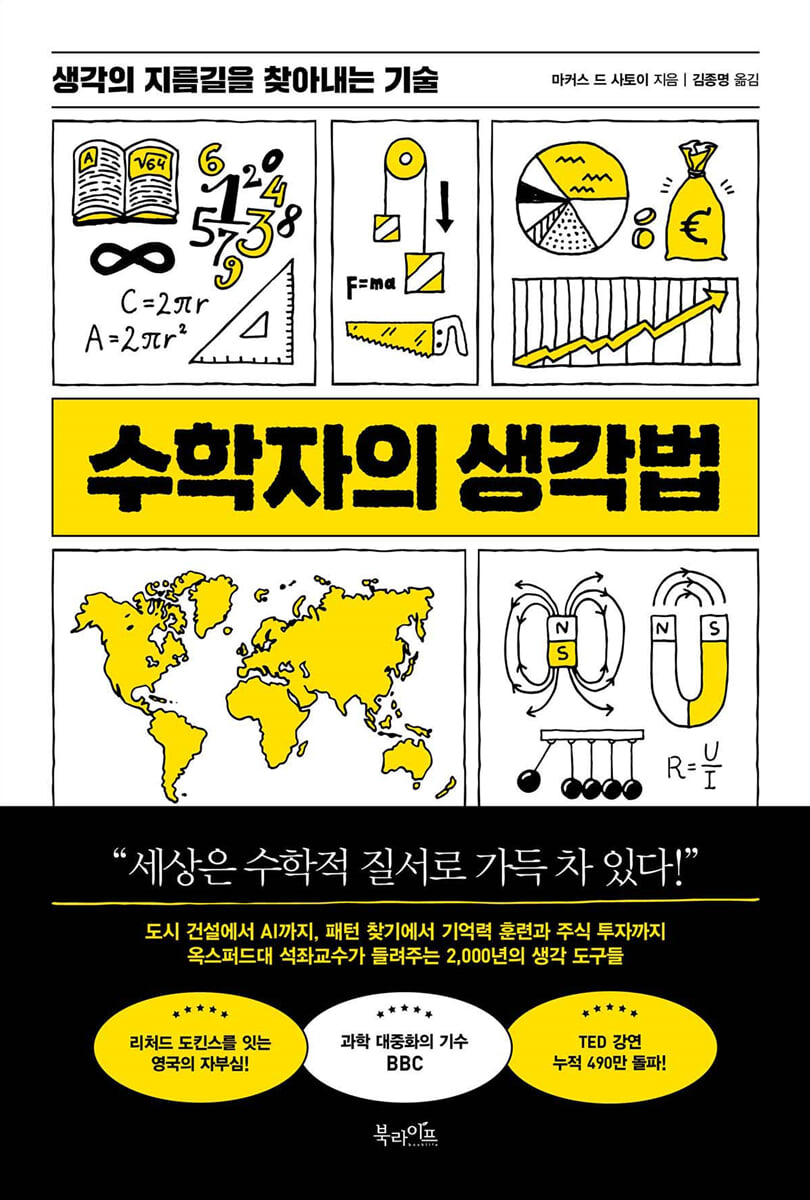
“The world is full of mathematical order!” From city building to AI, from pattern finding to memory training and stock investing. Oxford University Professor Emeritus Shares 2,000 Years of Thinking Tools “How to think quickly and accurately!” Oxford University Professor Emeritus, succeeding Richard Dawkins, Tracing 2,000 years of wisdom across history, art, science, and economics! Marcus de Sautoy, a professor of mathematics at Oxford University, is a bestselling author known for his erudition and literary prose. He also took over as Professor Simonyi, head of the UK's Science Popularisation Programme, following in the footsteps of Richard Dawkins, and has continued to serve in that role ever since. The British royal family awarded him the Order of the British Empire in recognition of his contributions to science, and TED, the world-renowned knowledge conference, calls him "Oxford's Science Ambassador." Marcus du Sautoy, who popularized the mystery of prime numbers, considered the greatest mystery in the history of mathematics, with his first book, “The Music of Primes,” and who traced the secrets of artificial intelligence and creativity with “The Creativity Code,” is meeting domestic readers again with a new book after four years. The theme of this book is 'better thinking' - how to think faster and more accurately. According to the author, mathematics is a discipline that seeks shortcuts to thinking. Just as a shortcut is the fastest way to reach a destination with the least possible effort, mathematical thinking is a way of thinking that seeks innovative solutions to complex problems encountered in everyday life. Mathematics is a science that guides us not only through physical shortcuts but also through shortcuts of thought. "The Mathematician's Way of Thinking" is a journey that explores the shortcuts to better ways of thinking that humanity has developed over the past 2,000 years. The author guides us to the birthplace of human civilization, allowing us to witness the birth of symbols and language, and takes us back to the era of great mathematicians like Gauss and Leibniz, making us question and ponder alongside them. It also vividly presents a variety of strategies for finding shortcuts to success in various areas of life, such as memory training, foreign language learning, and stock investment. Listening to the author's insightful and friendly explanations, you will clearly understand why mathematics is the ultimate weapon, embodying humanity's wisdom, and how mathematical thinking exerts its power in every aspect of human life and moves the world. Learn the principles that govern the world: the skills to see the invisible, the mindset to overcome shortcomings, the strategies to find the best solutions to complex problems, the tools to avoid getting lost in the jungle of vast data, and how to predict an uncertain future. |
- You can preview some of the book's contents.
Preview
index
Getting Started - Mathematics, the Art of Finding Shortcuts to Thinking
Chapter 1: Shortcuts to Patterns
The Power of Reading Patterns│What's Next?│Magic Numbers Hidden in Cities Around the World│Patterns Are in Everything?│The Secret to Improving Your Memory│The Allure of the Fibonacci Sequence│Shortcuts Connecting Different Worlds│The Path to Shortcuts to Thinking
Taking a Break - Is There a Shortcut to Learning an Instrument?
Chapter 2 Shortcuts to Calculation
The first attempts at counting numbers│The wizard who eliminated the boredom of calculation│Machines can do calculations│The discovery of imaginary numbers and numbers in mirrors│The hidden numbers in airplane landings│Let's try various number systems│The path to shortcuts in thinking
Break the Rules - If You Want to Succeed
Chapter 3: Shortcuts to Language
The Magical Language of Algebra│Mathematics: Decoding the Power of Nature│What Gifts Did You Receive on the Twelve Days of Christmas?│Descartes: Transforming Geometry and Algebra│Find the Higher-Dimensional Shortcuts│Win Life Like a Game│The Path to the Shortcuts of Thought
Take a break - Want to become a memory genius?
Chapter 4: Shortcuts to Geometry
Finding the way to the east of the Earth│Measuring the Earth's circumference for the first time│Trigonometry, a tool for measuring distances around the world│The tumultuous history of the meter│How to minimize travel distances│Who makes the real road│The science of finding the shortest path│The path to the shortcut of thought
Take a break - find a shortcut like climbing a mountain
Chapter 5 Shortcuts in Diagrams
A picture that has a stronger impact than numbers│How a map is made│A map of things big and small│A picture that reveals the secrets of relationships│The path to a shortcut to thinking
Taking a Break - How Economics Can Be Relevant in the 21st Century
Chapter 6 Shortcuts to Calculus
Newton, Capturing Momentary Movements│The Ultimate Tool for Calculating Maximum Profits│The Art of Mathematics That Completed the Cathedral Dome│The Hidden Numbers in Roller Coasters│Do Animals Practice Calculus?│The Path to Shortcuts to Thinking
Take a break - Anyone can become an artist with algorithms.
Chapter 7: Data Shortcuts
How to Find Reliable Data│Can Collective Intelligence Find Answers│We Can All Be Scientists│The Reality of Self-Learning Computers│Consider This Much Before Making a Decision│The Path to Shortcuts in Thinking
Taking a break - is there a shortcut to healing the mind?
Chapter 8: Shortcuts to Probability
How to increase your odds of winning at dice rolls│Think the opposite way if you want to solve a problem│Shortcuts to increase your odds of winning at the casino│Calculate your return before jumping in│Analyze scenarios and increase your odds│How variables affect probability│Where should Fifths bet│The road to shortcuts in thinking
Take a break - If you want to become an investment genius
Chapter 9: Shortcuts to Networking
Euler, Euler, Euler! │Euler's solution to networks│What information to discard and what information to keep│How matrices create search lists│You can meet anyone with just six people│The secrets of connections hidden in the brains of geniuses│How to connect without lifting a pen│The path to shortcuts in thought
Taking a Break - How Does the Brain Come Up with Amazing Ideas?
Chapter 10: The Impossible Shortcut
What is a good shortcut? │ Shortcuts for finding shortcuts │ Finding a needle in a haystack │ Use problems with no shortcuts │ Prime numbers, a secret still unsolved │ Shortcuts in quantum mechanics that have yet to be discovered │ DNA reveals the possibility of new shortcuts │ The path to shortcuts in thought
Arriving - A shortcut is not an end, but a new beginning.
Acknowledgements
Search
Chapter 1: Shortcuts to Patterns
The Power of Reading Patterns│What's Next?│Magic Numbers Hidden in Cities Around the World│Patterns Are in Everything?│The Secret to Improving Your Memory│The Allure of the Fibonacci Sequence│Shortcuts Connecting Different Worlds│The Path to Shortcuts to Thinking
Taking a Break - Is There a Shortcut to Learning an Instrument?
Chapter 2 Shortcuts to Calculation
The first attempts at counting numbers│The wizard who eliminated the boredom of calculation│Machines can do calculations│The discovery of imaginary numbers and numbers in mirrors│The hidden numbers in airplane landings│Let's try various number systems│The path to shortcuts in thinking
Break the Rules - If You Want to Succeed
Chapter 3: Shortcuts to Language
The Magical Language of Algebra│Mathematics: Decoding the Power of Nature│What Gifts Did You Receive on the Twelve Days of Christmas?│Descartes: Transforming Geometry and Algebra│Find the Higher-Dimensional Shortcuts│Win Life Like a Game│The Path to the Shortcuts of Thought
Take a break - Want to become a memory genius?
Chapter 4: Shortcuts to Geometry
Finding the way to the east of the Earth│Measuring the Earth's circumference for the first time│Trigonometry, a tool for measuring distances around the world│The tumultuous history of the meter│How to minimize travel distances│Who makes the real road│The science of finding the shortest path│The path to the shortcut of thought
Take a break - find a shortcut like climbing a mountain
Chapter 5 Shortcuts in Diagrams
A picture that has a stronger impact than numbers│How a map is made│A map of things big and small│A picture that reveals the secrets of relationships│The path to a shortcut to thinking
Taking a Break - How Economics Can Be Relevant in the 21st Century
Chapter 6 Shortcuts to Calculus
Newton, Capturing Momentary Movements│The Ultimate Tool for Calculating Maximum Profits│The Art of Mathematics That Completed the Cathedral Dome│The Hidden Numbers in Roller Coasters│Do Animals Practice Calculus?│The Path to Shortcuts to Thinking
Take a break - Anyone can become an artist with algorithms.
Chapter 7: Data Shortcuts
How to Find Reliable Data│Can Collective Intelligence Find Answers│We Can All Be Scientists│The Reality of Self-Learning Computers│Consider This Much Before Making a Decision│The Path to Shortcuts in Thinking
Taking a break - is there a shortcut to healing the mind?
Chapter 8: Shortcuts to Probability
How to increase your odds of winning at dice rolls│Think the opposite way if you want to solve a problem│Shortcuts to increase your odds of winning at the casino│Calculate your return before jumping in│Analyze scenarios and increase your odds│How variables affect probability│Where should Fifths bet│The road to shortcuts in thinking
Take a break - If you want to become an investment genius
Chapter 9: Shortcuts to Networking
Euler, Euler, Euler! │Euler's solution to networks│What information to discard and what information to keep│How matrices create search lists│You can meet anyone with just six people│The secrets of connections hidden in the brains of geniuses│How to connect without lifting a pen│The path to shortcuts in thought
Taking a Break - How Does the Brain Come Up with Amazing Ideas?
Chapter 10: The Impossible Shortcut
What is a good shortcut? │ Shortcuts for finding shortcuts │ Finding a needle in a haystack │ Use problems with no shortcuts │ Prime numbers, a secret still unsolved │ Shortcuts in quantum mechanics that have yet to be discovered │ DNA reveals the possibility of new shortcuts │ The path to shortcuts in thought
Arriving - A shortcut is not an end, but a new beginning.
Acknowledgements
Search
Detailed image
Into the book
"The Mathematician's Way of Thinking" is a travel book that explores the shortcuts to better ways of thinking that humanity has developed over the past 2,000 years.
The tricks of navigating the rugged terrain, discovering the clever tunnels and hidden mountain passes I'll encounter on this journey, are things that took me decades to discover on my own.
Historically, it took mathematicians thousands of years to piece together the pieces of that discovery.
We've tried to explain some of the clever strategies we use to solve complex problems we encounter in our daily lives.
I sincerely hope that this book will serve as a shortcut to the art of thinking.
---From "Departure"
Throughout history, and even today, anyone in business, construction, or finance has gained a competitive advantage by knowing how to calculate faster and more efficiently than their competitors.
In this chapter, I'd like to share with you some shortcuts I've discovered for working with numbers and calculations.
What's interesting is that these shortcuts can still be powerful strategies even when numbers aren't involved.
---From Chapter 2, Shortcuts to Calculation
In this book, I discovered that I could use mathematical equations to tell the story of planets moving across the night sky.
Symmetry theory can explain the shapes of bubbles, honeycombs, and flower petals.
Numbers also play a key role in composing musical chords.
If you want to describe the universe, what you need is not German, Russian, or English, but 'mathematics'.
《The Language of Mathematics》 taught us that mathematics is not just one language, but is made up of many different languages.
It also made me realize that mathematics is very good at creating dictionaries that translate one language into another, making invisible shortcuts appear through other languages.
The history of mathematics is filled with such brilliant moments.
---From Chapter 3, "Shortcuts to Language"
How can you express the message or data you want to convey using pictures or diagrams? Applying these techniques across a wide range of genres can be a shortcut to understanding the content.
A simple graph can show the relationship between business revenues at different times of the year.
A bar graph can help you track what foods are most popular at a particular cafe.
In the political realm, Venn diagrams can be used to illustrate overlaps and differences in opinion between political parties.
Network diagrams, such as the London Underground, can help us clearly reveal the connections between ideas that would otherwise be more complex to express in words.
---From "Chapter 5: Shortcuts to Diagrams"
The space industry isn't the only sector that's harnessing the power of these mathematical shortcuts.
Many companies seek the most efficient way to manufacture their products while maximizing production volume and minimizing costs.
In the aerospace industry, the goal is to create wings with minimal drag so that fuel is wasted as little as possible.
Large transport ships must find the fastest route through the swirling turbulence.
Stockbrokers try to capture the moment when a stock hits its highest price before it crashes.
Architects seek to design buildings that maximize interior space while taking into account the constraints of the surrounding environment.
Civil engineers want to build bridges that use minimal materials without compromising structural stability.
What all these challenges have in common is that they require calculus to achieve their respective goals.
---From "Chapter 6: Shortcuts to Calculus"
I've found that this strategy works as a very effective shortcut no matter what problem I'm tackling.
If facing a problem head-on is too complicated, just look at the opposite side.
For example, understanding the world of human consciousness is a very difficult scientific challenge.
However, analyzing the phenomenon of something appearing unconsciously can sometimes provide new insights into approaching the problem directly.
Analyzing patients in deep sleep or coma can help us understand what factors create conscious activity in the waking brain.
Approaching a problem from the opposite angle can also be an important shortcut when solving problems such as:
---From Chapter 8, Shortcuts to Probability
Shortcuts aren't about getting through the trip quickly.
It's about a stepping stone to start a new journey.
It's a story about roads opening, tunnels being dug, and bridges being built.
This allows others to quickly reach the frontiers of knowledge.
And then they can embark on their own journey into the darkness.
Armed with the tools that Gauss and his fellow mathematicians have honed over the years, I hope you will now stretch out your arms for your own great conquests.
The tricks of navigating the rugged terrain, discovering the clever tunnels and hidden mountain passes I'll encounter on this journey, are things that took me decades to discover on my own.
Historically, it took mathematicians thousands of years to piece together the pieces of that discovery.
We've tried to explain some of the clever strategies we use to solve complex problems we encounter in our daily lives.
I sincerely hope that this book will serve as a shortcut to the art of thinking.
---From "Departure"
Throughout history, and even today, anyone in business, construction, or finance has gained a competitive advantage by knowing how to calculate faster and more efficiently than their competitors.
In this chapter, I'd like to share with you some shortcuts I've discovered for working with numbers and calculations.
What's interesting is that these shortcuts can still be powerful strategies even when numbers aren't involved.
---From Chapter 2, Shortcuts to Calculation
In this book, I discovered that I could use mathematical equations to tell the story of planets moving across the night sky.
Symmetry theory can explain the shapes of bubbles, honeycombs, and flower petals.
Numbers also play a key role in composing musical chords.
If you want to describe the universe, what you need is not German, Russian, or English, but 'mathematics'.
《The Language of Mathematics》 taught us that mathematics is not just one language, but is made up of many different languages.
It also made me realize that mathematics is very good at creating dictionaries that translate one language into another, making invisible shortcuts appear through other languages.
The history of mathematics is filled with such brilliant moments.
---From Chapter 3, "Shortcuts to Language"
How can you express the message or data you want to convey using pictures or diagrams? Applying these techniques across a wide range of genres can be a shortcut to understanding the content.
A simple graph can show the relationship between business revenues at different times of the year.
A bar graph can help you track what foods are most popular at a particular cafe.
In the political realm, Venn diagrams can be used to illustrate overlaps and differences in opinion between political parties.
Network diagrams, such as the London Underground, can help us clearly reveal the connections between ideas that would otherwise be more complex to express in words.
---From "Chapter 5: Shortcuts to Diagrams"
The space industry isn't the only sector that's harnessing the power of these mathematical shortcuts.
Many companies seek the most efficient way to manufacture their products while maximizing production volume and minimizing costs.
In the aerospace industry, the goal is to create wings with minimal drag so that fuel is wasted as little as possible.
Large transport ships must find the fastest route through the swirling turbulence.
Stockbrokers try to capture the moment when a stock hits its highest price before it crashes.
Architects seek to design buildings that maximize interior space while taking into account the constraints of the surrounding environment.
Civil engineers want to build bridges that use minimal materials without compromising structural stability.
What all these challenges have in common is that they require calculus to achieve their respective goals.
---From "Chapter 6: Shortcuts to Calculus"
I've found that this strategy works as a very effective shortcut no matter what problem I'm tackling.
If facing a problem head-on is too complicated, just look at the opposite side.
For example, understanding the world of human consciousness is a very difficult scientific challenge.
However, analyzing the phenomenon of something appearing unconsciously can sometimes provide new insights into approaching the problem directly.
Analyzing patients in deep sleep or coma can help us understand what factors create conscious activity in the waking brain.
Approaching a problem from the opposite angle can also be an important shortcut when solving problems such as:
---From Chapter 8, Shortcuts to Probability
Shortcuts aren't about getting through the trip quickly.
It's about a stepping stone to start a new journey.
It's a story about roads opening, tunnels being dug, and bridges being built.
This allows others to quickly reach the frontiers of knowledge.
And then they can embark on their own journey into the darkness.
Armed with the tools that Gauss and his fellow mathematicians have honed over the years, I hope you will now stretch out your arms for your own great conquests.
---From "Arriving"
Publisher's Review
“Mathematics is the art of shortcuts!”
Oxford University Professor Emeritus Shares 2,000 Years of Thinking Tools
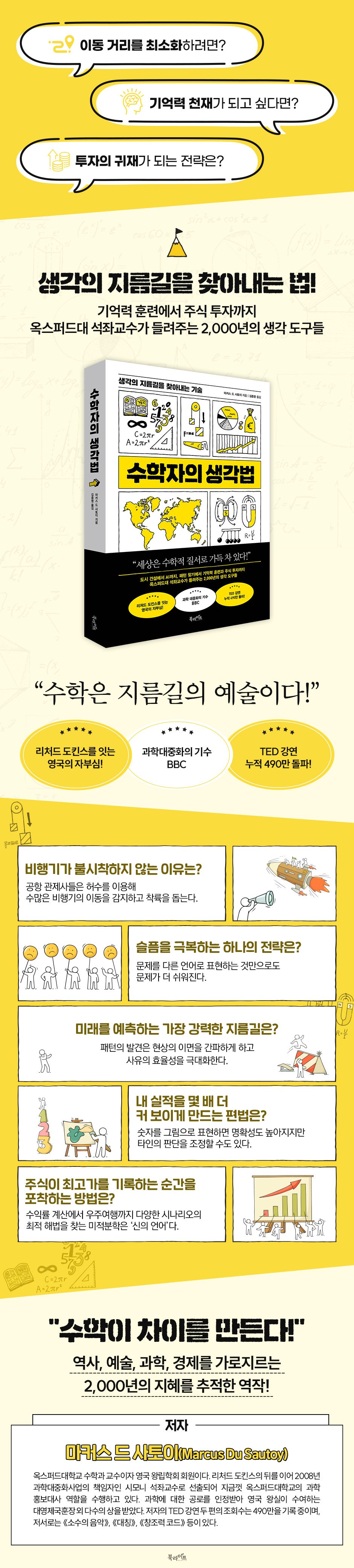
Why is math the ultimate time-saving tool? What if there were a few simple shortcuts that could make anyone's life easier? And what if we could salvage them from the history of humanity, woven over thousands of years?
We often hear that hard work is the key to success.
But the author of this book makes an interesting argument: success depends not on effort, but on the mindset of finding shortcuts.
A shortcut is a tool that allows you to quickly solve one problem so that you can tackle a bigger one.
This book is a monumental story of how humanity, seeking to avoid unnecessary labor and understand the complexities of the world, invented clever strategies to achieve more with fewer resources, and how it learned and recorded the principles of the invisible world.
5,000 years ago, humans built the first cities in the Euphrates River valley, the birthplace of ancient civilization, and used geometry and algebra to measure the size of the Earth.
Diagrams revolutionized civilization, we invented calculus, the greatest invention of all time, and we entered space, and algorithms allowed us to design and manage life intricately.
Do we really need 10,000 hours of practice to become a violinist? Are there more effective methods? Why do shortcuts outperform powerful artificial intelligence? Throughout the book, the author presents compelling strategies and case studies, including how shortcuts can be used to learn foreign languages, improve memory, and even influence investment. He also introduces artists, scientists, psychologists, and entrepreneurs who have used mathematical shortcuts to change the world.
How can we remember more and forget less? What are simple ways to earn more and be more creative? How can we most efficiently pack our car trunk and plan the shortest route for our trips? This book is filled with intriguing puzzles and smart strategies for quickly finding solutions to problems ranging from trivial everyday choices to momentous decisions.
The ability to discern the rules of the world is essential to leading us to a better life.
Patterns, diagrams, coordinates, probability, statistics, algorithms… Mathematics is the language that helps us recognize the fundamental principles behind all problems.
The skills to visualize abstract concepts, to visualize the physical world in numbers, to find the best solutions to engineering problems without wasting time or getting lost in the jungle of vast data, to strengthen memory and find the most efficient paths through networks—these are the various shortcuts in life that mathematics offers us.
Patterns, rules, observations, predictions, plans, memories, data… Welcome to the mysterious world.
“Math makes the difference!”
The greatest tools of thought discovered by mankind
The most obvious example of a shortcut to thinking is the anecdote involving the nine-year-old Gauss.
During math class, the teacher gave the young students a boring problem to add up all the numbers from 1 to 100 so they could take a nap.
While children were laboriously adding numbers one by one, Gauss found a shortcut to easily obtain the answer.
When you add numbers in pairs like 1+100, 2+99, 3+98, you realize that the sum is always 101, and since there are 50 of those pairs, you quickly get the answer that 50×101=5,050.
In this way, mathematics is not a subject of boring calculations, but a discipline of strategic thinking.
The ability to think about the overall structure of a problem rather than focusing on its details is what has fueled the development of civilization.
《The Mathematician's Way of Thinking》 introduces various shortcuts devised by mankind and their meanings.
For example, the ability to discover common structures, or "patterns," behind visible phenomena not only increases work efficiency, but also helps us predict and plan for the future, and is closely related to improving memory.
The ability to represent complex ideas in symbols was a powerful tool that allowed us to speed up our thinking and gain a competitive advantage over others, and it was a pivotal moment in the advancement of humanity.
And while representing numbers as a 'picture' can increase understanding, it can also be used as a shortcut to manipulate the judgment of others. The true power of diagrams lies in their ability to elicit a completely new perspective on the world.
When faced with an unsolvable problem, changing the problem to something else is one shortcut to finding a solution.
For example, Descartes invented the concept of coordinates, turning geometry into numbers and discovering shortcuts that were invisible in the geometric environment, and Leibniz provided a new language called calculus that could clearly capture fleeting moments in a moving world, providing shortcuts for finding optimal solutions to scenarios ranging from calculating profitability to space travel.
Moreover, probability and statistics have been tools of thought that have helped us overcome uncertainty by allowing us to quickly find information about large amounts of data.
“The world is full of mathematical order!”
How to Think Like a Mathematician
"The Mathematician's Way of Thinking" covers the fascinating history of humanity's struggle to find shortcuts to more efficient problem solving.
It tells the stories of a diverse cast of characters, from mathematicians with grand dreams of discovering formulas that explain how the world works, to architects and engineers who strive to create beautiful roofs or the best roller coasters, to gamblers who hope to have the best odds at the casino.
Mathematics has always been with humans as they strive for perfection in their own respective fields.
Mathematics is fundamental to the world and influences our lives.
It is the power of calculus that allows companies to find the most efficient way to maximize production and minimize costs when manufacturing products, and air traffic controllers use imaginary numbers to detect aircraft movements and help them land safely.
In this way, the author presents various examples and illuminates from various angles the mathematical principles at work at the foundation of the civilization we have achieved today.
The author says:
The journey to find a shortcut to thought is a story about roads opening, tunnels being dug, and bridges being built.
Mathematics is a tool and strategy that allows us to live more comfortably through better thinking.
At every stage of life, we encounter intersections where many different paths lead us far away, and uncertainty is inherent in every choice we make.
When we don't know which path will ultimately lead us to our destination, mathematical shortcuts can help us manage risk more effectively and offer a much better map of the future.
Oxford University Professor Emeritus Shares 2,000 Years of Thinking Tools
Why is math the ultimate time-saving tool? What if there were a few simple shortcuts that could make anyone's life easier? And what if we could salvage them from the history of humanity, woven over thousands of years?
We often hear that hard work is the key to success.
But the author of this book makes an interesting argument: success depends not on effort, but on the mindset of finding shortcuts.
A shortcut is a tool that allows you to quickly solve one problem so that you can tackle a bigger one.
This book is a monumental story of how humanity, seeking to avoid unnecessary labor and understand the complexities of the world, invented clever strategies to achieve more with fewer resources, and how it learned and recorded the principles of the invisible world.
5,000 years ago, humans built the first cities in the Euphrates River valley, the birthplace of ancient civilization, and used geometry and algebra to measure the size of the Earth.
Diagrams revolutionized civilization, we invented calculus, the greatest invention of all time, and we entered space, and algorithms allowed us to design and manage life intricately.
Do we really need 10,000 hours of practice to become a violinist? Are there more effective methods? Why do shortcuts outperform powerful artificial intelligence? Throughout the book, the author presents compelling strategies and case studies, including how shortcuts can be used to learn foreign languages, improve memory, and even influence investment. He also introduces artists, scientists, psychologists, and entrepreneurs who have used mathematical shortcuts to change the world.
How can we remember more and forget less? What are simple ways to earn more and be more creative? How can we most efficiently pack our car trunk and plan the shortest route for our trips? This book is filled with intriguing puzzles and smart strategies for quickly finding solutions to problems ranging from trivial everyday choices to momentous decisions.
The ability to discern the rules of the world is essential to leading us to a better life.
Patterns, diagrams, coordinates, probability, statistics, algorithms… Mathematics is the language that helps us recognize the fundamental principles behind all problems.
The skills to visualize abstract concepts, to visualize the physical world in numbers, to find the best solutions to engineering problems without wasting time or getting lost in the jungle of vast data, to strengthen memory and find the most efficient paths through networks—these are the various shortcuts in life that mathematics offers us.
Patterns, rules, observations, predictions, plans, memories, data… Welcome to the mysterious world.
“Math makes the difference!”
The greatest tools of thought discovered by mankind
The most obvious example of a shortcut to thinking is the anecdote involving the nine-year-old Gauss.
During math class, the teacher gave the young students a boring problem to add up all the numbers from 1 to 100 so they could take a nap.
While children were laboriously adding numbers one by one, Gauss found a shortcut to easily obtain the answer.
When you add numbers in pairs like 1+100, 2+99, 3+98, you realize that the sum is always 101, and since there are 50 of those pairs, you quickly get the answer that 50×101=5,050.
In this way, mathematics is not a subject of boring calculations, but a discipline of strategic thinking.
The ability to think about the overall structure of a problem rather than focusing on its details is what has fueled the development of civilization.
《The Mathematician's Way of Thinking》 introduces various shortcuts devised by mankind and their meanings.
For example, the ability to discover common structures, or "patterns," behind visible phenomena not only increases work efficiency, but also helps us predict and plan for the future, and is closely related to improving memory.
The ability to represent complex ideas in symbols was a powerful tool that allowed us to speed up our thinking and gain a competitive advantage over others, and it was a pivotal moment in the advancement of humanity.
And while representing numbers as a 'picture' can increase understanding, it can also be used as a shortcut to manipulate the judgment of others. The true power of diagrams lies in their ability to elicit a completely new perspective on the world.
When faced with an unsolvable problem, changing the problem to something else is one shortcut to finding a solution.
For example, Descartes invented the concept of coordinates, turning geometry into numbers and discovering shortcuts that were invisible in the geometric environment, and Leibniz provided a new language called calculus that could clearly capture fleeting moments in a moving world, providing shortcuts for finding optimal solutions to scenarios ranging from calculating profitability to space travel.
Moreover, probability and statistics have been tools of thought that have helped us overcome uncertainty by allowing us to quickly find information about large amounts of data.
“The world is full of mathematical order!”
How to Think Like a Mathematician
"The Mathematician's Way of Thinking" covers the fascinating history of humanity's struggle to find shortcuts to more efficient problem solving.
It tells the stories of a diverse cast of characters, from mathematicians with grand dreams of discovering formulas that explain how the world works, to architects and engineers who strive to create beautiful roofs or the best roller coasters, to gamblers who hope to have the best odds at the casino.
Mathematics has always been with humans as they strive for perfection in their own respective fields.
Mathematics is fundamental to the world and influences our lives.
It is the power of calculus that allows companies to find the most efficient way to maximize production and minimize costs when manufacturing products, and air traffic controllers use imaginary numbers to detect aircraft movements and help them land safely.
In this way, the author presents various examples and illuminates from various angles the mathematical principles at work at the foundation of the civilization we have achieved today.
The author says:
The journey to find a shortcut to thought is a story about roads opening, tunnels being dug, and bridges being built.
Mathematics is a tool and strategy that allows us to live more comfortably through better thinking.
At every stage of life, we encounter intersections where many different paths lead us far away, and uncertainty is inherent in every choice we make.
When we don't know which path will ultimately lead us to our destination, mathematical shortcuts can help us manage risk more effectively and offer a much better map of the future.
GOODS SPECIFICS
- Date of issue: May 21, 2024
- Page count, weight, size: 456 pages | 652g | 152*225*22mm
- ISBN13: 9791191013634
- ISBN10: 1191013634
You may also like
카테고리
korean


korean

![GQ KOREA Mark (Monthly): December [2025]](http://librairie.coreenne.fr/cdn/shop/files/8ef265dbbfbf186523ed75ba7319009d.jpg?v=1765340328&width=3840)


