

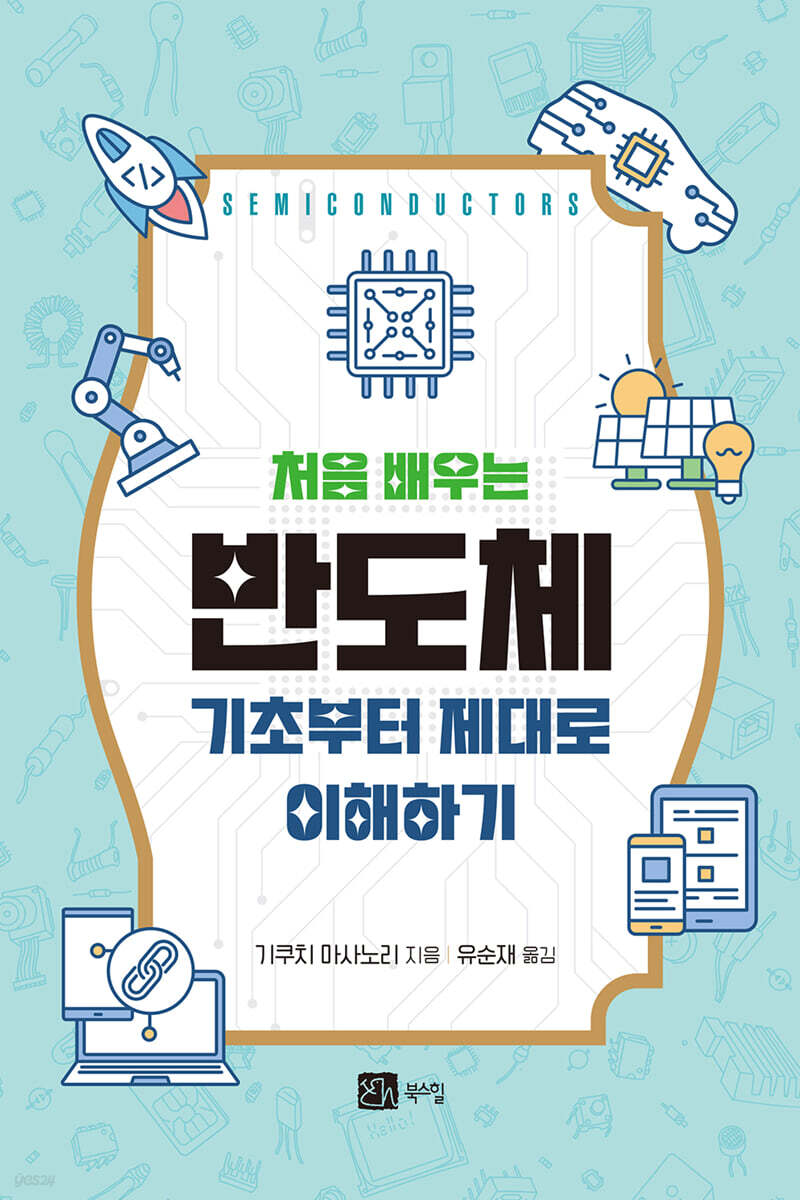
Learning semiconductors for the first time
 |
Description
Book Introduction
Semiconductors, called “the rice of modern industry,”
How much do we know?
Semiconductors are considered so important not only in Korea but also around the world that they are called the "rice of modern industry," and have become an indispensable product in modern industry to the point of even causing industrial wars between countries. We come across them through news media and articles every day, but books on semiconductors are actually difficult to find.
Above all, this book covers semiconductors in a way that anyone can easily understand, with the goal of providing 'explanations that are as easy and friendly as possible.'
We will introduce the various characteristics of silicon, a representative semiconductor material, as well as devices that utilize various properties of semiconductors. We will also look at the actual manufacturing process and the fields and purposes in which they are used. Finally, we will look at the movements taking place at the forefront of semiconductor development and future prospects.
How much do we know?
Semiconductors are considered so important not only in Korea but also around the world that they are called the "rice of modern industry," and have become an indispensable product in modern industry to the point of even causing industrial wars between countries. We come across them through news media and articles every day, but books on semiconductors are actually difficult to find.
Above all, this book covers semiconductors in a way that anyone can easily understand, with the goal of providing 'explanations that are as easy and friendly as possible.'
We will introduce the various characteristics of silicon, a representative semiconductor material, as well as devices that utilize various properties of semiconductors. We will also look at the actual manufacturing process and the fields and purposes in which they are used. Finally, we will look at the movements taking place at the forefront of semiconductor development and future prospects.
- You can preview some of the book's contents.
Preview
index
Chapter 1: Semiconductor Basics
001 Semiconductor, an intermediate material between conductors and insulators
002 Various semiconductors ① Types of semiconductors
003 Various Semiconductors ② Representative Semiconductor 'Silicon'
004 Three types of solid silicon: single crystal, polycrystalline, and amorphous
005 Charge carriers in silicon semiconductors ①
'n-type silicon', where free electrons carry charge
006 Charge carriers in silicon semiconductors ②
'P-type silicon', where holes carry charge
007 Movement of electrons and holes in semiconductors
Energy Bands and Belt Theory ①
008 The movement of electrons or holes in semiconductors 'energy
'Band' and 'Band Theory' ②
009 Advanced semiconductors with properties different from silicon
A 'compound semiconductor' composed of two or more types of elements
COLUMN Oxide semiconductors and organic semiconductors
Chapter 2 Semiconductor Devices
010 A 'resistance element' made of an electrically resistive semiconductor that has the property of impeding the flow of electricity.
011 A 'capacitor' made of a semiconductor that temporarily stores charge
012 pn junction, a device that conducts current in one direction
diode
013 Photodiode, a semiconductor device that converts light into electricity
014 Semiconductor device that converts electricity into light
diode
015 Optical semiconductor devices for communication or information processing
semiconductor laser
016 What is a Transistor? Typical Types of Transistors
017 Electron carrier MOS transistor n-channel type
018 P-channel type hole carrier MOS transistor
019 Circuit configuration of mobile devices CMOS
020 pn junction gate transistor JFET
021 Schottky Gate Transistor MESFET
022 Electron and hole transistor Bipolar transistor
The Birth of the COLUMN Transistor
Chapter 3: Semiconductor Integrated Circuits - Logic
023 Components and wiring on semiconductor substrates
Circuit integrated circuit (IC)
024 Differences in various IC structures, substrates, and signals
025 Number of components per chip depending on integration density
Classification of MOS-IC
026 Classification of MOS-ICs according to IC's operating function
027 Mathematical Foundations of Logic Circuits Boolean Algebra
028 Basic components of logic circuits
Gate circuit ① NOT circuit
029 Basic components of logic circuits
Gate circuit ② OR circuit
030 Basic components of logic circuits
Gate Circuit ③ AND Circuit
031 Addition Circuit Addition Circuit
032 Subtraction Circuit Subtraction Circuit
033 Signal size comparison judgment circuit
Comparison circuit and matching circuit
034 Computer's Brain IC MPU
035 Microcomputer Function IC MCU
036 Digital Signal Processing Specialized Processor DSP
037 Application and User IC ASIC
038 User function change logic circuit
Programmable logic 'PLD'
039 IC system IC with system functions
040 Electronic Eye IC CCD
COLUMN The first digital calculator
Chapter 4 Semiconductor Integrated Circuits - Memory
041 Temporary data memory circuit flip-flops and registers
042 Structure of information memory semiconductor
043 Computer main memory device memory DRAM
044 High-speed memory SRAM that does not require memory retention operation
045 Manufacturing Stage Data Entry Memory Mask ROM
046 Flash memory that is remembered even when the power is turned off
047 Increase capacity with the same number of memory cells
multi-value memory
The fundamental principle of column miniaturization: the "scaling law."
Chapter 5 IC Development and Design
048 IC Development Process From Market Research to Shipment
049 IC Hierarchy Design System From Design to Layout
050 IC Component Dimensions and Location Rules Design Standards
051 IC Structure and Electrical Characteristics Design Element Design
052 IC Manufacturing Process Design Process Design
COLUMN The Segmentation of the Semiconductor Chip Manufacturing Industry
Chapter 6: How to Make Silicon Wafers
053 Silicon, an element widely present in the earth's crust
054 Reduction, conversion, and distillation process of silica polycrystalline silicon
055 Single crystal silicon rod growth CZ growth method
056 Single crystal bar cutting and milling wafer processing
057 Gettering process for removing metal impurities
058 Evolution of Silicon Wafers: Epiwafers and SOI
COLUMN Required characteristics for silicon wafers
Chapter 7: IC Manufacturing ① - Preliminary Process
059 IC Manufacturing Process Overview Pre- and Post-processes
060 The first part of the process before device formation ① FEOL
061 The first part of the process before device formation ② FEOL
062 BEOL (Back of Line) before wire formation process
063 Thin film process for forming conductor, insulator, and semiconductor thin films
064 Mask Pattern Transfer Technology Lithography
065 Material film corrosion removal etching
066 Conductive impurity addition technology: thermal diffusion and ion implantation
067 Pushing in various heat treatment technologies,
Reflow, annealing
068 Wafer surface planarization CMP
069 Wafer Washing Cleaning
070 Defective Chip Selection Wafer Inspection and Trimming
COLUMN Clean Room
Chapter 8: IC Manufacturing ② - Post-process
071 Dicing: cutting out chips one by one from a wafer
Chip mount mount in 072 package
073 Chip electrode and package terminal connection wire bonding
074 Chip Packaging Molding
075 Package terminal processing and IC identification lead plating,
Lead forming, history notation
076 Package Type Through-hole (TH) element and surface
SMD (Small-Medium-Density Device)
077 IC shape and characteristic inspection process inspection and selection
COLUMN IC Reliability and Accelerated Testing
Chapter 9: Cutting-Edge Semiconductor Technology
078 Large-diameter silicon wafer, wafer diameter 450 mm
079 MOS transistor speed-up using 'modified silicon technology'
080 New structure MOS transistor
081 The Future of Lithography Technology
① Immersion exposure and double patterning
082 The Future of Lithography Technology
② Extreme ultraviolet (EUV) exposure
083 The Future of Lithography Technology
③ Maskless (ML2) and nano imprint
084 Realization of universal function memory
① Candidate technology for functional memory
085 Realization of universal function memory
② Ferroelectric memory and magnetic memory
086 Realization of universal function memory
③ Phase change memory and resistance change memory
087 Breakthrough with the introduction of new materials
① High-k gate insulating film and metal gate electrode
Breakthrough with the introduction of new materials
②DRAM high-performance capacitance film and low-k interlayer insulating film
COLUMN 'More Moore' and 'More than Moore'
001 Semiconductor, an intermediate material between conductors and insulators
002 Various semiconductors ① Types of semiconductors
003 Various Semiconductors ② Representative Semiconductor 'Silicon'
004 Three types of solid silicon: single crystal, polycrystalline, and amorphous
005 Charge carriers in silicon semiconductors ①
'n-type silicon', where free electrons carry charge
006 Charge carriers in silicon semiconductors ②
'P-type silicon', where holes carry charge
007 Movement of electrons and holes in semiconductors
Energy Bands and Belt Theory ①
008 The movement of electrons or holes in semiconductors 'energy
'Band' and 'Band Theory' ②
009 Advanced semiconductors with properties different from silicon
A 'compound semiconductor' composed of two or more types of elements
COLUMN Oxide semiconductors and organic semiconductors
Chapter 2 Semiconductor Devices
010 A 'resistance element' made of an electrically resistive semiconductor that has the property of impeding the flow of electricity.
011 A 'capacitor' made of a semiconductor that temporarily stores charge
012 pn junction, a device that conducts current in one direction
diode
013 Photodiode, a semiconductor device that converts light into electricity
014 Semiconductor device that converts electricity into light
diode
015 Optical semiconductor devices for communication or information processing
semiconductor laser
016 What is a Transistor? Typical Types of Transistors
017 Electron carrier MOS transistor n-channel type
018 P-channel type hole carrier MOS transistor
019 Circuit configuration of mobile devices CMOS
020 pn junction gate transistor JFET
021 Schottky Gate Transistor MESFET
022 Electron and hole transistor Bipolar transistor
The Birth of the COLUMN Transistor
Chapter 3: Semiconductor Integrated Circuits - Logic
023 Components and wiring on semiconductor substrates
Circuit integrated circuit (IC)
024 Differences in various IC structures, substrates, and signals
025 Number of components per chip depending on integration density
Classification of MOS-IC
026 Classification of MOS-ICs according to IC's operating function
027 Mathematical Foundations of Logic Circuits Boolean Algebra
028 Basic components of logic circuits
Gate circuit ① NOT circuit
029 Basic components of logic circuits
Gate circuit ② OR circuit
030 Basic components of logic circuits
Gate Circuit ③ AND Circuit
031 Addition Circuit Addition Circuit
032 Subtraction Circuit Subtraction Circuit
033 Signal size comparison judgment circuit
Comparison circuit and matching circuit
034 Computer's Brain IC MPU
035 Microcomputer Function IC MCU
036 Digital Signal Processing Specialized Processor DSP
037 Application and User IC ASIC
038 User function change logic circuit
Programmable logic 'PLD'
039 IC system IC with system functions
040 Electronic Eye IC CCD
COLUMN The first digital calculator
Chapter 4 Semiconductor Integrated Circuits - Memory
041 Temporary data memory circuit flip-flops and registers
042 Structure of information memory semiconductor
043 Computer main memory device memory DRAM
044 High-speed memory SRAM that does not require memory retention operation
045 Manufacturing Stage Data Entry Memory Mask ROM
046 Flash memory that is remembered even when the power is turned off
047 Increase capacity with the same number of memory cells
multi-value memory
The fundamental principle of column miniaturization: the "scaling law."
Chapter 5 IC Development and Design
048 IC Development Process From Market Research to Shipment
049 IC Hierarchy Design System From Design to Layout
050 IC Component Dimensions and Location Rules Design Standards
051 IC Structure and Electrical Characteristics Design Element Design
052 IC Manufacturing Process Design Process Design
COLUMN The Segmentation of the Semiconductor Chip Manufacturing Industry
Chapter 6: How to Make Silicon Wafers
053 Silicon, an element widely present in the earth's crust
054 Reduction, conversion, and distillation process of silica polycrystalline silicon
055 Single crystal silicon rod growth CZ growth method
056 Single crystal bar cutting and milling wafer processing
057 Gettering process for removing metal impurities
058 Evolution of Silicon Wafers: Epiwafers and SOI
COLUMN Required characteristics for silicon wafers
Chapter 7: IC Manufacturing ① - Preliminary Process
059 IC Manufacturing Process Overview Pre- and Post-processes
060 The first part of the process before device formation ① FEOL
061 The first part of the process before device formation ② FEOL
062 BEOL (Back of Line) before wire formation process
063 Thin film process for forming conductor, insulator, and semiconductor thin films
064 Mask Pattern Transfer Technology Lithography
065 Material film corrosion removal etching
066 Conductive impurity addition technology: thermal diffusion and ion implantation
067 Pushing in various heat treatment technologies,
Reflow, annealing
068 Wafer surface planarization CMP
069 Wafer Washing Cleaning
070 Defective Chip Selection Wafer Inspection and Trimming
COLUMN Clean Room
Chapter 8: IC Manufacturing ② - Post-process
071 Dicing: cutting out chips one by one from a wafer
Chip mount mount in 072 package
073 Chip electrode and package terminal connection wire bonding
074 Chip Packaging Molding
075 Package terminal processing and IC identification lead plating,
Lead forming, history notation
076 Package Type Through-hole (TH) element and surface
SMD (Small-Medium-Density Device)
077 IC shape and characteristic inspection process inspection and selection
COLUMN IC Reliability and Accelerated Testing
Chapter 9: Cutting-Edge Semiconductor Technology
078 Large-diameter silicon wafer, wafer diameter 450 mm
079 MOS transistor speed-up using 'modified silicon technology'
080 New structure MOS transistor
081 The Future of Lithography Technology
① Immersion exposure and double patterning
082 The Future of Lithography Technology
② Extreme ultraviolet (EUV) exposure
083 The Future of Lithography Technology
③ Maskless (ML2) and nano imprint
084 Realization of universal function memory
① Candidate technology for functional memory
085 Realization of universal function memory
② Ferroelectric memory and magnetic memory
086 Realization of universal function memory
③ Phase change memory and resistance change memory
087 Breakthrough with the introduction of new materials
① High-k gate insulating film and metal gate electrode
Breakthrough with the introduction of new materials
②DRAM high-performance capacitance film and low-k interlayer insulating film
COLUMN 'More Moore' and 'More than Moore'
Detailed image

Publisher's Review
Semiconductors, called “the rice of modern industry,”
How much do we know?
Semiconductors are considered so important not only in Korea but also around the world that they are called the "rice of modern industry" and have become an indispensable product in modern industry to the point of even causing industrial wars between countries. We come across them through news media and articles every day, but books on semiconductors are actually difficult to find.
Above all, this book covers semiconductors in a way that anyone can easily understand, with the goal of providing 'explanations that are as easy and friendly as possible.'
We will introduce the various characteristics of silicon, a representative semiconductor material, as well as devices that utilize various properties of semiconductors. We will also look at the actual manufacturing process and the fields and purposes in which they are used. Finally, we will look at the movements taking place at the forefront of semiconductor development and future prospects.
Dreaming of a leap forward for the semiconductor industry
Semiconductors, a key material driving modern scientific and technological civilization, are becoming increasingly important in today's information and communications society, and the semiconductor industry's capabilities are exerting such powerful influence that they are becoming a measure of power.
Accordingly, the author wrote this book to provide a broader audience with a more accessible overview of the basics of semiconductors, particularly silicon and integrated circuits (ICs), which dominate the lives of people around the world.
Semiconductors fall into the intermediate range between conductors and insulators when classifying materials according to electrical conductivity.
In its pure state, it is similar to an insulator, but its electrical conductivity can be increased by adding impurities or other manipulations.
Because of these properties, they are used to control current as needed, and silicon is mainly used as a semiconductor material.
Silicon is a very common element, with a Clarke number of 25.8%, making it the second most abundant element on Earth after oxygen at 49.5%.
This book first focuses on explaining the basic concepts of semiconductors.
We will learn about what semiconductors are, what their properties are, how they work, the types and structures of integrated circuits, the actual manufacturing process, and in what fields and for what purposes they are used.
Finally, we conclude with the movements taking place at the forefront of semiconductor development and future prospects.
I hope that through this book, readers can easily understand semiconductors in general and foster even a little more hope for the future of the semiconductor industry.
A three-dimensional, easy-to-understand story about semiconductors
This book actively utilizes pictures and diagrams to provide a three-dimensional understanding of semiconductor-related information, which is a somewhat specialized field, so that even non-specialists can easily understand it.
First, the first chapter explains the various characteristics of silicon, a representative elemental semiconductor.
In addition, we briefly mention band theory, which is the basis of semiconductor theory.
Next, we will learn about passive and active components, including electrical resistance, which utilizes the various properties of semiconductors.
Here, you can hear a brief explanation of the electrical characteristics of semiconductor devices, as well as light-emitting and light-receiving devices.
Next, we will explain the logic that performs numerical calculations or logical operations in semiconductor integrated circuits (CMOS-IC).
We will also learn about volatile memory and nonvolatile memory, which are semiconductor memory devices that can store information and retrieve it when needed.
Diving deep into the book, you'll gain a glimpse into the diverse processes and product development processes of actual semiconductor manufacturing. Beginning with IC development and design, the book explores silicon wafer manufacturing, the pre- and post-processes of IC manufacturing, and the core technologies and techniques of each field.
Ironically, the ongoing advancement of semiconductor technology has brought many technological barriers to the surface.
To overcome these limitations, the book concludes by examining the ongoing research and development of new materials, new structures, and new processes in the cutting-edge semiconductor field.
How much do we know?
Semiconductors are considered so important not only in Korea but also around the world that they are called the "rice of modern industry" and have become an indispensable product in modern industry to the point of even causing industrial wars between countries. We come across them through news media and articles every day, but books on semiconductors are actually difficult to find.
Above all, this book covers semiconductors in a way that anyone can easily understand, with the goal of providing 'explanations that are as easy and friendly as possible.'
We will introduce the various characteristics of silicon, a representative semiconductor material, as well as devices that utilize various properties of semiconductors. We will also look at the actual manufacturing process and the fields and purposes in which they are used. Finally, we will look at the movements taking place at the forefront of semiconductor development and future prospects.
Dreaming of a leap forward for the semiconductor industry
Semiconductors, a key material driving modern scientific and technological civilization, are becoming increasingly important in today's information and communications society, and the semiconductor industry's capabilities are exerting such powerful influence that they are becoming a measure of power.
Accordingly, the author wrote this book to provide a broader audience with a more accessible overview of the basics of semiconductors, particularly silicon and integrated circuits (ICs), which dominate the lives of people around the world.
Semiconductors fall into the intermediate range between conductors and insulators when classifying materials according to electrical conductivity.
In its pure state, it is similar to an insulator, but its electrical conductivity can be increased by adding impurities or other manipulations.
Because of these properties, they are used to control current as needed, and silicon is mainly used as a semiconductor material.
Silicon is a very common element, with a Clarke number of 25.8%, making it the second most abundant element on Earth after oxygen at 49.5%.
This book first focuses on explaining the basic concepts of semiconductors.
We will learn about what semiconductors are, what their properties are, how they work, the types and structures of integrated circuits, the actual manufacturing process, and in what fields and for what purposes they are used.
Finally, we conclude with the movements taking place at the forefront of semiconductor development and future prospects.
I hope that through this book, readers can easily understand semiconductors in general and foster even a little more hope for the future of the semiconductor industry.
A three-dimensional, easy-to-understand story about semiconductors
This book actively utilizes pictures and diagrams to provide a three-dimensional understanding of semiconductor-related information, which is a somewhat specialized field, so that even non-specialists can easily understand it.
First, the first chapter explains the various characteristics of silicon, a representative elemental semiconductor.
In addition, we briefly mention band theory, which is the basis of semiconductor theory.
Next, we will learn about passive and active components, including electrical resistance, which utilizes the various properties of semiconductors.
Here, you can hear a brief explanation of the electrical characteristics of semiconductor devices, as well as light-emitting and light-receiving devices.
Next, we will explain the logic that performs numerical calculations or logical operations in semiconductor integrated circuits (CMOS-IC).
We will also learn about volatile memory and nonvolatile memory, which are semiconductor memory devices that can store information and retrieve it when needed.
Diving deep into the book, you'll gain a glimpse into the diverse processes and product development processes of actual semiconductor manufacturing. Beginning with IC development and design, the book explores silicon wafer manufacturing, the pre- and post-processes of IC manufacturing, and the core technologies and techniques of each field.
Ironically, the ongoing advancement of semiconductor technology has brought many technological barriers to the surface.
To overcome these limitations, the book concludes by examining the ongoing research and development of new materials, new structures, and new processes in the cutting-edge semiconductor field.
GOODS SPECIFICS
- Publication date: December 15, 2022
- Page count, weight, size: 224 pages | 153*225*20mm
- ISBN13: 9791159714603
- ISBN10: 1159714606
You may also like
카테고리
korean


korean

![GQ KOREA Mark (Monthly): December [2025]](http://librairie.coreenne.fr/cdn/shop/files/8ef265dbbfbf186523ed75ba7319009d.jpg?v=1765340328&width=3840)


