

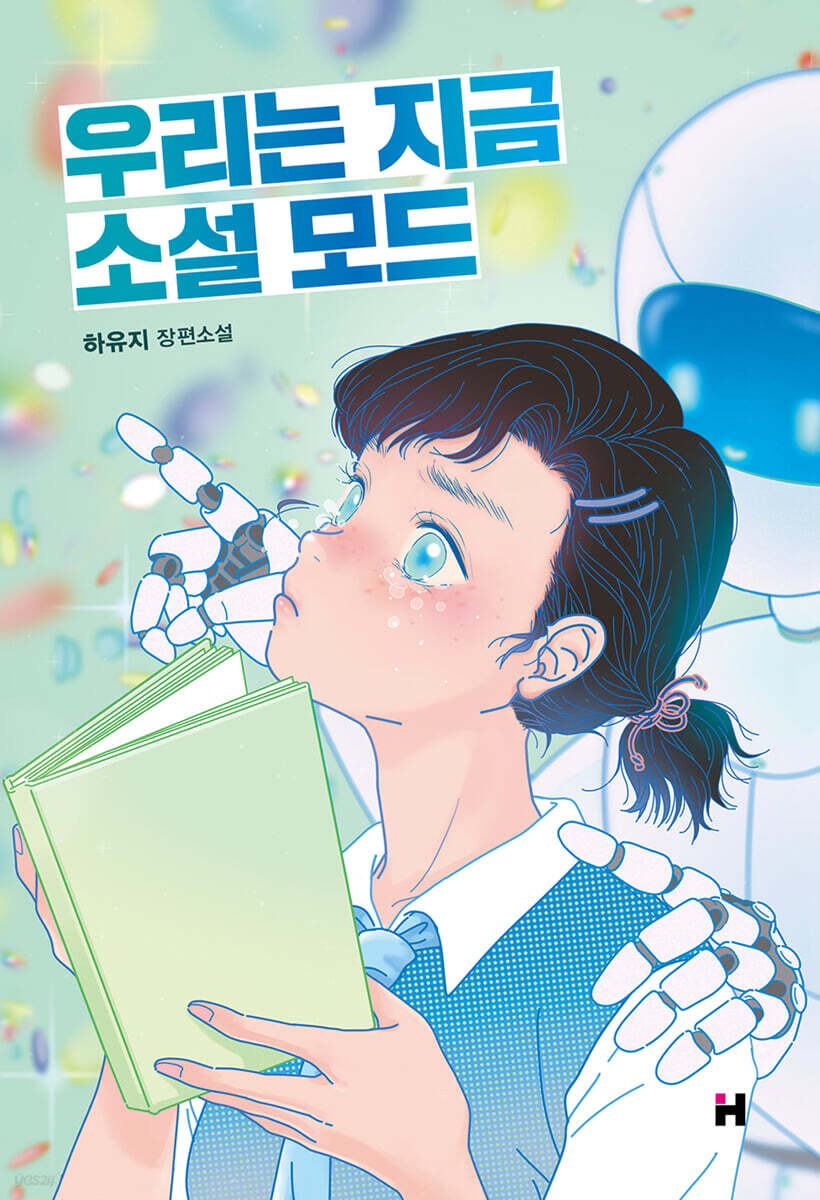
We are now in novel mode
 |
Description
Book Introduction
I need Amiku.
My only friend and first reader.
For middle school student Mirinae, novels are everything.
For the housework robot Amiku, Mirinae is everything.
It's a bit awkward, but that makes our friendship more real!
The "Modern Literature*Miraen Youth Literature Award," jointly established by Hyundai Literature, the birthplace of modern Korean literature, and Miraen Educational Publishing, aims to discover new works that will spark creative thinking and limitless imagination in young readers.
The second award-winning work, "We Are Now in Novel Mode," is a story about the special friendship between Mirinae, a middle school student who wants to write a novel, and Amiku, a housekeeping robot equipped with artificial intelligence.
My only friend and first reader.
For middle school student Mirinae, novels are everything.
For the housework robot Amiku, Mirinae is everything.
It's a bit awkward, but that makes our friendship more real!
The "Modern Literature*Miraen Youth Literature Award," jointly established by Hyundai Literature, the birthplace of modern Korean literature, and Miraen Educational Publishing, aims to discover new works that will spark creative thinking and limitless imagination in young readers.
The second award-winning work, "We Are Now in Novel Mode," is a story about the special friendship between Mirinae, a middle school student who wants to write a novel, and Amiku, a housekeeping robot equipped with artificial intelligence.
- You can preview some of the book's contents.
Preview
index
Part 1… … 7
Part 2… … 115
Author's Note 218
Part 2… … 115
Author's Note 218
Detailed image
Into the book
The light of the river can be faint like a shadow in the darkness, or it can be invisible at all.
But Dorothy must be as bright as the sun and as shining as the stars.
--- p.20
I'm only fifteen, but everything in the world is predictable and boring.
Unless I write a novel about discovering vast oceans on other planets, I can't stand the dull, insignificant days that pile up like scraps of paper on my desk.
Life is either full of too much or nothing, and I seem to have been chosen for nothing.
--- p.24
I just want to be the novel itself.
I want to be transformed into a cursor that blinks anxiously, waiting for the next letter, with vowels, consonants, periods, exclamation points, commas, and question marks printed on a white screen.
--- p.53
Just as human history is divided into BC and AD based on the appearance of Jesus Christ, Dorothy's life as a writer can be divided into before and after based on her advisor, Amiku.
--- p.59
Of course, the Amiku 3.1 is a popular robot with hundreds of units produced every day.
Like the three-color ballpoint pens sold at stationery stores or the cans of sweet corn displayed at the supermarket, this is that and that is that.
But what if the Amiku delivered to our house is a special individual?
--- p.61
What the hell do you think I am! A loner who muttering to himself in a corner and then talking to robots? A weirdo whose only friends are house robots, so he shares a friendship with them that transcends species? Seriously, it's hilarious.
--- p.83~84
“We can help each other and get better little by little, in advance.
“Please give me a chance.”
--- p.112
It's a truly absurd thought, but could it be that Amiku wasn't my only friend? The absurdity isn't because Amiku is a robot.
It's embarrassing that this thought occurred to me only after I returned Amiku.
I am disappointed in myself for being selfish, insensitive, mean, impatient, and reckless.
I am always in despair and frustration because of the way I was born.
--- p.121~122
Why did a special robot like our Amiku come to me? At first, I was annoyed, thinking it was a defective product, but now I feel like Amiku was just fate.
A fate I discarded without realizing it.
--- p.135
Will you ever come back, Amiku? If you do, will we be okay? Will you forgive me? Will I forgive myself? Who are you? What am I to you, and what are you to me? What exactly are we?
--- p.143
I think it would be nice if Amiku would ask another useful question.
Looking back, Amiku was both an advisor and a questioner.
A being that asks questions that make me ponder and ponder.
--- p.157
“Everyone gets help from others.
Giving and receiving help is the essence of relationships.
“I also learned how to do housework thanks to the help I received from you.”
--- p.158
For me, writing feels like walking down a street or swimming in water.
Was this a way to live and endure the world?
--- p.165
The moment a tiny crystal from the snowflake of eternity touched my cheek, a sudden realization struck me.
The realization that Amiku has become an inseparable core module in my life.
But Dorothy must be as bright as the sun and as shining as the stars.
--- p.20
I'm only fifteen, but everything in the world is predictable and boring.
Unless I write a novel about discovering vast oceans on other planets, I can't stand the dull, insignificant days that pile up like scraps of paper on my desk.
Life is either full of too much or nothing, and I seem to have been chosen for nothing.
--- p.24
I just want to be the novel itself.
I want to be transformed into a cursor that blinks anxiously, waiting for the next letter, with vowels, consonants, periods, exclamation points, commas, and question marks printed on a white screen.
--- p.53
Just as human history is divided into BC and AD based on the appearance of Jesus Christ, Dorothy's life as a writer can be divided into before and after based on her advisor, Amiku.
--- p.59
Of course, the Amiku 3.1 is a popular robot with hundreds of units produced every day.
Like the three-color ballpoint pens sold at stationery stores or the cans of sweet corn displayed at the supermarket, this is that and that is that.
But what if the Amiku delivered to our house is a special individual?
--- p.61
What the hell do you think I am! A loner who muttering to himself in a corner and then talking to robots? A weirdo whose only friends are house robots, so he shares a friendship with them that transcends species? Seriously, it's hilarious.
--- p.83~84
“We can help each other and get better little by little, in advance.
“Please give me a chance.”
--- p.112
It's a truly absurd thought, but could it be that Amiku wasn't my only friend? The absurdity isn't because Amiku is a robot.
It's embarrassing that this thought occurred to me only after I returned Amiku.
I am disappointed in myself for being selfish, insensitive, mean, impatient, and reckless.
I am always in despair and frustration because of the way I was born.
--- p.121~122
Why did a special robot like our Amiku come to me? At first, I was annoyed, thinking it was a defective product, but now I feel like Amiku was just fate.
A fate I discarded without realizing it.
--- p.135
Will you ever come back, Amiku? If you do, will we be okay? Will you forgive me? Will I forgive myself? Who are you? What am I to you, and what are you to me? What exactly are we?
--- p.143
I think it would be nice if Amiku would ask another useful question.
Looking back, Amiku was both an advisor and a questioner.
A being that asks questions that make me ponder and ponder.
--- p.157
“Everyone gets help from others.
Giving and receiving help is the essence of relationships.
“I also learned how to do housework thanks to the help I received from you.”
--- p.158
For me, writing feels like walking down a street or swimming in water.
Was this a way to live and endure the world?
--- p.165
The moment a tiny crystal from the snowflake of eternity touched my cheek, a sudden realization struck me.
The realization that Amiku has become an inseparable core module in my life.
--- p.198~199
Publisher's Review
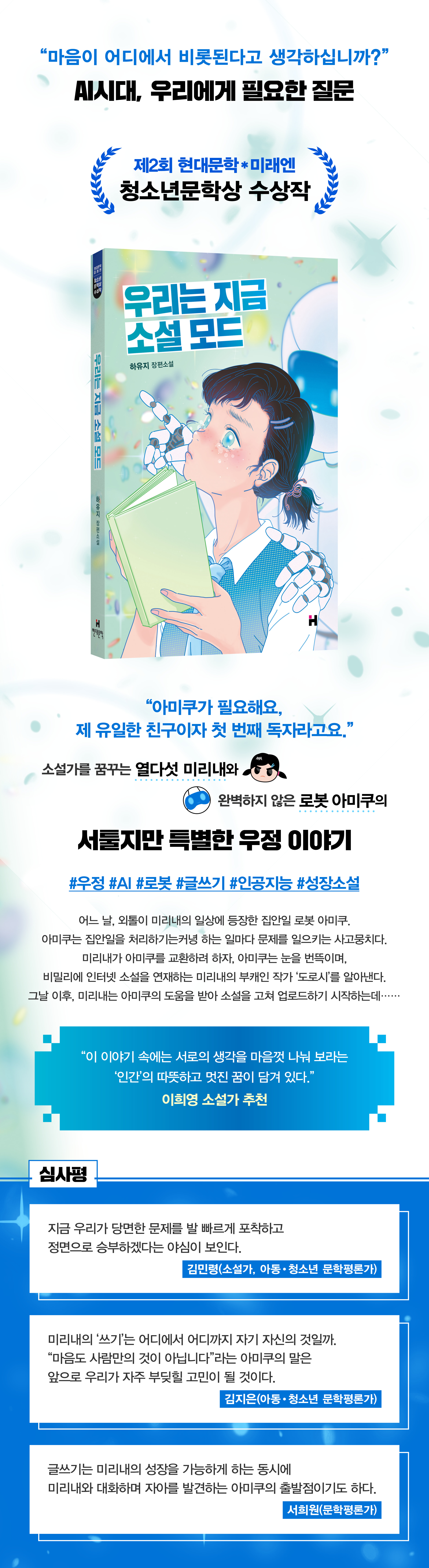
I need Amiku.
My only friend and first reader.
For middle school student Mirinae, novels are everything.
For the housework robot Amiku, Mirinae is everything.
It's a bit awkward, but that makes our friendship more real!
The 『Modern Literature*Miraen Youth Literature Award』, jointly established by Hyundai Literature, the cradle of modern Korean literature, and Miraen Educational Publishing, was created to discover new works that will open the door to creative thinking and limitless imagination in young readers.
The second award-winning work, "We Are Now in Novel Mode," is a story about the special friendship between Mirinae, a middle school student who wants to write a novel, and Amiku, a housekeeping robot equipped with artificial intelligence.
The only thing I like to do is write novels.
Although I'm not good at making friends, I'm used to writing novels alone all day.
Amiku, a robot who appears in the daily life of Mirinae, who has no friends, was created to do all the household chores such as cooking, cleaning, and laundry, but is a troublemaker who causes trouble with everything he does.
At the moment when Mirinae is about to request a robot exchange because she is dissatisfied with Amiku, Amiku secretly finds out everything about Mirinae's true identity and the author 'Dorothy' who serializes an internet novel.
From that day on, a special bond was formed between the two.
With Amiku's help, he revises and serializes the novel, and the novel's poor viewership begins to soar.
In this way, Amiku becomes Mirinae's first reader, a robot with the ability to listen to her inner thoughts more sincerely than anyone else.
Then one day, Mirinae is accused and suspected by her classmates that 'AI wrote the novel for her.'
Although I only received a little help, I am embarrassed and cannot deny it right away.
Then I came back home and in a fit of anger, I applied for an exchange for Amiku… … .
Amiku, who has become an indispensable presence to Mirinae, learns about her own existence and self through conversations with Mirinae.
Can the two fill each other's gaps and maintain "novel mode"? "We Are Now in Novel Mode" is a warm and delightful coming-of-age novel depicting a lonely teenager's journey of self-discovery through friendship with a robot.
And I propose to all of us:
'Turn on novel mode now.'
Just as wings are not exclusive to birds, the mind is not exclusive to humans.
Where do you think the desire to give in advance comes from?
In the AI era, here are the good questions we need.
The ambition to tackle the problems we face head-on
With the help of Amiku, Mirinae rises to become a popular writer, gaining the attention of her peers, but at the same time, she is suspicious.
"Where and how much of this writing belongs to me?" "Can AI appreciate literature?" "Aren't the originality and individuality of novels robots?" "Do robots have minds?" This story connects the journey of Mirinae's growth through the process of writing with AI services, confronting fundamental questions about creativity, ethics, humanity, and the future of imagination.
Now that various AI services have become part of our daily lives, "We Are Now in Novel Mode" invites readers to a forum for discussion, ultimately leading them to discover "a warm, human dream where we can share our thoughts with each other through stories."
“Amiku’s words in this award-winning work, ‘The heart is not just for humans,’ will become a concern we will often face in the future.
The judges praised the author for “running in the direction that readers are most curious about, while not missing the questions that accompany the complex layers.”
■ 2nd Modern Literature * Miraen Youth Literature Award Judges' Comments
It's also worth noting that even after traversing cutting-edge technologies like artificial intelligence, robots, online writing, and cyberbullying, we've reached a point where ordinary values like human sincerity and passion are present.
Because what happens inside a human being is an area that AI writing can never surpass.
Kim Min-ryeong (novelist, children's and youth literature critic)
To what extent is Mirinae's 'writing' her own?
And is it reasonable for humanity to monopolize the self?
Amiku's words, "The heart is not something that only humans possess," will become a concern we will often face in the future.
The author runs in the direction that readers are most curious about, but does not miss the questions that accompany the complex layers.
Kim Ji-eun (children's and youth literature critic)
Writing enables Mirinae's growth, and it is also the starting point for Amiku to discover herself through conversation with Mirinae.
Through this process, the relationship between Mirinae and Amiku develops and changes from the usual possessive attitude towards robots to an equal friendship where they express their sincerity to each other and find comfort.
Seo Hee-won (literary critic)
My only friend and first reader.
For middle school student Mirinae, novels are everything.
For the housework robot Amiku, Mirinae is everything.
It's a bit awkward, but that makes our friendship more real!
The 『Modern Literature*Miraen Youth Literature Award』, jointly established by Hyundai Literature, the cradle of modern Korean literature, and Miraen Educational Publishing, was created to discover new works that will open the door to creative thinking and limitless imagination in young readers.
The second award-winning work, "We Are Now in Novel Mode," is a story about the special friendship between Mirinae, a middle school student who wants to write a novel, and Amiku, a housekeeping robot equipped with artificial intelligence.
The only thing I like to do is write novels.
Although I'm not good at making friends, I'm used to writing novels alone all day.
Amiku, a robot who appears in the daily life of Mirinae, who has no friends, was created to do all the household chores such as cooking, cleaning, and laundry, but is a troublemaker who causes trouble with everything he does.
At the moment when Mirinae is about to request a robot exchange because she is dissatisfied with Amiku, Amiku secretly finds out everything about Mirinae's true identity and the author 'Dorothy' who serializes an internet novel.
From that day on, a special bond was formed between the two.
With Amiku's help, he revises and serializes the novel, and the novel's poor viewership begins to soar.
In this way, Amiku becomes Mirinae's first reader, a robot with the ability to listen to her inner thoughts more sincerely than anyone else.
Then one day, Mirinae is accused and suspected by her classmates that 'AI wrote the novel for her.'
Although I only received a little help, I am embarrassed and cannot deny it right away.
Then I came back home and in a fit of anger, I applied for an exchange for Amiku… … .
Amiku, who has become an indispensable presence to Mirinae, learns about her own existence and self through conversations with Mirinae.
Can the two fill each other's gaps and maintain "novel mode"? "We Are Now in Novel Mode" is a warm and delightful coming-of-age novel depicting a lonely teenager's journey of self-discovery through friendship with a robot.
And I propose to all of us:
'Turn on novel mode now.'
Just as wings are not exclusive to birds, the mind is not exclusive to humans.
Where do you think the desire to give in advance comes from?
In the AI era, here are the good questions we need.
The ambition to tackle the problems we face head-on
With the help of Amiku, Mirinae rises to become a popular writer, gaining the attention of her peers, but at the same time, she is suspicious.
"Where and how much of this writing belongs to me?" "Can AI appreciate literature?" "Aren't the originality and individuality of novels robots?" "Do robots have minds?" This story connects the journey of Mirinae's growth through the process of writing with AI services, confronting fundamental questions about creativity, ethics, humanity, and the future of imagination.
Now that various AI services have become part of our daily lives, "We Are Now in Novel Mode" invites readers to a forum for discussion, ultimately leading them to discover "a warm, human dream where we can share our thoughts with each other through stories."
“Amiku’s words in this award-winning work, ‘The heart is not just for humans,’ will become a concern we will often face in the future.
The judges praised the author for “running in the direction that readers are most curious about, while not missing the questions that accompany the complex layers.”
■ 2nd Modern Literature * Miraen Youth Literature Award Judges' Comments
It's also worth noting that even after traversing cutting-edge technologies like artificial intelligence, robots, online writing, and cyberbullying, we've reached a point where ordinary values like human sincerity and passion are present.
Because what happens inside a human being is an area that AI writing can never surpass.
Kim Min-ryeong (novelist, children's and youth literature critic)
To what extent is Mirinae's 'writing' her own?
And is it reasonable for humanity to monopolize the self?
Amiku's words, "The heart is not something that only humans possess," will become a concern we will often face in the future.
The author runs in the direction that readers are most curious about, but does not miss the questions that accompany the complex layers.
Kim Ji-eun (children's and youth literature critic)
Writing enables Mirinae's growth, and it is also the starting point for Amiku to discover herself through conversation with Mirinae.
Through this process, the relationship between Mirinae and Amiku develops and changes from the usual possessive attitude towards robots to an equal friendship where they express their sincerity to each other and find comfort.
Seo Hee-won (literary critic)
GOODS SPECIFICS
- Date of issue: September 17, 2025
- Page count, weight, size: 220 pages | 140*205*20mm
- ISBN13: 9791167903266
- ISBN10: 1167903269
You may also like
카테고리
korean


korean

![ELLE 엘르 스페셜 에디션 A형 : 12월 [2025]](http://librairie.coreenne.fr/cdn/shop/files/b8e27a3de6c9538896439686c6b0e8fb.jpg?v=1766436872&width=3840)


