

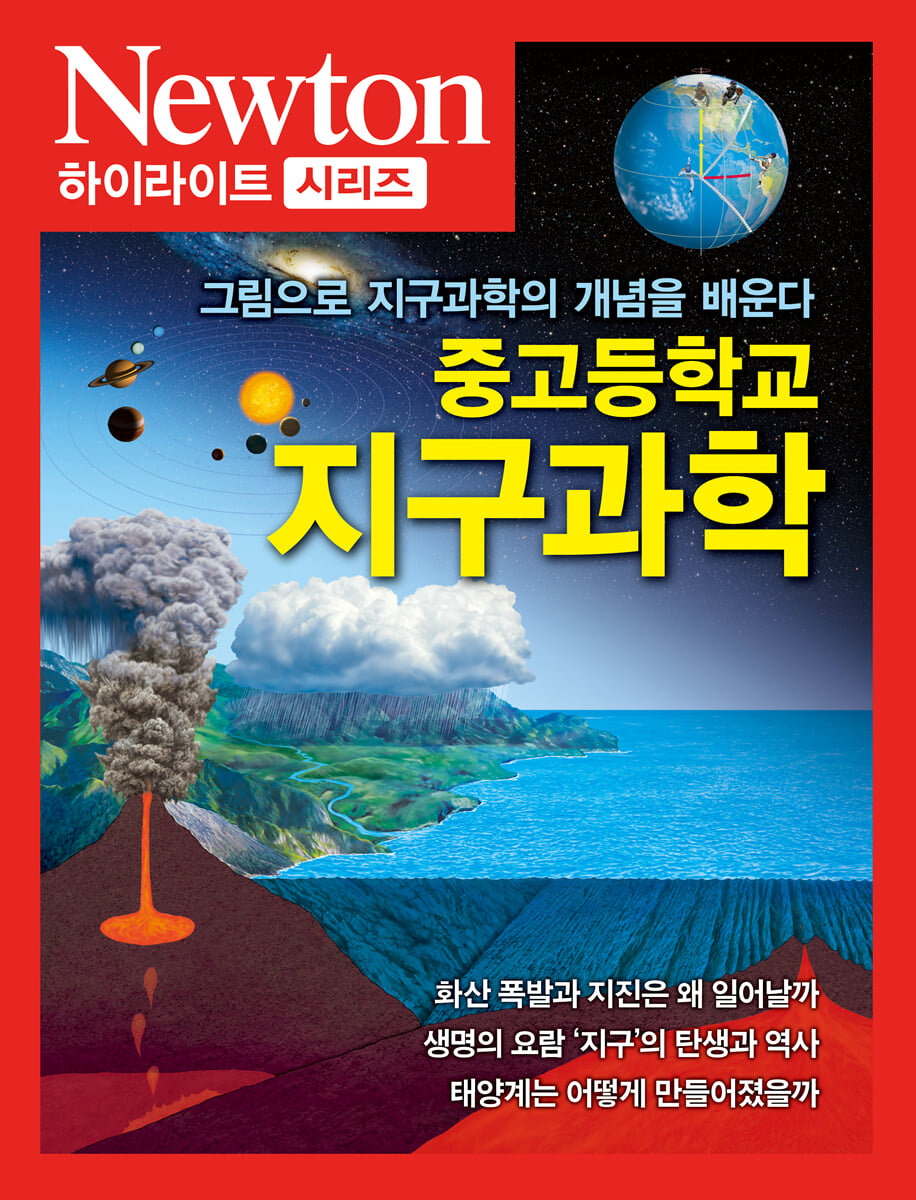
NEWTON HIGHLIGHT 143 High School Earth Science
 |
Description
Book Introduction
Learn Earth Science Concepts Through Pictures
Earth, the planet of life with sky, sea, and abundant land.
'Earth science' is learning about the active changes of the Earth and the universe where we humans live.
As we enter the 21st century, the impact of changes in the Earth's environment, including environmental issues, resource and energy issues, record-breaking rainfall, and massive natural disasters such as super typhoons, is gaining attention, making knowledge of Earth science more necessary than ever.
Earth science learned in middle and high school is broadly divided into four categories.
First, we learn about the 'Earth' where we live, second, about the 'ocean' that covers 70% of the Earth and the Earth's 'atmosphere', third, about the space surrounding the Earth, and fourth, about the 'history of the Earth' that deals with how life on Earth was born and disappeared and how mankind was born.
This book covers the four areas of earth science taught in middle and high school.
Chapters 1 and 2 introduce various concepts about the Earth we live on, focusing on the Earth's activities such as plates, volcanoes, and earthquakes.
Chapter 3 covers the atmosphere and oceans that cover the Earth, focusing on atmospheric circulation, weather, and abnormal climate.
Chapter 4 is space.
It also covers the solar system in which the Earth exists, our galaxy, and the Moon, the Earth's satellite.
The final chapter deals with the history of the Earth, including the birth of the Earth and how life was born and developed.
The fields covered in earth science are very broad, but we have gathered them all into one volume, so we hope you will enjoy reading this interesting and profound knowledge of earth science, along with rich illustrations.
Earth, the planet of life with sky, sea, and abundant land.
'Earth science' is learning about the active changes of the Earth and the universe where we humans live.
As we enter the 21st century, the impact of changes in the Earth's environment, including environmental issues, resource and energy issues, record-breaking rainfall, and massive natural disasters such as super typhoons, is gaining attention, making knowledge of Earth science more necessary than ever.
Earth science learned in middle and high school is broadly divided into four categories.
First, we learn about the 'Earth' where we live, second, about the 'ocean' that covers 70% of the Earth and the Earth's 'atmosphere', third, about the space surrounding the Earth, and fourth, about the 'history of the Earth' that deals with how life on Earth was born and disappeared and how mankind was born.
This book covers the four areas of earth science taught in middle and high school.
Chapters 1 and 2 introduce various concepts about the Earth we live on, focusing on the Earth's activities such as plates, volcanoes, and earthquakes.
Chapter 3 covers the atmosphere and oceans that cover the Earth, focusing on atmospheric circulation, weather, and abnormal climate.
Chapter 4 is space.
It also covers the solar system in which the Earth exists, our galaxy, and the Moon, the Earth's satellite.
The final chapter deals with the history of the Earth, including the birth of the Earth and how life was born and developed.
The fields covered in earth science are very broad, but we have gathered them all into one volume, so we hope you will enjoy reading this interesting and profound knowledge of earth science, along with rich illustrations.
- You can preview some of the book's contents.
Preview
index
1 The Earth We Live On
Earth's internal structure/Mantle convection/Plate covering the Earth/Earth's magnetic field/Pangaea/Plate motion ①~②/Invading plates/Scenario for the birth of the Himalayas/Formation and division of supercontinents/Fossa Magna/Civil spur
2 Mechanisms of Earthquakes and Volcanoes
Giant Earthquake/Intensity and Magnitude/Mechanism of Earthquake/Tsunami/Active Fault/Tokyo Earthquake/Earthquake Prediction/Strata/Mechanism of Volcano/Types of Volcanoes/Caldera/World's Volcanoes①~②/Volcano Damage/Eruption Prediction/Rocks/Column 1 How did a M9.0 super-large earthquake occur?
3 Atmosphere and Ocean
Earth's atmosphere/Atmospheric circulation/Solar radiation and temperature/Monsoon winds/Water covering the Earth/Role of the ocean/Weather and climate/High pressure and the four seasons/Monsoon/Weather map/Ocean circulation/World climate/Abnormal climate/Tropical cyclones/Global warming/column 2 Marine resources
4 Evolution of the Universe
The birth of the universe/The formation of our galaxy/The solar system/The origin of the solar system/The sun/The planets of the solar system/The rotation and revolution of the Earth/The waxing and waning of the moon/Our galaxy/The life of a star
5 History of Life
Habitable Zone/Earth History Timeline/Formation of the Earth/Birth of Life/Palaeozoic Era/Mesozoic Era/Cenozoic Era
Earth's internal structure/Mantle convection/Plate covering the Earth/Earth's magnetic field/Pangaea/Plate motion ①~②/Invading plates/Scenario for the birth of the Himalayas/Formation and division of supercontinents/Fossa Magna/Civil spur
2 Mechanisms of Earthquakes and Volcanoes
Giant Earthquake/Intensity and Magnitude/Mechanism of Earthquake/Tsunami/Active Fault/Tokyo Earthquake/Earthquake Prediction/Strata/Mechanism of Volcano/Types of Volcanoes/Caldera/World's Volcanoes①~②/Volcano Damage/Eruption Prediction/Rocks/Column 1 How did a M9.0 super-large earthquake occur?
3 Atmosphere and Ocean
Earth's atmosphere/Atmospheric circulation/Solar radiation and temperature/Monsoon winds/Water covering the Earth/Role of the ocean/Weather and climate/High pressure and the four seasons/Monsoon/Weather map/Ocean circulation/World climate/Abnormal climate/Tropical cyclones/Global warming/column 2 Marine resources
4 Evolution of the Universe
The birth of the universe/The formation of our galaxy/The solar system/The origin of the solar system/The sun/The planets of the solar system/The rotation and revolution of the Earth/The waxing and waning of the moon/Our galaxy/The life of a star
5 History of Life
Habitable Zone/Earth History Timeline/Formation of the Earth/Birth of Life/Palaeozoic Era/Mesozoic Era/Cenozoic Era
Detailed image

Publisher's Review
● Learn about the Earth we live on
The Earth on which we were born, raised, and live is still actively working.
What we can see with our eyes are phenomena such as earthquakes, volcanoes, and tectonic movements.
But what happens inside the Earth, beyond what we can see with our eyes or touch with our hands? The science that elucidates such things is "Earth Science."
Research into the Earth's interior progressed rapidly in the 20th century.
This chapter explains various activities on the Earth we live on, using the theory of plate tectonics, which explains the reality of the Earth, as a clue.
● Explain the mechanisms of earthquakes and volcanoes with pictures.
The Earth is a planet that experiences various activities, including earthquakes, volcanic eruptions, and the formation of mountain ranges due to tectonic shifts.
Volcanic activity and earthquakes are, in a sense, evidence that the Earth is 'alive'.
How do these activities occur? And how can humans prevent disasters and coexist with nature? In Chapter 2, we will focus on Earth's activities by examining in detail the mechanisms of earthquakes and volcanoes.
●Explore everything about the atmosphere and oceans that support life on Earth.
The existence of the atmosphere is what allowed the Earth to support diverse life.
The atmosphere keeps the Earth's temperature warm and protects life on Earth from harmful ultraviolet rays emitted by the sun.
And the seasons come and the weather changes.
Just like the atmosphere, the ocean is also important to life.
The ocean covers about 70% of the Earth's surface and has a large heat capacity, which can moderate rapid temperature changes.
Of course, the season and weather also have a big influence.
Chapter 3 examines in detail the atmosphere and oceans, which are closely related to and influence each other's geography, both space and terrestrial.
● Examine the birth and evolution of the universe, including the solar system and galaxies.
As early as thousands of years BC, humans needed a proper calendar to know the right time to plant and harvest.
This led to the development of astronomy, such as celestial observation and systematization of celestial movements.
Thousands of years later, thanks to advances in observation technology and the activities of space probes, the universe continues to be revealed.
Chapter 4 introduces how the universe was born and evolved.
●Explore the birth and history of Earth and life
The Earth was born about 4.6 billion years ago.
The early Earth was a harsh environment for life, with no atmosphere or oceans.
How did Earth nurture life under such circumstances? Chapter 5 introduces the history of Earth, how it evolved into its current environment, and how life developed within it.
The Earth on which we were born, raised, and live is still actively working.
What we can see with our eyes are phenomena such as earthquakes, volcanoes, and tectonic movements.
But what happens inside the Earth, beyond what we can see with our eyes or touch with our hands? The science that elucidates such things is "Earth Science."
Research into the Earth's interior progressed rapidly in the 20th century.
This chapter explains various activities on the Earth we live on, using the theory of plate tectonics, which explains the reality of the Earth, as a clue.
● Explain the mechanisms of earthquakes and volcanoes with pictures.
The Earth is a planet that experiences various activities, including earthquakes, volcanic eruptions, and the formation of mountain ranges due to tectonic shifts.
Volcanic activity and earthquakes are, in a sense, evidence that the Earth is 'alive'.
How do these activities occur? And how can humans prevent disasters and coexist with nature? In Chapter 2, we will focus on Earth's activities by examining in detail the mechanisms of earthquakes and volcanoes.
●Explore everything about the atmosphere and oceans that support life on Earth.
The existence of the atmosphere is what allowed the Earth to support diverse life.
The atmosphere keeps the Earth's temperature warm and protects life on Earth from harmful ultraviolet rays emitted by the sun.
And the seasons come and the weather changes.
Just like the atmosphere, the ocean is also important to life.
The ocean covers about 70% of the Earth's surface and has a large heat capacity, which can moderate rapid temperature changes.
Of course, the season and weather also have a big influence.
Chapter 3 examines in detail the atmosphere and oceans, which are closely related to and influence each other's geography, both space and terrestrial.
● Examine the birth and evolution of the universe, including the solar system and galaxies.
As early as thousands of years BC, humans needed a proper calendar to know the right time to plant and harvest.
This led to the development of astronomy, such as celestial observation and systematization of celestial movements.
Thousands of years later, thanks to advances in observation technology and the activities of space probes, the universe continues to be revealed.
Chapter 4 introduces how the universe was born and evolved.
●Explore the birth and history of Earth and life
The Earth was born about 4.6 billion years ago.
The early Earth was a harsh environment for life, with no atmosphere or oceans.
How did Earth nurture life under such circumstances? Chapter 5 introduces the history of Earth, how it evolved into its current environment, and how life developed within it.
GOODS SPECIFICS
- Publication date: August 15, 2022
- Page count, weight, size: 144 pages | 210*275*20mm
- ISBN13: 9791161961200
- ISBN10: 1161961208
You may also like
카테고리
korean


korean

![GQ KOREA Mark (Monthly): December [2025]](http://librairie.coreenne.fr/cdn/shop/files/8ef265dbbfbf186523ed75ba7319009d.jpg?v=1765340328&width=3840)


