

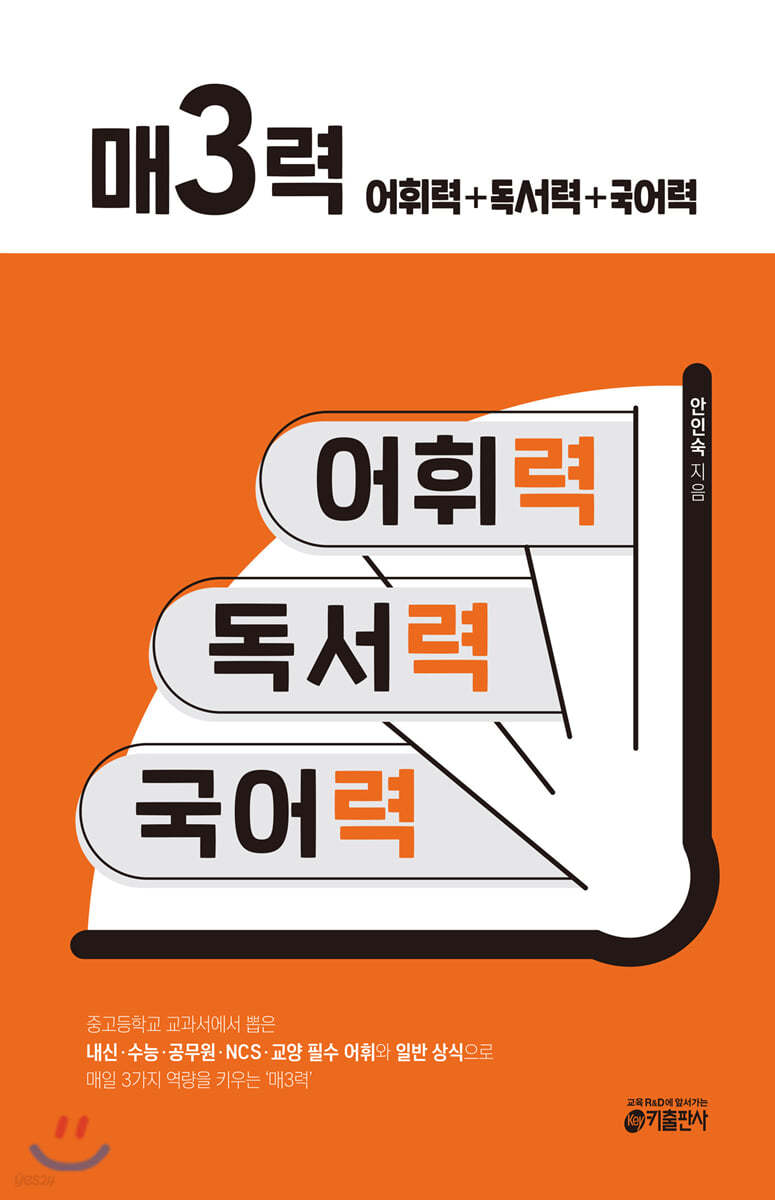
Every 3rd level vocabulary + reading + Korean language skills
 |
Description
Book Introduction
『Mae3ryuk: Vocabulary + Reading + Korean Language』 is a three-in-one solution that not only prepares you for exams but also helps you apply your knowledge in real life and build your general knowledge! 『Mae3ryeok (Vocabulary + Reading + Korean Language)』, which was created for not only middle and high school students preparing for NCS and civil service exams, but also general adults, contains everything that is applicable not only to exam preparation but also to real life and general knowledge in one book. It will also help you develop vocabulary and reading skills, which are the foundation and core of Korean language study, thereby solidifying your Korean language skills. strict-origin-when-cross-origin" allowfullscreen> |
- You can preview some of the book's contents.
Preview
index
[3rd level vocabulary + reading + Korean language skills]
Week 1 Textbook Chinese Characters (including reading practice materials)
2nd Week Korean Language Test Frequently Used Chinese Character Idioms (Including Reading Training Materials)
Week 3 Korean Language Essential Concepts (+See Related Concepts Together)
Week 4: Confusing Spelling (Including Reading Practice)
"Mae3Power Plus": A Practical Guide to Life and Exams
- Frequently appearing native Korean words and proverbs that are popular in the Korean language test
- Foreign word notation
- Understanding Chinese characters, the key to vocabulary development
- Newly added standard words that are easy to miss
Week 1 Textbook Chinese Characters (including reading practice materials)
2nd Week Korean Language Test Frequently Used Chinese Character Idioms (Including Reading Training Materials)
Week 3 Korean Language Essential Concepts (+See Related Concepts Together)
Week 4: Confusing Spelling (Including Reading Practice)
"Mae3Power Plus": A Practical Guide to Life and Exams
- Frequently appearing native Korean words and proverbs that are popular in the Korean language test
- Foreign word notation
- Understanding Chinese characters, the key to vocabulary development
- Newly added standard words that are easy to miss
Detailed image

Into the book
It has been 10 years since the publication of 『Mae3bi』, which prepares for the non-literature section of the Korean language section of the CSAT with three non-literature passages every day.
I set the direction of my Korean language studies with the Mae3B study method, and at the request of students whose scores improved, I also published textbooks for the CSAT, including 『Mae3mun』, 『Mae3Grammar』, 『Mae3Speaking and Writing』, and 『Mae3Vocabulary』, covering literature, grammar, speaking and writing, and vocabulary.
And to help resolve students' questions, he opened a cafe (cafe.daum.net/anin95) and answered questions about Korean language study methods and the 'Mae 3' textbook one by one.
In this process, I became more aware of the parts of the Korean language that students find particularly difficult. Students say that non-fiction is difficult, that they don't know how to study literature, and that grammar is difficult, but when I looked into it in detail, I realized that their vocabulary was weak, and that they often had difficulty reading the text because they thought they knew vaguely what they knew for sure, and that they often missed the main point of the question.
So the conclusion is that if you develop vocabulary and reading comprehension, you will develop Korean language skills.
I believe and expect that 『Mae3ryeok』 will help develop vocabulary and reading skills, which are the foundation and core of Korean language study, and solidify Korean language skills.
I also hope that this book will provide you with a wealth of background knowledge and culture, and I would like to once again express my deepest gratitude to the readers of 'Mae3' who helped publish this book.
I set the direction of my Korean language studies with the Mae3B study method, and at the request of students whose scores improved, I also published textbooks for the CSAT, including 『Mae3mun』, 『Mae3Grammar』, 『Mae3Speaking and Writing』, and 『Mae3Vocabulary』, covering literature, grammar, speaking and writing, and vocabulary.
And to help resolve students' questions, he opened a cafe (cafe.daum.net/anin95) and answered questions about Korean language study methods and the 'Mae 3' textbook one by one.
In this process, I became more aware of the parts of the Korean language that students find particularly difficult. Students say that non-fiction is difficult, that they don't know how to study literature, and that grammar is difficult, but when I looked into it in detail, I realized that their vocabulary was weak, and that they often had difficulty reading the text because they thought they knew vaguely what they knew for sure, and that they often missed the main point of the question.
So the conclusion is that if you develop vocabulary and reading comprehension, you will develop Korean language skills.
I believe and expect that 『Mae3ryeok』 will help develop vocabulary and reading skills, which are the foundation and core of Korean language study, and solidify Korean language skills.
I also hope that this book will provide you with a wealth of background knowledge and culture, and I would like to once again express my deepest gratitude to the readers of 'Mae3' who helped publish this book.
--- From the preface
Publisher's Review
Even in the digital age, the basic skills for analyzing data and interpreting information are vocabulary, reading skills, and Korean language skills.
The importance of these three cannot be overemphasized!
This book was written by teacher Ahn In-sook, who also wrote “Mae3bi,” which is considered the college entrance exam bible.
This is a must-read book of the times that teaches a study method that allows you to know ten things by knowing one thing, and also helps you develop insight accordingly.
1.
Korean vocabulary that is applicable to both real life and exams is improved through the 3 habits of Mae3 → Mae3 skills!
2.
Apply the Ma3Power solution to understand unfamiliar vocabulary without memorizing it → Increase your vocabulary!
3.
Reading training cases and compressed training that develop common sense and background knowledge → Reading ability UP!
4.
Provides practice problems that can help you build and expand your vocabulary → Expand your vocabulary!
5.
Even if you refer to a dictionary, you can understand concepts that are not well understood along with related concepts → Improve your Korean language skills!
6.
Even spelling mistakes that are confusing every time you write are explained with reading examples → Improve your spelling skills!
I was lucky enough to be the first to encounter this book.
The moment I saw this book, I felt without a moment's hesitation that everyone should read this book at least once in their lifetime.
Why do we laugh at English spelling mistakes or basic English grammar mistakes, yet tolerate mistakes in our own language? Even in this age of illiteracy, why do we simply gloss over information when complete comprehension is impossible without vocabulary, reading skills, and Korean language proficiency? I've always pondered these questions, so I was delighted to come across this book.
It was filled with everything I had always wondered about and wanted to be covered.
And as someone who has experienced it firsthand, I highly recommend this book because it fundamentally improves vocabulary, reading skills, and Korean language skills.
This book is a valuable resource for both practical and cultural knowledge, not only for students preparing for the exam, but also for ordinary people like me, and it is a book I would definitely recommend to those who are important to me.
The importance of these three cannot be overemphasized!
This book was written by teacher Ahn In-sook, who also wrote “Mae3bi,” which is considered the college entrance exam bible.
This is a must-read book of the times that teaches a study method that allows you to know ten things by knowing one thing, and also helps you develop insight accordingly.
1.
Korean vocabulary that is applicable to both real life and exams is improved through the 3 habits of Mae3 → Mae3 skills!
2.
Apply the Ma3Power solution to understand unfamiliar vocabulary without memorizing it → Increase your vocabulary!
3.
Reading training cases and compressed training that develop common sense and background knowledge → Reading ability UP!
4.
Provides practice problems that can help you build and expand your vocabulary → Expand your vocabulary!
5.
Even if you refer to a dictionary, you can understand concepts that are not well understood along with related concepts → Improve your Korean language skills!
6.
Even spelling mistakes that are confusing every time you write are explained with reading examples → Improve your spelling skills!
I was lucky enough to be the first to encounter this book.
The moment I saw this book, I felt without a moment's hesitation that everyone should read this book at least once in their lifetime.
Why do we laugh at English spelling mistakes or basic English grammar mistakes, yet tolerate mistakes in our own language? Even in this age of illiteracy, why do we simply gloss over information when complete comprehension is impossible without vocabulary, reading skills, and Korean language proficiency? I've always pondered these questions, so I was delighted to come across this book.
It was filled with everything I had always wondered about and wanted to be covered.
And as someone who has experienced it firsthand, I highly recommend this book because it fundamentally improves vocabulary, reading skills, and Korean language skills.
This book is a valuable resource for both practical and cultural knowledge, not only for students preparing for the exam, but also for ordinary people like me, and it is a book I would definitely recommend to those who are important to me.
GOODS SPECIFICS
- Date of issue: September 9, 2019
- Page count, weight, size: 240 pages | 542g | 168*260*12mm
- ISBN13: 9791189719593
- ISBN10: 1189719592
- Reference book for use in: prospective high school students
- Reference book usage semester: Common semester
- Reference book difficulty: Medium Reference book difficulty guide
You may also like
카테고리
korean


korean

![GQ KOREA Mark (Monthly): December [2025]](http://librairie.coreenne.fr/cdn/shop/files/8ef265dbbfbf186523ed75ba7319009d.jpg?v=1765340328&width=3840)


