

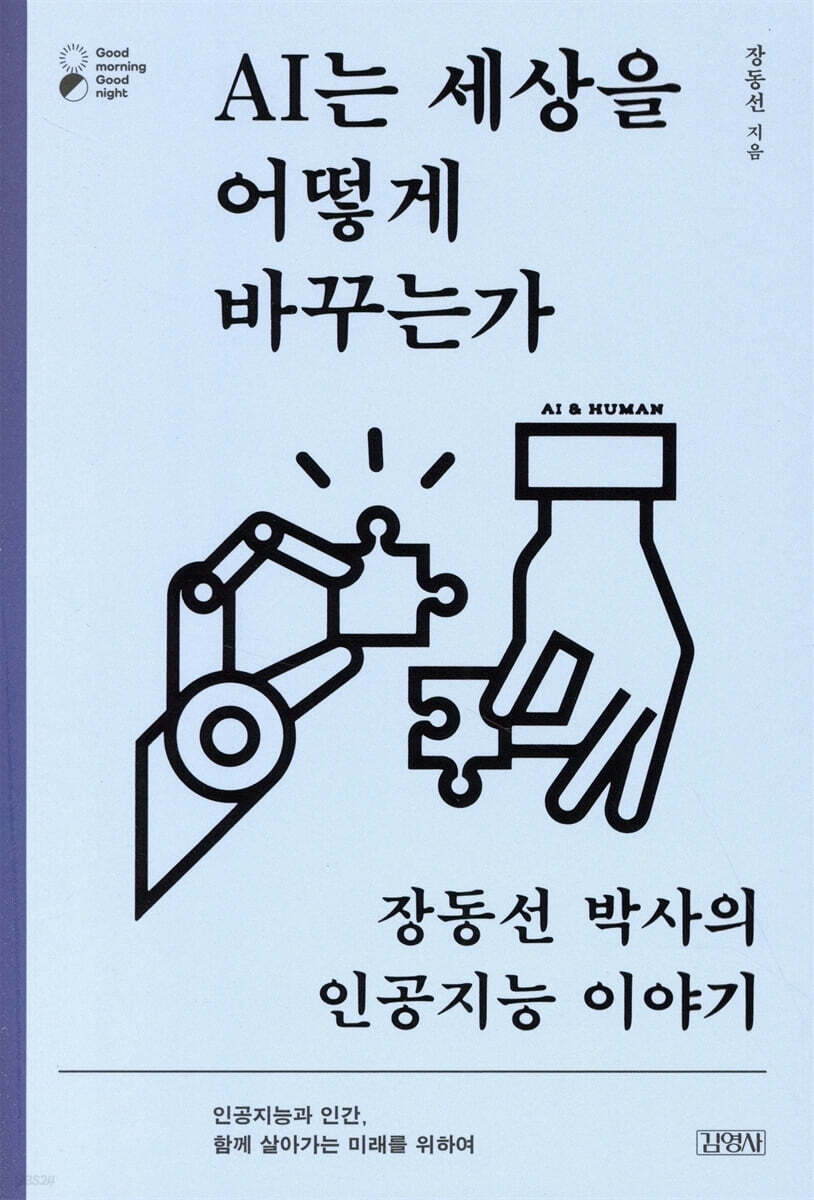
How AI Changes the World
 |
Description
Book Introduction
How will our lives change in the era of the Fourth Industrial Revolution and artificial intelligence?
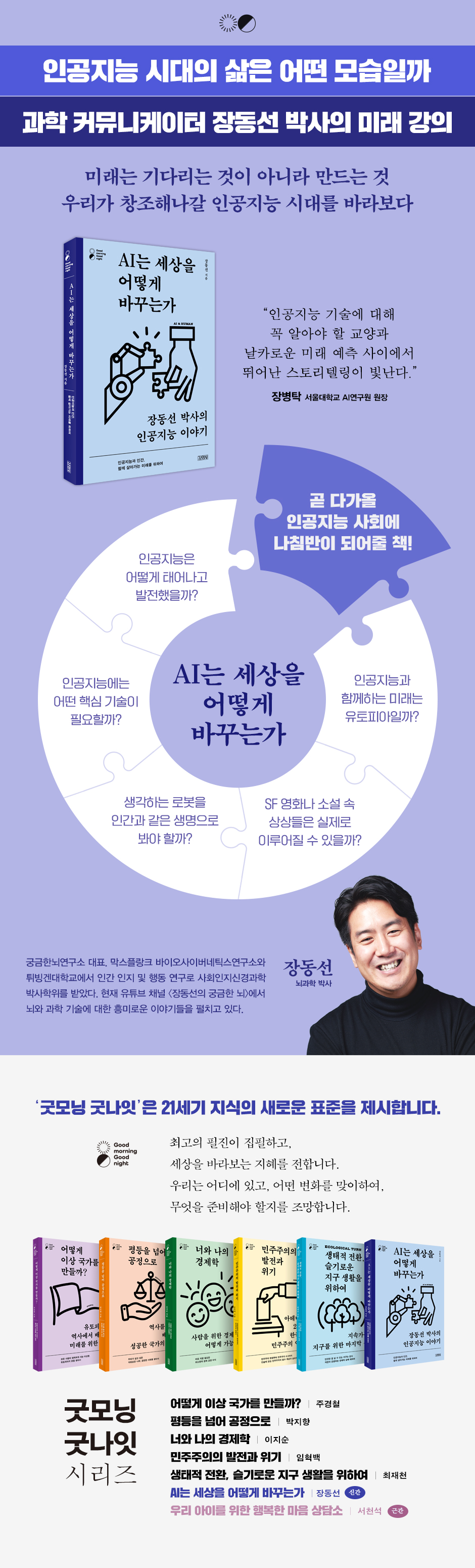
A lecture on the future of AI by science communicator Dr. Jang Dong-seon.
"How AI Changes the World" is the "Artificial Intelligence" edition of the "Good Morning, Good Night" series, a knowledge library created by leading scholars and researchers in each field for future generations.
This essential textbook covers the history and development of artificial intelligence technology, its basic concepts and principles, as well as social trends and future predictions.
We captured both fun and knowledge through storytelling by Dr. Dong-seon Jang, a world-renowned science communicator who received his doctorate from the Max Planck Institute for Biocybernetics in Germany.
This book will serve as a compass for understanding the rapidly changing AI society and preparing for the future that is just around the corner.
How was artificial intelligence born and developed?
What core technologies are needed for artificial intelligence?
Can the imaginations in science fiction movies and novels actually come true?
Should we consider thinking robots as living beings like humans?
Is a future with artificial intelligence a utopia?
[This book is available for pre-order and may have changes in cover and specifications.]
A lecture on the future of AI by science communicator Dr. Jang Dong-seon.
"How AI Changes the World" is the "Artificial Intelligence" edition of the "Good Morning, Good Night" series, a knowledge library created by leading scholars and researchers in each field for future generations.
This essential textbook covers the history and development of artificial intelligence technology, its basic concepts and principles, as well as social trends and future predictions.
We captured both fun and knowledge through storytelling by Dr. Dong-seon Jang, a world-renowned science communicator who received his doctorate from the Max Planck Institute for Biocybernetics in Germany.
This book will serve as a compass for understanding the rapidly changing AI society and preparing for the future that is just around the corner.
How was artificial intelligence born and developed?
What core technologies are needed for artificial intelligence?
Can the imaginations in science fiction movies and novels actually come true?
Should we consider thinking robots as living beings like humans?
Is a future with artificial intelligence a utopia?
[This book is available for pre-order and may have changes in cover and specifications.]
- You can preview some of the book's contents.
Preview
index
introduction
prolog
Chapter 1: The Present and Future of Humans and Artificial Intelligence
1.
Utopia and Dystopia Created by Artificial Intelligence
2.
The Future of Humans and AI: Three Scenarios
3.
What if humans were enhanced by artificial intelligence?
Interlude 1
Chapter 2: How Artificial Intelligence Has Developed
1.
Could we create living things that move on their own?
2.
From automata to the first computers
3.
Alan Turing, the father of artificial intelligence, and mathematical logic
4.
The Birth of Modern Artificial Intelligence
5.
A Brief History of Artificial Intelligence Research
Interlude 2
Chapter 3: How Should Humans and Artificial Intelligence Coexist?
1.
Three conditions that define a human being
2.
Why Ethics Are Necessary
3.
What kind of future will come?
conclusion
Epilogue
Acknowledgements
Read more
prolog
Chapter 1: The Present and Future of Humans and Artificial Intelligence
1.
Utopia and Dystopia Created by Artificial Intelligence
2.
The Future of Humans and AI: Three Scenarios
3.
What if humans were enhanced by artificial intelligence?
Interlude 1
Chapter 2: How Artificial Intelligence Has Developed
1.
Could we create living things that move on their own?
2.
From automata to the first computers
3.
Alan Turing, the father of artificial intelligence, and mathematical logic
4.
The Birth of Modern Artificial Intelligence
5.
A Brief History of Artificial Intelligence Research
Interlude 2
Chapter 3: How Should Humans and Artificial Intelligence Coexist?
1.
Three conditions that define a human being
2.
Why Ethics Are Necessary
3.
What kind of future will come?
conclusion
Epilogue
Acknowledgements
Read more
Detailed image
Into the book
People unfamiliar with artificial intelligence might first think of the mechanical soldiers from the movie “Terminator” and the robots that will wipe out humanity in the future when they hear the word “AI.”
But for software programmers who use and develop AI every day, AI is just an algorithm written in a computer programming language—a bunch of lines of code that tell the computer what to do.
--- p.31
While many people tend to view the emergence of superintelligence negatively, futurist Ray Kurzweil, who first talked about the "singularity," actually believes that artificial intelligence will not evolve in a way that threatens humans.
The singularity he speaks of is not, as is widely known, the moment when artificial intelligence surpasses humans, but rather the moment when artificial intelligence and humans become indistinguishable.
--- p.37
Turing's belief that machines can have intelligence has been actively studied in the field of cybernetics, also called 'artificial brain science'.
The word cybernetics comes from the Greek word 'Kybernetes', meaning boatman or helmsman, and in this field it is defined as 'the study of control and communication of animals and machines'.
In other words, it is a field that studies the common mechanisms underlying how animals and machines regulate and control their behavior by exchanging feedback with their surroundings.
--- p.85
The most frequently appearing concepts in the field of artificial intelligence are machine learning and deep learning.
According to the general classification, artificial intelligence is the highest concept, machine learning is below it, and deep learning is a subconcept of machine learning.
However, with the remarkable progress made in the fields of machine learning and deep learning, some experts who reject the logic-knowledge approach of the early days of artificial intelligence say that the fields of machine learning and deep learning only partially overlap with the field of artificial intelligence research.
--- p.103
Humans are beings who are constantly formed through relationships with the environment and other humans.
Within that relationship, a new human creation called artificial intelligence has now taken its place.
Artificial intelligence has suddenly entered our lives as a kind of curator, acting as a bridge between the relationship between humans and the world, and between human connections.
We need to form new relationships that never existed before.
But for software programmers who use and develop AI every day, AI is just an algorithm written in a computer programming language—a bunch of lines of code that tell the computer what to do.
--- p.31
While many people tend to view the emergence of superintelligence negatively, futurist Ray Kurzweil, who first talked about the "singularity," actually believes that artificial intelligence will not evolve in a way that threatens humans.
The singularity he speaks of is not, as is widely known, the moment when artificial intelligence surpasses humans, but rather the moment when artificial intelligence and humans become indistinguishable.
--- p.37
Turing's belief that machines can have intelligence has been actively studied in the field of cybernetics, also called 'artificial brain science'.
The word cybernetics comes from the Greek word 'Kybernetes', meaning boatman or helmsman, and in this field it is defined as 'the study of control and communication of animals and machines'.
In other words, it is a field that studies the common mechanisms underlying how animals and machines regulate and control their behavior by exchanging feedback with their surroundings.
--- p.85
The most frequently appearing concepts in the field of artificial intelligence are machine learning and deep learning.
According to the general classification, artificial intelligence is the highest concept, machine learning is below it, and deep learning is a subconcept of machine learning.
However, with the remarkable progress made in the fields of machine learning and deep learning, some experts who reject the logic-knowledge approach of the early days of artificial intelligence say that the fields of machine learning and deep learning only partially overlap with the field of artificial intelligence research.
--- p.103
Humans are beings who are constantly formed through relationships with the environment and other humans.
Within that relationship, a new human creation called artificial intelligence has now taken its place.
Artificial intelligence has suddenly entered our lives as a kind of curator, acting as a bridge between the relationship between humans and the world, and between human connections.
We need to form new relationships that never existed before.
--- p.162
Publisher's Review
From AlphaGo to Transhumans
Prepare for a future where we live alongside machines that are smarter than humans!
A Story About Artificial Intelligence from Neuroscience Expert and Science Communicator Dr. Dong-seon Jang
Artificial intelligence has become a part of our daily lives.
Just by speaking into the speaker, it plays the most popular songs these days and recommends movies that suit your tastes through big data.
Artificial intelligence will translate foreign languages for you without you having to learn them, and self-driving cars that will soon be on the road are being developed.
There is no area where artificial intelligence technology is not being used, from education and industry to the arts, medicine, and even food.
It is clear that artificial intelligence will have an even greater impact on our lives in the future.
To prepare for a future where humans and artificial intelligence coexist and develop, understanding and knowledge of artificial intelligence technology are essential.
Dr. Dong-sun Jang, a world-renowned neuroscientist who received his doctorate from the Max Planck Institute for Biocybernetics in Germany and a friendly science communicator on the YouTube channel “Dong-sun Jang’s Curious Brain,” unravels the past, present, and future of artificial intelligence.
How did AI technology emerge, and how is it evolving? As the world changes in the blink of an eye, what must we prepare for? This book explores the concept and history of AI technology, the current state of modern AI research, and its social and ethical challenges.
The future is not something to be waited for, but to be created.
Looking forward to the era of artificial intelligence we will create.
The concept of artificial intelligence (AI) was created by MIT researcher Marvin Minsky.
The computer logic circuits that he envisioned, imitating the brain neural network, gradually developed into 'intelligent machines'.
We have only a fragmentary understanding of modern artificial intelligence technology developed by numerous researchers, including John McCarthy and Claude Shannon, through Google's 'AlphaGo' and Apple's 'Siri'.
There have been several attempts to imagine what a world where artificial intelligence is widespread would look like.
Numerous science fiction novels and films have interpreted the fascinating subject of 'thinking machines' from various perspectives.
From HAL 9000 in 2001: A Space Odyssey to JARVIS in Iron Man and Skynet in Terminator.
Artificial intelligence still piques our curiosity, yet it also evokes a vague sense of unpredictability and fear.
Can artificial intelligence and humans coexist peacefully?
Considering the technological and social issues of ‘machines with life’
Most artificial intelligence researchers aim to develop artificial intelligence that is equal to, or even surpasses, humans.
In addition, we are in a situation where we must consider the ethical question of whether we should view artificial intelligence as a living being like humans.
In this book, neuroscientist Dr. Dong-seon Jang freely moves between keywords such as life, intelligence, and networking (connection), and covers the current state of artificial intelligence technology as well as social and ethical issues.
It is both fun and informative, with storytelling that is easy to understand for everyone from teenagers to college students and adults.
Will our future be Thomas More's 'Utopia'?
Or will it be a totalitarian 'dystopia' like those depicted in Brave New World or 1984?
This book presents various visions of the future that artificial intelligence will bring, and explores ways for humans and artificial intelligence to coexist peacefully.
This book will serve as a compass for understanding the Fourth Industrial Revolution society, which is changing more rapidly than ever before, and preparing for the future that is just around the corner.
How was the concept of artificial intelligence created and developed?
What core technologies are needed for artificial intelligence?
? Can the imaginations in science fiction movies and novels actually come true?
Should we consider thinking robots as living beings, just like humans?
Is a future with artificial intelligence a utopia?
Today's culture, future wisdom, every day
The 'Good Morning, Good Night' series, a knowledge library that starts in the morning and ends in the evening.
'Good Morning, Good Night' sets a new standard for knowledge in the 21st century.
Written by the best writers, we share wisdom on how to view the world.
We take a look at where we are, what changes we are facing, and what we need to prepare for.
The world is changing.
The paradigm is shifting in all fields.
These are uncertain times, where we don't know what will happen tomorrow.
What choices will you make in the face of the great tide of change?
Will you fall into crisis because you can't read the changes, or will you actively respond to the changes and create opportunities?
Where do we stand, what changes are we facing, and what should we prepare for?
Leading scholars and researchers from each field have come together to create a comprehensive collection of knowledge and culture for future generations.
This knowledge library historically examines the changes and issues facing us in this era of transition across all fields, including the humanities, social sciences, economics, natural sciences, and the arts, and comprehensively examines phenomena and their essence to seek solutions and alternatives.
It is a paperback book that can be read by anyone of all generations, from middle school students to college students and the general public, and contains core knowledge and culture in one volume, so you can keep it close by and refer to it every day.
The 'Good Morning, Good Night' library will present a new standard for 21st century knowledge and serve as a guide to providing wisdom for viewing the world.
We await you, seeking wisdom and insight.
Prepare for a future where we live alongside machines that are smarter than humans!
A Story About Artificial Intelligence from Neuroscience Expert and Science Communicator Dr. Dong-seon Jang
Artificial intelligence has become a part of our daily lives.
Just by speaking into the speaker, it plays the most popular songs these days and recommends movies that suit your tastes through big data.
Artificial intelligence will translate foreign languages for you without you having to learn them, and self-driving cars that will soon be on the road are being developed.
There is no area where artificial intelligence technology is not being used, from education and industry to the arts, medicine, and even food.
It is clear that artificial intelligence will have an even greater impact on our lives in the future.
To prepare for a future where humans and artificial intelligence coexist and develop, understanding and knowledge of artificial intelligence technology are essential.
Dr. Dong-sun Jang, a world-renowned neuroscientist who received his doctorate from the Max Planck Institute for Biocybernetics in Germany and a friendly science communicator on the YouTube channel “Dong-sun Jang’s Curious Brain,” unravels the past, present, and future of artificial intelligence.
How did AI technology emerge, and how is it evolving? As the world changes in the blink of an eye, what must we prepare for? This book explores the concept and history of AI technology, the current state of modern AI research, and its social and ethical challenges.
The future is not something to be waited for, but to be created.
Looking forward to the era of artificial intelligence we will create.
The concept of artificial intelligence (AI) was created by MIT researcher Marvin Minsky.
The computer logic circuits that he envisioned, imitating the brain neural network, gradually developed into 'intelligent machines'.
We have only a fragmentary understanding of modern artificial intelligence technology developed by numerous researchers, including John McCarthy and Claude Shannon, through Google's 'AlphaGo' and Apple's 'Siri'.
There have been several attempts to imagine what a world where artificial intelligence is widespread would look like.
Numerous science fiction novels and films have interpreted the fascinating subject of 'thinking machines' from various perspectives.
From HAL 9000 in 2001: A Space Odyssey to JARVIS in Iron Man and Skynet in Terminator.
Artificial intelligence still piques our curiosity, yet it also evokes a vague sense of unpredictability and fear.
Can artificial intelligence and humans coexist peacefully?
Considering the technological and social issues of ‘machines with life’
Most artificial intelligence researchers aim to develop artificial intelligence that is equal to, or even surpasses, humans.
In addition, we are in a situation where we must consider the ethical question of whether we should view artificial intelligence as a living being like humans.
In this book, neuroscientist Dr. Dong-seon Jang freely moves between keywords such as life, intelligence, and networking (connection), and covers the current state of artificial intelligence technology as well as social and ethical issues.
It is both fun and informative, with storytelling that is easy to understand for everyone from teenagers to college students and adults.
Will our future be Thomas More's 'Utopia'?
Or will it be a totalitarian 'dystopia' like those depicted in Brave New World or 1984?
This book presents various visions of the future that artificial intelligence will bring, and explores ways for humans and artificial intelligence to coexist peacefully.
This book will serve as a compass for understanding the Fourth Industrial Revolution society, which is changing more rapidly than ever before, and preparing for the future that is just around the corner.
How was the concept of artificial intelligence created and developed?
What core technologies are needed for artificial intelligence?
? Can the imaginations in science fiction movies and novels actually come true?
Should we consider thinking robots as living beings, just like humans?
Is a future with artificial intelligence a utopia?
Today's culture, future wisdom, every day
The 'Good Morning, Good Night' series, a knowledge library that starts in the morning and ends in the evening.
'Good Morning, Good Night' sets a new standard for knowledge in the 21st century.
Written by the best writers, we share wisdom on how to view the world.
We take a look at where we are, what changes we are facing, and what we need to prepare for.
The world is changing.
The paradigm is shifting in all fields.
These are uncertain times, where we don't know what will happen tomorrow.
What choices will you make in the face of the great tide of change?
Will you fall into crisis because you can't read the changes, or will you actively respond to the changes and create opportunities?
Where do we stand, what changes are we facing, and what should we prepare for?
Leading scholars and researchers from each field have come together to create a comprehensive collection of knowledge and culture for future generations.
This knowledge library historically examines the changes and issues facing us in this era of transition across all fields, including the humanities, social sciences, economics, natural sciences, and the arts, and comprehensively examines phenomena and their essence to seek solutions and alternatives.
It is a paperback book that can be read by anyone of all generations, from middle school students to college students and the general public, and contains core knowledge and culture in one volume, so you can keep it close by and refer to it every day.
The 'Good Morning, Good Night' library will present a new standard for 21st century knowledge and serve as a guide to providing wisdom for viewing the world.
We await you, seeking wisdom and insight.
GOODS SPECIFICS
- Date of issue: January 31, 2022
- Page count, weight, size: 176 pages | 212g | 132*193*12mm
- ISBN13: 9788934949213
- ISBN10: 893494921X
You may also like
카테고리
korean


korean

![GQ KOREA Mark (Monthly): December [2025]](http://librairie.coreenne.fr/cdn/shop/files/8ef265dbbfbf186523ed75ba7319009d.jpg?v=1765340328&width=3840)


