

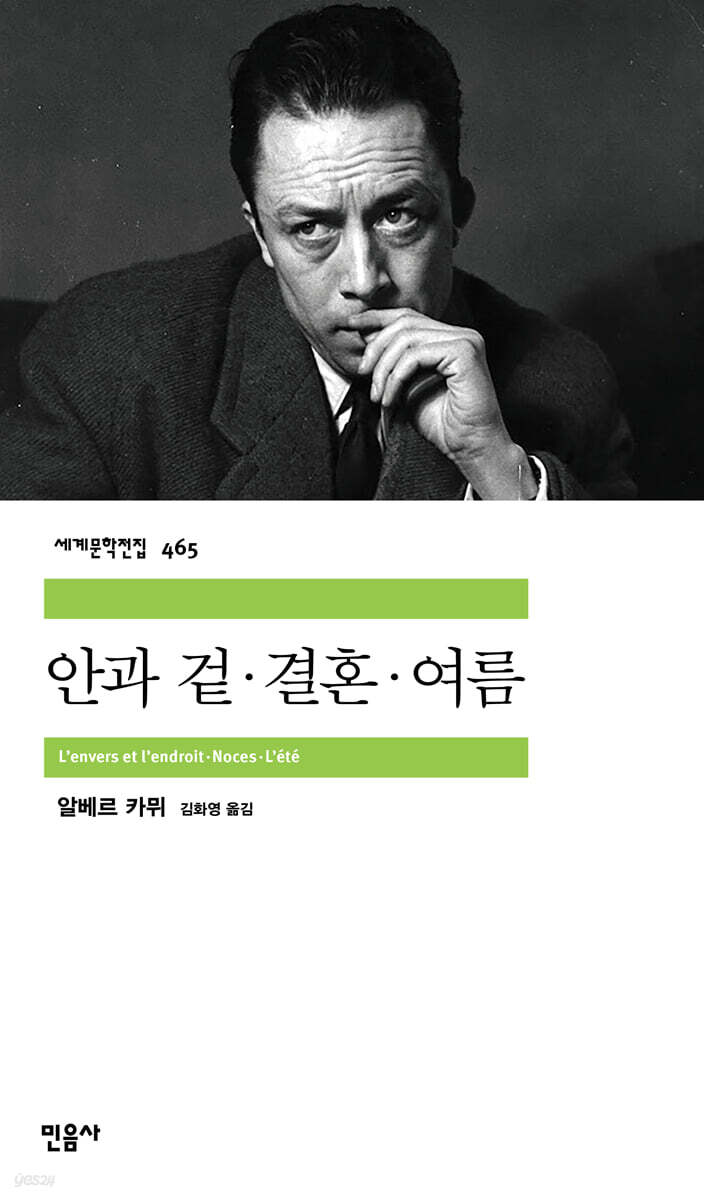
Inside and Out, Marriage, Summer
 |
Description
Book Introduction
Albert Camus, a representative writer of existentialist literature who became a legend at the young age of 44.
Includes "Inside and Outer," the source of all works; "Marriage," the union of nature and humanity; and "Summer," a memory of the Mediterranean.
“There is no love of life without despair of life.”
* Camus has become a myth.
It doesn't matter anymore whether you acknowledge him or not.
-Roland Barthes
* Camus is now standing on the very cornerstone from which he so desperately tried to escape while alive.
-Patrick Modiano
* Camus's greatness comes from deviation, and this deviation is only a natural expression of his greatness.
-Jean Grenier
* Greetings to the soul that is constantly searching for itself and asking itself questions.
-William Faulkner (congratulating Camus on receiving the Nobel Prize in Literature)
Meet the true "inside and out" of young Camus
The source of Camus's work, "Inside and Out," and his essays on the Mediterranean and the Sun, "Marriage" and "Summer."
"Inside and Out, Marriage, Summer," a book filled with essays on travel, memories, and love by Albert Camus, a representative writer of existentialism and an icon of resistance who won the Nobel Prize in Literature at the young age of 44, has been published in Minumsa's World Literature Collection.
"Inside and Out" consists of five episodes, accompanied by a preface by Camus.
'Irony', 'Between Positive and Negative', 'Death in the Soul', 'Love for Life', 'Inside and Out' are the themes of life's 'inside' and 'outside' that constantly change through light and darkness, Prague and Vicenza, death and the sun.
What does Camus mean by inside and outside?
Camus' answer is 'one lump'.
“At this extreme point of consciousness, everything fused into one, and my life seemed like a lump that I had to either throw away or accept.” “Marriage” is composed of five episodes: “Marriage in Tipasa,” “The Wind of Djemila,” “Summer in Algiers,” “Notes,” and “Desert,” and the places that Camus, a traveler, visited and the feelings and reflections he felt there are reflected in the writing.
Wealth and poverty meet, and man, standing before a landscape that flaunts its splendor, affirms his own greatness.
Because we are rebellious humans who accept our inevitable fate rather than relying on God.
"Summer" is a collection of prose written between 1939 and 1953, and is thematically similar to "Marriage."
The common roots of these writings are clear.
Although they look at it from different perspectives, they all deal with the theme of individuality, 'solitaire'.
After 1953, Camus began preparing to write his last unfinished work, The First Man, by moving from the previous cycle of 'absurdity' and 'rebellion' to the cycle of 'love' and 'theft'.
In these three essays, we can feel Camus's philosophy, his traveler's journey, and his intense literary talent.
Includes "Inside and Outer," the source of all works; "Marriage," the union of nature and humanity; and "Summer," a memory of the Mediterranean.
“There is no love of life without despair of life.”
* Camus has become a myth.
It doesn't matter anymore whether you acknowledge him or not.
-Roland Barthes
* Camus is now standing on the very cornerstone from which he so desperately tried to escape while alive.
-Patrick Modiano
* Camus's greatness comes from deviation, and this deviation is only a natural expression of his greatness.
-Jean Grenier
* Greetings to the soul that is constantly searching for itself and asking itself questions.
-William Faulkner (congratulating Camus on receiving the Nobel Prize in Literature)
Meet the true "inside and out" of young Camus
The source of Camus's work, "Inside and Out," and his essays on the Mediterranean and the Sun, "Marriage" and "Summer."
"Inside and Out, Marriage, Summer," a book filled with essays on travel, memories, and love by Albert Camus, a representative writer of existentialism and an icon of resistance who won the Nobel Prize in Literature at the young age of 44, has been published in Minumsa's World Literature Collection.
"Inside and Out" consists of five episodes, accompanied by a preface by Camus.
'Irony', 'Between Positive and Negative', 'Death in the Soul', 'Love for Life', 'Inside and Out' are the themes of life's 'inside' and 'outside' that constantly change through light and darkness, Prague and Vicenza, death and the sun.
What does Camus mean by inside and outside?
Camus' answer is 'one lump'.
“At this extreme point of consciousness, everything fused into one, and my life seemed like a lump that I had to either throw away or accept.” “Marriage” is composed of five episodes: “Marriage in Tipasa,” “The Wind of Djemila,” “Summer in Algiers,” “Notes,” and “Desert,” and the places that Camus, a traveler, visited and the feelings and reflections he felt there are reflected in the writing.
Wealth and poverty meet, and man, standing before a landscape that flaunts its splendor, affirms his own greatness.
Because we are rebellious humans who accept our inevitable fate rather than relying on God.
"Summer" is a collection of prose written between 1939 and 1953, and is thematically similar to "Marriage."
The common roots of these writings are clear.
Although they look at it from different perspectives, they all deal with the theme of individuality, 'solitaire'.
After 1953, Camus began preparing to write his last unfinished work, The First Man, by moving from the previous cycle of 'absurdity' and 'rebellion' to the cycle of 'love' and 'theft'.
In these three essays, we can feel Camus's philosophy, his traveler's journey, and his intense literary talent.
- You can preview some of the book's contents.
Preview
index
Preface to Albert Camus's "Inside and Out" (Part 5)
Inside and Out 2 7
Marriage 9 7
Summer 1 65
Albert Camus's "Swedish Speech"_Kim Hwa-young 2 71
On Marriage_Louis Faucon 2 80
About "Summer"_Rosé Kiyo 2 86
Translator's Note 2 89
Author's Chronology 2 90
Inside and Out 2 7
Marriage 9 7
Summer 1 65
Albert Camus's "Swedish Speech"_Kim Hwa-young 2 71
On Marriage_Louis Faucon 2 80
About "Summer"_Rosé Kiyo 2 86
Translator's Note 2 89
Author's Chronology 2 90
Detailed image

Into the book
As I reread "Inside and Out," despite the awkward writing style on some pages, I instinctively knew, "Yes, this is it."
This, that old woman, that silent mother, poverty, the light pouring over the Italian olive trees, the lonely but human love, all that I believe tells me the truth in my own eyes.
--- p.17
One angel has the face of a friend, and the other has the face of an enemy.
Yes, that's right.
I know all about it.
I also learned what the price of love is in general.
But as for life itself, I still know no more than I clumsily spoke of in "Inside and Out."
“There is no love of life without despair of life.”
--- p.18
Death comes to everyone, but it is a death that is unique to each person.
Anyway, even so, the sun warms our bones.
--- p.45
Then I was able to love by surrendering myself, and finally I became myself.
Because only love can bring us back to ourselves.
--- p.47
There is a certain loneliness in poverty, a loneliness that gives each and every thing its own value.
For those who are somewhat wealthy, the sky itself and the star-filled night are simply considered natural treasures.
But in the lower classes, heaven regains all its original meaning and becomes a priceless blessing.
Summer nights, a mysterious world where stars twinkle!
--- p.49
Travel destroys a kind of inner stage set within us.
There's no more room for cheating.
We can no longer hide behind the mask of time spent working in the office and workshop (the very time we complain so bitterly about, yet it is precisely these hours that so reliably protect us from the pain of loneliness).
--- p.82
The important thing is to be truthful.
Then everything, both human and simple, is engraved there.
But when will I ever be more truthful than when I am the world? I am satisfied before I even long for it.
Eternity was right before my eyes, and I was hoping for it.
What I want at this moment is not to be happy, but only to maintain a clear state of consciousness.
--- p.93
What I learned during the summer in Algiers is that the only thing more tragic than suffering is the life of a happy human being.
But it may also be a greater way of life.
Because it prevents you from being deceived any longer.
--- p.140
Happiness is born from the absence of hope, and the mind finds its basis in the body.
If it is said that any truth contains bitterness within it, then it can be said that any negativity contains the blossoming of 'positivity'.
--- p.161
The chained hero does not abandon his unwavering faith in humanity even amidst the thunder and lightning sent down by the gods.
In this way he became stronger than his rock and more patient than his eagle.
--- p.215
Where does the absurdity of the world lie? Is it this dazzling sunlight, or the memories of a time without sunlight? How could I, with such an abundance of sunlight in my memory, bet on such a meaningless thing? That's why those around me are astonished.
I get surprised sometimes too.
I could answer to others, and to myself, that it was the sun itself that helped me to do so, that its light was so intense that it solidified the universe and its forms into a mass of dark dazzle.
--- pp.233-234
In the midst of winter, I finally realized that there was an unstoppable summer inside me.
--- p.253
When people compliment me, I get a little lost in thought, and when they insult me, I get a little surprised.
Then I forget and smile at the person who insults me or greet the person I like too politely.
What can I do, since all I remember is one image? People finally press me to tell them who I am.
“It’s nothing yet, it’s nothing yet…….”
--- pp.257-258
"To the sea!" And so, across the Indian Ocean, to the Red Sea, where the fiery and freezing desert stones crackle and crack in the still night, we return to the ancient sea where those cries are silenced.
This, that old woman, that silent mother, poverty, the light pouring over the Italian olive trees, the lonely but human love, all that I believe tells me the truth in my own eyes.
--- p.17
One angel has the face of a friend, and the other has the face of an enemy.
Yes, that's right.
I know all about it.
I also learned what the price of love is in general.
But as for life itself, I still know no more than I clumsily spoke of in "Inside and Out."
“There is no love of life without despair of life.”
--- p.18
Death comes to everyone, but it is a death that is unique to each person.
Anyway, even so, the sun warms our bones.
--- p.45
Then I was able to love by surrendering myself, and finally I became myself.
Because only love can bring us back to ourselves.
--- p.47
There is a certain loneliness in poverty, a loneliness that gives each and every thing its own value.
For those who are somewhat wealthy, the sky itself and the star-filled night are simply considered natural treasures.
But in the lower classes, heaven regains all its original meaning and becomes a priceless blessing.
Summer nights, a mysterious world where stars twinkle!
--- p.49
Travel destroys a kind of inner stage set within us.
There's no more room for cheating.
We can no longer hide behind the mask of time spent working in the office and workshop (the very time we complain so bitterly about, yet it is precisely these hours that so reliably protect us from the pain of loneliness).
--- p.82
The important thing is to be truthful.
Then everything, both human and simple, is engraved there.
But when will I ever be more truthful than when I am the world? I am satisfied before I even long for it.
Eternity was right before my eyes, and I was hoping for it.
What I want at this moment is not to be happy, but only to maintain a clear state of consciousness.
--- p.93
What I learned during the summer in Algiers is that the only thing more tragic than suffering is the life of a happy human being.
But it may also be a greater way of life.
Because it prevents you from being deceived any longer.
--- p.140
Happiness is born from the absence of hope, and the mind finds its basis in the body.
If it is said that any truth contains bitterness within it, then it can be said that any negativity contains the blossoming of 'positivity'.
--- p.161
The chained hero does not abandon his unwavering faith in humanity even amidst the thunder and lightning sent down by the gods.
In this way he became stronger than his rock and more patient than his eagle.
--- p.215
Where does the absurdity of the world lie? Is it this dazzling sunlight, or the memories of a time without sunlight? How could I, with such an abundance of sunlight in my memory, bet on such a meaningless thing? That's why those around me are astonished.
I get surprised sometimes too.
I could answer to others, and to myself, that it was the sun itself that helped me to do so, that its light was so intense that it solidified the universe and its forms into a mass of dark dazzle.
--- pp.233-234
In the midst of winter, I finally realized that there was an unstoppable summer inside me.
--- p.253
When people compliment me, I get a little lost in thought, and when they insult me, I get a little surprised.
Then I forget and smile at the person who insults me or greet the person I like too politely.
What can I do, since all I remember is one image? People finally press me to tell them who I am.
“It’s nothing yet, it’s nothing yet…….”
--- pp.257-258
"To the sea!" And so, across the Indian Ocean, to the Red Sea, where the fiery and freezing desert stones crackle and crack in the still night, we return to the ancient sea where those cries are silenced.
--- p.268
Publisher's Review
“I believe in justice.
But before justice, I defend my mother.” (Le Monde, December 14, 1957)
"Inside and Out," dedicated to his lifelong teacher and friend Jean Grenier, is virtually the first work published during Camus's lifetime and serves as the source for all of his subsequent works.
However, Camus himself hesitated to publish this work, written in his youth, as he felt it was too incomplete to be reprinted, and compared to his later, more passionate style, it is clumsy and unclear in many ways.
According to translator Kim Hwa-young's explanation, 'Such limitations sometimes become a source of extraordinary emotion for us.
Because the vibrations of youth, still tormented by that awkwardness, are transmitted directly into our souls, not yet having subsided.' "Inside and Out" consists of five episodes, along with a preface by Camus.
'Irony', 'Between Positive and Negative', 'Death in the Soul', 'Love for Life', 'Inside and Out' are the themes of life's 'inside' and 'outside' that constantly change through light and darkness, Prague and Vicenza, death and the sun.
What does Camus mean by inside and outside?
Camus' answer is 'one lump'.
“At this extreme point of consciousness, everything merged into one, and my life seemed like a single lump that I had to either discard or accept.”
As critic Louis Faucon, who wrote the commentary on the Camus collected works, explains, “If Inside and Outside tells us that our lot is misery and loneliness, Marriage responds that the fact that we exist in a world of sorrow confers an incomparable power of compensation on even our simplest joys.” Between 1935 and 1936, when he was writing Inside and Outside, and between 1936 and 1937, when he was writing Marriage and Summer, Camus was experiencing repeated personal disappointments and frustrations, such as failing his professorial exams and facing a crisis in his marriage with his wife.
Then, in 1937, while on a solo trip to the Mediterranean, Camus looked back on his past life in front of the scorching sun and sea, reflected on the reality of life, and regained his desire to write.
"Marriage" consists of five episodes: "The Marriage in Tipasa," "The Wind of Djemila," "Summer in Algiers," "Notes," and "The Desert." The places that Camus, a traveler, visited, and the emotions and reflections he felt there are reflected in the writing.
Wealth and poverty meet, and man, standing before a landscape that flaunts its splendor, affirms his own greatness.
Because we are rebellious humans who accept our inevitable fate rather than relying on God.
In the request for a review of "Summer," a collection of prose written between 1938 and 1953, Camus wrote:
'The common roots of these writings are clear.
Although they look at it from different perspectives, they all deal with the theme of individuality, 'solitaire'.
This theme is also the theme of one of my early works, “Marriage.”
The writings in "Marriage," which were published over twenty years ago, therefore bear witness to a long and unchanging path of pursuit.' Camus also wrote the following in a letter to Roger Quillot in 1956:
'There is a reason why your research stopped at "Summer" and mine at the age of forty.
Because, although it was purely coincidental, this year was a kind of turning point in my creative work and life.” After this, Camus moved from the previous cycle of ‘absurdity’ and ‘rebellion’ to the cycle of ‘love’ and ‘theft’, and began preparing to write his unfinished posthumous work, ‘The First Man.’
In response, Kiyo explains "Summer" as follows:
Camus tried to place “Summer” within the tradition of the “solar” essay.
In a sense, these essays remind us of an innocent calling.
These writings, which are the fruit of 'Noon Thought', extend and maintain a balanced relationship with 'The Rebellious Man'.
Because, after his painful debate with Sartre, these writings also allocate a share of humor and irony.' While walking through the Mediterranean nature, Camus contemplates ways to shatter the various myths that surround him.
The rebellious human being is thus born in the heat of the Mediterranean.
On December 12, a meeting between Camus and students was held at the Stockholm University Student Union.
At this time, a young Algerian man came up to the podium and criticized Camus.
The reason was that he did not actively support Algerian independence.
To this Camus responds as follows:
“I kept my mouth shut for a year and eight months.
That doesn't mean I didn't take action.
Then and now, I am a supporter of a just Algeria where the two peoples can live in peace and equality.
I have repeatedly insisted that the rights of the Algerian people be recognized and that fully democratic institutions be established until the hatred on both sides has waned and the intervention of intellectuals is no longer necessary, lest their pronouncements inflame terrorism.
(......) I have always condemned terrorism.
“I cannot help but condemn the terrorism that is being carried out blindly on the streets of Algiers, which could one day harm my mother and my family,” he said.
“I believe in justice.
But before justice, I defend my mother.” (Le Monde, December 14, 1957) These words prove that just as Camus’s mother was not a symbol of injustice, Camus himself was never against justice, and that he always shared the misfortune of the Algerian people.
Introduction to included works
Inside and out
"Inside and Out" is the first of Camus's works to be published during his lifetime, so it can be considered his first work.
I believe the importance and limitations of this book are sufficiently assessed by the author's famous preface and Roger Kiyo's commentary.
Compared to Camus's always transparent and simple, yet passionate style, the writings of this youth are often clumsy and unclear.
Such limitations sometimes become a source of extraordinary emotion for us.
Because the vibrations of youth, troubled by that clumsiness, have not yet subsided and are directly transmitted to our souls.
The inseparable relationship between the 'inside' and the 'outside' of life, which constantly changes through light and darkness, Prague and Vicenza, death and the sun—this is the theme that Albert Camus dealt with throughout his life.
So, the work “Inside and Outside” is the starting point and source of all his works.
It is impossible to understand Camus without understanding this work.
“At this extreme point of consciousness, everything fused into one, and my life seemed like a lump that had to be either thrown away or accepted.” This is Camus’ answer.
The inside and the outside are one mass.
To choose between the inside and the outside is a betrayal of life.
The title 'L'envers et l'endroit', which is often translated as 'the inside and the outside', I translated it more simply as 'the inside and the outside'.
As for the text, I chose the one from the second volume of the Pleiades edition of Camus's complete works, "ESSAIS."
Written in 1935-1936, published in 1937. (Kim Hwa-young)
marriage
From Algeria to Italy, from the land of ruins to the Mediterranean, Camus immerses himself in daydreams.
Weddings in Tipasa, where the gods descend, are enveloped in the sensual scent of sun, absinthe, blue sky, piles of stones, and incense.
Looking at the wind blowing over the hills of Djemila and the large birds flying heavily in the sky, Camus feels what it means to see on this earth, and what he himself seeks to achieve is to become completely himself in this passive passion.
What secret signals and calls are embedded in these brief moments, as day fades into night, that Algiers is so deeply connected to them in his mind? 'There are not many truths that a man can be certain of with his heart.
One evening, as the vines and olive trees of the Florentine fields were covered with a tremendous, silent sadness, I felt something inside me unravel as I rode through the darkness in a train.
'This is what is called happiness, with a sad face.' The life and truth that Camus desires is a truth that rots away, and it is a journey to find the water of happiness that begins with one's own thirst.
“From Pandora’s box, teeming with all the evils of mankind, the Greeks poured out all the other evils and then took out the most terrible of all evils: hope.
I don't know a more touching symbol.
Because, contrary to popular belief, hope is the same as resignation.
“To live means not to give up on oneself.” A travel essay that reveals Camus’ philosophy, which is the central theme of “The Stranger.”
Works from 1936-1937.
Published in 1938.
summer
Camus wrote this in the review request attached to “Summer”:
“This book is a collection of prose written between 1939 and 1953.
The common roots of these writings are clear.
These writings, although from different perspectives, all deal with the theme of individuality, of being 'alone' (solitaire).
This theme is also the theme of one of the author's early works, "Marriage," published in 1938.
“The writings in “Marriage” that have appeared over the past twenty years therefore bear witness in their own way to a long and unchanging path of pursuit.” He also wrote to Roger Kiyot, who published the first important study on him, on January 21, 1956, stating:
“There is good reason why your research stopped at ‘Summer’ and my forties.
Because, although it was purely coincidental, this year was a kind of turning point in my creative work and life.” After 1953, Camus entered the cycle of ‘love’ and ‘theft’ from the previous cycle of ‘absurdity’ and ‘rebellion’ and began preparing to write his last unfinished work, ‘The First Man.’
An essay that lets you feel Camus's intense 'summer'.
Written between 1939 and 1953, published in 1953. (Kim Hwa-young)
But before justice, I defend my mother.” (Le Monde, December 14, 1957)
"Inside and Out," dedicated to his lifelong teacher and friend Jean Grenier, is virtually the first work published during Camus's lifetime and serves as the source for all of his subsequent works.
However, Camus himself hesitated to publish this work, written in his youth, as he felt it was too incomplete to be reprinted, and compared to his later, more passionate style, it is clumsy and unclear in many ways.
According to translator Kim Hwa-young's explanation, 'Such limitations sometimes become a source of extraordinary emotion for us.
Because the vibrations of youth, still tormented by that awkwardness, are transmitted directly into our souls, not yet having subsided.' "Inside and Out" consists of five episodes, along with a preface by Camus.
'Irony', 'Between Positive and Negative', 'Death in the Soul', 'Love for Life', 'Inside and Out' are the themes of life's 'inside' and 'outside' that constantly change through light and darkness, Prague and Vicenza, death and the sun.
What does Camus mean by inside and outside?
Camus' answer is 'one lump'.
“At this extreme point of consciousness, everything merged into one, and my life seemed like a single lump that I had to either discard or accept.”
As critic Louis Faucon, who wrote the commentary on the Camus collected works, explains, “If Inside and Outside tells us that our lot is misery and loneliness, Marriage responds that the fact that we exist in a world of sorrow confers an incomparable power of compensation on even our simplest joys.” Between 1935 and 1936, when he was writing Inside and Outside, and between 1936 and 1937, when he was writing Marriage and Summer, Camus was experiencing repeated personal disappointments and frustrations, such as failing his professorial exams and facing a crisis in his marriage with his wife.
Then, in 1937, while on a solo trip to the Mediterranean, Camus looked back on his past life in front of the scorching sun and sea, reflected on the reality of life, and regained his desire to write.
"Marriage" consists of five episodes: "The Marriage in Tipasa," "The Wind of Djemila," "Summer in Algiers," "Notes," and "The Desert." The places that Camus, a traveler, visited, and the emotions and reflections he felt there are reflected in the writing.
Wealth and poverty meet, and man, standing before a landscape that flaunts its splendor, affirms his own greatness.
Because we are rebellious humans who accept our inevitable fate rather than relying on God.
In the request for a review of "Summer," a collection of prose written between 1938 and 1953, Camus wrote:
'The common roots of these writings are clear.
Although they look at it from different perspectives, they all deal with the theme of individuality, 'solitaire'.
This theme is also the theme of one of my early works, “Marriage.”
The writings in "Marriage," which were published over twenty years ago, therefore bear witness to a long and unchanging path of pursuit.' Camus also wrote the following in a letter to Roger Quillot in 1956:
'There is a reason why your research stopped at "Summer" and mine at the age of forty.
Because, although it was purely coincidental, this year was a kind of turning point in my creative work and life.” After this, Camus moved from the previous cycle of ‘absurdity’ and ‘rebellion’ to the cycle of ‘love’ and ‘theft’, and began preparing to write his unfinished posthumous work, ‘The First Man.’
In response, Kiyo explains "Summer" as follows:
Camus tried to place “Summer” within the tradition of the “solar” essay.
In a sense, these essays remind us of an innocent calling.
These writings, which are the fruit of 'Noon Thought', extend and maintain a balanced relationship with 'The Rebellious Man'.
Because, after his painful debate with Sartre, these writings also allocate a share of humor and irony.' While walking through the Mediterranean nature, Camus contemplates ways to shatter the various myths that surround him.
The rebellious human being is thus born in the heat of the Mediterranean.
On December 12, a meeting between Camus and students was held at the Stockholm University Student Union.
At this time, a young Algerian man came up to the podium and criticized Camus.
The reason was that he did not actively support Algerian independence.
To this Camus responds as follows:
“I kept my mouth shut for a year and eight months.
That doesn't mean I didn't take action.
Then and now, I am a supporter of a just Algeria where the two peoples can live in peace and equality.
I have repeatedly insisted that the rights of the Algerian people be recognized and that fully democratic institutions be established until the hatred on both sides has waned and the intervention of intellectuals is no longer necessary, lest their pronouncements inflame terrorism.
(......) I have always condemned terrorism.
“I cannot help but condemn the terrorism that is being carried out blindly on the streets of Algiers, which could one day harm my mother and my family,” he said.
“I believe in justice.
But before justice, I defend my mother.” (Le Monde, December 14, 1957) These words prove that just as Camus’s mother was not a symbol of injustice, Camus himself was never against justice, and that he always shared the misfortune of the Algerian people.
Introduction to included works
Inside and out
"Inside and Out" is the first of Camus's works to be published during his lifetime, so it can be considered his first work.
I believe the importance and limitations of this book are sufficiently assessed by the author's famous preface and Roger Kiyo's commentary.
Compared to Camus's always transparent and simple, yet passionate style, the writings of this youth are often clumsy and unclear.
Such limitations sometimes become a source of extraordinary emotion for us.
Because the vibrations of youth, troubled by that clumsiness, have not yet subsided and are directly transmitted to our souls.
The inseparable relationship between the 'inside' and the 'outside' of life, which constantly changes through light and darkness, Prague and Vicenza, death and the sun—this is the theme that Albert Camus dealt with throughout his life.
So, the work “Inside and Outside” is the starting point and source of all his works.
It is impossible to understand Camus without understanding this work.
“At this extreme point of consciousness, everything fused into one, and my life seemed like a lump that had to be either thrown away or accepted.” This is Camus’ answer.
The inside and the outside are one mass.
To choose between the inside and the outside is a betrayal of life.
The title 'L'envers et l'endroit', which is often translated as 'the inside and the outside', I translated it more simply as 'the inside and the outside'.
As for the text, I chose the one from the second volume of the Pleiades edition of Camus's complete works, "ESSAIS."
Written in 1935-1936, published in 1937. (Kim Hwa-young)
marriage
From Algeria to Italy, from the land of ruins to the Mediterranean, Camus immerses himself in daydreams.
Weddings in Tipasa, where the gods descend, are enveloped in the sensual scent of sun, absinthe, blue sky, piles of stones, and incense.
Looking at the wind blowing over the hills of Djemila and the large birds flying heavily in the sky, Camus feels what it means to see on this earth, and what he himself seeks to achieve is to become completely himself in this passive passion.
What secret signals and calls are embedded in these brief moments, as day fades into night, that Algiers is so deeply connected to them in his mind? 'There are not many truths that a man can be certain of with his heart.
One evening, as the vines and olive trees of the Florentine fields were covered with a tremendous, silent sadness, I felt something inside me unravel as I rode through the darkness in a train.
'This is what is called happiness, with a sad face.' The life and truth that Camus desires is a truth that rots away, and it is a journey to find the water of happiness that begins with one's own thirst.
“From Pandora’s box, teeming with all the evils of mankind, the Greeks poured out all the other evils and then took out the most terrible of all evils: hope.
I don't know a more touching symbol.
Because, contrary to popular belief, hope is the same as resignation.
“To live means not to give up on oneself.” A travel essay that reveals Camus’ philosophy, which is the central theme of “The Stranger.”
Works from 1936-1937.
Published in 1938.
summer
Camus wrote this in the review request attached to “Summer”:
“This book is a collection of prose written between 1939 and 1953.
The common roots of these writings are clear.
These writings, although from different perspectives, all deal with the theme of individuality, of being 'alone' (solitaire).
This theme is also the theme of one of the author's early works, "Marriage," published in 1938.
“The writings in “Marriage” that have appeared over the past twenty years therefore bear witness in their own way to a long and unchanging path of pursuit.” He also wrote to Roger Kiyot, who published the first important study on him, on January 21, 1956, stating:
“There is good reason why your research stopped at ‘Summer’ and my forties.
Because, although it was purely coincidental, this year was a kind of turning point in my creative work and life.” After 1953, Camus entered the cycle of ‘love’ and ‘theft’ from the previous cycle of ‘absurdity’ and ‘rebellion’ and began preparing to write his last unfinished work, ‘The First Man.’
An essay that lets you feel Camus's intense 'summer'.
Written between 1939 and 1953, published in 1953. (Kim Hwa-young)
GOODS SPECIFICS
- Date of issue: April 4, 2025
- Page count, weight, size: 304 pages | 350g | 132*225*15mm
- ISBN13: 9788937464652
- ISBN10: 8937464659
You may also like
카테고리
korean


korean

![GQ KOREA Mark (Monthly): December [2025]](http://librairie.coreenne.fr/cdn/shop/files/8ef265dbbfbf186523ed75ba7319009d.jpg?v=1765340328&width=3840)


