

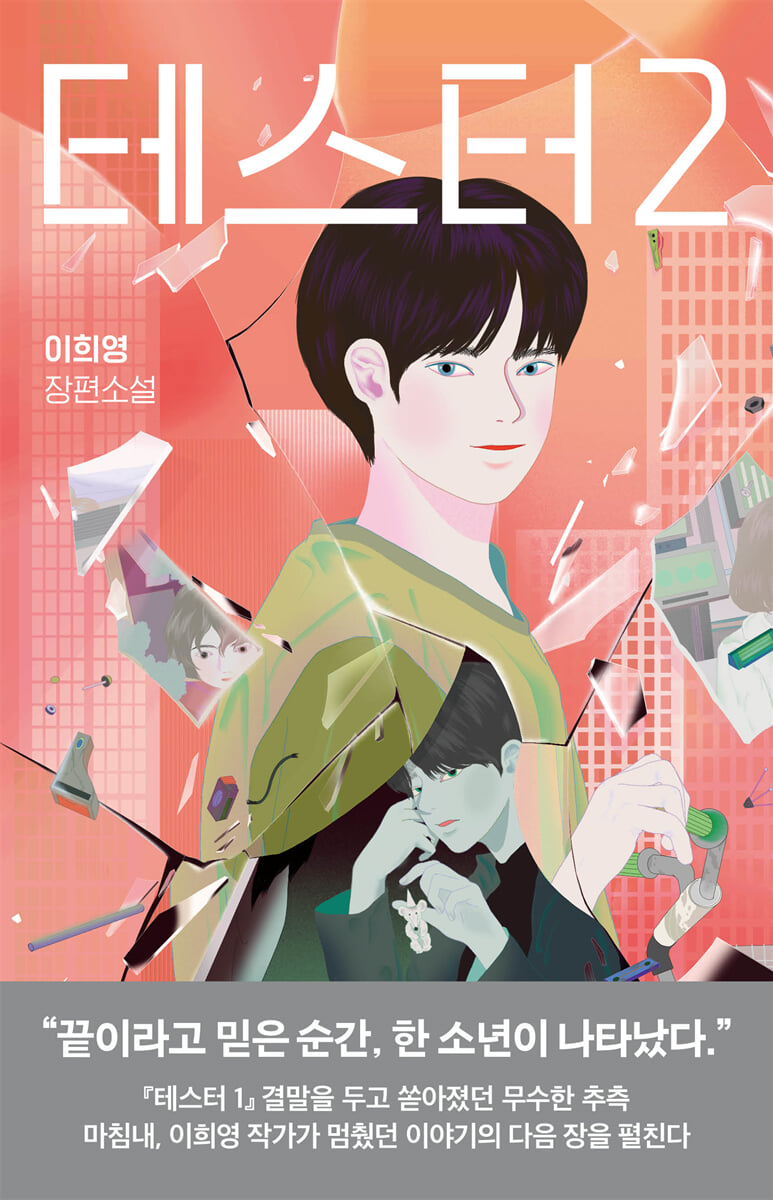
Tester 2
 |
Description
Book Introduction
Countless speculations surrounding the ending of "Tester 1"
Finally, the next chapter of the story that had been paused unfolds.
Tester was published to rave reviews, including “sophisticated, beautiful, dreamlike, and somehow sad” (novelist Jang Kang-myeong) and “the moment another masterpiece is born, following in the footsteps of “Paint” and “Nana”” (literary critic Jeong Yeo-ul).
After three years of being loved by countless readers and establishing itself as a bestseller in youth science fiction, its sequel, "Tester 2," was finally published by Hubble.
"Tester 2" takes place three years after Mao climbed the rooftop.
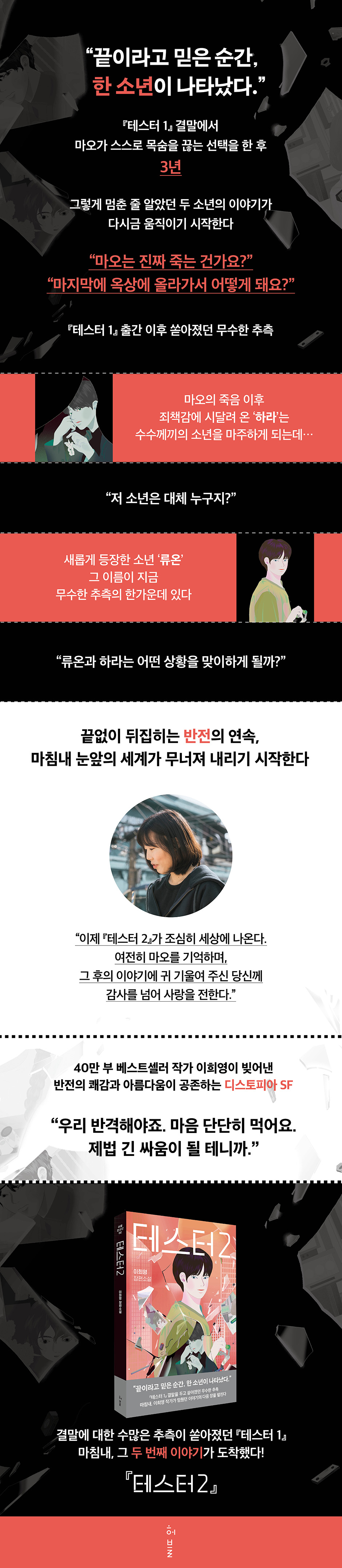
Hara, who has recovered from the virus, still harbors guilt over Mao's death and awaits the day when he can take revenge on Chairman Kang, who sacrificed the testers.
In the meantime, he finds 'Mr. Lee', the head of the tester project who holds a secret that threatens Chairman Kang, and meets her.
In the process, they encounter a boy named 'Ryu-on', whom the teacher was supporting, and at this time, both Hara and the reader begin to have the same question.
What exactly is the relationship between this teacher and Ryu-on?
In 『Tester 2』, you can enjoy the tightly woven narrative centered around the twists and mysteries that you could experience in the prequel, and the special charm of a sequel has been added to it.
It is the history between Mao and Hara that has been built up step by step throughout the previous story.
Hara's psychological portrayal based on this unfolds with great tension, and it is especially gripping in the latter half when his guilt towards Mao and his desire to protect his humanoid confidant, 'Jinsol', clash.
Moreover, these moments of conflict illuminate not only Hara's inner self but also those around her, leaving readers anticipating what the final outcome will be.
Finally, the next chapter of the story that had been paused unfolds.
Tester was published to rave reviews, including “sophisticated, beautiful, dreamlike, and somehow sad” (novelist Jang Kang-myeong) and “the moment another masterpiece is born, following in the footsteps of “Paint” and “Nana”” (literary critic Jeong Yeo-ul).
After three years of being loved by countless readers and establishing itself as a bestseller in youth science fiction, its sequel, "Tester 2," was finally published by Hubble.
"Tester 2" takes place three years after Mao climbed the rooftop.
Hara, who has recovered from the virus, still harbors guilt over Mao's death and awaits the day when he can take revenge on Chairman Kang, who sacrificed the testers.
In the meantime, he finds 'Mr. Lee', the head of the tester project who holds a secret that threatens Chairman Kang, and meets her.
In the process, they encounter a boy named 'Ryu-on', whom the teacher was supporting, and at this time, both Hara and the reader begin to have the same question.
What exactly is the relationship between this teacher and Ryu-on?
In 『Tester 2』, you can enjoy the tightly woven narrative centered around the twists and mysteries that you could experience in the prequel, and the special charm of a sequel has been added to it.
It is the history between Mao and Hara that has been built up step by step throughout the previous story.
Hara's psychological portrayal based on this unfolds with great tension, and it is especially gripping in the latter half when his guilt towards Mao and his desire to protect his humanoid confidant, 'Jinsol', clash.
Moreover, these moments of conflict illuminate not only Hara's inner self but also those around her, leaving readers anticipating what the final outcome will be.
- You can preview some of the book's contents.
Preview
index
Part 1 Ryu On...
007
Part 2 Hara...
143
Epilogue...
283
Author's Note...
293
007
Part 2 Hara...
143
Epilogue...
283
Author's Note...
293
Detailed image
Into the book
“Even a robot that has lost power and is broken can have all its memories restored by simply restoring its brain chip.
But he's not human.
When you stop breathing, it's all over.
“There is nothing left of the body.”
--- p.72
“Humans feel longing.
The desire to meet someone and be together.
“Do you have someone you miss?” “There is such a connection.”
--- p.107
“We have to fight back.
Make up your mind.
“It’s going to be a long fight.” “Aren’t you tired of this fight?” “I’m tired, so let’s end it quickly.”
--- p.235
That's absolutely not what I meant.
But I was at a loss as to how to explain it.
That was the human mind.
It was unnecessarily complicated and sometimes I couldn't see clearly even though it was my own feelings.
--- p.242
“All choices in the world are like that.
“There is no such thing as 100 percent.” “It would be reckless.” “That’s not necessarily true.
Anyway, just by trying it, you won't have any regrets or regrets.
“Isn’t that enough?”
--- p.268
“You said it once.
People want someone to remember them even when they disappear from the world.
It was said that the human brain chip becomes the person closest to you.
“That’s fate.” “….”
“I want you to have all my memories intact.
Then my brain chip will never be erased.
“Because my fate is to be with you, Hara.”
--- p.273
“Sometimes you can cry without shedding tears.” Can Jin-Sol truly know what sadness is when even tears have dried up?
Can you really understand the meaning of such great pain that cannot be shed with tears?
But On couldn't ask.
The question will be posed by someone else. “It must be a truly fortunate thing for humans to be able to cry when they need to cry.”
--- pp.277-278
“You must survive.
“That way, both you and I can feel a little less sorry.”
But he's not human.
When you stop breathing, it's all over.
“There is nothing left of the body.”
--- p.72
“Humans feel longing.
The desire to meet someone and be together.
“Do you have someone you miss?” “There is such a connection.”
--- p.107
“We have to fight back.
Make up your mind.
“It’s going to be a long fight.” “Aren’t you tired of this fight?” “I’m tired, so let’s end it quickly.”
--- p.235
That's absolutely not what I meant.
But I was at a loss as to how to explain it.
That was the human mind.
It was unnecessarily complicated and sometimes I couldn't see clearly even though it was my own feelings.
--- p.242
“All choices in the world are like that.
“There is no such thing as 100 percent.” “It would be reckless.” “That’s not necessarily true.
Anyway, just by trying it, you won't have any regrets or regrets.
“Isn’t that enough?”
--- p.268
“You said it once.
People want someone to remember them even when they disappear from the world.
It was said that the human brain chip becomes the person closest to you.
“That’s fate.” “….”
“I want you to have all my memories intact.
Then my brain chip will never be erased.
“Because my fate is to be with you, Hara.”
--- p.273
“Sometimes you can cry without shedding tears.” Can Jin-Sol truly know what sadness is when even tears have dried up?
Can you really understand the meaning of such great pain that cannot be shed with tears?
But On couldn't ask.
The question will be posed by someone else. “It must be a truly fortunate thing for humans to be able to cry when they need to cry.”
--- pp.277-278
“You must survive.
“That way, both you and I can feel a little less sorry.”
--- p.280
Publisher's Review
A prequel and sequel intertwined with distorted memories and hidden truths.
Boys who resonate with the "Voice of the Past" and approach the truth.
"Tester 2" unfolds through alternating perspectives of two characters, Hara and Ryuon.
However, as the story progresses, the various mysteries that arose from "Tester 1," especially the core question regarding Mao's life and death, are shrouded in even thicker fog rather than being resolved.
This is because distorted memories due to incomplete information and intentionally hidden truths are intertwined.
Hara constantly revisits the past due to guilt and a desire for revenge.
On the other hand, Ryu-on is a survivor who lost his family and home to the tsunami, and he is faithful to a peaceful present, albeit lacking, rather than a painful past related to the disaster.
These two characters, who have suffered such different losses, each confront the truth in their own way.
And I begin to listen to the forgotten beings of the past, the erased memories, and the quiet voices of those left behind.
"Tester 2" portrays the loss and regret experienced by two boys, as well as the weight of being left behind, in a three-dimensional way through the device of memory severance.
Following the afterimage of Mao Hara, Ryu-on pursues pieces of the truth, and gradually confronts the past that he had covered up as he goes back and forth between everyday spaces such as 'Junkland' and 'Health Center' where he lives.
Even in a dystopian world, the wounds they embrace are deeply human, and their narratives go beyond simple revenge or conspiracy dismantling.
The story gradually expands to include the attitude toward responsibility and guilt, forgetting and remembering, and the attitude toward memory that lies deep within the human mind.
In particular, Ryu On hears the news that his younger brother, Ryu Hui, whom he thought was dead, is alive, and is led from the trauma of the past to the truth of reality.
With that news as a trigger, he begins to gaze into the cracks in his memories that he had been hiding, one by one.
Hara also revisits the boundaries between humans and non-humans, love and compassion, memory and identity in her relationship with the humanoid Jinsol.
These two characters, who had been moving towards the truth from different places, finally stand side by side before the shocking truth about Mao's life and death.
And at that moment, we realize that the voices from the past that remained in each of our memories were connected to form one story.
That voice was not just a simple recollection, but the root of their wounds and at the same time the key to moving forward into the future.
Faced with the cruel yet beautiful truth, the two ask themselves:
How much truth can we bear?
How much responsibility can you take in the face of that truth?
And what kind of future can we dream of with this heart that has risen again?
The author's gaze reaches smaller hearts and sees lower places.
Questioning the relationship between humans and non-humans and human responsibility.
Unlike the previous installment, which focused on individual desires and selfishness, 『Tester 2』 focuses on ‘relationships’ rather than ‘individuals.’
This relationship is broadly divided into two types.
One is the relationship between blood relatives, the other is non-blood relatives, and further, the relationship between humans and machines.
The novel exposes the violence and oppression hidden beneath the surface of a seemingly noble, blood-centered family.
Through the narrative of the humanoid 'Jeong-woo', it satirizes the selfish family relationships centered around inheritance, and through Ryu-on's younger brother 'Ryu-hwi', it shows the structure of repeated violence within the family and sacrifices forced upon certain members.
Hara's story illuminates how the parent's (Chairman Kang's) desires instrumentalize their children, ultimately trapping them in a prison of guilt.
In this way, "Tester 2" exposes the true face of violence hidden under the name of family, while simultaneously expanding the meaning of family.
If Lee Hee-young's previous works, such as "Paint," "Salt Child," and "Bear," suggested the possibility of a non-blood-centered family, "Tester 2" goes a step further and presents the relationship between humans and humanoids, or humans and non-humans, as another form of family.
In the possibility that a non-human, robot-like entity could understand me more accurately than a human and provide me with unconditional support, the novel expands the concept of "family" into future relationships.
This redefinition of relationships enriches the world of 『Tester 2』.
Like its predecessor, this work also examines the light and dark sides of a world created by highly advanced science and technology, but its perspective is broader and deeper.
If the first part focused on the inner lives of the two main characters, this time the story expands beyond the two characters' perspectives to include the lives and world of those around them.
This is because the main characters of the previous story, Mao and Hara, broke out of their respective worlds and encountered a new world, and as an extension of that, Hara and Ryuon ask questions not only about themselves but also about the entire world they live in.
Ultimately, 『Tester 2』 asks what we must protect and how we should live in a dystopia.
And at the end of that question, he says this:
No matter what world we live in, what ultimately matters is the will to remember and protect one another.
Boys who resonate with the "Voice of the Past" and approach the truth.
"Tester 2" unfolds through alternating perspectives of two characters, Hara and Ryuon.
However, as the story progresses, the various mysteries that arose from "Tester 1," especially the core question regarding Mao's life and death, are shrouded in even thicker fog rather than being resolved.
This is because distorted memories due to incomplete information and intentionally hidden truths are intertwined.
Hara constantly revisits the past due to guilt and a desire for revenge.
On the other hand, Ryu-on is a survivor who lost his family and home to the tsunami, and he is faithful to a peaceful present, albeit lacking, rather than a painful past related to the disaster.
These two characters, who have suffered such different losses, each confront the truth in their own way.
And I begin to listen to the forgotten beings of the past, the erased memories, and the quiet voices of those left behind.
"Tester 2" portrays the loss and regret experienced by two boys, as well as the weight of being left behind, in a three-dimensional way through the device of memory severance.
Following the afterimage of Mao Hara, Ryu-on pursues pieces of the truth, and gradually confronts the past that he had covered up as he goes back and forth between everyday spaces such as 'Junkland' and 'Health Center' where he lives.
Even in a dystopian world, the wounds they embrace are deeply human, and their narratives go beyond simple revenge or conspiracy dismantling.
The story gradually expands to include the attitude toward responsibility and guilt, forgetting and remembering, and the attitude toward memory that lies deep within the human mind.
In particular, Ryu On hears the news that his younger brother, Ryu Hui, whom he thought was dead, is alive, and is led from the trauma of the past to the truth of reality.
With that news as a trigger, he begins to gaze into the cracks in his memories that he had been hiding, one by one.
Hara also revisits the boundaries between humans and non-humans, love and compassion, memory and identity in her relationship with the humanoid Jinsol.
These two characters, who had been moving towards the truth from different places, finally stand side by side before the shocking truth about Mao's life and death.
And at that moment, we realize that the voices from the past that remained in each of our memories were connected to form one story.
That voice was not just a simple recollection, but the root of their wounds and at the same time the key to moving forward into the future.
Faced with the cruel yet beautiful truth, the two ask themselves:
How much truth can we bear?
How much responsibility can you take in the face of that truth?
And what kind of future can we dream of with this heart that has risen again?
The author's gaze reaches smaller hearts and sees lower places.
Questioning the relationship between humans and non-humans and human responsibility.
Unlike the previous installment, which focused on individual desires and selfishness, 『Tester 2』 focuses on ‘relationships’ rather than ‘individuals.’
This relationship is broadly divided into two types.
One is the relationship between blood relatives, the other is non-blood relatives, and further, the relationship between humans and machines.
The novel exposes the violence and oppression hidden beneath the surface of a seemingly noble, blood-centered family.
Through the narrative of the humanoid 'Jeong-woo', it satirizes the selfish family relationships centered around inheritance, and through Ryu-on's younger brother 'Ryu-hwi', it shows the structure of repeated violence within the family and sacrifices forced upon certain members.
Hara's story illuminates how the parent's (Chairman Kang's) desires instrumentalize their children, ultimately trapping them in a prison of guilt.
In this way, "Tester 2" exposes the true face of violence hidden under the name of family, while simultaneously expanding the meaning of family.
If Lee Hee-young's previous works, such as "Paint," "Salt Child," and "Bear," suggested the possibility of a non-blood-centered family, "Tester 2" goes a step further and presents the relationship between humans and humanoids, or humans and non-humans, as another form of family.
In the possibility that a non-human, robot-like entity could understand me more accurately than a human and provide me with unconditional support, the novel expands the concept of "family" into future relationships.
This redefinition of relationships enriches the world of 『Tester 2』.
Like its predecessor, this work also examines the light and dark sides of a world created by highly advanced science and technology, but its perspective is broader and deeper.
If the first part focused on the inner lives of the two main characters, this time the story expands beyond the two characters' perspectives to include the lives and world of those around them.
This is because the main characters of the previous story, Mao and Hara, broke out of their respective worlds and encountered a new world, and as an extension of that, Hara and Ryuon ask questions not only about themselves but also about the entire world they live in.
Ultimately, 『Tester 2』 asks what we must protect and how we should live in a dystopia.
And at the end of that question, he says this:
No matter what world we live in, what ultimately matters is the will to remember and protect one another.
GOODS SPECIFICS
- Date of issue: April 9, 2025
- Page count, weight, size: 300 pages | 388g | 145*225*17mm
- ISBN13: 9791193078464
- KC Certification: Certification Type: Conformity Confirmation
You may also like
카테고리
korean


korean

![ELLE 엘르 스페셜 에디션 A형 : 12월 [2025]](http://librairie.coreenne.fr/cdn/shop/files/b8e27a3de6c9538896439686c6b0e8fb.jpg?v=1766436872&width=3840)


