

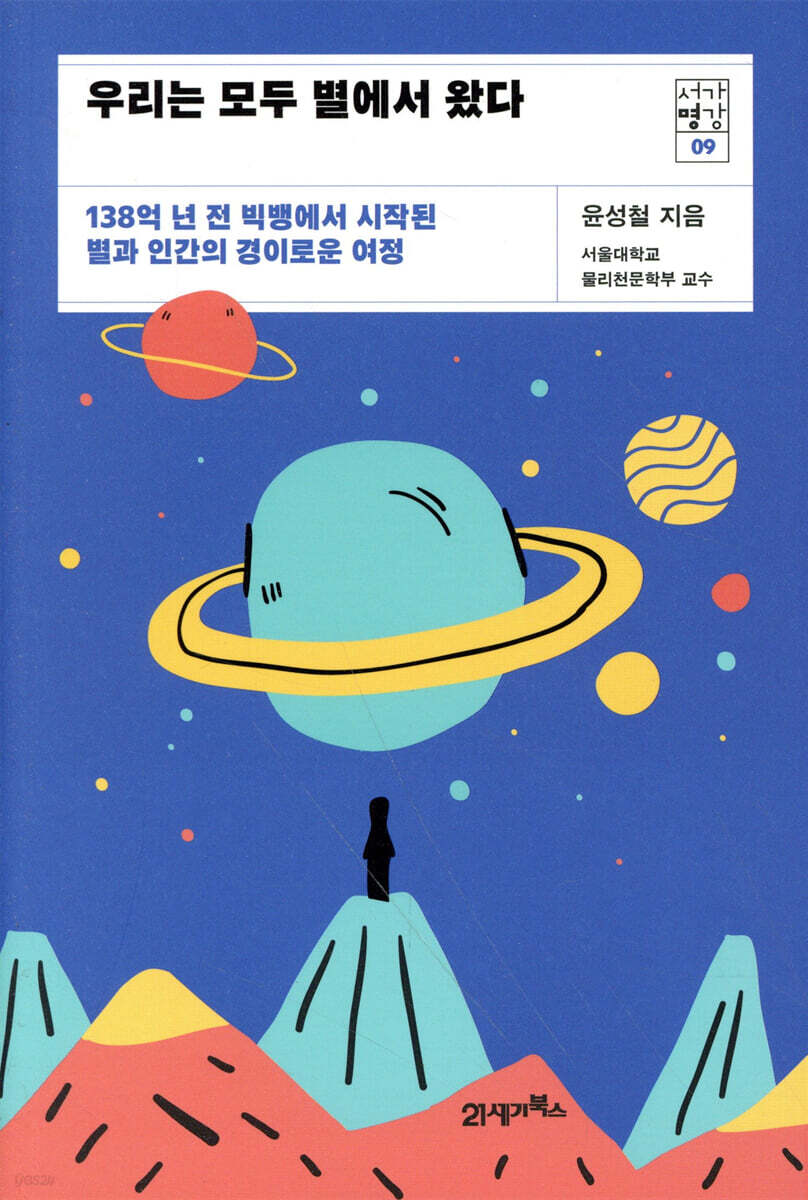
We all come from stars
 |
Description
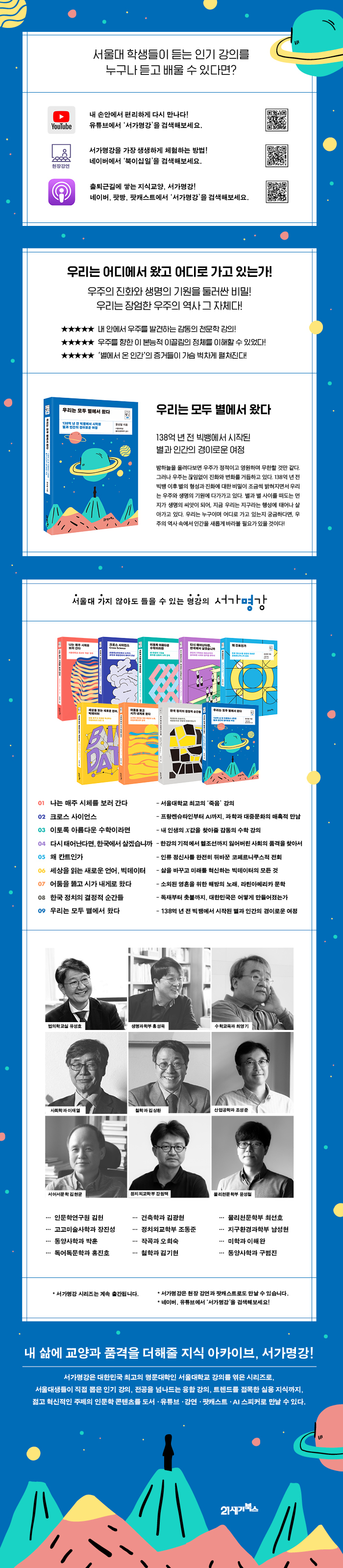
Book Introduction
"Seogamyeonggang": A famous lecture you can attend without going to Seoul National University. The wondrous journey of stars and humans, beginning with the Big Bang 13.8 billion years ago. Discover Korea's finest lectures in book form! The ninth volume in the "Seogamyeonggang" series, featuring carefully curated lectures by current Seoul National University faculty, has been published. The Seoga Myunggang series, which transcribes the lectures of Seoul National University's top professors in various fields, including history, philosophy, science, medicine, and art, into books, provides readers with the expansion of knowledge and the joy of learning. "We All Came from the Stars" is a book written by Professor Seong-cheol Yoon of the Department of Physics and Astronomy at Seoul National University based on the content of a class he taught in the popular liberal arts course [Humanity and the Universe] at Seoul National University. Professor Yoon Seong-cheol also appeared on JTBC's [China Class] and received attention for introducing astronomy at a level that appeals to the general public. This book takes us into the unfamiliar space of space by introducing the dazzling achievements of modern astronomy regarding the birth of the universe and the origin of life. The fact that we were born and are living on this planet called Earth through the formation and evolution of stars that occurred after the Big Bang will provide readers with a fresh shock and excitement. |
- You can preview some of the book's contents.
Preview
index
Classification of Academic Studies Before Reading This Book
Main keywords
Introduction: Meeting Humans at the End of the Universe
Part 1: The Copernican Revolution: Why We Became the Cosmic Orphans
Plato's eternal and unchanging universe
Cracking the Perfectly Beautiful Geocentric Theory
The History of Astronomy and Human Humiliation
Q/A Ask and Answer
Part 2: The Big Bang: How the Universe Began
The Great Question of the Scientists Who Discovered the Big Bang
Intellectual exploration toward the beginning and end of the universe
The primordial universe was hot and dense.
Traces of the Big Bang left by the universe
Q/A Ask and Answer
Part 3: Stars and Humans: How We Were Made
The evolution of the universe began with a small deviation
In the distant past, humans were stars.
The magnificent history of the universe engraved within us
Q/A Ask and Answer
Part 4: Alien Life and Artificial Intelligence: Where Will Humanity Go?
Until the seeds of life fall to the Earth
Reasonable reasons to believe in the existence of extraterrestrial life
Are you ready to encounter life outside of Earth?
Q/A Ask and Answer
Outgoing article: Exploring the limits and possibilities of the universe
annotation
References
Main keywords
Introduction: Meeting Humans at the End of the Universe
Part 1: The Copernican Revolution: Why We Became the Cosmic Orphans
Plato's eternal and unchanging universe
Cracking the Perfectly Beautiful Geocentric Theory
The History of Astronomy and Human Humiliation
Q/A Ask and Answer
Part 2: The Big Bang: How the Universe Began
The Great Question of the Scientists Who Discovered the Big Bang
Intellectual exploration toward the beginning and end of the universe
The primordial universe was hot and dense.
Traces of the Big Bang left by the universe
Q/A Ask and Answer
Part 3: Stars and Humans: How We Were Made
The evolution of the universe began with a small deviation
In the distant past, humans were stars.
The magnificent history of the universe engraved within us
Q/A Ask and Answer
Part 4: Alien Life and Artificial Intelligence: Where Will Humanity Go?
Until the seeds of life fall to the Earth
Reasonable reasons to believe in the existence of extraterrestrial life
Are you ready to encounter life outside of Earth?
Q/A Ask and Answer
Outgoing article: Exploring the limits and possibilities of the universe
annotation
References
Detailed image
Into the book
Defining a star in a simple sentence is not as easy as it sounds.
One reason is that stars are not unchanging, fixed entities.
Stars evolve.
If someone were to judge you based on how you looked 20 years ago, you might feel insulted.
This is because it could be the same as trying to define 21st century Korean society as it was during the Japanese colonial period.
The world we live in is constantly changing.
The same goes for stars and space.
--- p.14
If the Earth's axial tilt had been 97.8 degrees, like Uranus, the evolution of life would have proceeded in a completely different way, and it is highly likely that humans would not have emerged.
There are countless random events that occur in the universe.
We call this series of events history.
The determination of the Earth's axis of rotation and the emergence of humans are both events that occurred as part of the complex history of the universe.
Without knowing this history, we can never understand ourselves or the universe.
--- p.54~55
We cannot help but ask questions about the beginning of the universe.
Did the universe really have a beginning? If so, does that mean it's finite, not eternal? The beginning of the universe evokes the idea of God's creation.
Because of this, Friedman's work, which presented a theory about a dynamic universe, was rejected in his home country, the Soviet Union.
This was because Friedman's theory, reminiscent of the creation myth of God, did not conform to the dialectical materialism believed in by Soviet communists at the time.
--- p.102
The iron that flows through our blood and the elements that make up our DNA were all created in stars at some point in the past.
Our bodies, made of stardust, remember the process of star birth, star evolution, star death, and supernova explosion.
In the process, a planet like Earth was created and the elements that make up the human body were provided on Earth.
We were all in the stars in the distant past.
--- p.200
Anything that cannot evolve is not life.
It is meaningless to try to understand the phenomenon of life through an 'archetype' that was predetermined from the beginning.
A fixed order means nothing but death to life.
This naturally raises the question:
To what extent can life truly adapt to extreme environments? Without relying on scientific and technological advancements, humans could not survive permanently in an environment devoid of oxygen or at temperatures exceeding 100 degrees Celsius.
Humans are that fragile.
So we often fall prey to the prejudice that 'life is fragile'.
--- p.239
The old custom of defining a certain aspect of human nature as an eternal essence and understanding anything that did not fit that mold as sin, corruption, or a departure from purposefulness was the source of countless oppressions and tragedies.
But many aspects of humanity, which are nothing but dust, have been determined by various special circumstances in history.
This means that the future of humanity is also open and not bound by a predetermined order.
We are overwhelmed by the vastness of the universe and often ask where the universe ends.
But the question that excites us more is this:
What are the limits of the countless possibilities inherent in the universe?
One reason is that stars are not unchanging, fixed entities.
Stars evolve.
If someone were to judge you based on how you looked 20 years ago, you might feel insulted.
This is because it could be the same as trying to define 21st century Korean society as it was during the Japanese colonial period.
The world we live in is constantly changing.
The same goes for stars and space.
--- p.14
If the Earth's axial tilt had been 97.8 degrees, like Uranus, the evolution of life would have proceeded in a completely different way, and it is highly likely that humans would not have emerged.
There are countless random events that occur in the universe.
We call this series of events history.
The determination of the Earth's axis of rotation and the emergence of humans are both events that occurred as part of the complex history of the universe.
Without knowing this history, we can never understand ourselves or the universe.
--- p.54~55
We cannot help but ask questions about the beginning of the universe.
Did the universe really have a beginning? If so, does that mean it's finite, not eternal? The beginning of the universe evokes the idea of God's creation.
Because of this, Friedman's work, which presented a theory about a dynamic universe, was rejected in his home country, the Soviet Union.
This was because Friedman's theory, reminiscent of the creation myth of God, did not conform to the dialectical materialism believed in by Soviet communists at the time.
--- p.102
The iron that flows through our blood and the elements that make up our DNA were all created in stars at some point in the past.
Our bodies, made of stardust, remember the process of star birth, star evolution, star death, and supernova explosion.
In the process, a planet like Earth was created and the elements that make up the human body were provided on Earth.
We were all in the stars in the distant past.
--- p.200
Anything that cannot evolve is not life.
It is meaningless to try to understand the phenomenon of life through an 'archetype' that was predetermined from the beginning.
A fixed order means nothing but death to life.
This naturally raises the question:
To what extent can life truly adapt to extreme environments? Without relying on scientific and technological advancements, humans could not survive permanently in an environment devoid of oxygen or at temperatures exceeding 100 degrees Celsius.
Humans are that fragile.
So we often fall prey to the prejudice that 'life is fragile'.
--- p.239
The old custom of defining a certain aspect of human nature as an eternal essence and understanding anything that did not fit that mold as sin, corruption, or a departure from purposefulness was the source of countless oppressions and tragedies.
But many aspects of humanity, which are nothing but dust, have been determined by various special circumstances in history.
This means that the future of humanity is also open and not bound by a predetermined order.
We are overwhelmed by the vastness of the universe and often ask where the universe ends.
But the question that excites us more is this:
What are the limits of the countless possibilities inherent in the universe?
--- p.265~266
Publisher's Review
Long, long ago, we were all stars!
The secrets surrounding the evolution of the universe and life!
The universe always poses new questions to us.
Why did the Big Bang occur? What will the universe look like in the distant future? Where do we fit into this universe, and what does our existence mean? Professor Yoon Seong-cheol provides a compelling explanation of how astronomy can answer these questions in his book, "We All Came from Stars."
The universe began with a sudden explosion 13.8 billion years ago.
As traces remaining in the universe were discovered, this was accepted as an established theory rather than a simple hypothesis, and the Big Bang theory took the place of the steady-state theory, which advocated a static universe, while solving many major problems about the universe and standing at the center of modern astronomy.
“Just as the world we live in is constantly changing, the universe is also constantly evolving.” This great discovery of modern science has revealed the link between the birth of the universe after the Big Bang, the formation and evolution of stars, and the origin of life.
In this book, the author explains in detail, using various scientific evidence and theories, that the matter that makes up stars and the matter that makes up humans are the same.
In other words, the substances synthesized inside stars spread out into space through the cycle of star birth and death, becoming seeds of life that float between stars, and these are then reborn as new stars or fall to Earth to become life forms like us humans.
Additionally, hydrogen, one of the elements that make up our bodies, is a substance that exists in the universe through the Big Bang.
What we can learn from this is that “our body is both the universe itself that remembers the moment of the Big Bang and dust from stars.”
Ultimately, we are all part of the history of the universe, with the magnificent history of the universe engraved on us.
The author recommends to readers:
“If we want to know about the stars in the sky, it would not be a bad idea to first look at ourselves in front of a mirror before looking at the sky.
“You, reflected in the mirror, are the embodiment of the history of the universe.”
Where did we come from and where are we going!
Astronomy's wondrous journey into space!
When we look up at the night sky, the universe seems static, eternal, and infinite.
So, for thousands of years since ancient times, humans believed in the geocentric theory, which explained a 'perfect and beautiful universe'.
However, with the discovery of the Big Bang, modern astronomy has developed a cosmology that is qualitatively completely different from that of its predecessors in just half a century.
This book, "We All Came from the Stars," tells the story of how humans have viewed and understood the universe from the past to the present.
In particular, as you follow the interesting episodes that decorate the history of astronomy, such as 'Copernicus's revolution that changed the human world view', 'Einstein's biggest mistake, the cosmological constant', and 'Cecilia Payne, the first woman to become a professor at Harvard University', you will feel that you are getting closer to the formation and evolution of stars in the universe, as well as the origin of the wonderful life.
Moreover, readers will gain new knowledge and enjoyment about the universe as they understand the process by which many modern astronomers covered in this book, including Friedman, Lemaître, Hubble, Lockyer, and Palmier, went through rigorous scientific verification and error to discover the spectra of stars and the substances that make up the universe.
This book contains various illustrations that explain the mysteries of the universe and physics theories, making it easy for readers who are new to astronomy or have little scientific knowledge to understand.
Any reader who experiences the author's gentle and nuanced approach to scientific topics, which can be quite challenging, will be captivated by the emotions the universe offers.
Are you ready to meet aliens!
Humanistic insights from science!
The exploration of exoplanets is emerging as a major topic in modern astronomy.
This could be considered the next mission of modern astronomy, which has succeeded in explaining the connection between the universe and humanity.
In this book, the author continues to ask rational questions and provide scientific answers about extraterrestrial life based on the discovery of habitable exoplanets like Earth.
In particular, the author describes the appearance of imaginable extraterrestrial life and aliens, and says that such speculations are by no means wild imaginations when looking at the evolutionary phenomenon of the Earth.
In this way, the author provides readers with the opportunity to imagine an encounter with a stranger.
Could we communicate and emotionally connect with aliens? He predicts that our feelings when encountering aliens would be similar to those we have when interacting with strangers.
He then points out that in the face of the 'fear' of inferior beings, we need 'maturity' that is equipped with the wisdom to coexist with nature and others, rather than 'violence'.
In this way, this book goes beyond simple science and allows us to look back at human existence from a new perspective: the universe.
The wondrous journey from the universe to the stars, and from humanity to the humanities, and the humanistic insights it offers, will allow us to experience the joy and fascination of science.
The secrets surrounding the evolution of the universe and life!
The universe always poses new questions to us.
Why did the Big Bang occur? What will the universe look like in the distant future? Where do we fit into this universe, and what does our existence mean? Professor Yoon Seong-cheol provides a compelling explanation of how astronomy can answer these questions in his book, "We All Came from Stars."
The universe began with a sudden explosion 13.8 billion years ago.
As traces remaining in the universe were discovered, this was accepted as an established theory rather than a simple hypothesis, and the Big Bang theory took the place of the steady-state theory, which advocated a static universe, while solving many major problems about the universe and standing at the center of modern astronomy.
“Just as the world we live in is constantly changing, the universe is also constantly evolving.” This great discovery of modern science has revealed the link between the birth of the universe after the Big Bang, the formation and evolution of stars, and the origin of life.
In this book, the author explains in detail, using various scientific evidence and theories, that the matter that makes up stars and the matter that makes up humans are the same.
In other words, the substances synthesized inside stars spread out into space through the cycle of star birth and death, becoming seeds of life that float between stars, and these are then reborn as new stars or fall to Earth to become life forms like us humans.
Additionally, hydrogen, one of the elements that make up our bodies, is a substance that exists in the universe through the Big Bang.
What we can learn from this is that “our body is both the universe itself that remembers the moment of the Big Bang and dust from stars.”
Ultimately, we are all part of the history of the universe, with the magnificent history of the universe engraved on us.
The author recommends to readers:
“If we want to know about the stars in the sky, it would not be a bad idea to first look at ourselves in front of a mirror before looking at the sky.
“You, reflected in the mirror, are the embodiment of the history of the universe.”
Where did we come from and where are we going!
Astronomy's wondrous journey into space!
When we look up at the night sky, the universe seems static, eternal, and infinite.
So, for thousands of years since ancient times, humans believed in the geocentric theory, which explained a 'perfect and beautiful universe'.
However, with the discovery of the Big Bang, modern astronomy has developed a cosmology that is qualitatively completely different from that of its predecessors in just half a century.
This book, "We All Came from the Stars," tells the story of how humans have viewed and understood the universe from the past to the present.
In particular, as you follow the interesting episodes that decorate the history of astronomy, such as 'Copernicus's revolution that changed the human world view', 'Einstein's biggest mistake, the cosmological constant', and 'Cecilia Payne, the first woman to become a professor at Harvard University', you will feel that you are getting closer to the formation and evolution of stars in the universe, as well as the origin of the wonderful life.
Moreover, readers will gain new knowledge and enjoyment about the universe as they understand the process by which many modern astronomers covered in this book, including Friedman, Lemaître, Hubble, Lockyer, and Palmier, went through rigorous scientific verification and error to discover the spectra of stars and the substances that make up the universe.
This book contains various illustrations that explain the mysteries of the universe and physics theories, making it easy for readers who are new to astronomy or have little scientific knowledge to understand.
Any reader who experiences the author's gentle and nuanced approach to scientific topics, which can be quite challenging, will be captivated by the emotions the universe offers.
Are you ready to meet aliens!
Humanistic insights from science!
The exploration of exoplanets is emerging as a major topic in modern astronomy.
This could be considered the next mission of modern astronomy, which has succeeded in explaining the connection between the universe and humanity.
In this book, the author continues to ask rational questions and provide scientific answers about extraterrestrial life based on the discovery of habitable exoplanets like Earth.
In particular, the author describes the appearance of imaginable extraterrestrial life and aliens, and says that such speculations are by no means wild imaginations when looking at the evolutionary phenomenon of the Earth.
In this way, the author provides readers with the opportunity to imagine an encounter with a stranger.
Could we communicate and emotionally connect with aliens? He predicts that our feelings when encountering aliens would be similar to those we have when interacting with strangers.
He then points out that in the face of the 'fear' of inferior beings, we need 'maturity' that is equipped with the wisdom to coexist with nature and others, rather than 'violence'.
In this way, this book goes beyond simple science and allows us to look back at human existence from a new perspective: the universe.
The wondrous journey from the universe to the stars, and from humanity to the humanities, and the humanistic insights it offers, will allow us to experience the joy and fascination of science.
GOODS SPECIFICS
- Date of issue: January 29, 2020
- Page count, weight, size: 272 pages | 340g | 128*188*20mm
- ISBN13: 9788950985813
- ISBN10: 8950985810
You may also like
카테고리
korean


korean

![GQ KOREA Mark (Monthly): December [2025]](http://librairie.coreenne.fr/cdn/shop/files/8ef265dbbfbf186523ed75ba7319009d.jpg?v=1765340328&width=3840)


